You plan to move to the Philippines? Wollen Sie auf den Philippinen leben?

There are REALLY TONS of websites telling us how, why, maybe why not and when you'll be able to move to the Philippines. I only love to tell and explain some things "between the lines". Enjoy reading, be informed, have fun and be entertained too!

Ja, es gibt tonnenweise Webseiten, die Ihnen sagen wie, warum, vielleicht warum nicht und wann Sie am besten auf die Philippinen auswandern könnten. Ich möchte Ihnen in Zukunft "zwischen den Zeilen" einige zusätzlichen Dinge berichten und erzählen. Viel Spass beim Lesen und Gute Unterhaltung!


Visitors of germanexpatinthephilippines/Besucher dieser Webseite.Ich liebe meine Flaggensammlung!

free counters

Total Pageviews

Showing posts with label Dexter Barro II. Show all posts

Tuesday, June 23, 2026

BPO sector fights back against proposed US call center restrictions


By Dexter Barro II

Published Jun 23, 2026 03:42 pm


The Philippines’ information technology and business process management (IT-BPM) sector has warned that American businesses could face higher operational costs if the United States (US) government pushes through with plans to discourage offshoring.

Industry advocacy groups representing the IT-BPM industry submitted a position paper dated May 18 to the Federal Communications Commission (FCC), urging it to reconsider proposed offshoring policies that threaten to negatively impact the sector’s contributions to the Philippine economy.

“We respectfully submit that several of the proposed measures, particularly those that would restrict offshore customer service delivery based on location, risk undermining these objectives by increasing costs, reducing service availability, and misdirecting regulatory focus away from the actual sources of consumer harm,” the paper read.

The position paper was jointly signed by the IT and Business Process Association of the Philippines (IBPAP), the American Chamber of Commerce of the Philippines (AmCham), and the US-ASEAN Business Council (USABC).

The groups issued their response after the FCC released a Notice of Proposed Rulemaking (NPRM) last March to explore measures that would encourage businesses to bring call center jobs back to the US and improve customer service at existing domestic facilities.

Among the controversial measures are empowering customers to transfer calls to a US-based location, ensuring that calls involving certain types of sensitive information are handled domestically, and mandating that service providers disclose the location of the call center during customer interactions.

The FCC also wants to require call center workers to be proficient in American Standard English and appropriately trained to resolve issues raised by US customers. The federal agency said these measures aim to address the “frustration and poor customer service” regularly experienced by consumers when connecting with offshore call centers.

While the industry groups welcomed the intention to address the concerns of US consumers, they stressed there is no basis for placing the blame entirely on offshoring operations. They noted that offshore providers, particularly those in the Philippines, operate under strict contractual and regulatory frameworks imposed by US companies themselves. These frameworks cover service-level agreements, data protection obligations, and compliance requirements that already meet rigid US standards.

“Absent a demonstrated causal link between offshore operations and consumer harm, location-based restrictions risk being both overinclusive and underinclusive—burdening compliant providers while failing to effectively target problematic conduct,” the groups stated.

On the matter of language proficiency, the groups pointed out that Philippine call centers supporting US companies already implement rigorous language and communication benchmarks as part of their standard hiring processes. Given the country’s long-established strength in adult English proficiency, they argued that “additional English certification requirements would appear to duplicate competencies that are already established and consistently demonstrated over time.”

Regarding illegal robocalls, the groups emphasized that Philippine-based providers are not the source of unlawful robocall traffic due to their strict adherence to legitimate contact-center operations.

If the FCC proceeds with these restrictions, the groups explained that US companies utilizing offshore operations would see an immediate spike in overhead.

“Absent the ability to utilize offshore capacity, many companies would face materially higher operating costs. These costs would, in turn, be passed on to U.S. consumers through higher prices,” they warned.

Citing estimates from the employment website Indeed, the FCC noted that the average annual salary for a call center representative in the Philippines is $5,115 (roughly ₱312,600). In contrast, the average salary for the same role in the US is $66,809 (around ₱4.07 million).

Instead of the proposed restrictions, the groups are urging the FCC to adopt regulatory measures focused on a risk-based, outcome-oriented approach.

“A regulatory framework focused on measurable outcomes—including customer satisfaction, responsiveness, complaint resolution, cybersecurity safeguards, fraud prevention, and provider accountability—would more directly address the Commission's concerns than broad restrictions based on service location alone,” the paper read.

According to IBPAP data, the Philippine IT-BPM sector generated more than $40 billion in revenues last year, a five-percent increase from the $38 billion recorded in 2024.

Monday, February 2, 2026

Philippines reclaims spot as world's 2nd largest banana exporter


By Dexter Barro II

Published Feb 2, 2026 12:00 am


The Philippines regained its position as the second largest exporter of bananas in the world last year after overcoming setbacks from pests and adverse weather conditions, according to the Food and Agriculture Organization (FAO).


In its preliminary report on the global banana market, the FAO said the country regained its long-standing rank after slipping to third place in 2023, when it was overtaken by Guatemala, with Costa Rica taking second place the following year.


Based on FAO data, the Philippines shipped out 2.93 million metric tons (MT) of bananas last year, nearly 26 percent higher than the 2.33 million MT recorded in 2024.


ADVERTISEMENT


The country’s export figure last year was up 49.5 percent from Costa Rica’s shipments of 1.96 million MT, and 34 percent higher than the 2.18 million MT in exports by Guatemala.


Last year, Ecuador remained the world’s top banana exporter with a total volume of 6.41 million MT. Colombia ranked second with exports reaching 2.48 million MT.


Meanwhile, the Philippines once again led Asia in banana shipments, accounting for more than half of the continent's total exports of 5.19 million MT.


The FAO attributed the rebound in the country’s exports last year to the recovery in banana production from the impact of plant diseases and weather disturbances over the past two years.


ADVERTISEMENT


The foreign agency previously reported that the country has been struggling to control the spread of Banana Fusarium Wilt Tropical Race 4 (TR4), a soil-borne fungus that affects banana growth.


Banana plantations are also affected by occasional flooding, which leads to crop losses, higher recovery costs, and reduced export volumes.


Citing industry sources, the FAO said the Department of Agriculture (DA) poured in “substantial investments” to make the country’s banana sector more resilient to these threats.


For one, the FAO noted strong initiatives to expand production in Cagayan Valley, one of the country's top banana-producing regions, through the provision of organic fertilizer and other inputs.


Agriculture Secretary Francisco Tiu Laurel earlier said the DA will invest more in research, particularly in disease tolerance, breeding strategies, and new technologies to secure the industry’s long-term viability.


In addition, he also committed to advocating for fairer trade terms with export partners to further expand the country’s banana shipments.

Wednesday, July 23, 2025

Social media links now top scam method in Philippines—Whoscall


By Dexter Barro II

Published Jul 22, 2025 05:27 pm


Filipinos are increasingly being targeted on social media platforms and messaging apps as scammers move away from traditional text and call scams, according to anti-fraud app Whoscall.

In its latest scam report, Whoscall said reports of suspicious links have surged 28 percent in the second quarter to 18,735 from 13,602 in the first quarter.


These links often lead to malicious websites that pose a potential threat to users’ security, privacy, or finances when clicked or visited.

The majority of these are circulated on social media sites like Facebook and messaging platforms such as Viber and Telegram.

Links related to online gambling recorded a 76 percent jump to 4,303 reports in the second quarter, as scammers capitalize on its growing popularity.

Similarly, links related to promotions, rewards, and incentives saw a 57 percent surge to 4,497, exploiting Filipinos’ desire to earn quick money.

Loan-related links rose, meanwhile, rose by 20 percent to 9,930, with scammers alluring victims through attractive loan deals.

Mel Migriño, country head and general manager of Whoscall developer Gogolook, said the increase of scams in social media was driven by the ongoing crackdown against text- and call-based scams.

“The joint effort of the government and private sectors minimized scam calls and SMS scams,” she said. “However, scam actors are now shifting to other platforms, such as social media and messaging apps, to continue their operations.”

Based on Whoscall’s report, the number of text scam incidents dropped by 95 percent year-on-year.

From 1.28 million reports in the second quarter last year, only 65,035 cases were recorded this year.

The number of scam calls also saw a steep decline, from 135,535 reports in the same period last year, it fell 74 percent to 34,964 this year.

With the rise of scams in social media, Cybercrime Investigation and Coordinating Center (CICC) said the challenge for the government is to crack down on deceptive content embedded in apps where Filipinos spend most of their screen time.

Friday, June 13, 2025

NAIA to deploy more immigration officers to ease queues


By Dexter Barro II

Published Jun 12, 2025 12:19 am


Government agencies overseeing Ninoy Aquino International Airport (NAIA) have agreed to enhance the passenger experience, including the deployment of immigration personnel during peak hours at the country’s main gateway.


On Wednesday, June 11, the Department of Transportation (DOTr), the Bureau of Immigration (BI), and the Manila International Airport Authority (MIAA) signed a memorandum of agreement to help ease the queues at the airport's immigration counters.


DOTr Undersecretary Giovanni Lopez said the agency has observed long queues in immigration processing, particularly during early morning hours, due to limited personnel staffing the counters.


The lack of personnel, he said, is driven by the budget constraints of the BI.


“Sa pamamagitan po ng MOA na ‘to, matitiyak natin na pagdating sa peak hours, may mga tatao na po sa ating mga immigration,” said Lopez in a media briefing.


(Through this MOA, we can ensure that during peak hours, there will be personnel stationed at our immigration counters.)


“Pangalawa po, umaasa tayo na matitiyak natin na itong mga tao na nagbibigay serbisyo ay mabibigayan ng karampatang suweldo in the form of overtime pay or honoraria,” he added.


(Secondly, we hope to ensure that these personnel will receive appropriate compensation in the form of overtime pay or honoraria.)


Under the agreement, the DOTr will authorize the allocation and disbursement of the Immigration Service Charge (ISC) for the BI.


This will kick in once additional immigration officers are designated to perform overtime duties not covered under this year’s national budget.


MIAA, the regulator of NAIA, will allocate a portion of its authorized collections to fund the ISC, either in the form of overtime or honoraria.


MIAA General Manager Eric Jose Ines said an estimated ₱5 million per month will be allocated for this undertaking.


However, he told reporters that a technical working group will still review this to determine the actual amount needed.


BI, meanwhile, will provide 24/7 immigration services with a commitment to offering international-standard airport accommodations and services whenever necessary.


BI Commissioner Joel Anthony Viado said the agency will provide MIAA a certified list of immigration officers and personnel at the NAIA Terminals 1 and 3 monthly.


Currently, there are 180 immigration officers in NAIA. Additional funding would enable the agency to hire 50 more personnel.


With the planned introduction of electronic gates within the year to modernize the immigration process and address congestion, Viado said his personnel will also undergo upskilling.


The official said there will be mental and physical training, as well as initiating “modern” methods to conduct interviews for the immigration process.

Monday, May 12, 2025

DA: Imported onions test positive for salmonella, heavy metals

By Dexter Barro II

Published May 10, 2025 14:40 pm | Updated May 10, 2025 18:12 pm

Department of Agriculture (DA) Secretary Francisco Tiu Laurel is warning consumers against buying imported white onions, following the recent seizure of smuggled onions that tested positive for salmonella and heavy metals.

"If possible, please don’t buy imported onions because they may be contaminated with salmonella. These contaminated onions are not fit for human consumption,” said Laurel in a statement.

Laurel said the DA has not authorized the recent importation of foreign-sourced white onions, which are typically larger than locally grown varieties.

In fact, the DA's Bureau of Plant Industry (BPI) has not issued sanitary and phytosanitary import clearance (SPSIC) for onions since February.

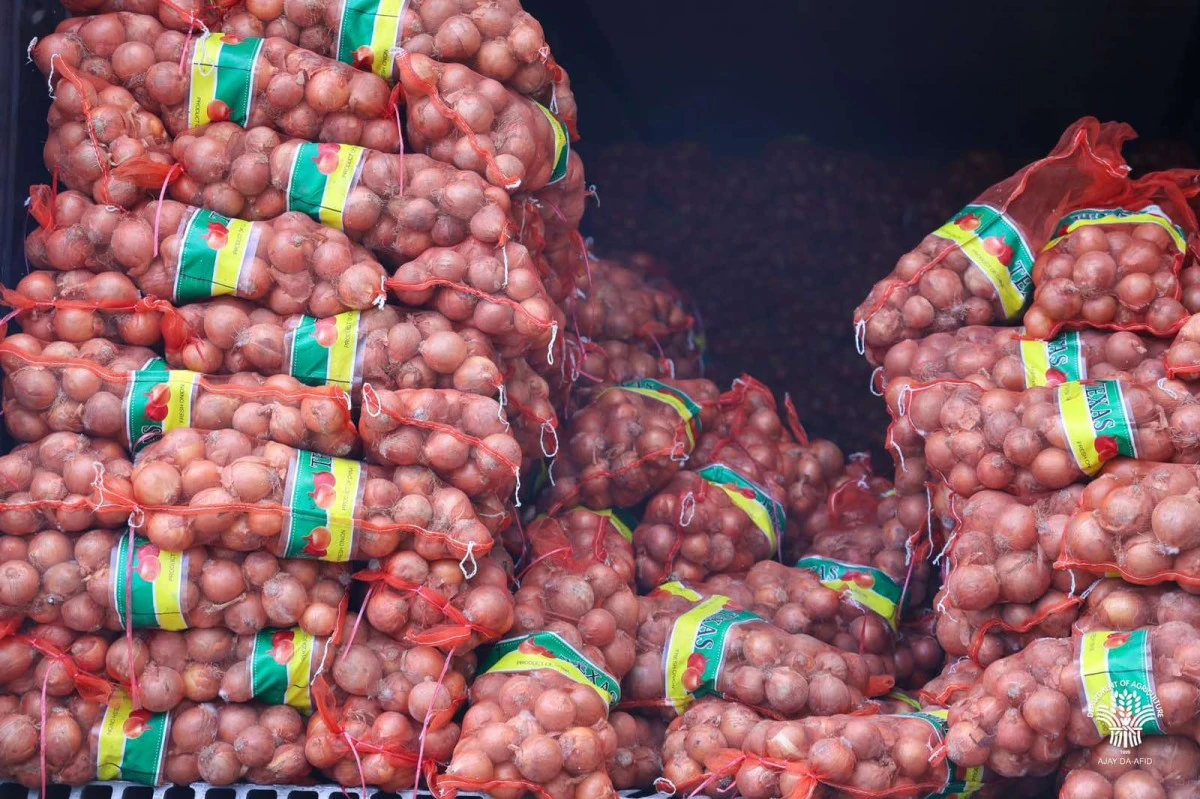
On Friday, May 9, Laurel led the inspection of two container vans carrying 34 metric tons of smuggled white onions from China in Mexico, Pampanga.

Tests conducted by the BPI’s Plant Products Safety Services Division (PPSSD) and the National Plant Quarantine Services Division (NPQSD) showed that the produce was positive for heavy metals and salmonella.

Heavy metal poisoning has been attributed to cancer and damage to major body organs, while salmonella bacteria could cause food poisoning and various infections.

The shipments—misdeclared as processed chicken karaage strips—were allegedly consigned to Manila-based Leksei B. Specialized Goods Trading, arriving at Subic Port on April 20 aboard the SITC Hochiminh. 

The two containers were then transported to a warehouse in Mexico town, where it was seized by the Criminal Investigation and Detection Group (CIDG) on April 26.

BPI said the agency accredits neither the importer nor the warehouse. 

One container held 1,800 red mesh bags of white onions, while the other contained 1,600 bags, each weighing 9 kilos—bringing the total to around 34,200 kilos.

In total, the smuggled onions had a market value of approximately ₱4.1 million.

Initial investigation by the CIDG suggests that the shipments were planned to be distributed to Divisoria and parts of Nueva Ecija. 

Laurel has since requested the CIDG to investigate the “recurring preference” of smugglers to utilize Subic Port for such illegal activities.

“Preventing the entry of misdeclared agricultural goods is crucial not only to ensure food safety but also to stop the potential spread of plant diseases and pests,” he added.

Laurel is urging the public to report any sightings of unauthorized white onions in markets as a measure to safeguard public health.