This might not be the typical expat blog, written by a German expat, living in the Philippines since 1999. It's different. In English and in German. Check it out! Enjoy reading!
Dies mag' nun wirklich nicht der typische Auswandererblog eines Deutschen auf den Philippinen sein. Er soll etwas anders sein. In Englisch und in Deutsch! Viel Spass beim Lesen!
You plan to move to the Philippines? Wollen Sie auf den Philippinen leben?
There are REALLY TONS of websites telling us how, why, maybe why not and when you'll be able to move to the Philippines. I only love to tell and explain some things "between the lines". Enjoy reading, be informed, have fun and be entertained too!
Ja, es gibt tonnenweise Webseiten, die Ihnen sagen wie, warum, vielleicht warum nicht und wann Sie am besten auf die Philippinen auswandern könnten. Ich möchte Ihnen in Zukunft "zwischen den Zeilen" einige zusätzlichen Dinge berichten und erzählen. Viel Spass beim Lesen und Gute Unterhaltung!
Visitors of germanexpatinthephilippines/Besucher dieser Webseite.Ich liebe meine Flaggensammlung!
Total Pageviews
Showing posts with label NYAH GENELLE C. DE LEON. Show all posts
Showing posts with label NYAH GENELLE C. DE LEON. Show all posts
The Philippine government has secured another 200 million euros ($230 million) in financing from French development agency Agence Française de Développement (AFD), this time for a program aimed at protecting marine ecosystems and developing the country’s blue economy.
In a statement on Thursday, the Department of Finance (DOF) said the financing, equivalent to around P14 billion, will fund the Marine Ecosystem for Blue Economy Development (MEBED) 1. The program is expected to generate sustainable livelihoods for more than three million people, including fisherfolk, aquaculture operators and tourism workers.
This marks the second 200-million-euro financing secured by the DOF this week, following a separate agreement with AFD to support food security among low-income families.
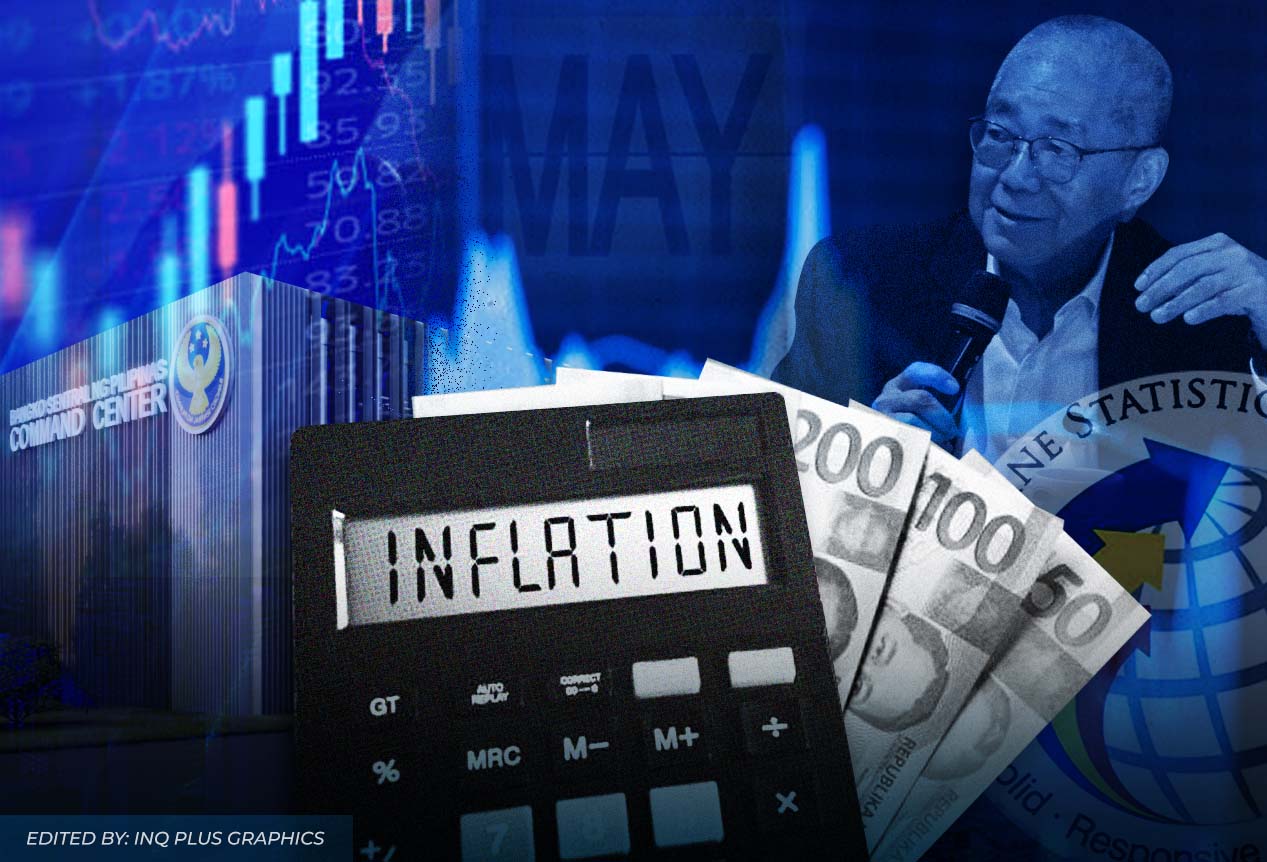
Philippine inflation likely climbed further in May, surpassing the previous month’s three-year high as the spillover effects from the Middle East war continued to intensify food price pressures and weaken the peso.
According to the Bangko Sentral ng Pilipinas (BSP), consumer prices likely rose between 7.1 percent and 7.9 percent in May, accelerating from the 7.2 percent recorded in April.
The war, now in its third month, has yet to show signs of de-escalation. Although domestic pump prices finally began to ease, the relief was likely insufficient to temper broader pressures.
VULNERABLE “The Philippines is projected to remain severely impacted by climate change... posing grave risks to businesses, communities, infrastructure, and ecosystems,” warns the Organisation for Economic Co-operation and Development. —AP
The Philippines could lose as much as one-fifth of its economic output within the next five decades if climate change effects continue unchecked, undermining long-term growth and fiscal stability.
According to the Organisation for Economic Co-operation and Development (OECD), a high-emissions scenario could shrink gross domestic product (GDP) by about 5 percent as early as 2040, with losses accelerating to 20 percent by 2070.
“As a tropical island nation, the Philippines is projected to remain severely impacted by climate change, with more intense and more frequent typhoons, accelerated sea-level rise, and more extreme rainfall events—all posing grave risks to businesses, communities, infrastructure, and ecosystems,” the OECD said in its first Economic Survey of the Philippines.
Further, extreme weather events can cut local economic activity by up to 2.2 percent on impact, with about 1.7 percentage points of that contraction persisting even five years later despite post-disaster adaptation, relief, and reconstruction efforts.
Direct fiscal cost
Separate data from the World Bank show that the direct fiscal cost of natural hazards amounts to about 0.5 percent of GDP annually. The OECD said this underscores the need to integrate climate change and its consequences into economic activity, employment, inflation, fiscal space, and public indebtedness.
The Paris-based organization also flagged the lack of projections of the future fiscal change of climate change in the country’s Medium-Term Fiscal Framework (MTFF) and Debt Sustainability Analyses (DSA).
“Effective fiscal policy is crucial for enhancing a country’s resilience to climate change. A regular assessment of government climate actions is essential—in particular those to protect vulnerable groups, strengthen infrastructure resiliency, and reform agriculture—in the context of medium-term budget planning and debt sustainability analyses,” the OECD said.
The country is already ranked first among 193 countries in the World Risk Index due to high exposure to hazards, compounded by an average of 20 typhoons annually, frequent earthquakes, volcanic activity, flooding, and sea-level rise.
Beyond science, societal vulnerability among the poor is heightened by fragile infrastructure and limited adaptive systems.
Calls for insurance
Despite the mounting risks, the OECD said most households remain uninsured, leaving millions vulnerable to climate-related losses.
As of 2025, the country’s insurance penetration rate reached only 1.79 percent, still behind regional peers and short of the Insurance Commission’s 2-percent target.
But this coverage is largely dominated by life insurance, the OECD noted. Property insurance, which could cover natural hazards, is optional and mostly limited to mortgage or commercial requirements.
“Low-income communities are typically uninsured in many parts of the world, despite being the most exposed to losses when a large weather disaster occurs,” the OECD said.
“Low demand for insurance coverage stems from financial illiteracy, weak financial inclusion, insufficient income to afford insurance premiums in many segments of the population, and the fact that property insurance is typically not mandatory,” it added.
Although the Philippine government has dedicated funds for calamities and disasters, the OECD said these efforts are insufficient.
“While these initiatives have improved the country’s protection against climate risks, much remains to be done to broaden insurance coverage for extreme weather events. Further initiatives to expand insurance coverage are urgent to help low-income groups better protect themselves from escalating climate risks,” the OECD said.
As an alternative, the organization suggested microinsurance as a low-cost option for low-income and informal sector households.
“Microinsurance has generally been successful in the Philippines, with 27 percent of the population covered by at least one microinsurance product (mostly health-care insurance), with policy holders generally low-income, informal sector, or those without access to conventional insurance,” it added.
Only half of Filipinos feel financially prepared for retirement, even as a broader Asian trend shows that most prioritize quality of life over living longer, according to a survey by Manulife.
In its 2025 Financial Resilience and Longevity Report, Manulife found that just 52 percent of Filipinos believe they have enough funds to retire comfortably, placing the Philippines third out of four countries least likely to have sufficient retirement savings.
The finding highlights a gap between retirement aspirations and financial preparedness, as fewer than one in 10 respondents across Asia said they want to live longer regardless of circumstances, with the majority prioritizing independence, health and a meaningful life instead.
“Despite believing that financial well-being can affect health span and lifespan, people aren’t taking sufficient action to prepare,” Manulife said.
Planning
Even so, Manulife said the Philippines was showing signs of an optimistic transition in retirement planning, with 73 percent of respondents now preferring income-generating investments over property.
“Those who have de-prioritized property as an investment have done so because they’ve discovered it’s not the safe, low-downside investment they believed it was. They also feel property keeps them from being able to take advantage of other investments,” Manulife said.
Compared to Hong Kong, Indonesia and Malaysia, the Philippines had the highest share of respondents (55 percent) who believe that owning property could eat into their future savings.
With this, 66 percent of Filipino respondents rely on cash and fixed deposits for retirement, rather than alternatives such as pensions, property or mutual funds.
However, Manulife warned that relying on cash alone could leave retirees exposed to financial risks. It added that three to four in 10 Asians are not knowledgeable about investing.
“Holding too much cash and relying solely on property can leave people vulnerable to inflation and income shortfalls,” Calvin Chiu, head of Asia Retirement Manulife and chief executive officer of Manulife Hong Kong, said.
“Building financial resilience means diversifying across income-generating and inflation-protected assets—and doing so early,” he added.
Manulife surveyed over 9,000 respondents aged at least 25 years old across Mainland China, Hong Kong, Taiwan region, Japan, Singapore, Vietnam, Indonesia, Malaysia and the Philippines between January and February 2025.