You plan to move to the Philippines? Wollen Sie auf den Philippinen leben?

There are REALLY TONS of websites telling us how, why, maybe why not and when you'll be able to move to the Philippines. I only love to tell and explain some things "between the lines". Enjoy reading, be informed, have fun and be entertained too!

Ja, es gibt tonnenweise Webseiten, die Ihnen sagen wie, warum, vielleicht warum nicht und wann Sie am besten auf die Philippinen auswandern könnten. Ich möchte Ihnen in Zukunft "zwischen den Zeilen" einige zusätzlichen Dinge berichten und erzählen. Viel Spass beim Lesen und Gute Unterhaltung!


Visitors of germanexpatinthephilippines/Besucher dieser Webseite.Ich liebe meine Flaggensammlung!

free counters

Total Pageviews


Monday, October 13, 2025

A "Pinoy style" of emotional survival

 A "Pinoy style" of emotional survival involves using a combination of resilience, strong family and social bonds, faith, and humor to cope with stress. Key coping mechanisms include social support (paghingi ng tulong), cognitive reappraisal (pagsusuri), and tolerance (pagtitiis), while cultural expressions like community gatherings, faith through novenas and prayer, and finding humor in hardship are also important. 


  • Resilience and optimism: 
    Filipinos are known for their strong "survivor" spirit, a basic optimism, and flexibility in facing difficult circumstances. 
  • Family and social support: 
    The family is a core source of support, and close relationships are crucial for emotional strength. This includes seeking help (paghingi ng tulong) from both family and friends.


  •  
  • Faith: 
    Spirituality and a strong faith in God are often used to find comfort and hope, sometimes expressed through traditions like novenas or the fatalistic phrase "Bahala na si Lord" (Leave it to God). 
  • Humor: 
    Laughter is a coping mechanism to lighten the load during difficult times.

  •  
  • Tolerance and emotional expression: 
    Filipinos often practice tolerance (pagtitiis), which can involve enduring hardship. At the same time, there is a cultural outlet for emotional release (paglabas ng saloobin), though sometimes this is expressed in less direct ways, such as through humor. 
Examples of "Pinoy style" coping
  • Seeking support: 
    Asking for help from family, friends, or community members is a common way to manage stress. 
  • Community rituals: 
    During times of grief, communal gatherings like wakes ("lamay") provide a structured way to process emotions and find support from the community. 
  • Humor and prayer: 
    Using humor to diffuse tense situations or turning to prayer for comfort and guidance are frequently used strategies. 
  • Delayed emotional expression: 
    Some may endure hardship with a cheerful outward appearance to avoid worrying loved ones, a phenomenon often seen in overseas workers who must project strength despite their struggles. 
  • Acceptance: 
    A level of acceptance, sometimes bordering on fatalism, is common, especially when faced with uncontrollable circumstances. 

Magnitude 4.0 quake jolts Surigao del Sur anew


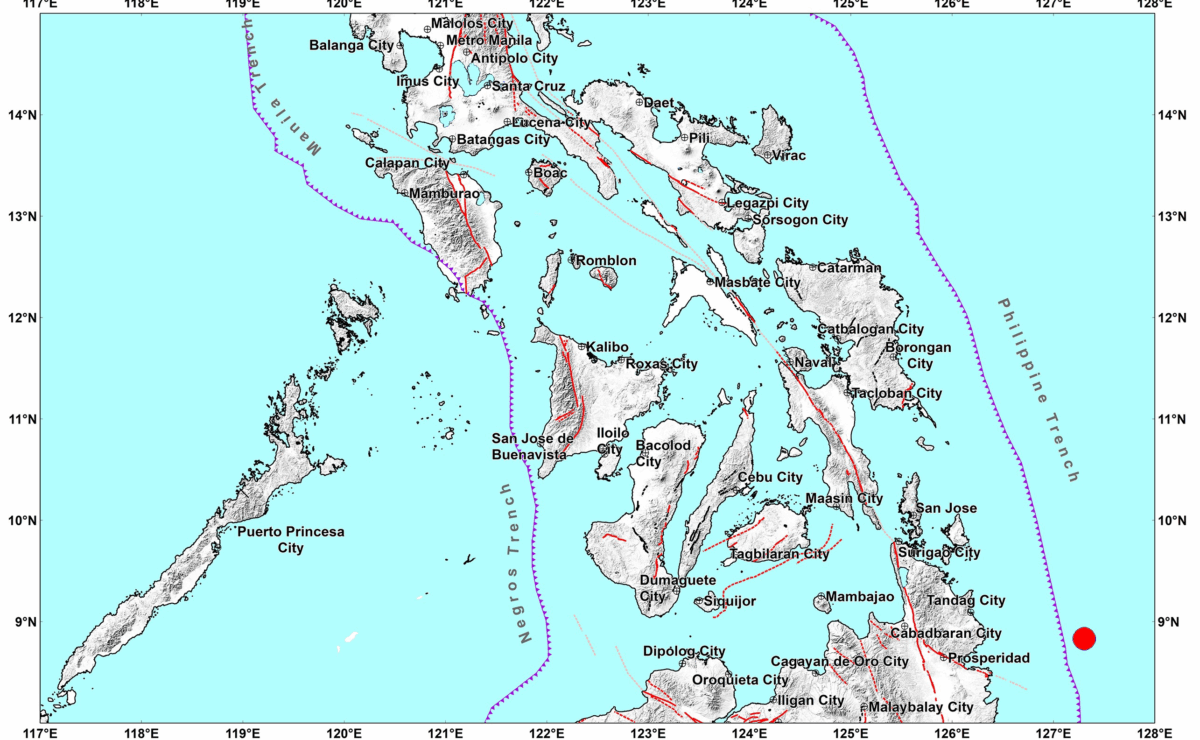
Another earthquake with a magnitude of 4.0 struck the waters off Cagwait, Surigao del Sur, on Sunday afternoon, the second earthquake recorded in the province over the last 24 hours.

Sunday’s earthquake was recorded at 2:56 p.m., originating 112 kilometers southeast of Cagwait, according to the Philippine Institute of Volcanology and Seismology (Phivolcs). The earthquake was tectonic in origin with a 12-km depth of focus.

On Saturday evening, a stronger magnitude 6.0 earthquake struck the coast northeast of Cagwait at a depth of 24 km.

There were no immediate reports of casualties or damage from the two earthquakes.

‘Remain calm’

With consecutive earthquakes being reported across the country in the last two weeks, the Department of Health (DOH) reminded the public to remain calm. Many patients have reportedly been rushed to hospitals due to panic attacks and hyperventilation.

In a social media post on Saturday, the DOH said it was normal to feel fear, shock or worry, but stressed that it was important to remain calm and composed.

“This is why earthquake drills and disaster drills are very important, because this is due to lack of knowledge on what to do when there’s an earthquake. They don’t know what to do, so they panic,” Health Secretary Teodoro Herbosa said in a radio interview with dzMM on Saturday.

The DOH said it has already conducted psychological first aid to individuals who experienced extreme stress, and continues to hold mental health and psychosocial support services to those affected.

Doublet quake

On Sept. 30, a magnitude 6.9 earthquake shook northern Cebu, killing at least 74.

Ten days later, on Oct. 10, two earthquakes with magnitudes 7.4 and 6.9 hit Davao Oriental, with at least nine fatalities, including two who died of heart attack in the midst of the shaking.

At least 11,000 aftershocks followed the Cebu quake, while over a thousand aftershocks have been recorded since the Davao Oriental quakes.

Phivolcs said Friday’s tremblors may be considered a “doublet earthquake,” which refers to distinct or different earthquakes that occur in almost the same area “with two (or more) main shocks that have slight difference in magnitude.”

The National Disaster Risk Reduction and Management Council (NDRRMC) estimated the damage at P100.3 million from the Davao Oriental quakes alone.

It added that 125,283 families or 491,258 people were affected. Of these figures, 66,366 families or 280,868 individuals were from the Davao Region while 58,917 families or 210,390 were from the Caraga Region.

More tremors hit the Philippines


Close to 11,000 aftershocks have rattled parts of Cebu and nearby provinces following the magnitude 6.9 offshore quake last Sept. 30, the Philippine Institute of Volcanology and Seismology (Phivolcs) reported Saturday, Oct. 11. Read more 

A magnitude 5 earthquake struck off the coast of Cabangan, Zambales on Saturday evening, Oct. 11. Read more 

Meanwhile, a magnitude 4.1 earthquake jolted the waters off Silago, Southern Leyte, on Saturday night, Oct. 11. Read more

A magnitude 6 earthquake struck the waters east of Cagwait, Surigao del Sur, on Saturday night, Oct. 11. Read more

DepEd suspends in-person classes


DepEd suspends in-person classes in NCR on Oct. 13–14 amid rise in influenza-like illnesses, recent earthquakes

A student assembly (file photo)

The Department of Education–National Capital Region (DepEd-NCR) on Sunday, Oct. 12, ordered the suspension of face-to-face classes in all public schools in Metro Manila on Monday and Tuesday, Oct. 13–14, 2025, following a spike in influenza-like illnesses and recent earthquakes in various parts of the country. Read more

Senator Bong Go expresses deep concern for Mindanao following powerful earthquake

October 13, 2025


Senator Christopher “Bong” Go expressed profound concern and sorrow following the strong earthquake that struck the Davao Region on Friday, October 10. The senator, who hails from Davao Oriental, recounted his own experience during the tremor and urgently called for unity, prayer, and swift government action to help affected communities recover.


“Mga kababayan ko, magdasal po tayo, magtulungan po tayo. Ako po’y nalulungkot sa nabalitaan ko po kanina na napakalakas po na lindol dito sa Mindanao, sa Davao Region,” Go said, urging Filipinos to come together in the spirit of compassion and solidarity.


He shared that he personally felt the earthquake while in the region. “Ako po mismo kanina, saksi po ako. Napakalakas talaga, nasa kalye po kami, umaalog yung sasakyan. Ako po’y nababahala, nalulungkot… magdasal po tayo,” he added.


The epicenter of the earthquake, according to data, was located in Manay, Davao Oriental—his own home province. “Ang epicenter po ay sa Manay, Davao Oriental. Ako rin po’y taga-Davao Oriental,” he remarked, expressing his concern for fellow Davaoeños who might have been affected.


Based on official reports from the Philippine Institute of Volcanology and Seismology (PHIVOLCS), the magnitude 7.4 earthquake struck offshore near Manay, Davao Oriental, at a depth of approximately 20 kilometers. The tremor triggered tsunami warnings in coastal areas, prompting residents in low-lying communities to evacuate to higher ground. These warnings were later lifted after no major waves were recorded.


Authorities confirmed that the strong quake was followed by a second major seismic event later that evening — a magnitude 6.9 earthquake that also shook several provinces across Southern Mindanao. PHIVOLCS clarified that the 6.9 tremor was not an aftershock but a separate “doublet” earthquake, occurring within the same tectonic system along the Philippine Trench.


Damage assessments are ongoing, with reports of cracked roads, damaged buildings, and power interruptions in several provinces. Local authorities confirmed multiple casualties, along with residents sustaining minor injuries during the tremors and ensuing panic. Evacuation centers were opened in affected areas, and disaster response teams were deployed to clear debris, restore access roads, and provide immediate relief to displaced families.


Go then assured that his office, through the Malasakit Team, was already preparing to extend assistance. “Nagdadasal po tayo na wala pong nasaktan, at bukas po ang aking opisina. Tutulong kaagad ang aking Malasakit Team, handang tumulong sa abot ng aming makakaya. Ang pinagdadasal natin ay walang nasaktan, at maka-recover kaagad ang ating mga kababayan. Makabalik kaagad sa normal na pamumuhay,” Go said.


The senator emphasized the need for close coordination among national and local agencies to ensure the rapid delivery of essential aid to communities in need. “We will be closely coordinating with local authorities at nakikiusap po ako sa ating mga national government agencies — mga pagkain, itulong kaagad; yung mga ayuda, itulong kaagad; sa Department of Energy, ibalik kaagad yung mga naputol na kuryente; mga nasirang daan sa DPWH, please lang, bigyan ninyo ito ng prayoridad,” he urged.


Go also appealed to relevant agencies to immediately deploy medical teams and relief workers to affected areas. “At sa DOH naman po, mga gamot, mga doctors agad pong ma-deploy sa mga evacuation centers. Sa DSWD rin po, kailangan maibigay kaagad yung mga pangangailangan na mga pagkain. Dapat po’y walang magutom na mga kababayan natin,” he said.


He underscored the Filipino spirit of bayanihan — mutual aid and compassion — in facing disasters. “Magtulungan po tayo. Dasal po ang kailangan sa ngayon, at kilala naman po ang mga Pilipino sa pakikipag-tulungan,” Go noted.


The senator acknowledged the series of recent earthquakes that have hit various parts of the country, expressing concern over their increasing frequency. “Nakakalungkot po, nakakabahala na panay sunod-sunod na po ang lindol na nangyayari sa ating bansa. Ingat po tayo, mga kababayan ko,” he said.


As a reminder to the public, Go reiterated the importance of following the guidance of local authorities and disaster officials to ensure safety. “Lumikas kaagad sa ligtas na lugar, pag merong mga paalala ang ating awtoridad, sumunod kaagad na lumikas sa mga ligtas na lugar. Importante safe po ang ating mga kababayan,” he reminded.


“Maraming salamat po,” Go said, extending his prayers for the people of Mindanao and expressing hope that affected communities will soon recover.


Go continues to push for stronger disaster resilience and housing programs to better protect and support Filipino communities.


Go, who is the principal author and co-sponsor of Republic Act No. 12076, is pushing for the full implementation of the Ligtas Pinoy Centers Act, which mandates the establishment of permanent, disaster-resilient, and fully equipped evacuation centers nationwide.


He has also refiled Senate Bill No. 173, or the proposed Department of Disaster Resilience Act, which seeks to establish a dedicated agency that will unify disaster risk reduction, preparedness, response, and rehabilitation efforts under one institution.


Other proposals include Senate Bill No. 669, or the Hazard Pay for Disaster Personnel bill, which if enacted, requires local government units (LGUs) to grant hazard pay to disaster responders during calamities; and Senate Bill No. 666, or the New Building Code bill, which seeks to update national construction standards to promote safety and resilience.


Sunday, October 12, 2025

What foreigners can teach us


Published Oct 12, 2025 12:05 am | Updated Oct 11, 2025 04:59 pm   REFLECTIONS TODAY
Luke 17:11-19
Today’s Gospel reading underscores the importance of gratitude and faith in our journey of discipleship. Luke uses the story of the ten lepers who call out to Jesus to have pity on them. Trusting in Jesus’ word and his command to show themselves to the priests, they find themselves cleansed on their way.
The nine, who are Jews, proceed to Jerusalem to be examined by priests who certify that they are clean and so can join their community. The Samaritan, whose people do not worship in Jerusalem, instead returns to Jesus to do him homage and thank him. It is his faith in Jesus as the prophet of God, even as the Taheb (essentially the Samaritan equivalent of the Jewish Messiah) that saves him, which is more than being cleansed of his leprosy.
The cure of the Samaritan, a foreigner among the Jews, is introduced by the story of the cure of the leprous general Naaman in the First Reading. After being cleansed of leprosy through the prophet Elisha, Naaman realizes that there is no God in all the earth, except in Israel. Knowing that he has to be at the side of the king of Aram when this worships in the temple of Rimmon, Naaman asks for forgiveness if he, too, bows with his master.
Elisha understands his situation and allows him to carry loads of earth to be taken to Aram. Worship of the Lord is associated with the soil of Israel, where the Lord is present. He can therefore worship God in Syria. The Word of God underscores the significance of gratitude.
We often find ourselves asking for God’s blessings, for healing, for guidance. But how often do we return to offer thanks when our prayers are answered?
The Samaritan leper returns to Jesus to give thanks. The Syrian Naaman brings with him soil from Israel as “sacrament” of his faith and worship of the Lord, the true God. The cure of the two lepers who are foreigners likewise shows that God’s blessing is open to all. While Israel may have the priority as God’s elect, Jesus opens the Kingdom of heaven to everyone. God’s love transcends boundaries, prejudices, and differences.
As followers of Christ, we are called to embrace this truth and extend our love and compassion to all people, regardless of their background or circumstances. Pope Francis invites us to nurture fraternity and friendship among peoples.
He writes, “It is my desire that, in this our time, by acknowledging the dignity of each human person, we can contribute to the rebirth of a universal aspiration to fraternity. Fraternity between all men and women. ‘Here we have a splendid secret that shows us how to dream and to turn our life into a wonderful adventure.
No one can face life in isolation… We need a community that supports and helps us, in which we can help one another to keep looking ahead. How important it is to dream together… By ourselves, we risk seeing mirages, things that are not there. Dreams, on the other hand, are built together.’
Let us dream, then, as a single human family, as fellow travelers sharing the same flesh, as children of the same earth which is our common home, each of us bringing the richness of his or her beliefs and convictions, each of us with his or her own voice, brothers and sisters all (Fratelli Tutti, 8).

Davao Oriental fast-tracks earthquake rehab


Published Oct 11, 2025 03:27 pm
DAYANHIRANG and Cabinet officials discuss rehabilitation efforts. (PIO Davao Oriental)
DAVAO CITY – The provincial government of Davao Oriental convened with Cabinet officials on Saturday, Oct. 11, to fast-track relief and rehabilitation efforts in the province following the doublet earthquake that jolted the province on Friday.
Three were reported killed in the province while 360 others were injured after a magnitude-7.4 earthquake hit the coast of Manay town in Davao Oriental. Over 70,000 families were affected from 10 towns and one city of the province.
A series of aftershocks, which include a magnitude-6.8 tremor, rattled Davao region until Saturday.
Gov. Nelson Dayanghirang met Department of Social Welfare and Development (DSWD) Secretary Rex Gatchalian, Department of Public Works and Highways (DPWH) Secretary Vince Dizon, Department of Education (DepEd) Secretary Sonny Angara, and Mindanao Development Authority (MinDA) Secretary Leo Tereso Magno in City of Mati to outline priority relief and rehabilitation efforts.
“Davao Oriental may have been shaken but it’s people remain steadfast and untied,” Dayanghirang said as he assured intensified coordination among agencies.
He emphasized the importance of a well-coordinated effort to fast-track the rehabilitation of critical infrastructures.
Gatchalian assured earthquake-hit communities that they will extend relief aid to affected families in the region.
The provincial government has activated the Incident Command Post at the provincial capitol gymnasium to monitor the situation as well coordinate ongoing relief and rehabilitation operations.
Dayanghirang also activated the Provincial Rapid Damage Assessment and Needs Analysis (RDANA) team composed of the Provincial Disaster Reduction and Management Office (PDRRMO), Provincial Engineers Office (PEO), Provincial Social Welfare and Development Office (PSWDO), Provincial Health Office (PHO), DPWH, and DepEd.
RDANA will lead damage assessment and relief requirements among affected areas.
As of 6 a.m. Saturday, a report from the DSWD Disaster Response Operations Management, Information, and Communication (DROMIC) showed that the doublet earthquake has affected 356,858 persons from 205 barangays in the Davao and Caraga regions.
The provincial government of Davao Oriental suspended tourism-related activities in all coastal areas of the province effective Saturday.
“Tourism establishments located along the coastal zones are particularly vulnerable to aftershocks, ground instability, and potential secondary hazards such as landslides and tsunamis,” an executive order issued by Dayanghirang said.
The province’s white sand beaches are a known weekend destination.
It added that “tourism establishments may only resume operations upon certification of structural integrity and safety clearance issued by the Municipal Engineering Office and or other competent authorities.”

Bayanihan in action: Now is the time to step up, not step back


 By Manila Bulletin

Published Oct 12, 2025 12:05 am


In the wake of last week’s calamitous earthquakes — first a magnitude-7.4 quake off Davao Oriental then a magnitude 6.8 in the same area Oct. 10, following closely after the magnitude 6.9 quake in Cebu island on Sept. 30 — the Philippines is once again confronted with the raw power of nature and the fragility of our built environment. In Cebu alone, more than 70 lives were lost, hundreds were injured, and thousands of homes and public infrastructure were severely damaged or destroyed. In Davao and surrounding provinces, the quake triggered landslides, damaged roads and schools, and left communities reeling.

These earthquakes come on top of a long season of calamities — protracted flooding in recent months, coming from monsoon surges and tropical storms, has already battered provinces and displaced many families. Barangay, local government units’, and government agencies’ volunteers and community groups have already been stretched thin managing evacuation centers, distributing food, and doing frontline relief work.

The Philippine Red Cross, too, has proven how indispensable volunteer networks are in such times. Even when their own homes were threatened, their volunteers persisted in search-and-rescue missions, medical outreach, health education, and managing relief distribution. In the Davao earthquakes, Red Cross volunteers responded swiftly to affected municipalities, joining the front lines of relief and damage assessment.

It is telling: in every recent Philippine disaster, professional responders—government, police, military, NGOs—cannot reach every barangay immediately. The gap between disaster onset and formal assistance is precisely where volunteerism matters most.

There is much room for volunteer work. If you live near or can travel to affected areas—Cebu, Davao Oriental, or intermediate provinces—join official volunteer corps (Red Cross, local NGOs) rather than simply showing up uncoordinated. These organizations have protocols for safety, logistics, and working with local disaster risk reduction offices.

Those who cannot go to the affected areas, or are not fit to do volunteer work, can donate cash or goods to trusted organizations (Philippine Red Cross chapters, accredited foundations, or local NGOs).

Beyond monetary support, volunteer your time and skills: Help pack relief goods, hygiene kits, and medical supplies. Help manage or staff evacuation or distribution centers. Assist in logistics, transportation, communications, or data registration. Help in fundraising, awareness campaigns, or coordination efforts.

Ask, don’t wait to be asked. In devastated areas, resources may be overwhelmed, and official volunteer recruitment slow. Reach out to your local disaster risk reduction management council, or to the non-government organizations (NGOs), to the Department of Social Welfare and Development (Dswd) through their websites. They have issued calls for volunteers. Ask, “How can I help?” Even small tasks multiply when many hands answer the call.

Some might argue that disaster response should be left to professionals. True, technical decisions (search & rescue, medical triage, infrastructure assessment) require expertise. But the recovery and relief process depends on sustained community involvement. The debris must be cleared, relief packages must be sorted and delivered, centers must be run, and emotional wounds must be tended. All of these demand manpower, care, and consistency.

Moreover, volunteerism sends a message: victims are not alone. The presence of volunteers restores dignity, nurtures hope, and strengthens social fabric when it is most frayed. This is the heart of bayanihan—not heroism for media headlines but quiet, selfless service.

In this moment of suffering and uncertainty, each Filipino has a role to play. Let our bayanihan not be a cliché, but a living force. Let us answer with solidarity, courage, and compassion. Because in disasters, we must always choose to stand with our fellow Filipinos—not with empty words, but with hands and hearts.

In crises, the Filipino spirit of bayanihan must now move beyond symbolism and become visible action.


Friday, October 10, 2025

Feeling stressed? You're not alone, survey shows more Filipinos do


 By Ellalyn De Vera-Ruiz

Published Oct 9, 2025 08:44 pm


Photo from Pixabay

As the world observes World Mental Health Day on Oct. 10, a nationwide survey shows that more Filipinos are living under daily stress as they cope with financial, health, work, and family pressures.

The Social Weather Stations (SWS) Third Quarter 2025 survey found that 34 percent of adult Filipinos experience stress “frequently” in their daily lives, up from 27 percent recorded in the fourth quarter of 2019, just before the pandemic.

Another 32 percent said they “sometimes” feel stressed (down from 37 percent in 2019), 30 percent “rarely” (down from 34 percent), and 4 percent “never” experience stress (roughly unchanged from 2 percent).

The survey also examined the magnitude of stress related to specific aspects of daily life.

Financial concerns ranked highest, with 53 percent of respondents reporting “big” stress (very big or somewhat big).

Health-related issues affected 42 percent of adults, 39 percent reported stress from work or school, and 38 percent experienced stress from family matters.

Metro Manila reports highest stress levels

SWS found that 50 percent of adults in Metro Manila said they experience stress frequently, the highest among all regions.

This was followed by Balance Luzon (36 percent), Mindanao (28 percent), and the Visayas (26 percent).

Compared to fourth quarter 2019, the share of adults experiencing frequent stress rose sharply in Metro Manila, up 15 points from 35 percent.

It also increased in Balance Luzon by eight points (from 28 percent) and in Mindanao by 10 points (from 18 percent).

The Visayas saw little change, remaining at 28 percent.

For those who experience stress sometimes, Balance Luzon had the highest share at 34 percent, down from 38 percent in fourth quarter 2019.

It was followed by Mindanao with 32 percent (down from 41 percent), the Visayas with 31 percent (up from 29 percent), and Metro Manila with 27 percent (down from 38 percent).

Those who rarely experience stress were most common in the Visayas and Mindanao, with 37 percent each (down from 41 percent and 36 percent, respectively).

Balance Luzon had 27 percent (down from 33 percent), and Metro Manila 19 percent (down from 25 percent).

Meanwhile, the share of adults who never experience stress was highest in the Visayas at 6 percent (up from 2 percent), followed by Balance Luzon at 4 percent (up from 2 percent), while Metro Manila and Mindanao recorded 3 percent each, remaining largely unchanged from 2 percent and 4 percent, respectively.

Women report higher stress than men

The survey also found that women are more likely to experience stress frequently than men.

About 41 percent of women reported feeling stressed daily, compared to 27 percent of men.

Since fourth quarter of 2019, the share of women reporting frequent stress increased by eight points, while it rose by seven points for men.

Women also reported higher levels of stress across all major areas, including finances, health, work or school, and family responsibilities.

On financial matters, 57 percent of women reported experiencing big stress (24 percent very big, 34 percent somewhat big), compared to 48 percent of men (18 percent very big, 30 percent somewhat big).

Regarding health-related stress, 46 percent of women considered it big (18 percent very big, 29 percent somewhat big), versus 38 percent of men (12 percent very big, 26 percent somewhat big).

In terms of family-related stress, 44 percent of women reported big stress (16 percent very big, 28 percent somewhat big), compared to 32 percent of men (12 percent very big, 20 percent somewhat big).

For stress from work or school, 40 percent of women considered it big (14 percent very big, 26 percent somewhat big), slightly higher than 38 percent of men (12 percent very big, 26 percent somewhat big).

The Third Quarter 2025 Social Weather Survey was conducted from Sept. 24 to 30, through face-to-face interviews with 1,500 adults nationwide, aged 18 and above.

The sample included 300 respondents in Metro Manila, 600 in Balance Luzon (Luzon outside Metro Manila), and 300 each in the Visayas and Mindanao.

The survey has a sampling error margin of ±3 percent for national percentages, ±4 percent for Balance Luzon, and ±6 percent for each of the other regions.