This might not be the typical expat blog, written by a German expat, living in the Philippines since 1999. It's different. In English and in German. Check it out! Enjoy reading! Dies mag' nun wirklich nicht der typische Auswandererblog eines Deutschen auf den Philippinen sein. Er soll etwas anders sein. In Englisch und in Deutsch! Viel Spass beim Lesen!

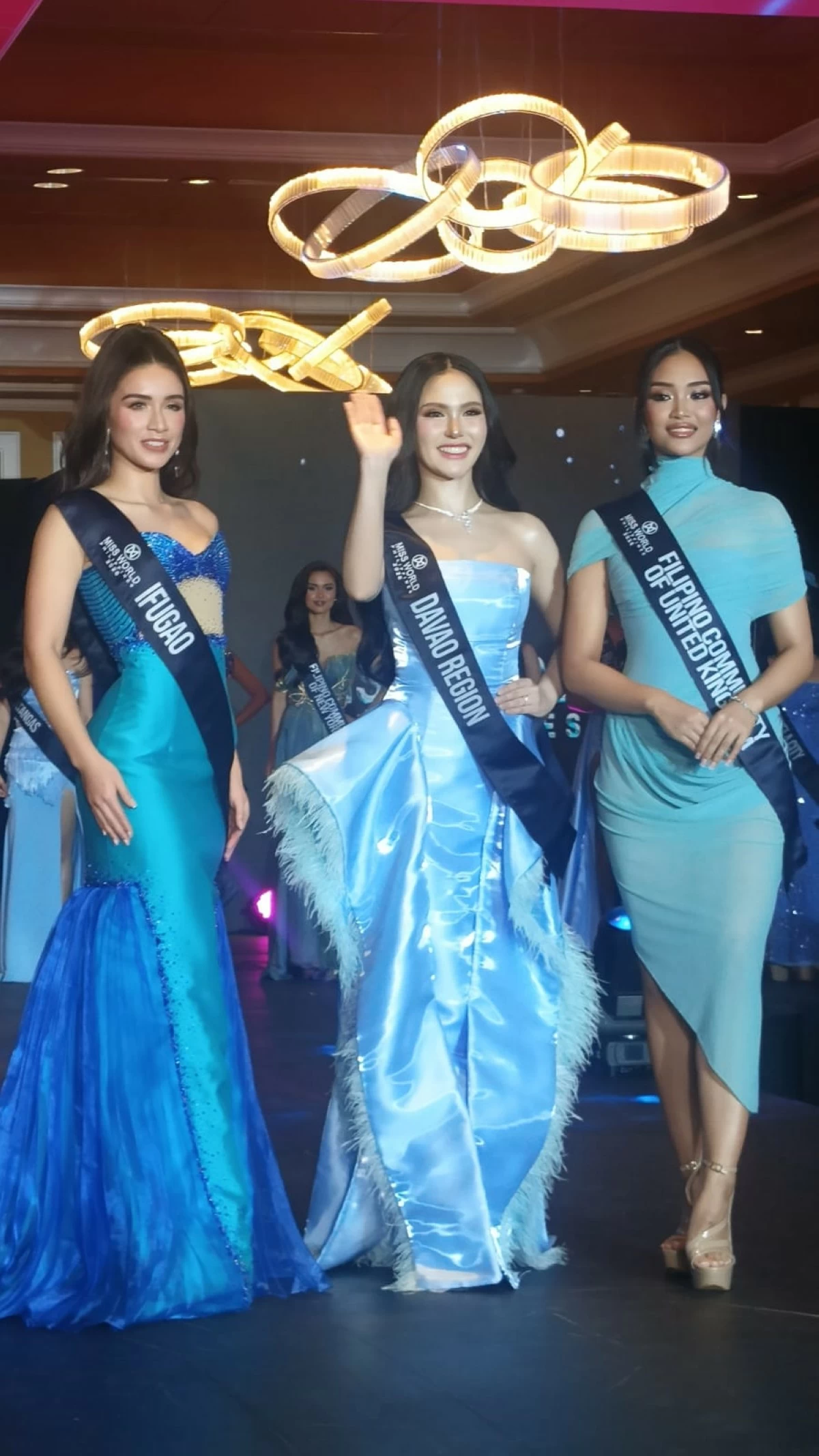
The grand coronation night of Miss World Philippines will be held on Feb. 3 at the SM Mall of Asia Arena, with the organization officially presenting its 24 candidates to the media at the Golden Ballroom of Okada Manila on Jan. 16.

In his opening remarks, Miss World Philippines national director Arnold L. Vegafria expressed hope that the country's second blue crown is within reach, following Megan Young's win in 2013. He noted that last year's representative, Krishnah Gravidez, came close after being named Miss World Asia 2025 at the 72nd Miss World pageant held in Telangana, India.
"Krishnah set the bar high with her near-finish last year, but we pray that we remain consistent with our winning track record," he noted.
Aside from the main winner, the Feb. 3 pageant will also crown the candidates who will represent the Philippines in Universal Woman 2026 and Miss Global 2026.
This year's official candidates are the following:
1. Nikki Malabuyoc Lorzano - Batangas
2. Carolyn Kean Tuquero - Bauan, Batangas
ADVERTISEMENT
3. Gwen Marie Perion - Bukidnon
4. Jayvee Lyn Lorejo - Davao Region
5. Imani Ja'Asia Quiban-Smith - Filipino Community of Hawaii
6. Marizza Delgado - Filipino Community of New York
7. Angel Abergas - Filipino Community of Singapore
8. Margarethe Elize Romano - Filipino Community of United Kingdom
9. Valerie Pawid West - Ifugao
10. Christal Briseis Polancos - Iligan City
11. Zia Ainhize Arboleda - Laguna
12. Anne De Mesa - Manila
13. Zoe Sofia Gabon - Naga City
14. Cindy Valencia - Negros Island Region
15. Meridith Bobadilla - Occidental Mindoro
16. Ronette Castillo - Oriental Mindoro
17. Jiji Galapia - Pampanga
18. Asia Rose Simpson - Quezon City
19. Kiana Rose Henson - Quezon Province
20. Lorraine Ojimba - Rizal Province
21. Olivia Grace Reilly - Sultan Kudarat
22. Cherline Dalangin - Valenzuela
23. Ansha Lichelle Jones - Zamboanga City
24. Roveelaine Eve Castillo - Zamboanga Peninsula

At the event, three candidates were named the Darling of the Press based on their beauty, personality, and stage presence. They are: Miss Davao Region Jayvee Lyn Lorejo, Miss Ifugao Valerie West, and Miss FilCom UK Margarethe Romano.
The candidates will now proceed to a series of fast-track competitions, including Top Model, Talent, Sports Challenge, Multimedia Challenge, and Head-to-Head Challenge. This will all culminate in a Charity Gala Night scheduled on Jan. 29 at the Okada Manila Grand Ballroom.
Vegafria noted that one of its accomplishments this year was acquiring more franchise partners. This led to the participation of Filipino communities in Hawaii, New York, Singapore, the United Kingdom, as well as in Davao City, Ifugao Province, Iligan City, and Sultan Kudarat.

"This is part of our organization's push for inclusivity and our legacy of promoting local tourism. I always say pageantry is the best and cheapest platform to promote our tourism industry. If the government will not do anything to promote, then we will take the initiative ourselves because we love our country," he stressed.
Miss World Philippines 2026 is presented by: JuanHand in cooperation with Bench, Bench Body, and Bench Active. Major sponsors are: GlutaLipo, Philippine Airlines, Honest Glow, Hikari, Hotel 101, SY Glow, Discovery Suites, Monarch Montage Skin Science and Medical Aesthetics International, Nova Aesthetic and Wellness Clinic, and co-sponsors MWell, Hairfix, Megan Beauty, Nutriexpert, Deoflex, and Nook Salon + Estetik.
Miss World PH also gives thanks to: John Robert Powers, SysProtech, Reyes-Tacandong and Company, City of Pasig, Jojo Bragais, Southville, Power House, Victoria Sports Club, Kembot Studios, Sta. Barbara Polo & Racquet Club, Peculiar Eyewear, Proshot, Flower Bouquet by Abbey Abad, and Flower Bouquet by Muelo.
By Gabriell Christel Galang
Published Jan 16, 2026 09:41 am
Fuel prices are poised for a hefty jump next week as escalating geopolitical risks in the Middle East and the Black Sea outweigh a potential global supply glut.
Based on the four-day trading data from the Mean of Platts Singapore, gasoline prices may rise by ₱1 to ₱1.20 per liter, while diesel is projected to spike by ₱1.80 to ₱2 per liter. Kerosene is also expected to increase by approximately ₱1 per liter.
The potential adjustments follow a volatile week where supply disruption fears took center stage.
The rally is being driven by civil unrest in Iran, the fourth-largest producer in the Organization of Petroleum Exporting Countries. Demonstrations against the country’s clerical system have sparked concerns over the stability of its output, which accounts for roughly four percent of global demand.
Any sustained loss of Iranian exports would tighten markets across Asia, particularly in China, which remains the primary buyer of the Islamic Republic’s crude.
“Crude oil and finished petroleum products had a short-lived upswing this week driven primarily by fears of an escalation in tension in Iran,” said Rodela Romero, director of the Department of Energy’s Oil Industry Management Bureau.
Market participants are also monitoring the Strait of Hormuz, a critical chokepoint for global oil transit.
Leo Bellas, president of Jetti Petroleum, said that despite a looming supply surplus, the threat of United States (US) intervention in support of Iranian protesters has raised the risk of the conflict spreading and threatening flows through the waterway.
Further pressure emerged from the Black Sea, where drone attacks on two Western-operated oil tankers added to the geopolitical premium. The incident has intensified worries that regional conflicts are expanding to hit vital energy infrastructure far beyond the Persian Gulf.
Domestic factors are exacerbating the impact of rising global benchmarks. The Philippine peso recently hit a record low of ₱59.46 against the US dollar, adding an estimated ₱0.10 to ₱0.50 per liter to the projected price hikes.
To be sure, some factors could limit the scale of the increases. The U.S. recently reported a larger-than-expected build in oil and fuel inventories, and the potential for steady supply from Venezuela may provide a buffer. However, these factors have yet to offset the risk premium currently baked into regional prices.
Stand:
Von: Marike Stucke

Das Sparbuch war lange der Klassiker, wenn Eltern oder Großeltern Geld für Kinder und Enkel anlegen wollten. Doch es gibt bessere Alternativen.
Viele Eltern möchten frühzeitig finanziell für ihre Kinder vorsorgen – doch das klassische Sparbuch ist dafür kaum noch geeignet. Die Zinsen sind niedrig, während die Preise steigen. Das bedeutet: Das Ersparte verliert über die Jahre an Kaufkraft, selbst wenn der Kontostand wächst. Für langfristige Ziele wie Studium, Ausbildung oder eine Starthilfe ins Erwachsenenleben braucht es daher bessere Lösungen.
Tipps rund um das Thema Familien-Finanzen finden Sie auch in unserem gratis PDF:

Welche finanziellen Unterstützungen gibt es vom Staat für Eltern vor und nach der Geburt des Kindes? Dieses PDF gibt einen Überblick über die Leistungen, einzuhaltende Fristen und Voraussetzungen für den Bezug der Gelder.
Eine der beliebtesten Alternativen sind ETF-Sparpläne. Sie investieren breit gestreut in viele Unternehmen und bieten langfristig deutlich höhere Renditechancen als klassische Sparprodukte. Durch regelmäßige Einzahlungen profitieren Eltern vom Durchschnittskosteneffekt, der Kursschwankungen abmildert. Auch Fonds, Tages- oder Festgeldkonten können sinnvoll sein – vor allem für kürzere Zeiträume oder als Ergänzung zu renditestärkeren Anlagen. Viele Familien setzen auf eine Mischung aus Sicherheit und Wachstum.
Besonders interessant ist das Anlegen auf den Namen des Kindes, etwa über ein spezielles Kinderdepot bei Banken oder Online-Brokern. Der große Vorteil: Kinder haben eigene Steuerfreibeträge, die genutzt werden können. Kapitalerträge bleiben so oft steuerfrei, während Eltern mit denselben Erträgen möglicherweise bereits Steuern zahlen müssten. Wichtig ist jedoch zu wissen: Das Geld gehört rechtlich dem Kind und steht ihm spätestens mit dem 18. Geburtstag vollständig zur Verfügung.
Kinderdepots sind bei vielen Banken günstig oder sogar kostenlos und eignen sich gut für langfristige Sparpläne. Ein Anbieter-Vergleich lohnt sich, da Kosten, Angebot und Bedienung variieren.
Noch mehr Infos zu finanziellen Hilfen für Familien vom Staat haben wir in einem praktischen PDF zusammengefasst.
Fazit zur Geldanlage für Kinder
Wer Geld für sein Kind anlegen möchte, sollte das Sparbuch nur noch als kurzfristige Lösung sehen. Langfristige Anlagen wie ETF-Sparpläne bieten deutlich bessere Chancen, Vermögen aufzubauen und die Inflation auszugleichen. In Kombination mit der Nutzung der Steuerfreibeträge für Kinder lässt sich mit überschaubaren Beträgen früh ein solides finanzielles Fundament schaffen – je früher, desto besser.
A new year has just begun, but 2026 arrives with a bang, as if to remind us that the world does not pause for calendars.
Nicolás Maduro, the embattled president of Venezuela, has been captured by the United States. On the surface, it is another headline in the endless stream of news, yet for us in the Philippines, it resonates differently. When we see a leader being taken down by the United States, it echoes a history we know too well, a history that continues to shape how we understand power and resistance.
When Maduro’s capture appears on our smart phone or television screens, it is difficult, as Filipinos, not to think of our own past, when after the Spanish-American War, the United States annexed the Philippines, transforming what had been hope for liberation into a long, bloody struggle against a new colonizer.
The Philippine Insurrection, or the Philippine-American War, began in 1899, triggered by the firing upon soldiers who had expected independence after Spain’s defeat, and over the next three relentless years, guerrilla tactics, ambushes, and brutal reprisals left tens of thousands of Filipinos dead, exposing in the harshest terms the violent logic of imperial ambition and the fragility of freedom when power is unevenly distributed.
In March 1901, in Palanan, Isabela, a small group of American soldiers, led by General Frederick Funston, disguised as prisoners of war, slipped deep into Aguinaldo’s camp and captured Emilio Aguinaldo, the self-proclaimed President of the Philippine Republic, effectively decapitating the leadership and causing organized resistance to falter; history, if we are willing to look closely, shows this pattern repeating itself across time and place, whether it was Saddam Hussein in Iraq, Muammar Gaddafi in Libya, or now Nicolás Maduro in Venezuela, where the removal or isolation of a leader sends a message, not only to the people resisting but to the wider world, that dissent against the hegemon will not be tolerated.
From where I stand, as a Filipino youth committed to understanding global affairs, 2026 is shaping up to reveal how far a global hegemon will go to preserve its grip on power, and guided by its grand strategy, every policy, every alliance, every intervention seems designed to secure a world order in which it remains dominant. I support Western values such as freedom and justice—they are worth defending—but history and current events show that these ideals are often subordinated to strategic interests, bending to serve power rather than people.
Even domestic policies abroad, or actions aimed at vulnerable populations, demonstrate how foreign and domestic priorities converge in the service of control, which leaves those who resist to face the full weight of that power.
This is the paradox we, as Filipinos, inherit: the language of moral leadership, often spoken with grand ideals and lofty promises, frequently conceals a simpler, harsher truth—that survival, control, and dominance, rather than justice or virtue, drive the actions of the powerful, while ordinary people bear the heaviest consequences, struggling to live and to dream under systems they neither shaped nor consented to.
The Global North frames its interventions and strategies as the defense of order, as the maintenance of stability, yet much of the Global South, where the Philippines is part of, experiences them as nothing more than the continuation of an uneven system, one in which compliance is rewarded, dissent punished, and the very notion of freedom becomes contingent on the whims and calculations of those in power.
As Filipinos, we have seen this play out across generations: in the sudden imposition of foreign policies, in the rewriting of our history, and in the ways in which decisions made oceans away ripple through our daily lives, shaping what we can aspire to, what we are allowed to question, and ultimately, what it means to be free in our own land.
2026 is not just another year to mark on the calendar; it arrives as a challenge, a call to remember that history is not a distant story but a living presence that shapes how we, as Filipinos, perceive the world and our place within it. It reminds us that the struggles for sovereignty, for dignity, and for self-determination did not end with Aguinaldo’s capture or with the countless unnamed heroes who took up arms against colonizers; they continue in every act of resistance against oppression, in every effort to claim our rights, and in every question we ask about who truly holds power in our world.