Airfare relief ahead as fuel surcharge dips

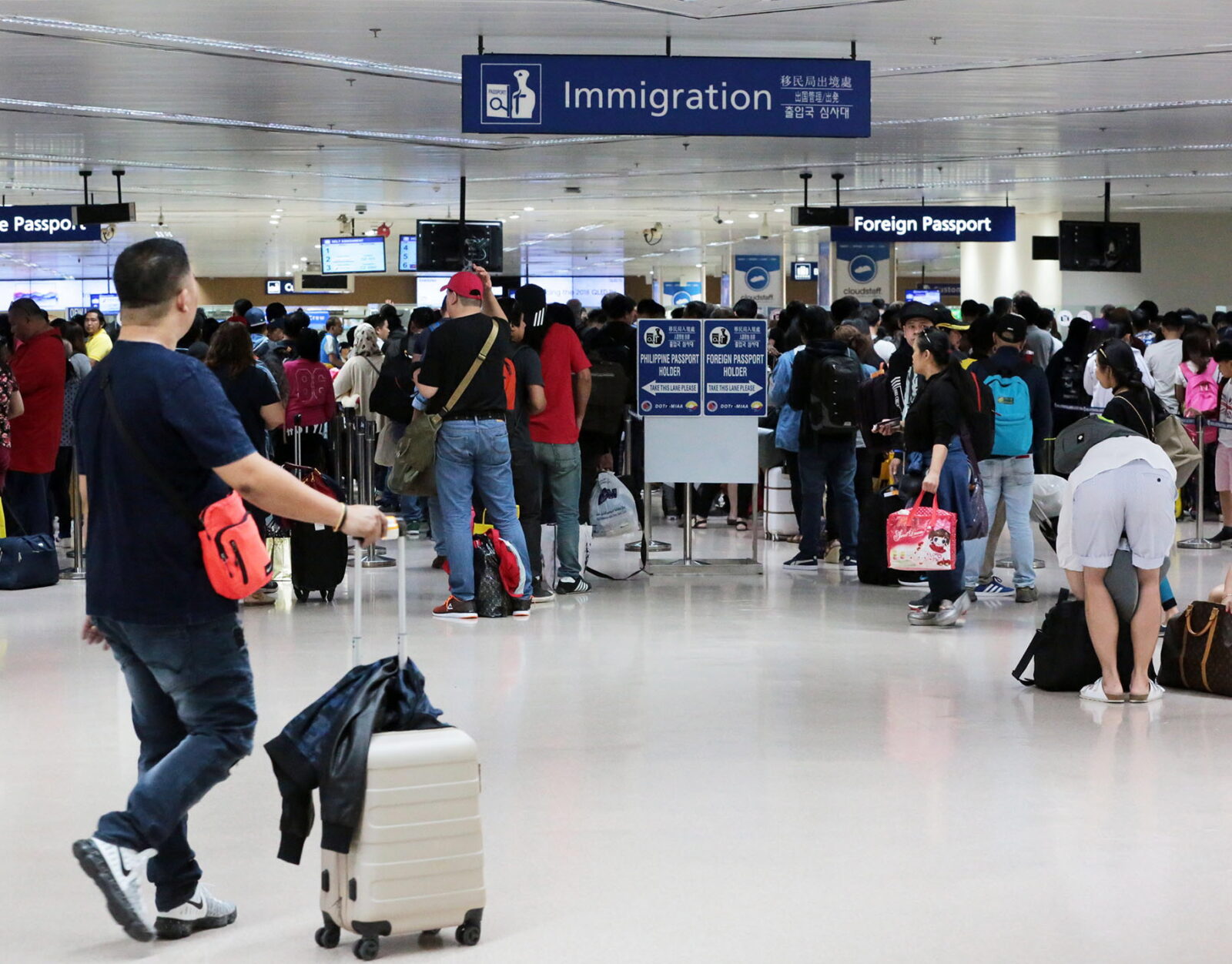
FILE PHOTO: Arriving passengers queue at the immigration counters of the Ninoy Aquino International Airport (NAIA) terminal 1 on Sunday, August 8, 2018. —GRIG C. MONTEGRANDE

Tycoon Ramon Ang’s New Naia Infra Corp. (NNIC) is seting new, clear-cut performance standards for airlines operating at Ninoy Aquino International Airport (Naia), starting with the country’s flag carrier, Philippine Airlines (PAL).
NNIC, which took over the country’s primary gateway in 2024, said the new operating framework will spell out how airlines use Naia facilities and infrastructure, as well as define the respective responsibilities of carriers and the airport operator.
There will also be key performance indicators meant to improve operational efficiency at the congested Naia.
In a statement on Tuesday, the San Miguel Corp.-backed NNIC described the move as part of Naia’s overall refresh, which it is now extending beyond terminals, facilities and airport systems to how operations across the gateway are managed.
“This agreement gives us a clearer framework for setting expectations, measuring performance and working together to maintain consistent service standards,” NNIC president and CEO Ang said. “That is important to making airport operations more efficient and dependable.”
As part of this push, the Lucio Tan-led PAL signed the first standardized Airport Use Agreement with NNIC, a framework that the Naia operator intends to use as a blueprint for future agreements with other airlines using the gateway.
While it described the deal only in broad strokes, NNIC said the agreement was meant to make airline operations more consistent and improve coordination among the different parties involved in moving passengers, baggage and aircraft through Naia.
Under the framework, the agreed service levels will be part of PAL’s contractual obligations and will include mechanisms for addressing persistent failures to meet the standards.
“This is a positive development for both PAL and NNIC, and ultimately for our passengers. It supports the continuing modernization of Naia and our collective goal of delivering a better airport experience,” Lucio Tan III, president and COO of the airline’s parent company PAL Holdings Inc.
NNIC said it was taking a similar approach with ground handlers and other service providers at Naia.
Since taking over the airport, NNIC has been upgrading its terminals, airport systems, airfield infrastructure and passenger amenities while seeking to address long-standing capacity and operational constraints.
In 2025, Naia recorded its highest annual passenger count, with 52.02 million travelers passing through the country’s main gateway.
Despite the new 12.5-percent tariff imposed by the United States, the Philippines remains in a stronger position than many of its regional competitors, with more than 60 percent of its exports exempt from the additional levy.
Trade Undersecretary Ceferino Rodolfo said the tariff, imposed by Washington on countries which it deems to lack safeguards against the importation of goods made through forced labor, would be “not at all” disruptive for Philippine exporters.
Only 34.28 percent of Philippine exports to the United States—or $6.25 billion worth of goods—will be subject to the new tariff, according to the Department of Trade and Industry (DTI).
The remaining $11.98 billion will remain exempt.
“We’re not in a bad situation. Not at all,” Rodolfo said. “But we want the best for our exporters.”
Bianca Sykimte, director of the DTI’s Export Marketing Bureau, said the Philippines’ top exports to the United States—semiconductors and electronics as well as agricultural products—will continue to enter the US duty-free.
Automotive parts, minerals and aircraft parts are likewise spared from the new tariff.
Products that will be covered by the new levy are those produced by “labor-intensive” industries, such as leather and travel goods, apparel, footwear and toys.
The Philippines also compares favorably with its regional peers.
Based on the DTI’s assessment, Sykimte said about 83 percent of Indonesia’s exports to the US and roughly 40 percent of Malaysia’s shipments are exposed to the additional tariff.
Rodolfo added that the Philippines’ 12.5-percent tariff appears to be its “ceiling” under the US Section 301 investigation.
Unlike several neighboring economies, the Philippines was not included in the United States Trade Representative’s (USTR) separate investigation into structural excess capacity. This covers China, the European Union, Singapore, Switzerland, Norway, Indonesia, Malaysia, Cambodia, Thailand, South Korea, Vietnam, Taiwan, Bangladesh, Mexico, Japan and India.
Even so, Rodolfo said the government continues to engage the USTR to secure the “best deal possible” for Philippine exporters.
He added that the DTI has also secured offers from multilateral institutions and bilateral partners to support the implementation of the joint administrative order banning the importation of goods produced through forced labor.
That order, issued a day before Washington announced the new tariff, created an interagency committee led by the DTI, together with the Department of Labor and Employment and Department of Finance, to establish a mechanism for investigating forced labor cases. Support from development partners will come in the form of grants and technical assistance.
“They see that, at a principles level, this is something very good—that the Philippines is promoting decent work, even if the supposed forced labor happens outside the country,” Rodolfo said.
Rodolfo added that the USTR is already reviewing the order and has assured the Philippine government that its assessment is ongoing, meaning changes to the 12.5-percent tariff could be made “at any time.”

Travelers flying within and out of the Philippines are facing significantly higher airfares for the rest of April after the Civil Aeronautics Board (CAB) approved a Level 19 fuel surcharge, pushing additional charges to as much as P15,397 per ticket.
This new rate brings jet fuel surcharges close to the maximum Level 20 and marks a sharp increase from Level 8 imposed from April 1 to April 15.
Before the Middle East conflict broke out, Level 4 surcharge had applied.
Under Level 19, fuel surcharges for domestic flights now range from P627 to P1,834, up from P253 to P787 earlier in April—equivalent to increases of 147.83 percent and 133.04 percent, respectively.
For international flights, the surcharge rises to at least P2,070.77 and as much as P15,397.15, from P835.05 to P6,208.98 previously, representing a 147.98-percent increase.
CAB issued the advisory on Wednesday, although the new rates had taken effect for tickets issued starting April 16.
“This interim measure shall be in effect until the current situation stabilizes, or as may be revised or revoked accordingly,” it said.
These new rates will be applied at a conversion rate of P59.95 per US dollar.
This adjustment comes as global jet fuel prices remain high, reaching $184.63 per barrel as of April 17, from $99.40 per barrel prior to the Iran conflict, based on data from the International Air Transport Association.
Compared with prewar levels, Philippine jet fuel surcharges have now increased by 436 percent.
In March, carriers were unable to immediately reflect the price surge, as surcharges had already been set at Level 4 before hostilities escalated. At that level, domestic charges ranged from P117 to P342, while international surcharges were between P385.70 and P2,867.82.
Level 20 remains the highest allowable tier under CAB rules, with domestic surcharges ranging from P661 to P1,993 and international charges from P2,183.11 to P16,232.44.
Under CAB Resolution No. 25, Series of 2022, fuel surcharges are optional and charged on top of the base airfare. These may be removed if the one-month average price of jet fuel falls below P21 per liter.
In a statement, AirAsia Philippines said the increase reflects mounting cost pressures on carriers amid the ongoing conflict.
“With the ongoing geopolitical uncertainty, our operational cost base has significantly exceeded initial forecasts—global jet fuel prices have surged to more than double 2025 levels,” the airline said.