Baking soda is a gardener’s best friend: here are 10 clever uses in the garden
This might not be the typical expat blog, written by a German expat, living in the Philippines since 1999. It's different. In English and in German. Check it out! Enjoy reading! Dies mag' nun wirklich nicht der typische Auswandererblog eines Deutschen auf den Philippinen sein. Er soll etwas anders sein. In Englisch und in Deutsch! Viel Spass beim Lesen!
You plan to move to the Philippines? Wollen Sie auf den Philippinen leben?
Ja, es gibt tonnenweise Webseiten, die Ihnen sagen wie, warum, vielleicht warum nicht und wann Sie am besten auf die Philippinen auswandern könnten. Ich möchte Ihnen in Zukunft "zwischen den Zeilen" einige zusätzlichen Dinge berichten und erzählen. Viel Spass beim Lesen und Gute Unterhaltung!
Total Pageviews
Friday, May 23, 2025
10 clever uses in the garden
Always on the alert
By Fr. Roy Cimagala
Chaplain
Center for Industrial Technology and Enterprise (CITE)
Talamban, Cebu City
Email: roycimagala@gmail.com
THIS should always be our normal state of mind. This is not a matter of paranoia or that of overacting. This is to be very realistic about our life here on earth. We have to realize that we have to contend with many challenges and trials, difficulties and all kinds of issues. To top it all, we have to contend with our real enemies which are our wounded flesh, the sinful allurements of the world and the tricks of the devil.
In a sense, we should always be prepared to do battle, properly equipped and with a go-go attitude. To be sure, this does not go against our naturalness. Rather, it purifies our natural ways and elevates them to where they should be, that is, to be with God and not just to be by ourselves. It is in this state that we can allow the Holy Spirit to work on us, giving us a strong reason to be hopeful amid the drama of our life here on earth. (cfr. Jn 15,26-16-4)
For this, we are actually given all the means, both natural and supernatural, material and spiritual. We should just train ourselves to be always on the alert, aware of what our life is all about, what means are provided for us, what recourse we can make in cases where we find ourselves in difficult situations or, worse, when we fall, hopefully only temporarily.
Yes, we have to always learn how to be vigilant. That is why the Bible is full of reminders about this need. “Be watchful,” St. Paul says, for example, “stand firm in the faith, act like men, be strong. Let all that you do be done in love.” (1 Cor 16,13) St. Paul
practically has given us a good program of how it is to be watchful always.
We are familiar with Christ’s admonitions. “You also must be ready, for the Son of Man is coming at an hour you do not expect,” he said. (Mt 24,44) In another instance, he said, “Watch and pray so that you will not fall into temptation. The spirit is willing, but the flesh is weak.” (Mt 26,41)
Let’s learn the appropriate skills and art of being watchful both in good times and in bad times and also in ordinary times when things appear to be neutral yet. Let’s sharpen our skill in examining our conscience, in reading the signs of the times, in assessing the different circumstances of the day, etc.
We really have to learn how to be always on the alert because nowadays not only bad things separate us from God, but also good things. Take the case of the new wonders of the digital world. In themselves they are not bad. They are good. They offer many practical uses. And they generate a seemingly self-propelled force to discover more potentials and possibilities that look endless.
But precisely because of this character, the digital charm can intoxicate us. We can get so entrapped in its technological and pragmatic loop that instead of living with God, we would simply be living by ourselves, exclusively seeking our own interests instead of seeking God.
That is why it is good to be reminded of the virtue of temperance. To be vigilant, to keep our music with God playing, we need to practice restraint and moderation in the use of material and earthly things, no matter how good in themselves they may be.
Which famous authors from Germany have shaped the language?
I start with Martin Luther. He was not the first one who translated the Bible into German, but his translation was most influential.
When Luther died almost every second German household a German Bible. Before him, almost no one (a few highly educated academics had Latin Bibles). So, his translation contributed to the development of a written German language that was understood and accepted in the whole area where a German dialect was spoken. It was a matter of luck that Luther lived in a rather central part of Germany, so that his language was accepted in the North and in the South, in the West and in the East.
Also, Luther invented a number of new words, like Beruf, Lückenbüßer, friedfertig, wetterwendisch, Machtwort, Feuereifer, Langmut, Lästermaul, Morgenland, and he coined a lot of expressions, like "sein Licht unter den Scheffel stellen", "sein Scherflein beitragen", "der Mensch lebt nicht vom Brot allein", "Stein des Anstoßes sein", "mit Blindheit geschlagen sein".
EDIT:
Michael Staengl translated “Beruf” with “paid job”. This is inappropriate. The literal translation of “Beruf” would be “vocation”. In fact, Luther meant that God gave you a certain talent and that he called you to work according to this talent. “Beruf” means that you learn for years to do your work and that you keep working in this field lifelong. This is the reason why in German virtually every job is a “Beruf” which requires a three-year apprenticeship or even longer training. A typical conversation in German could be like this:
A: “What is your job?”
B: “I am currently selling homes, but my Beruf is being a teacher.”
A job is something what you may do just to earn money and you may do it temporarily. And you may change jobs during the course of life. A Beruf is something that you have learned to do and that you may do lifelong, giving you an identity. In the English language “profession” comes close to “Beruf”; Beruf, however, is not restricted to academics. Beruf is also blacksmith, shoemaker, hairdresser, cook, nurse, accountant - whatever.
So, Luther not only coined a new word - he brought a theological concept into society and economy. The sociologist Max Weber wrote an intriguing essay on this topic:
END OF EDIT.
So, Luther was doubtless the most influential German author.
Another influential author was Johann Wolfgang Goethe. Goethe used an elaborate, somewhat sententious language. But he also coined a lot of expressions which became part of the common language, like “Wer nie sein Brot…”, or “Mein schönes Fräulein, darf ichs wagen, Mein Arm und Geleit ihr anzutragen? Bin weder Fräulein weder schön, Kann ohngeleit nach Hause gehn” or “Dass ich erkenne, was die Welt Im Innersten zusammenhält”.
Then, the Grimm brothers. Jacob Grimm and Wilhelm Grimm were linguists. Their collection of fairy tales, however, was read by practically every literate German. Children heard the stories which were read by their parents or nannies. And each German, until today, knows the key sentences from these fairy tales. And expressions like “Königskinder” have become part of the common language.
Hugely influential was also Wilhelm Busch, who is also known as the inventor of comic strips. He wrote funny stories, often in rhymes, and used comical expressions. Many of his verses became also part of the common language, e.g. “Rotwein ist für alte Knaben eine von den besten Gaben”, “Und dieses war der erste Streich, doch der zweite folgt sogleich”, “Musik wird oft nicht schön gefunden, Weil sie stets mit Geräusch verbunden” and many more.
I would also mention Heinrich Heine. He was a romantic poet and he also was a political satirist. He also coined a number of expressions that everyone knows “Ich weiß nicht, was soll es bedeuten…”, “Das ist schön bei den Deutschen: Keiner ist so verrückt, dass er nicht einen noch Verrückteren fände, der ihn versteht”, “Denk ich an Deutschland in der Nacht, Dann bin ich um den Schlaf gebracht”, “„Dort wo man Bücher verbrennt, verbrennt man auch am Ende Menschen“, “So ein bisschen Bildung ziert den ganzen Menschen”.
Thursday, May 22, 2025
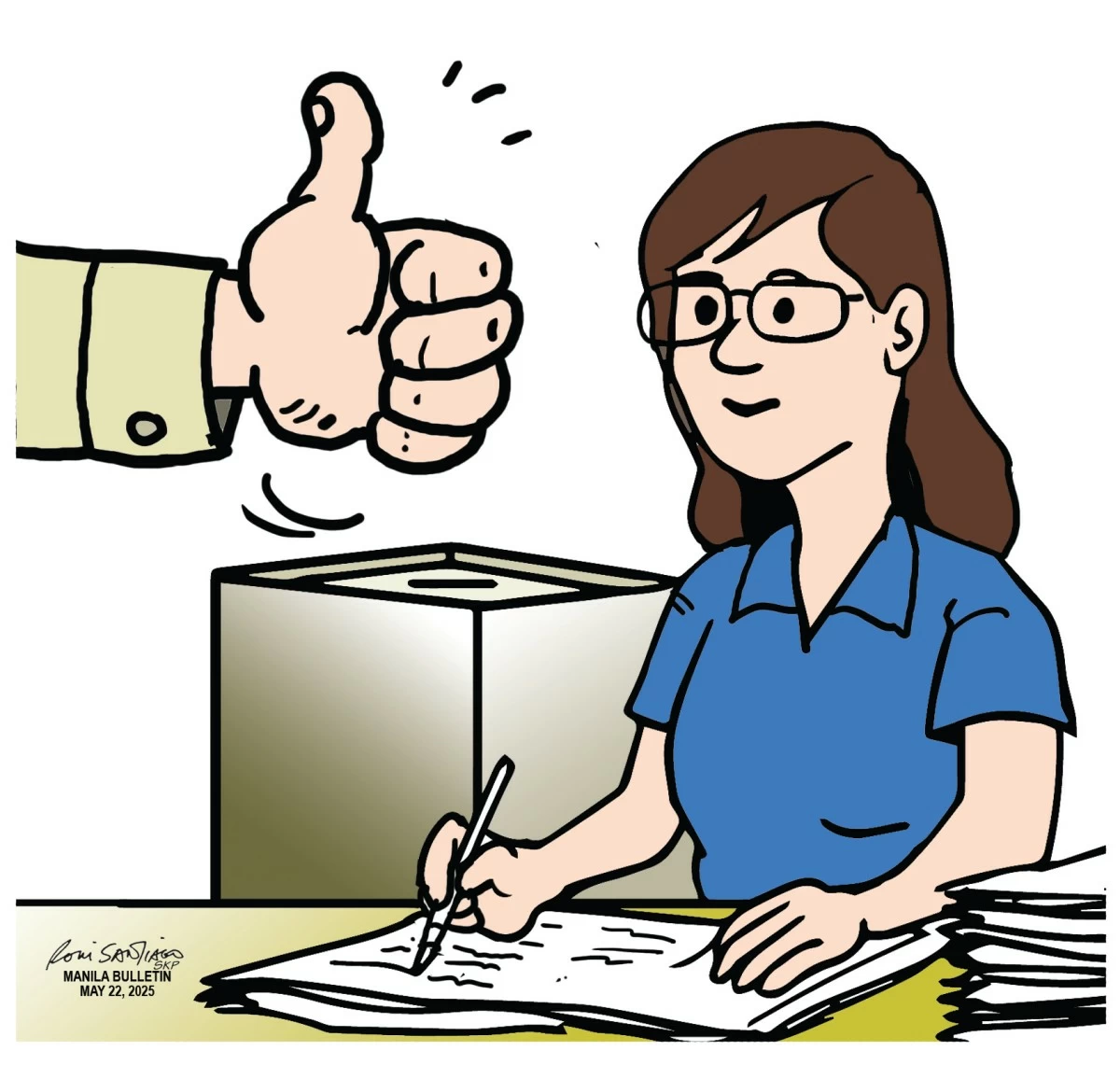
Guardians of democracy: A salute to our teachers

As the nation reflects on the results of the recent midterm elections which offer hope for real change, we pause to honor the public school teachers who served as members of Electoral Board. They are the unsung heroes who played a pivotal role in upholding our democratic process.
Department of Education (DepEd) Secretary Sonny Angara praised them as “not just public servants” but “frontliners of democracy.” “Mula simula hanggang matapos, and’yan kayo—hindi bumitaw (From start to finish, you were there—you never let go),” he said in a statement issued the day after the elections.
Over 660,000 public school teachers and DepEd personnel were among the 758, 549 poll workers who were mobilized to ensure the smooth conduct of the elections on May 12, 2025. Their responsibilities extended beyond mere facilitation; they were the custodians of electoral integrity, managing polling precincts, assisting voters, and safeguarding the sanctity of the ballot.
ADVERTISEMENT
“Saludo po kami. Dahil sa inyo, naging maayos at safe ang proseso. Kayo ang tunay na ka-team sa Bagong Pilipinas—laging handa, laging para sa bayan (We salute you. Because of you, the process was orderly and safe. You are the true teammates of Bagong Pilipinas—always ready, always for the nation),” Angara said.
The commitment of these educators was evident in the extensive hours they dedicated. With early voting commencing at 5 a.m. for senior citizens, persons with disabilities, and pregnant women, many teachers reported to their precincts as early as 2 a.m. Even when regular voting concluded at 7 p.m., they remained on duty until the early hours of the following day. That’s over 24 hours of continuous work, mostly under hot conditions, without adequate rest, to ensure every vote was counted accurately.
Beyond the physical toll, teachers faced various challenges, including technical issues with voting machines, logistical delays, and, in some regions, security threats.
In recognition of their invaluable service, the Commission on Elections (Comelec) approved a ₱2,000 increase in honoraria for poll workers. An additional ₱1,000 across-the-board honoraria for teachers and poll workers was announced a week after election day. Comelec said that full election compensation, including the newly approved increases, will be received by workers within 10 days after election day.
However, concerns have been raised regarding the sufficiency of these measures. The Alliance of Concerned Teachers (ACT) and the Teachers’ Dignity Coalition (TDC) emphasized the need for overtime pay, citing the extended hours teachers worked beyond their regular duties. They also advocated for the tax exemption of honoraria, citing that deductions significantly reduce the net compensation teachers receive for their election service.
As we commend their efforts, it is crucial for relevant agencies to address the concerns raised by these educators. Ensuring timely and fair compensation, providing adequate support, and recognizing the challenges they faced are essential steps in valuing their contributions.
The dedication exhibited by our teachers during the elections underscores their unwavering commitment to public service. Their role transcends the classroom, as they become pillars of our democratic system during electoral exercises.
Our public school teachers exemplify the spirit of service and dedication. Their involvement in the electoral process is a testament to their commitment to the nation. As we move forward, let us ensure that their sacrifices are met with the respect, support, and recognition they rightfully deserve.
Why is German so different than English?
Has German been influenced by some distinct languages such as Hunnic, Hungarian, Turkish or any other Ural-Altaic language?
No / Nein. And for grammatical idiomatic English, you want different from, here, not *than.
Old English ( also called Anglo-Saxon) was a lot more like German is, and still more like Old High German was. But OE was so much like Old Saxon that in mid to mid-later 1st Millenium, they were probably to some extent mutually intelligible. Even today Low German and ordinary common English are surprisingly rather alike.
But English changed more from OE to New English than German did. The final vowels that carried case suffixes were lost (also in German) but English also collapsed the indefinite and definite articles and lost adjectival final syllables. So the English noun has lost the case and gender marking systems. English’s common everyday vocabulary is heavily Germanic but it has also borrowed heavily from Norman French, later French and also Latin.
THOU ART THE ONE
The faults we see in others often reveal our own imperfections. We frequently criticize our own shortcomings when we see them in others.
Very often, we hear from friends and others things they seem to hate. They even criticize others about their looks or activities during weekends, vacations or off days.
In social networks, we are able to read comments and posts in a very bad manner about other people's houses and gardens.
Most of the time, gossiping ruins one's life. Gossips come about because of envy.
I know it's not that easy. But why not try to love the unlovables instead of giving them so many negative comments. And one step further: why not examine ourselves first before criticizing others?
Upon examination of my own life, I am annoyed when others are late for an appointment and keep me waiting. I feel angry when parents speak harshly and treat their children cruelly. I feel upset when individuals in a meeting monopolize the conservation. I could give you more and more examples, my dear readers.
But, at such times when I look inward, I hear the words, "Thou are the one"! I realize that imperfections I see in others are often my own.
When the Lord looks at us, He sees not only what we are but what He enables us to become. Very important - we can learn not to expect too much for ourselves that we become discouraged. The grace of God does not change us unless we respond. It can change our outlook and with our outlook, our attitudes. With changed attitudes, we can become whatever we would never be.
Kindness, helpfulness, hospitality, obligingness, ready to do favors - and our moment of virtue will not be destroyed by time's storm. Love and mercifulness from the bottom of our heart shared with people who will cross our path - and nobody will forget us,
Worrying has Never Helped Anyone — Stop Wasting Your Time
Life is better than ever, so why does everybody seem to be unhappy? As a regular reader of this column, you surely remember this topic which I already raised several times.
I often find that keeping myself busy and working out helps me relieve stress, worry & frustrations, allowing me to:
Think about the true significance of issues in the long run with a clear mind.
Rationally think about next steps/action plans to reduce stress (which in turn reduces worry).
Give myself realistic timelines to complete tasks. Hold myself accountable for execution
Whenever I hear people saying that things turned so bad nowadays, I think of my late LOLA, born in 1899 (!) into a really awful world in Germany and its surroundings. Also the so-called "Golden Twenties" between two World Wars have been everything but golden for her and my former relatives. Lola never complained, even during the sorrowful times in the former East German, the "German Democratic Republic". Lola reached the ripe old age of almost 86.
We hardly count our blessings. We enjoy counting our crosses. Instead of gains, we count our losses. We don't have to do all that counting - computers do it for us. Information is easily had.
Facebook to and fro, back and forth, there and back - how many posts and comments have been posted already with sadness, loneliness, boredom strikes, problems, worries ... .
Just remember this: Opportunity doesn't just knock - it jiggles the door-knob. and "your social media online-friend" - the warrior is with you day and night, at every corner, following your every step. Complaining and grumbling are good excuses, right?
Is social media bad for us? Three billion people, around 40% of the world’s population, use online social media – and we’re spending an average of two hours every day sharing, liking, tweeting and updating on these platforms, according to some reports. That breaks down to around half a million tweets and Snapchat photos shared every minute. Stress, mood, anxiety, depression, sleep (or better non-sleep), self-esteem - Overall, social media’s effects on well-being are ambiguous, according to a paper written last year by researchers from the Netherlands. However, they suggested there is clearer evidence for the impact on one group of people: social media has a more negative effect on the well-being of those who are more socially isolated.
Imagine, we have time and opportunities to do almost anything. So why haven't we done it? We have the freedom of bondage or restraint, every one of us in his or her very special unique way - but, we're still our old inferior selves.
The job is boring. I don't get a good job. The house is an unpleasant mixture of tidy and dirty things. It's a mess. I'm not in the mood to arrange my garden. I can't afford a gardener. That's life. How sad. No, it's not my fault; or course not.
The whole world is an awful place filled with dreadful and horrible negativism. Yes, I confess, I'm also surrounded by many worriers who put their fears into me. Politicians, i.e., many times love to search for some grave alarm that will cause individuals to abandon their separate concerns and act in concert, so that politicians can wield the baton. Calls to fatal struggles and fights are forever being sounded.
The overbearing person, who tyrannizes the weak, who wants to domineer and to bluster, is simply nothing else than a worrier, who claims to be a friend. But he isn't. Really not! The bullying of fellow citizens by means of dread and fright has been going on since Paleolithic times. The night wolf is eating the moon. Give me silver and I'll make him spit out.
Well, when will we start counting our courage and not our fears, or enjoy instead of our woe? Worrying itself is pointless.Of course, no society has achieved perfect rules of law, never-ending education or unique responsible governments. Let's seek out the worries but avoid the warriors, because they try to avoid liberty.
If you are still worrying right now about something, try to read Jeremiah 29:10-14 or Revelation 21:1-8, just to mention these two. It works.
Constant worrying, negative thinking, and always expecting the worst can take a toll on your emotional and physical health. It can sap your emotional strength, leave you feeling restless and jumpy, cause insomnia, headaches, stomach problems, and muscle tension, and make it difficult to concentrate at work or school.

.jpg)