You plan to move to the Philippines? Wollen Sie auf den Philippinen leben?

There are REALLY TONS of websites telling us how, why, maybe why not and when you'll be able to move to the Philippines. I only love to tell and explain some things "between the lines". Enjoy reading, be informed, have fun and be entertained too!

Ja, es gibt tonnenweise Webseiten, die Ihnen sagen wie, warum, vielleicht warum nicht und wann Sie am besten auf die Philippinen auswandern könnten. Ich möchte Ihnen in Zukunft "zwischen den Zeilen" einige zusätzlichen Dinge berichten und erzählen. Viel Spass beim Lesen und Gute Unterhaltung!


Visitors of germanexpatinthephilippines/Besucher dieser Webseite.Ich liebe meine Flaggensammlung!

free counters

Total Pageviews

Friday, January 23, 2026

Be kind With your Mind


 · 

  1. They don't compare themselves to others. (There is nothing useful in comparison, everyone is on a different journey.)
  2. They don't dwell on mistakes. (It is pointless to dwell, they look for solutions.)
  3. They adjust to and welcome change. (Change is inevitable. You have to learn to accept it, adjust to new situations, and learn to work with changes.)
  4. They take care of themselves and learn to say No. (They know boundaries are important to their wellbeing.)
  5. They are positive and confident in their endeavors. (They go into every situation with a good attitude.)
  6. They know they will experience failures. (Some failures are part of the course. They just handle them accordingly.)
  7. They practice gratitude. It keeps life in perspective and keeps the good energy flowing.)
  8. They Don't stay stuck on things they can't control focus on solutions and move forward.
  9. They know the world does not Owe them anything they have to make their own way.

Thanks for Reading

„Mensch ärgere dich nicht“ war vorgestern


Kinder beim Spielen. Zu sehen sind zwei Kinderhände, auf dem Tische ein Brettspiel. Eine Hand wirft einen Würfel, eine andere Hand zieht eine Spielfigur.
Kinder beim Spielen. © epd-bild/Detlef Heese

Wenn die Nächte lang sind, ist die Hauptsaison der Brettspiele. Der Markt boomt und bietet Spiele für jeden Geschmack. Trotz seiner Vielfalt kämpft das Hobby mit einem angestaubten Image.

Bunte Holzklötzchen, Spielkarten und ein taktischer Plan bestimmen den Spieltisch. Eine Gruppe von Mittvierzigern lässt an diesem Januarabend im beschaulichen Bettmar bei Peine Geschichten um den Wüstenplaneten Arrakis lebendig werden - mithilfe des Brettspiels „Dune Uprising“. Matthias Kaul, Thorsten Johl und ihre Mitspieler schlüpfen in Rollen von Charakteren wie Paul Atreides oder Duncan Idaho und kämpfen um Wasser, die Währung Solari, Spice und auch Siegpunkte.   

„Natürlich gibt es auch solche Spiele, in denen eher Glück entscheidet“, sagt Thorsten Johl. „Wir mögen es aber lieber taktisch, da ist solch ein Spiel mit möglichst wenigen Glückselementen das Richtige für uns.“ Thematisch passe es für die Spielgruppe perfekt. „Science-Fiction von Star Wars bis Star Trek und weit darüber hinaus geht eigentlich immer“, sagt Johl mit einem Lachen.

„Es gibt nichts, was es nicht gibt“

Familienvater Matthias Kaul ergänzt, moderne Spiele hätten inzwischen einen ganz eigenen Reiz. „Wir kommen einen sehr langen Weg.“ Heutige Spiele seien nicht mehr mit denen aus seiner Kindheit zu vergleichen. „Wenn ich meinem Sohn mit ‚Mensch ärgere dich nicht‘ oder so ankomme, dann rollt der höchstens die Augen und sagt: ‚Papa, das ist doch kein Spiel, das ist von vorgestern‘.“ Beim Angebot der Brettspiele gelte heutzutage: „Es gibt nichts, was es nicht gibt.“   

Dass modernen Brettspielen noch immer das eher antiquierte Image ihrer Urväter anhaftet, sagt auch der Berliner Spielforscher Jens Junge. Dabei gebe es in aktuellen Titeln sehr viel mehr Spielwert, betont der Experte. „Die Spielenden messen sich entweder anhand von Punkten oder betreiben kooperative Brettspiele.“ Auch würden Rollen, Normen oder Verhaltensweisen spielerisch erschlossen. „Es ist uns möglich, am Spieltisch neue Strategien auszuprobieren, die später in realen Situationen helfen können.“

Boomender Markt

Eine Gruppe von Mittvierzigern ist dem Experten zufolge am Spieltisch auch keine Ausnahme. „Durchschnittlich sind Brettspielende in Deutschland 37 Jahre alt - also eher nicht mehr im Kindesalter.“ Der Markt boome. „Allein im Jahr 2025 haben rund 220.000 Menschen die weltweit größte Fachmesse, die ‚Spiel‘ in Essen besucht“, sagt Junge. Brettspielenthusiasten schätzten die sozialen Aspekte ihres Hobbys: „Die gehen bewusst zu Freunden, in den Spieleladen oder treffen sich in Brettspielcafés, weil sie da echte Menschen erleben wollen.“   

Welche wirtschaftliche Wucht hinter dem Spieltrieb steckt, zeigt ein Blick in die Statistik. Allein die deutsche Spielwarenindustrie erzielt nach eigenen Angaben aktuell einen Umsatz von 4,4 Milliarden Euro jährlich und beschäftigt etwa 11.000 Menschen. Organisiert ist sie unter anderem im „Deutschen Verband der Spielwarenindustrie“ (DVSI), dem mehr als 200 Hersteller, Händler und Verlage angehören.

Protecting the environment means protecting our lives


By Fr. Shay Cullen, Founder since 1974

The massive landslide at a landfill facility in Binaliw village, Cebu City, on Jan. 8, 2026, left at least 22 people dead and 18 others injured as of Jan. 15. More are still missing. It could have been prevented if there was greater respect for human life, the environment, and the implementation of the rule of law in the Philippines.


There are excellent laws to save and protect nature, and preserve forests and seas. Our once-beautiful environment is being destroyed by corruption, irresponsibility and neglect that are allowing the laws to be flouted and ignored. The enormous level of corruption and maleficence exposed during the investigation into fake flood control projects is one example. The accumulation of trash and human waste being dumped in legal and illegal sites is polluting, even destroying, the environment and our communities. Republic Act 9003, or the Ecological Solid Waste Management Act of 2000, is seldom implemented and obeyed. People suffer and die as a consequence.


A workers’ rights group said the death of so many workers in the Binaliw landfill was a crime against them. Bishop Gerardo Alminaza of San Carlos, chairman of Church People-Workers Solidarity (CWS), said the landslide was not an accident, but was, “in truth, a crime born of greed, neglect, and the systematic violation of workers’ rights.”


The mountain of garbage, said to be about 35 meters or 20 stories high, collapsed on the 50 or so people working there, burying them. Some were pulled out alive; others died horribly underneath. Many were working inside adjacent buildings when the tragedy struck. It demolished the buildings and trapped the workers inside. The waste management company operating the landfill is Prime Integrated Waste Solutions Inc. (PWS). Its website says the site receives about 1,000 tons of solid waste daily from Cebu City and surrounding areas.


The Cebu City Council declared Jan. 16 as a day of mourning for the victims. Following the incident, a cease-and-desist order was issued against the landfill operator, and a state of calamity was declared in Cebu City to manage the waste crisis. The CWS has called for justice for the affected workers, saying they were “compelled to work under dangerous and inhumane conditions — conditions that should never have been allowed and that ultimately cost them their lives.”


Alminaza stood with the CWS, demanding accountability from both the company and government that failed to monitor the site and assess the dangerous condition after heavy rains and an earthquake in September made the garbage dump dangerous and unstable.


“As [a] Church, we affirm that work is sacred because the worker is sacred,” the CWS said, adding that when greed and profit caused safety to be ignored, then “human dignity is gravely violated and work is reduced to exploitation.” The bishop and the group’s leaders demanded that there be an “immediate, thorough, and transparent investigation.”


The late pope Francis frequently denounced the modern “throwaway culture” that treats both objects and people as disposable. He had warned that the earth was beginning to look like “an immense pile of filth” due to the vast amounts of waste generated annually. He also criticized the wasting of food and water, saying throwing out food is like stealing from the poor. Francis advocated for a circular production model that prioritizes reusing and recycling to conserve resources for future generations.


Cebu City councilor Joel Garganera told the media that “a landfill or a mountain that is made of garbage... is like a sponge: it really absorbs water. It doesn’t (take one to be) a rocket scientist to say that, eventually, [such an] incident will happen.”


The Philippines is facing serious challenges in waste management that the government has to address urgently, or else more tragic events will happen on the many dumpsites around the country, endangering thousands of people. Many of these sites are, in fact, illegal and growing faster than the legal ones approved by local government units (LGUs). As of 2025, illegal dumpsites around the country increased by 84 percent year on year. Meanwhile, legal landfill sites grew by 14.7 percent, bringing the total to 343. LGUs cannot cope with the growing volume of garbage being generated, some of which are hazardous.


The region with the most serious concentration of hazardous industrial wastes as of 2024 is in Region 4A, or Calabarzon (Cavite, Laguna, Batangas, Rizal and Quezon). It accounted for about 43 percent of the country’s total. Some of the illegal dumpsites on private property are to be found in Arenda, on the north shore of Laguna de Bay, and also in Nosara Spring. In Manila Bay, Baseco Beach is constantly polluted with plastic despite the ongoing heroic efforts of the “Baseco Beach Warriors,” who hold regular cleanup operations and pick up hundreds of bags of trash every week. This condition will only get worse everywhere unless there is a strict implementation of the rule of law and a complete change in the minds and hearts of people to love their environment and clean, recycle, and segregate trash for organized municipal pickup.


A World Bank study predicted that by 2025, the nation’s waste generation would be at 77,776 tons a day, or close to 28.39 million tons a year, considering the country’s population growth, particularly in urban areas. The most recent National Waste Analysis and Characterization Study found that 56.7 percent of municipal solid waste was generated from residential sources. A further 27.1 percent was from commercial establishments. The industrial and manufacturing sectors contribute the remaining 12.1 percent and 4.1 percent, respectively.


Pope Francis linked environmental abuse to social injustice, urging humanity to hear “both the cry of the earth and the cry of the poor.” When alive, he described the pollution of oceans, particularly from plastic waste, as “criminal.” He argued that wealthier nations have an “ecological debt” to poorer ones due to their disproportionate use of resources and export of toxic waste. He also attributed the “great majority” of global warming to human activity driven by a “predatory attitude” and the pursuit of short-term gain.

Thursday, January 22, 2026

I love Gardening


This powerful image reminds us of a simple but profound truth: nature doesn’t need people, but people certainly need nature. The natural world thrives without our intervention, yet our survival depends on the health of the ecosystems around us.
We must understand that we are not separate from nature but deeply connected to it. Our gardens, forests, rivers, and oceans provide us with the resources we need to live—from food and clean water to oxygen and beauty. By protecting nature, we are also protecting ourselves.
Let’s take this lesson to heart and remember that every effort to preserve the natural world benefits both nature and humanity.


May be an image of text that says 'NATURE DOESN'T NEED PEOPLE. H PEOPLE NEED NATURE. ht Gardening'


All reactions:
976

The lost art of waiting patiently: Not everything is under our control


By Pinky Concha-Colmenares
Published Jan 22, 2026 12:04 am | Updated Jan 21, 2026 06:12 pm


Patience is not one of my virtues but I lived with it because — as my mother used to say — it is a normal part of life. I discovered that including the time for waiting — and bringing something to do — tamed impatience.
Yes, waiting used to be a normal part of life. It was inconvenient, sometimes frustrating, but usually accepted. Today, waiting is viewed as inefficiency or even injustice.
We wait five seconds for a webpage to load and we complain the internet is slow! We refresh messages repeatedly, wondering why someone hasn’t replied when we know that replies can be instant. Somewhere along the way, whatever patience one had quietly slipped out of our daily vocabulary.
Life before Wi-Fi moved at a different pace. If you had a question, you didn’t “Google” it. You asked someone who might know, checked a book, or waited until you could get to a library. If you needed an official document, you physically went to a government office, filled out forms by hand, and waited your turn. Sometimes you were told to come back another day. And you did. There was no social media to complain about poor service.
There were no tracking numbers to check every hour, no “typing…” bubbles, no delivery riders racing against app timers. Information took time to arrive, and so did answers. Waiting was built into the process.
Oddly, age has taught me that slowness had benefits. When you waited, you prepared yourself for the wait. You brought a book, a newspaper, or simply learned how to sit still. You talked to strangers in lines. You observed people. You learned how to manage boredom, which is now almost extinct. Today, in any waiting line, people’s eyes are on their gadgets, they do not even notice who is beside them.
Today, technology has shortened waiting times but also shortened our tolerance. The problem isn’t convenience—it’s expectation. We now expect everything to be fast, seamless, and immediate. When it isn’t, we feel wronged — and feel we have the right to complain loudly — and insult a person, company or government agency in social media.
Consider government transactions. While many services are now online—and rightly so—there is something instructive about the old system. You planned your day around it. You knew delays were part of the process. You didn’t assume efficiency; you adjusted to reality. The waiting, as tedious as it was, taught patience and perspective.
The same goes for communication. Before messaging apps, you waited for phone calls, letters, or in-person conversations. Silence wasn’t automatically interpreted as disinterest or disrespect. People had lives offline, and everyone understood that. Now, delayed replies — especially at times when ordinary people commute, lunch break or are with family — can trigger anxiety, irritation, or unnecessary assumptions.
We — and most of the world — consider waiting as something to avoid at all costs. We multitask through it, distract ourselves from it, or complain loudly about it. Rarely do we sit with it.
But time has taught me that waiting, uncomfortable as it may be, teaches valuable lessons. It reminds us that not everything is under our control. It forces us to slow down, even briefly. It creates space—for thought, reflection, and sometimes understanding.
There’s also a certain humility in waiting your turn. In lines, in traffic, in systems that don’t bend to personal schedules, waiting reminds us that we are part of a larger whole. That lesson feels increasingly rare in a world designed around personalization and speed.
Faster services, digital access, and instant communication have undeniably improved daily life. But something has been lost along the way: our ability to be still without frustration, to accept delays without outrage, to understand that not everything happens on demand.
Perhaps patience, like any skill, needs practice. We can start small—by resisting the urge to refresh a page repeatedly, by allowing a message to sit unanswered without taking it personally, by treating waiting time not as wasted time but as neutral time.
Waiting patiently does not mean settling for inefficiency or excusing poor service. It simply means recognizing that life does not always move at the speed of our devices. And maybe it shouldn’t. (Email: pinky.colmenares@mb.com.ph)

Bomb threat rocks Davao City high school


Published Jan 21, 2026 06:07 pm
CABALLERO
CABALLERO
DAVAO CITY – The Davao City Police Office reiterated on Wednesday, Jan. 21, its warning against making bomb threats, stressing that such acts carry penalties and possible imprisonment.
DCPO spokesperson Police Capt. Hazel Caballero warned the public of the penalties following a bomb threat at the Cabantian National High School in Buhangin District here on Wednesday morning.
“Spreading bomb threats has penalties. Somebody has already been jailed for that,” Caballero said during the Davao Peace and Security Press Corps briefing at The Royal Mandaya Hotel.
Caballero said police continue to remind the public, especially students and parents, that bomb threats are taken seriously and should not be used to disrupt classes or exams.
She added that such threats cause panic among the public and place unnecessary strain on police resources, as authorities must respond immediately to ensure public safety.
“These acts cause panic and inconvenience, and we do not take alerts for granted,” Caballero said. “Police already filed charges against those who made bomb threats earlier.”
For incidents involving minors, the DCPO spokesperson said they are coordinating with schools and social workers, as current options for penalizing minors are limited.
“We can only refer them to their school advisers and social workers, who can counsel them as of now. We are doing our best to ensure this does not happen again,” Caballero said.
Personnel of the Buhangin Police Station immediately responded to an alleged bomb threat reported at around 6:29 a.m.
According to the police, a Cabantian National High School teacher reported that a Grade 7 student received a threatening message via Facebook Messenger the night before.
Initial investigation identified the 12-year-old student who received the message at around 9 p.m. on Jan. 20 from an unknown sender using a profile name “Dumpni Jo.”
The message contained a threatening statement claiming there was a bomb inside the school and warning the recipient to follow instructions as “the clock is ticking.”
After arriving at school, the student reported the message to his classmates and to the Grade 7 level head, prompting school officials to alert the police.
Police personnel, in coordination with school authorities, immediately evacuated students to the Barangay Cabantian Gymnasium as a safety precaution.
The DCPO Explosive Ordnance Disposal-K9 Unit conducted a thorough inspection and paneling of the school premises. Verification yielded negative results.
Caballero said follow-up investigation is ongoing and the cellular phone involved will be turned over to the Regional Anti-Cybercrime Unit 11 for digital forensic examination.
Authorities said they will do their best to identify the sender of the message and file appropriate charges against anyone found responsible for the bomb threat.

The Garden


Alex Eala thrills fans as Manila rolls out red carpet for tennis star


By Manila Bulletin Sports

Published Jan 21, 2026 06:12 pm


Filipina tennis sensation Alex Eala excites her fans after she boarded a plane bound for Manila, which hints at her possible participation in the inaugural Philippine Women's Open at the Rizal Memorial Tennis Center from Jan. 24 to 31.


By CHRISTAN SALVAÑA


Filipina tennis sensation Alex Eala excites her fans after she boarded a plane bound for Manila, which hints at her possible participation in the inaugural Philippine Women's Open at the Rizal Memorial Tennis Center from Jan. 24 to 31.

In an Instagram story on Wednesday, Jan. 21, the 20-year-old Eala shared a photo of herself on a plane with the text "Next-> MNL" after her run in the Australian Open.

The WTA No. 49 will have ample time to recover in a busy month highlighted by her main draw debut in the first Grand Slam tournament of the season.

She lost to American Alycia Parks, 6-0, 3-6, 2-6 in the first round of the singles event, and dropped a 6(3)-7, 6-2, 3-6 result with her brazilian partner Brazilian Ingrid Martins against Japan's Shuko Aoyama and Poland's Magda Linette in doubles.

Eala is trying to win her second WTA title after ruling the 2025 Guadalajara Open.

The Philippine Sports Commission has been doing an extensive job of rehabilitating the tennis courts and the surrounding areas at the Rizal Memorial Complex.

Throng of fans are expected to watch the games should Eala participate in the tournament.

Early Wednesday, tickets in the semifinal and final were already sold out.

Elena Kozlova ready to star in a full-length Filipino film


By Robert Requintina

Published Jan 21, 2026 10:54 am | Updated Jan 21, 2026 07:40 pm

Russian actress Elena Kozlova, known for her English-speaking roles in two previous films, has expressed her excitement to star in a full-length Filipino movie.
Elena Kozlova
Elena Kozlova
When asked if she is prepared to speak Tagalog in a Philippine film, Elena replied, "Ngayon na, pwede na mag-Tagalog. Syempre, I would like that. (I can speak Tagalog now.)," showing her enthusiasm to embrace the local language on screen.
Elena revealed that she watches numerous Filipino movies to improve her Tagalog skills. "I'm a big fan of Anne Curtis because I love her screen presence," she shared.
She shared that her experience in the Philippines has been wonderful, especially working with local directors and producers.
"It's fantastic. I'm having a great experience here. I'm very thankful to the Filipino directors and producers for trusting me," Elena said about her stay in the Philippines.
Elena added, "I plan to make more movies in the Philippines, but I have been selective about the roles I take. In my experience, many roles for foreigners tend to be stereotypical, often as the 'other woman' or in sexy parts. But the Philippine industry is open and evolving.
"Many films are now being produced for international competitions. I believe we'll see more unique stories in Philippine cinema moving forward, and I hope to be part of that growth," she said.
In 2022, Elena made her Netflix debut in "To Russia With Love" alongside Gerald Anderson. She acknowledged being particular about the roles she accepts. Elena also discussed her part in the romantic film "Spring in Prague," which was partly filmed in the Czech Republic.
"In 'Spring in Prague,' I play a supporting role as the best friend of the lead character. I hope I did justice to my part.
"I'm also selective about the projects I join, because in today's saturated industry, I want to be proud of the work I present. 'Spring in Prague' is a great example—I hope viewers enjoy it as much as I do!" she said.
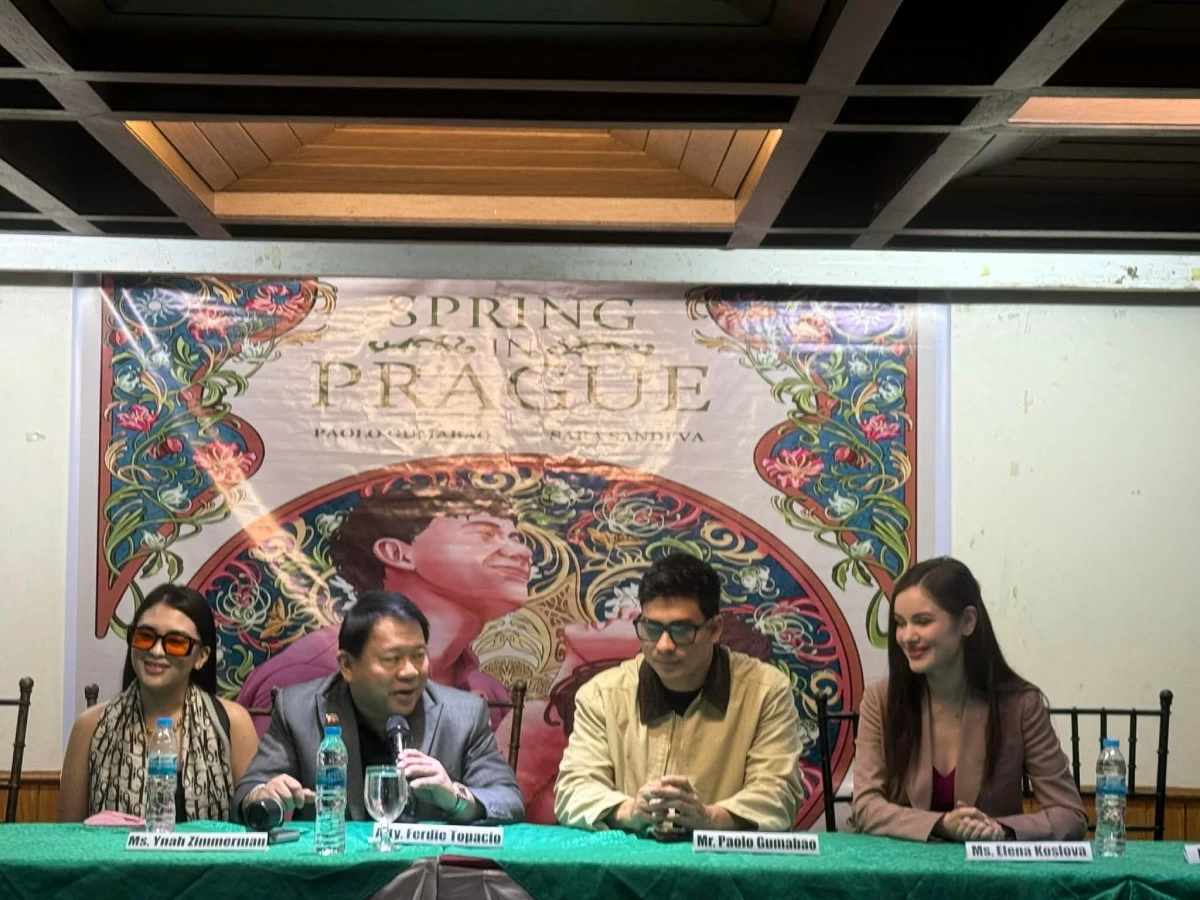
At the media conference of 'Spring in Prague' with actor Paolo Gumabao, producers Atty. Ferdinand Topacio and Ynah Zimmerman, and Elena Kozlova
Elena is a multi-talented personality—model, actress, singer, and interpreter. Despite her busy schedule, she emphasizes that family comes first. She is married to businessman Raymond Yap.
Among the new generation of stars, Elena admires Hollywood actress Ana de Armas, "because she can portray complex characters."
She added, "I have immense respect for talented actors. Internationally, I admire Eddie Redmayne, especially after 'Day of the Jackal.' Among Filipino artists, Nadine Lustre impressed me in 'Deleter.'"
As for her upcoming work, Elena revealed, "I have a few unreleased projects, including a historical drama about Filipinos in the US, which has yet to premiere."
Given the chance, Elena would love to portray a villain or a spy in future projects.
"My dream role would be to play a spy or villain. It would be exciting to explore a different persona, and I believe my skills—speaking multiple languages, handling firearms, and even horseback riding—would suit such characters," she explained.
Elena Kozlova and businessman Raymond Yap
Asked about her dream collaborations among local stars, Elena shared, "Everyone I've met in the industry has been very kind and welcoming. I met Ritz Azul at a Borracho Films premiere, and we had a great conversation—I think it would be a lot of fun to work together! I'd also love to work with my close friends Jef Gaitan and Veronica Reyes again."
'Spring in Prague' explores a cross-cultural romance between a Filipino and a Czech. It is directed by Lester Dimaranan and Paolo Emmanuel Magsino. Starring Paolo Gumabao and Sara Sandeva, the film premieres in cinemas nationwide on Feb. 4.