By Amenah F. Pangandaman

This might not be the typical expat blog, written by a German expat, living in the Philippines since 1999. It's different. In English and in German. Check it out! Enjoy reading! Dies mag' nun wirklich nicht der typische Auswandererblog eines Deutschen auf den Philippinen sein. Er soll etwas anders sein. In Englisch und in Deutsch! Viel Spass beim Lesen!

Named among the Top 10 influencers in Paris Fashion Week


By MBrand
Published Feb 23, 2026 10:45 am
The Lubao International Balloon and Music Festival makes its highly anticipated return this summer, reaffirming its stance as one of the biggest and most iconic hot air balloon festivals in the Philippines!
Since its debut in 2014, the Lubao International Balloon and Music Festival has captivated its thousands of audiences with its unique blend of aviation spectacle, live music, and immersive on-ground experiences.
After a 5-year hiatus due to the pandemic, the festival returned successfully to the skies over Lubao last April 2025. More than 70,000 people flocked to Pampanga to celebrate its much-awaited comeback. From hot air balloon flights to electrifying performances from your favorite local artists, this festival served it all!
This 2026, we’re keeping the streak and bringing you two days of breathtaking hot air balloon flights, thrilling attractions, and an exciting lineup of artist performances you can’t resist! Happening on March 7-8, 2026, at Pradera Verde in Lubao, Pampanga, the Lubao International Balloon and Music Festival is set to be a landmark celebration and a must-attend destination event.
Kicking off the festivities at sunrise, festival-goers can expect a mass ascension of over 25 colorful hot air balloons flown by both local and international pilots. Experience the skies of Lubao with spectacular balloon flights you can hop on right there and then.
Throughout the day, attendees can also enjoy a wide range of activities. Take in the magnificence of Pampanga’s landscape with helicopter and ultralight rides, bask in gastronomic food bazaars, and immerse in nature with the crowd favorite outdoor zoo attraction.
Pradera Islands, the newest theme park destination in Pampanga, located within the sparkling grounds of Pradera Verde also welcomes thrill-seekers and families alike for adrenaline-pumping rides, immersive attractions, and island-inspired adventures.
At sunset, the festival transforms into a dynamic concert experience, featuring acts from the biggest names in the Philippine music scene, delivering high-energy performances to cap off each day in unforgettable fashion.
This year’s lineup fulfills every OPM fan’s fantasy with musical acts from jikamarie, Illest Morena, Hev Abi, Flow G, Arthur Nery, December Avenue, Dionela, Maki, IV of Spades, Kamikazee, and Parokya ni Edgar!
And for the first time ever, former Rivermaya bandmates Rico Blanco and Bamboo will share the same stage at this year’s Lubao International Balloon and Music Festival! Bamboo is set to perform on the first day (March 7) while Rico’s set takes place on the second day (March 8). It’s safe to say that this year’s lineup ate.
Festival tickets are priced at PHP 500 for General Admission and PHP 1,500 for VIP. To get the most out of Lubao, you can purchase two-day passes for PHP 800 for General Admission and PHP 2,500 for VIP. Get your tickets at all SM Ticket outlets nationwide and/or online atwww.smtickets.com.
The Lubao International Balloon and Music Festival 2026 is organized by BLUE SKIES Hot Air Balloon AdVentures Association Inc. and Forthinker, Inc., in partnership with Pradera Verde and Pradera Islands Theme Park, with the support of the Provincial Government of Pampanga.
I am in college now, yet part of me still lives in the quiet glow of birthday candles.
Every year, I closed my eyes and wished for the same thing: that my family would become whole again. I repeated that wish for more than a decade, as if repetition could bend reality. It took me years to understand that children do not wish because they are naive—they wish because hope is the only power they have.
I grew up learning that love could be withheld. When my father was away, my stepmother forced me to eat what she knew I despised.
She would grip my face and push it into my mouth while I cried. I was seven, already washing my clothes by hand, my small arms aching as if labor were proof of obedience. At night, she turned off the electric fan, leaving me sweating in the dark, my skin marked by mosquito bites. I remember lying awake, wondering what flaw in me justified the punishment.
I began to believe that suffering must be correction—that pain was evidence of my inadequacy. I was not a difficult child. I was simply dependent. And dependency, I learned, is dangerous when placed in the wrong hands. Even small gestures confused me.
Wen she held my hand while crossing the street, I mistook proximity for affection. I interpreted survival as care. When one grows up deprived of gentleness, even the bare minimum feels like grace. There were other forms of violence, quieter but just as formative.
An aunt entrusted with my care disciplined me in ways that filled me with dread. I learned that authority does not guarantee morality.
That adults, too, can fail in their duty. I did not have the vocabulary for injustice then. I only knew the instinct to shrink, to silence myself, to endure. From this, I formed a philosophy of love: that it must be earned through suffering. If I endured enough, perhaps I would be worthy. If I gave enough, perhaps I would not be abandoned.
I carried this belief into adolescence, where I became the giver—the supportive friend, the dependable “Ate,” the one who absorbed others’ pain quietly. It felt noble. It felt virtuous. It also felt necessary.
Then I fell in love.
At first, I believed I had finally been chosen. But slowly, I began to feel measured. Compared. Adjusted.
He admired other girls openly. I recalibrated myself to fit his gaze. I abandoned hobbies, friendships, and even my dream university when he presented me with an ultimatum: follow him or lose him.
I chose him, believing that sacrifice was proof of devotion. The day before classes began, he cheated on me. What unsettled me most was not anger, but recognition. The pattern was familiar.
Once again, I had equated suffering with loyalty. Once again, I believed that shrinking myself was an act of love.
Philosophers speak of moral responsibility—of the obligation to care for those who depend on us. Children are the most vulnerable among us. When adults fail them, the damage is not merely emotional; it reshapes their understanding of justice. It teaches them that pain is ordinary, that harm is survivable, that endurance is virtue. But endurance is not the same as love.
Through reflection, especially through the lens of care ethics, I began to see that what was missing from my childhood was not discipline or resilience, but relational responsibility.
To care is not simply to provide food or shelter. To care is to protect dignity. To respond with empathy. To ensure that vulnerability is met with safety, not exploitation. When that care is absent, a child internalizes the failure. She concludes that she must be the defective one.
For years, I believed I was unlovable. That I required improvement before I deserved gentleness. That happiness, if it existed, would always demand payment in pain. Now I am questioning that belief.
Is suffering truly the prerequisite for depth? Must love wound before it heals? Or have I simply normalized what was never meant to be normal?
I am beginning to suspect that my deepest mistake was not loving too much, but misunderstanding love entirely. I thought it required self-erasure. I thought it demanded silence. I thought staying, no matter the cost, was moral. But perhaps morality also includes the self. Perhaps I, too, am someone to be cared for.
To choose a future that honors my dreams is not selfishness. To leave spaces where I am diminished is not betrayal. To want love that feels safe is not weakness. It is a reclamation of dignity.
Some days, I still feel like that child whispering wishes into the dark, hoping happiness will arrive if I endure long enough. But I am slowly realizing that happiness is not the reward for suffering. It is the result of refusing to accept harm as destiny.
Maybe I was never unlovable. Maybe I was simply taught that love and pain were inseparable—and now I am learning to untangle them.
If I was not loved gently as a child, I cannot change that past. But I can question the philosophy it left behind.
If love was never supposed to hurt, then why did hurting feel like the only proof it was real?
By Fr. Roy Cimagala
Chaplain
Center for Industrial Technology and Enterprise (CITE)
Email: roycimagala@gmail.com
THIS can only mean that our communication with God should be genuine, sincere and authentic. It’s about being honest about our thoughts, feelings and struggles. It should express our true intentions and desires.
It should not be about using fancy language or trying to impress. It’s about being real and open with God, connecting with God on a personal and emotional level, and speaking from a position of humility. It should be freed from pretenses, using the so-called “right words.”
This much we can gather from that gospel episode where Christ told his disciples: “When you pray, speak not much, as the heathens. For they think that in their much speaking they may be heard. Be not you therefore like them, for your Father knows what is needful for you, before you ask him.” (Mt 6,7-8) And from there he proceeded to give the ideal prayer which is the Lord’s Prayer or the “Our Father.”
In our quest to be true souls of prayer, we should see to it that our prayer really comes from our heart that is full of faith and humility. We have to be wary of our great tendency to be dominated by worldly and temporal concerns such that we fail to properly pray. That would be a disaster since that would be like being deluded that we are doing well in life when in fact we are failing big time.
We have to start to pick up the rudiments of prayer and begin the process of becoming authentic souls of prayer, such that wherever we are, whatever situation we may be in, somehow we are always praying, we are always in touch with God.
This should not be difficult because we know that God is always around. He is everywhere. Besides, he is always solicitous of us. He cannot fail to love us. We may fail him and earn his anger, but that anger would only be for a while, since his mercy is forever. We can always manage to pray any time and in any place if we just would have the proper disposition.
Definitely, we need to exercise our faith and be willing to exert effort and make sacrifices. That is how we can aspire to make our prayer alive always. We should put ourselves in God’s presence so we avoid anonymity in our intimate conversations with him.
What can also help is to train and use our imagination in our prayer. In fact, we have to use all our human powers and faculties—our intelligence and will, our feelings and memory, etc.—in our prayer.
And we should be ready to handle the unavoidable difficulties in our prayer. There will be times when we would feel dry and uninspired or when we would be tempted to think that our prayer is going nowhere.
Those difficulties are actually opportunities to improve our prayer and to grow in our spiritual life. If we persevere in praying, using all the means that are always available, we will see how this improvement and growth are taking place, and be filled with joy and satisfaction.
We really need to learn to pray from the heart, which also means that prayer should be second nature to us. As such, prayer becomes a constant activity. We can and should turn everything into prayer.
Even our work and mundane affairs should be an occasion or even a means of prayer also. We should end up praying as we breathe, and as our heart beats. Thus, St. Paul once said: “Pray without ceasing.” (1 Thes 5,17)
A person is said to buy in good faith when he or she holds an honest belief in his or her right or title to the property and has no knowledge or reason to know of any defect in the title.
Trust or reliance? What is faith for you? To say it clearly: without faith we are really nothing. Faith is belief; believe in us, beliefs in our works, talents and personalities.
We also should believe in our parents or better, in the whole family including the black sheep, who can be found everywhere. We should also believe in our friends, even sometimes it seems to become a very difficult task. A friend? A real friend? An expatriate friend…?
Without faith, we will be reaching the rock bottom. Please don’t say, it’s a likely story. The German poet Johann Christian Friedrich von Schiller (1759-1815) mentioned in his drama “Maria Stuart”: “Even the word might be dead, but faith keeps it alive.” Yes, I can live with this.
Faith and hope belong together. In his book “Through the Valley of the Kwai”, Scottish officer Ernest Gordon wrote of his years as a prisoner of World War II. The 6’2” man suffered from malaria, diphtheria, typhoid, beriberi and jungle ulcers. Many circumstances quickly plunged his weight to less than 100 pounds. Lying in the dirt of the death house, he waited to die. But every day, a fellow prisoner came to wash his wounds and to encourage him to eat parts of his own rations. As this fellow prisoner nursed Ernest back to health, he talked with the agnostic Scotsman of his own strong faith in God and showed him that, even in the midst of suffering – there is hope – and faith!
Faith is indeed tantamount to convincing and conviction. Richard Wagner, a German classical composer and poet found the following lyric: “Blessed are those people, who know how to live their life in humility and faith!”
Well, let’s even continue believing in our government. Faithful hope is loyal, reliable, exact and honorable.
Faith looks beyond the transient life with hope for all eternity. The hope we read in scripture is not a wishy-washy optimism. First and second Chapter of Thessalonians, for example, give encouragement to all Christians, who have been undergoing persecution for their faith. And, Corinthians 13:2 says: “If I have faith it can move mountains!”

In Filipino kitchens, monggo (mung beans) are synonymous with comfort. Simmered into hearty stews with malunggay, garlic, and sometimes tinapa or pork, monggo is a Friday staple in many households.
Meanwhile, in the Middle East, chickpeas are transformed into silky, lemony hummus—one of the region’s most beloved dishes. My husband’s first baby steps into plant-based eating was brought on by a love for hummus. Our fridge is stocked with hummus at any given moment. To lower the calories brought by olive oil, I use aquafaba or water that the beans are soaked in to add to the liquid, with the oil providing its taste instead of relying on it for texture and creaminess.
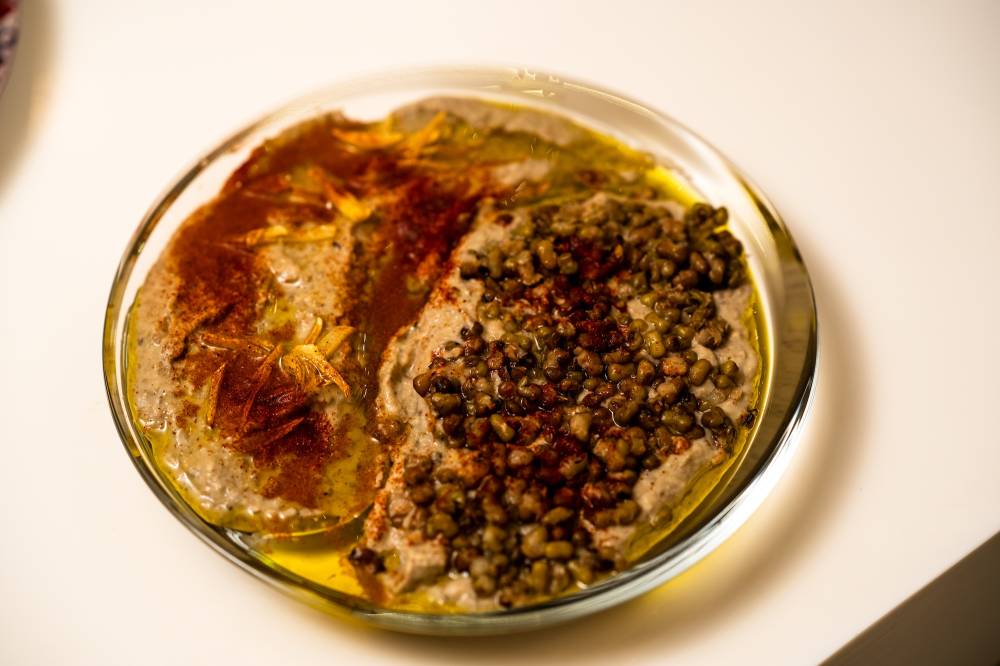
What happens when these two culinary traditions meet? You get monggo hummus—a vibrant, protein-rich spread that blends Filipino ingredients with Middle Eastern technique. The result is familiar yet new: earthy, creamy, and bright with citrus.
Monggo is the most researched Filipino legume, and for good reason. Its high protein content and year-round availability make it an affordable protein source. Most of us are used to eating monggo in the most common form: monggo guisado, topped with pork, fish, or served alongside paksiw.
Monggo was the first dish I used in creating my dishes for Mesa ni Misis—monggo Bolognese. Just like Bolognese recipes, the flavor varies from Filipino party spaghetti, which is sweet, to a more sophisticated version that uses red wine. The main point is to use the monggo, which is so versatile, in other dishes that are also familiar to us.
Monggo hummus proves that comfort food can cross borders. By blending the humble Filipino mung bean with the time-honored structure of Middle Eastern hummus, we create something nourishing, accessible, and culturally rich.
At first glance, swapping chickpeas for mung beans may seem unconventional. But from a culinary perspective, it makes perfect sense.

When cooked until tender, monggo becomes soft and creamy—ideal for blending into a smooth paste. Like chickpeas, they hold structure while still breaking down easily. There are two kinds of monggo—monggo kintab, or shiny—which stays more firm even with soaking and boiling, and monggo labo, which is softer and murkier. For this hummus dish, look for the ‘labo’ variety, as you will want it as creamy as possible.
Mung beans have a mild, slightly sweet earthiness. This pairs beautifully with tahini (sesame paste), garlic, olive oil, and lemon or calamansi.
In the Philippines, monggo is more accessible and budget-friendly than imported chickpeas. Choosing locally grown legumes reduces food miles and supports local farmers.
Mung beans are:
*High in plant-based protein
*Rich in fiber
*Packed with folate, magnesium, and antioxidants
*Naturally low in fat
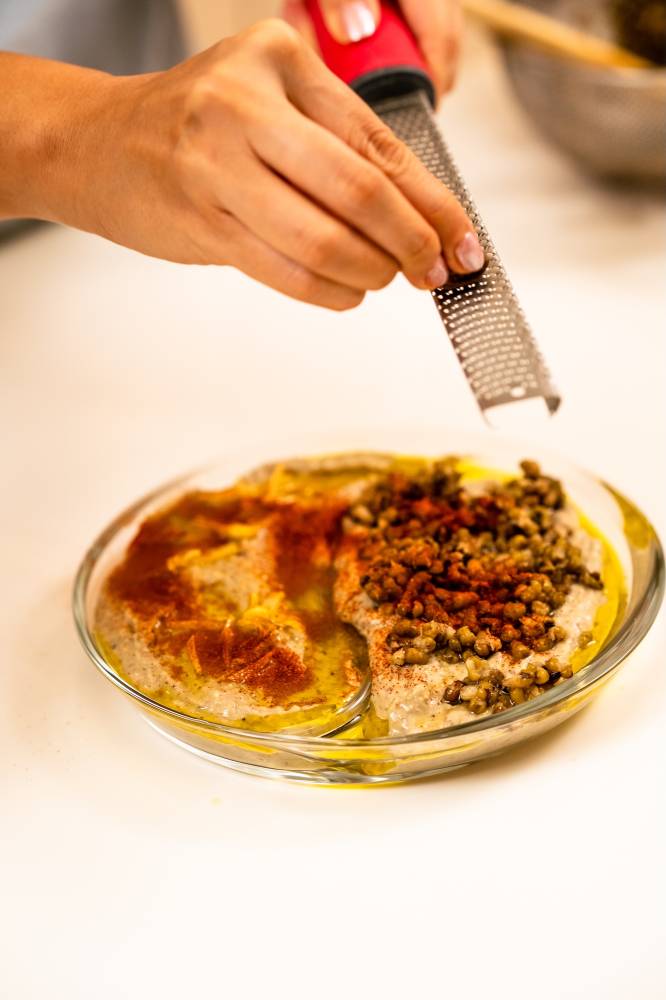
Traditional hummus from the Middle East often features a creamy chickpea base, richness that comes from tahini, lots of lemon, garlic, and olive oil. Monggo hummus on the other hand is a little gentler on the palate—sweeter and less heavy. For extra kick, I’ve added cumin but also feel free to try curry powder. I also added some serving suggestions for interesting takes on it.

Ingredients
*1 cup dried monggo (mung beans), soaked and cooked until soft
*1 to 2 cloves garlic
*Juice of 1 or 2 calamansi (or half a lemon)
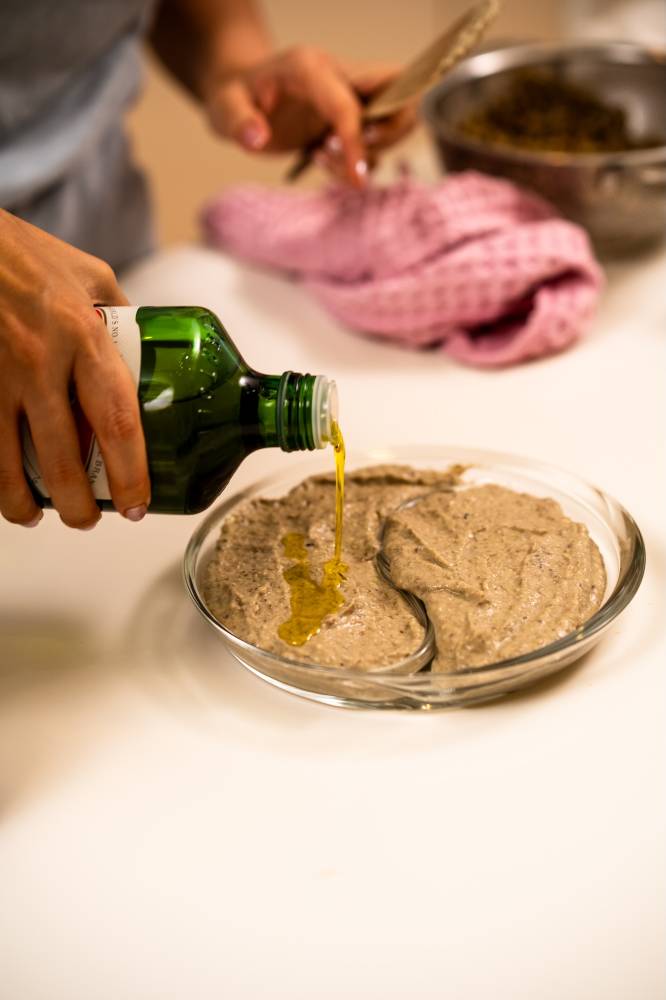
*2 to 3 tablespoons olive oil
*Salt to taste
*Cooking water from monggo (as needed for blending)
*Pinch of cumin
Instructions
Monggo hummus is versatile. Here are some serving suggestions to create your own twist for your desired occasion.
Blend in fresh malunggay leaves for added nutrients and a deeper green color. Monggo is often served with malunggay, but this time, it takes on a different form.
Incorporate flaked smoked fish for a savory, umami-forward spread—perfect with pandesal.
Add chopped red chilies or chili oil for heat.
Swap part of the olive oil with a small amount of coconut oil for a subtle tropical aroma.
Monggo hummus bridges cuisines effortlessly. Try it:
*As a dip with pita, flatbread, or pandesal
*Spread on whole-grain toast with tomatoes and cucumbers
*As a sandwich base instead of mayonnaise
*Paired with grilled vegetables or chicken
*As part of a mezze-style platter with olives and pickled vegetables
*It also fits beautifully into modern wellness-focused diets—whether you’re eating plant-based, high-protein, or simply trying to incorporate more whole foods.