You plan to move to the Philippines? Wollen Sie auf den Philippinen leben?

There are REALLY TONS of websites telling us how, why, maybe why not and when you'll be able to move to the Philippines. I only love to tell and explain some things "between the lines". Enjoy reading, be informed, have fun and be entertained too!

Ja, es gibt tonnenweise Webseiten, die Ihnen sagen wie, warum, vielleicht warum nicht und wann Sie am besten auf die Philippinen auswandern könnten. Ich möchte Ihnen in Zukunft "zwischen den Zeilen" einige zusätzlichen Dinge berichten und erzählen. Viel Spass beim Lesen und Gute Unterhaltung!


Visitors of germanexpatinthephilippines/Besucher dieser Webseite.Ich liebe meine Flaggensammlung!

free counters

Total Pageviews

Thursday, February 19, 2026

In praise of listening


Anna Cristina Tuazon

My maternity leave has led to an unintended consequence: opting out of my usual platforms for discourse. I had no students, no colleagues, no clients, and no column to which I can express my thoughts and ideas. It was not a slow month for news, either, making my self-imposed abstinence from opinion an even bigger challenge. There were concerning developments regarding civil rights violations in the United States, escalation of tensions around the West Philippine Sea, impeachment cases filed against the two highest positions in the land, and of course the infamous remarks of Sen. Robinhood Padilla regarding the youth as “weak” for having mental health issues. What a time to bring a child into the world!

That said, listening and observing are underrated skills and perhaps we should devote our time to it more often. In psychological first aid, we follow the core actions of “look, listen, and link.” Before we prescribe any intervention, we must first look at the situation and listen to our clients. In psychotherapy, listening and observing are fundamental and at times make up much of our work. I would often remind my students that if the therapist did most of the talking in session, that probably wasn’t therapy. This is what prompts the misconception that our work is easy, and that “all therapists do is listen.” In fact, listening is much more difficult, and has more impact, than talking.

There are depths to listening. One can hear but not listen. One can repeat what one hears but still fail to understand. To listen actively and empathically, which is what psychotherapy requires, is to observe at multiple levels at the same time. To hear what is being said, to hear what cannot be said, to observe how things are said, and to understand the context behind what is being said.

To listen to others well, you must also know how to listen to yourself. How are you receiving what you heard? What emotions and reactions are coming up for you as you listen to the experience of others? What urges accompany these reactions? What biases and context do you have that are filtering what you are hearing? For therapists, it is especially important to be well acquainted with your own voice, so you don’t impose it on others. One should also have the humility to acknowledge that our experience and views are, by essence, limited. This will allow us to listen to others without judgment or constraint.

Being forced to stay in listening mode this past month has been a good and humbling reminder for me. I’ve inhabited various positions of authority–of being a teacher, therapist, and professional–that has made me, perhaps, too comfortable in expressing and asserting my views. (Caring for a newborn is, likewise, a humbling experience. No amount of imposing my will on this little one will change when she wants to feed, cry, sleep, and poop. I am forced, as her mother, to hone my listening and observing skills to better anticipate her needs so that I can have even a sliver of a chance of sleep and rest.)

Listening opens us up to resources we usually gloss over. First, listening gives us time. Instead of reacting quickly, we have time to process and digest. If I had written this article right after Padilla’s statement, I would have probably expressed indignation and focused on providing counterarguments. But having to sit with it for a week, as well as allowing my emotions to complete their cycle, I feel less of a need to quench my personal frustration. I still do not agree with the senator’s sentiments. However, I can locate that my true frustration lies in the realization that such sentiments still exist in society–especially among leaders and elected officials–and that our work as mental health advocates are far from over.

Second, listening leads to empathy and compassion. The extra time I had to reflect on what I heard helped me see how our narrow definition of what it means to be strong and our unwillingness to be vulnerable has led us to cut short our empathy for others. Listening bridges us to others, helping us to see our interconnectedness. It opens us up beyond our personal and direct experience. It allows us to experience lives far different from our own. We see how this refusal to listen to others have led to cruelty. For example, refusing to listen to the lived experience of immigrants, instead labeling them as “illegals” or “criminals,” made supporting actions that violate their civil rights easier. Our version of it is “Red-tagging,” where we put labels such as “adik,” “tibak,” or “komunista” to give ourselves permission to stop listening and to stop seeing them as fellow human beings.

SEE ALSO

For this season of Lent, Pope Leo has urged us to abstain from speaking hurtful words and rash judgment. A good way of doing this is by focusing on listening. We might be surprised by what we hear.

Healthcare workers shortage: 56% of students don't make it to the workforce


By Manila Bulletin

Published Feb 18, 2026 04:16 pm


The shortage of healthcare workers in the Philippines is no longer an abstract policy debate. It is visible in overcrowded emergency rooms, months-long wait for specialist appointments, and rural communities without a resident doctor. Behind these realities is a stark statistic: the country needs an additional 290,000 healthcare professionals to adequately serve its population.

According to the Second Congressional Commission on Education (EDCOM II) in its report “Turning Point: A Decade of Necessary Reform 2026–2035,” the Philippines has only 21.2 healthcare workers per 10,000 people—less than half of the 44.5 benchmark recommended by the World Health Organization (WHO). Without urgent reforms, shortages are projected to reach 94,000 doctors, 196,000 nurses, and thousands more midwives and allied health professionals.

Migration is often blamed for the shortage. Nearly 27,000 Filipino healthcare workers leave the country each year for higher compensation and better working conditions.

But focusing solely on migration misses another problem. EDCOM II describes that as the “leaky” healthcare education pipeline, where large numbers of students fail to complete their training or enter professional practice.

Each year, about 59,000 students enroll in healthcare degree programs. Of these, roughly 15,000 drop out before graduation. Another 11,000 complete their degrees but fail licensure examinations. In the end, only 32,000 become licensed professionals. In total, an estimated 56 percent—around 33,000 students annually—never make it into the workforce.

This attrition rate is alarming. It signals financial hardship, uneven academic preparation, inadequate training facilities, and licensure barriers that prevent graduates from serving the public.

Access to education further compounds the crisis. Of the 80 medical schools in the country, only 28 are public institutions, limiting affordable options for students from low-income families. Entire regions, including Region 10 and the Cordillera Administrative Region, have no public medical schools at all. Dental education is even more centralized – of 34 dental schools nationwide, nearly a third are in Metro Manila, while 12 regions have virtually no access to dental education providers.

These geographic and economic disparities reinforce the uneven distribution of healthcare workers. Unsurprisingly, rural health units and government hospitals remain chronically understaffed. EDCOM II noted that 3,300 Department of Health plantilla positions remain unfilled, leaving the poorest Filipinos with the least access to care.

The crisis also has global dimensions. In November 2024, the Philippine-Pacific Health Initiative—launched by the Philippine government with Pacific Island countries and the WHO—underscored that health workforce shortages are a regional and global concern. WHO projects a global shortfall of 10 million health workers by 2030, disproportionately affecting low- and middle-income countries. Health worker shortages weaken health systems and make nations more vulnerable to pandemics and natural disasters.

Domestically, reform must begin with education. EDCOM II’s Workforce Development Plan calls for shifting from a “supply-driven” to a “demand-driven” system aligned with labor market needs. This includes expanding scholarships for medical and allied health students, improving training facilities, revisiting licensure policies to support competent graduates, and strengthening return service requirements.

Programs such as “Doktor Para Sa Bayan,” which fund medical education in exchange for mandatory service in underserved areas, should be expanded. Education agencies are also aligning efforts: the Department of Education is introducing healthcare electives in senior high school; the Technical Education and Skills Development Authority is developing advanced allied health certifications; and the Commission on Higher Education is prioritizing healthcare programs in its scholarships.

The private sector must step up—through scholarships, training partnerships, and investments in provincial medical education—to widen access and keep talent within the country.

The numbers are sobering, but they also offer clarity. Fixing the healthcare workforce shortage means sealing the leaks in the education pipeline, expanding equitable access, and creating conditions that make staying and serving at home a viable, dignified choice.

MOVIEGOER: Charo Santos lets her hair down


By Nestor Cuartero

Published Feb 18, 2026 11:45 pm

Love, love, love is bursting on social media in this post-Valentine season.
Matteo Guidicelli wrote on socmed: Don’t forget to smile, it’s Valentine’s Day. He did so as he and wife Sarah Geronimo reopened a part of their Italian restaurant in Alabang that had been damaged by a car that crashed right into the property.
Charo Santos (Instagram)
Aiko Melendez says Onemig Bondoc is her Valentine soulmate. The two lovebirds reconnected after many years of separation, since the 1990s. The couple officially announced on social media that they are now officially together.
Jomari Yllana and Abby Viduya have been flooding the same media with their lovey-dovey posing and postings whether or not it’s Valentine season.
Catriona Gray admits she was hurt deeply when her relationship with Sam Milby ended. She told Karen Davila on the broadcast journalist’s channel, "There was a point in our relationship where I think he just realized that he wasn't ready to take it to the stage of commitment.” Earlier, Sam had proposed marriage.
"And then, a few months later, he realized that hindi pala siya ready. So, that was very hurtful for me, and I was really blindsided at the time."
Vice Ganda posted, “I waited for someone and I was blessed with not just one. So blessed to celebrate Valentine with my loving husband (Ion Perez) and son (Ryan Bang).” Picture shows the trio having dinner in a cozy restaurant.
Nakakaaliw.
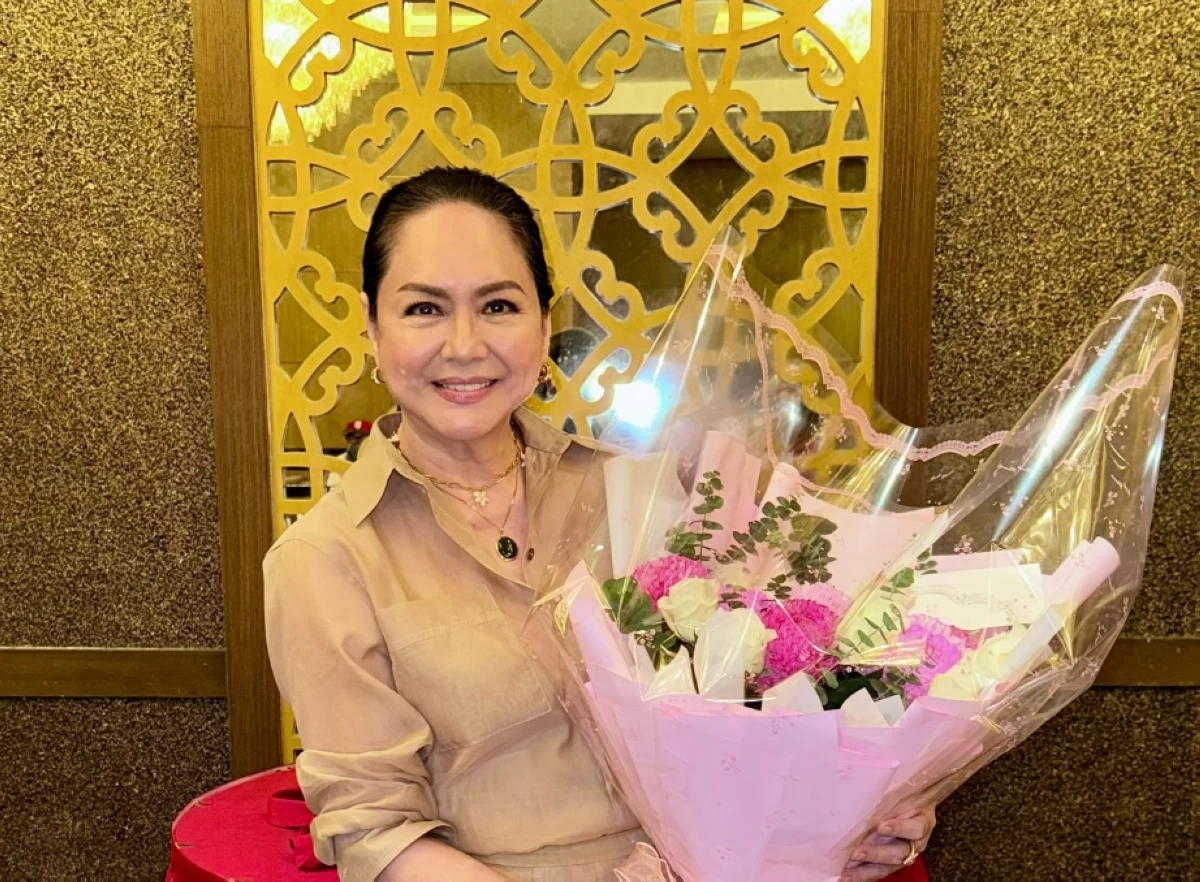
Charo Santos is turning a new, exciting leaf via her series of short reels portraying her in various capacities, completely shedding her corporate, presidential, woman-in-business image.
The reels, viewed on Tiktok and other social media platforms, are actually short films launching Charo in roles ranging from comedic to serious, singing and dancing, but always with a happy, funny twist.
The veteran actress lets her hair down through these videos, and it’s such a relief to see Charo in a more casual, light-hearted mode, so far detached from the untouchable image she has worn all these years. Asked why she’s doing TikTok at this point in her life, she said that, being in entertainment, she wanted to discover social media. The entertainment landscape, she added, continues to evolve and she wants to be in sync with what’s going on.
These reels casting Charo in a different light call attention to this other side to the actress, who quite coincidentally, has a new film opening on February 25. Until She Remembers, by Brillante Mendoza, is another experimental, out-of-the-box project for Charo as she plays a woman engaged in a same-sex relationship with the character played by Boots Anson Roa. Note how the two actresses are cut almost from the same mould, the same sweet, nice and wholesome padron. Interesting how the two women could do justice to the roles of two women in love with each other. In the old days, two women engaged in a same-sex relationship were tagged as beauties (byuts).
Charo and Boots have a young co-actor, Barbie Forteza, one of the better actresses of her generation, who has had the good fortune of having acted with other great Philippine actors, notably Nora Aunor in a Cinemalaya film called Tuos (2016) by director Derick Cabrido.

Ramadan in PH starts on Feb. 19


 MUSLIMS gather for a Quran reading session inside a mosque in Davao City. (Keith Bacongco)


By Keith Bacongcokeith

Published Feb 18, 2026 12:16 pm


DAVAO CITY – The month-long holding of Ramadan among Muslims in the country will begin on Thursday, Feb. 19, as the moon was not sighted on Tuesday evening, according to Grand Mufti Sheikh Abdulrauf Guialani of the Bangsamoro Darul-Ifta (BDI).

Guialani made the announcement at the Shariff Kabunsuan Cultural Complex (SKCC), Bangsamoro Government Center (BGC), in Cotabato City following the receipt of the results of the nationwide moon-sighting activities.

Aside from the Bangsamoro region, the BDI also deployed teams for the moonsighting activities in Iligan City in Lanao del Norte, Misamis Oriental province, and other parts of the country.

“With that premise and by the authority vested in me as Bangsamoro Mufti, I, Abdulrauf A. Guialani, hereby announce that the crescent moon was not sighted today. Therefore, Ramadan fasting 2026 will officially commence on Thursday, Feb. 19, 2026, In Shaa Allah,” the Grand Mufti announced.

For 30 days, Muslims in the country will observe a month-long fast, as aligned with Islamic teachings, principles, and practices.

“In Islam, sawm (fasting) is among the pillars of the religion that promotes discipline, strengthens spiritual connection with Allah (Subhanahu Wa Ta’ala), and helps in body detoxification for healthy living,” the Bangsamoro Autonomous Region in Muslim Mindanao said in a statement.

Bangsamoro interim Chief Minister Abdulraof Macacua issued a memorandum on Wednesday, Feb. 18, implementing a new work schedule for Muslim officials and employees during Ramadan.

“The regular working hours of 8 a.m. to 5 p.m. is hereby modified to 7:30 a.m. to 3:30 p.m., without a noon break, for Muslim officials and employees observing the holy month of Ramadan,” the memorandum said.

It added that there shall be no diminution on the 40-hour work week required under the Civil Service rules under these modified working hours.

After the Eid'l Fitr, Macacua said, all officials and employees shall automatically revert to regular working hours.

Sebastian "Baste" Z. Duterte - the silent architect of Modern Davao

 𝐃𝐚𝐯𝐚𝐨 𝐂𝐢𝐭𝐲 𝐃𝐨𝐞𝐬 𝐈𝐭 𝐃𝐢𝐟𝐟𝐞𝐫𝐞𝐧𝐭𝐥𝐲: 𝐖𝐡𝐲 𝐖𝐞 𝐋𝐨𝐯𝐞 𝐭𝐡𝐞 "𝐖𝐨𝐫𝐤 𝐅𝐢𝐫𝐬𝐭" 𝐕𝐢𝐛𝐞


In a world full of "epal" posters and staged photo-ops, Davao City is leaning into a different kind of energy. It’s what we call the "Silent Worker" movement, and honestly? It’s a whole lifestyle. 🤙
𝐋𝐢𝐤𝐞 𝐅𝐚𝐭𝐡𝐞𝐫, 𝐋𝐢𝐤𝐞 𝐒𝐨𝐧: 𝐓𝐡𝐞 𝐋𝐞𝐠𝐚𝐜𝐲 𝐨𝐟 𝐐𝐮𝐢𝐞𝐭 𝐀𝐜𝐭𝐢𝐨𝐧 👊
Many of us remember how former President Rodrigo Duterte ran the city for decades. He was the original "Silent Architect", often found patrolling the streets at 2 AM or working behind the scenes while the rest of the world slept.
Today, Mayor Baste is carrying that same torch. He’s proof that the Duterte brand of leadership hasn't just lasted; it’s evolved. He shares that same "work first, talk later" philosophy that resonates deeply with the Davaoeño spirit. No trailing camera crews, no media entourages, just the engine room of governance.
𝐓𝐡𝐞 "𝐁𝐚𝐬𝐭𝐞 𝐁𝐫𝐚𝐧𝐝" 𝐨𝐟 𝐋𝐞𝐚𝐝𝐞𝐫𝐬𝐡𝐢𝐩 :
🔹 𝐑𝐞𝐬𝐮𝐥𝐭𝐬 > 𝐑𝐞𝐞𝐥𝐬: While other cities are busy trending, Davao City is busy growing. From a massive 𝟕.𝟗% 𝐞𝐜𝐨𝐧𝐨𝐦𝐢𝐜 𝐠𝐫𝐨𝐰𝐭𝐡 𝐫𝐚𝐭𝐞 to being named 𝐭𝐡𝐞 𝐌𝐨𝐬𝐭 𝐎𝐮𝐭𝐬𝐭𝐚𝐧𝐝𝐢𝐧𝐠 𝐋𝐆𝐔 𝐟𝐨𝐫 𝐏𝐞𝐚𝐜𝐞 𝐚𝐧𝐝 𝐎𝐫𝐝𝐞𝐫, the results are felt in our daily lives, not just seen on a feed. 📈
🔹 𝐆𝐥𝐨𝐛𝐚𝐥 𝐂𝐨𝐧𝐧𝐞𝐜𝐭𝐢𝐨𝐧𝐬, 𝐋𝐨𝐜𝐚𝐥 𝐅𝐞𝐞𝐥: Have you noticed the influx of international diplomats lately? From Japan and China to the EU and France, the world is looking at Davao as the "𝐈𝐧𝐭𝐞𝐫𝐧𝐚𝐭𝐢𝐨𝐧𝐚𝐥 𝐇𝐮𝐛 𝐨𝐟 𝐭𝐡𝐞 𝐒𝐨𝐮𝐭𝐡." We’re becoming a global destination without losing our local soul. 🌏🤝
🔹 𝐓𝐞𝐜𝐡-𝐅𝐨𝐫𝐰𝐚𝐫𝐝 𝐋𝐢𝐯𝐢𝐧𝐠: Ever tried the new 𝗲-𝗕𝗢𝗦𝗦 (𝗕𝘂𝘀𝗶𝗻𝗲𝘀𝘀 𝗢𝗻𝗲-𝗦𝘁𝗼𝗽 𝗦𝗵𝗼𝗽)? No more red tape drama. It’s digitalization that actually works for the entrepreneurs of Davao. 💻🚀
🔹 𝐒𝐚𝐟𝐞𝐭𝐲 𝐢𝐬 𝐭𝐡𝐞 𝐏𝐫𝐢𝐨𝐫𝐢𝐭𝐲: Remember the Coastal Road? Mayor Baste refused to open segments until they met international safety standards. That’s the Duterte legacy refined: Life over photo-ops. Always. 🛣️🛡️
You don’t need a microphone to be heard when your achievements are visible in every safe street and every new opportunity. Davao isn’t just rising; it’s leveling up with a leader who works even when the cameras aren't watching. 💚👊
May be an image of text that says 'BAЛAΟ Ictn SEBASTIAN "BASTE" z. DUTERTE The Silent Architect of Modern Davao MORE OF พา DAVAO'
All reactions:
Mary Joselle Dilig Villafuerte, Skye Abad and 2.1K others