You plan to move to the Philippines? Wollen Sie auf den Philippinen leben?

There are REALLY TONS of websites telling us how, why, maybe why not and when you'll be able to move to the Philippines. I only love to tell and explain some things "between the lines". Enjoy reading, be informed, have fun and be entertained too!

Ja, es gibt tonnenweise Webseiten, die Ihnen sagen wie, warum, vielleicht warum nicht und wann Sie am besten auf die Philippinen auswandern könnten. Ich möchte Ihnen in Zukunft "zwischen den Zeilen" einige zusätzlichen Dinge berichten und erzählen. Viel Spass beim Lesen und Gute Unterhaltung!


Visitors of germanexpatinthephilippines/Besucher dieser Webseite.Ich liebe meine Flaggensammlung!

free counters

Total Pageviews

Thursday, March 12, 2026

Davao City dad proposes measures to ease impact of sky-high prices


By Ivy Tejano

Published Mar 11, 2026 11:04 pm


A Davao City councilor proposed on Tuesday, March 10, a combination of national and local legislative actions to cushion consumers and key sectors from rising fuel and commodity costs.

Councilor Danilo Dayanghirang, chairman of the Committee on Finance, Ways and Means, made the call during the regular session of the 21st Davao City Council at the Sangguniang Panlungsod.

Dayanghirang said a fuel price increase leads to higher costs in transportation, agriculture, manufacturing, and food distribution, affecting households, transport operators, farmers, and small businesses.

He attributed current inflationary pressures to global fuel price volatility, geopolitical tensions, supply chain disruptions, and the existing tax regime under the Tax Reform for Acceleration and Inclusion (TRAIN) Law.

Dayanghirang said that these inflationary pressures impose excise taxes of around P10 per liter on gasoline, P6 on diesel, and P5 on kerosene, in addition to a 12 percent Value-Added Tax on petroleum products.

In his policy paper titled “Legislative Mitigating Measures to Address the Economic Impact of Rising Fuel and Commodity Prices in the Philippines,” he proposed temporarily reducing fuel excise taxes when prices rise high.

Dayanghirang suggested mechanisms such as progressive taxation tied to fuel price thresholds, which could lower pump prices by P3 to P10 per liter, easing transportation and logistics costs.

The proposal recommended targeted fuel subsidies for vulnerable sectors, including Public Utility Vehicle drivers, farmers, fishermen, and logistics operators.

He proposed a strategic fuel rationing program during emergencies, prioritizing public transport, food supply, and government fleets to prevent hoarding and price spikes.

Dayanghirang highlighted stricter price monitoring and anti-profiteering efforts, including regular inspection of fuel stations and coordination with the Department of Trade and Industry and the Department of Energy.

On the local level, Dayanghirang suggested programs to stabilize public transport, such as fuel vouchers for jeepney drivers, fare stabilization initiatives, and support for transport cooperatives.

The councilor cited Davao City’s past measures during fuel spikes, including consultations with transport groups and support programs for farmers and fisherfolk, as best practices.

He encouraged local renewable energy projects, urban agriculture and food security initiatives, and improvements to logistics and supply chain efficiency, including farm-to-market roads and cold storage facilities.

“The rising cost of fuel and commodities requires coordinated action,” Dayanghirang said, urging proactive legislative measures to protect consumers and stabilize local economies.

Speaking at the Pulong-Pulong sa Dabawenyos on Tuesday, Councilor J. Melchor Quitain Jr., chairman of the Committee on City-Owned Real Properties, noted that the city is feeling the impact of rising global prices.

“The situation will likely continue while the conflict between the US and Iran persists,” Quitain said. “I’m just hoping that the situation will soon be under control and that there will be no escalation of the conflict.”

While the national and local governments are closely monitoring the situation, the councilor encouraged everyone to keep the faith, trust in the Lord, and pray that everything goes well.

Quitain assured that the city is implementing programs and preparing measures to ensure supply, prevent hoarding, and conserve energy, including evaluating reduced work schedules to offset fuel consumption.

Councilor Radge Ibuyan, chairman of the Committee on Government Enterprises and Privatization, added that the city is tracking the availability of basic goods in public markets.

Ibuyan said he has received information on recent prices at the city’s public markets, noting that the price of chicken might reach nearly P180 per kilo from P165 per kilo.

He said the city could strengthen its collaboration with vendors and market administrators to help manage any possible price increases, expressing hope that prices would remain stable.

“If necessary, we will coordinate with the City Economic Enterprises Office, and if they suggest any relevant resolution, we will study it carefully and take the appropriate action,” Ibuyan said.

Davao City Information Officer Harvey Lanticse said that gasoline stations are under strict supervision to prevent premature price hikes, hoarding, and overpricing.

Lanticse said the Business Bureau has been tasked with regular inspections, while residents are encouraged to report irregularities through the Davao City Reports platform.

City officials assured that the city government remains committed to protecting consumers, maintaining service delivery, and ensuring transparency in pricing amid ongoing global volatility.


PLDT drubs Galeries Tower, wrests solo lead


Published Mar 10, 2026 06:27 pm

At A Glance

  • The victory extended PLDT's winning streak to three games, improving its record to 6-1 to wrest the solo lead.
PLDT scores its sixth win at the expense of Galeries Tower. (PVL Images)
PLDT flexed its might and dominated Galeries Tower, 25-18, 25-22, 25-17, to zero in for a spot in the qualifying round in the Premier Volleyball League All-Filipino Conference at the Filoil Centre in San Juan City on Wednesday, March 11.
The High Speed Hitters were in full control of the 73-minute match, with veteran setter Kim Fajardo anchoring the team’s balanced offense. She tallied 15 excellent sets and added three points.
The victory extended PLDT’s winning streak to three games, improving its record  to 6-1 to wrest the solo lead.
PLDT coach Rald Ricafort said he is not expecting spectacular performances from his stalwarts, but simply wants them to stick to the team’s system.
“It’s all about discipline. Yun ang gusto naming i-impose sa game na ito at natupad naman,” he said.
“Sabi ko hindi kailangang maglaro ng extra special; basta laruin lang nila yung sistema namin,” he added.
Savi Davison unleashed another impressive game, pumping in 21 points including 18 attacks, while Alleiah Malaluan added 10 points highlighted by seven kills.
The High Speed Hitters dominated in all departments, unleashing 43 kills while adding nine blocks and six aces. In contrast, the Highrisers managed 37 attacks, four blocks, and a single ace.
Galeries Tower skidded to its fifth loss in seven outings, with no player scoring in double figures.
Gayle Pascual was limited to nine points, even as Aiza Pontillas and Erika Deloria were held to seven points apiece.

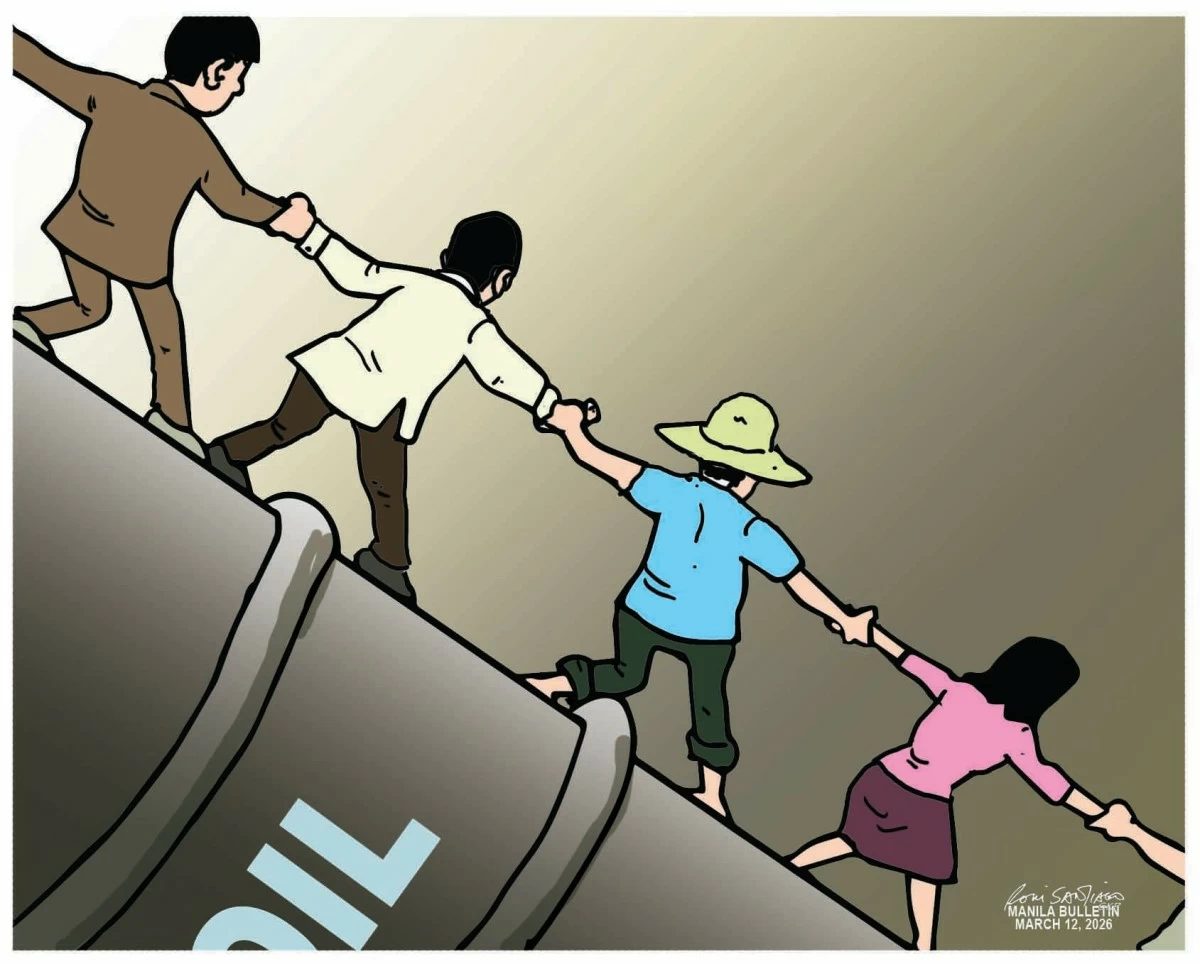
Let's unite and rise above the oil crisis


Published Mar 12, 2026 12:01 am | Updated Mar 11, 2026 04:18 pm
The warning could not have been clearer. As Economic Planning Secretary Arsenio Balisacan told lawmakers this week, escalating tensions among the United States, Israel, and Iran are tightening global oil supplies. And the ripple effects are already knocking at the country’s door. If crude oil prices surge to $100 per barrel, inflation could climb to 5.1 percent—well beyond the government’s two to four percent target. If the worst-case scenario of $140 per barrel materializes, inflation could soar to 7.5 percent, squeezing Filipino households and slowing economic growth.
Energy Secretary Sharon Garin captured this uncertainty bluntly: the worst may not yet have arrived.
But beyond the numbers and forecasts lies a deeper challenge. This oil shock is not just a problem for economists and energy officials. It is a test of the Filipino capacity for unity.
And this is precisely the moment when unity matters most.
For too long, national discourse has been consumed by political bickering—between parties, factions, and personalities. Social media amplifies every disagreement, turning governance into a constant battlefield of narratives. Yet an energy crisis does not care about political colors, campaign slogans, or partisan loyalties. When fuel prices surge, every Filipino pays the price—from jeepney drivers and factory workers to small entrepreneurs and farmers.
In times like this, the country cannot afford the luxury of division.
The government must lead with clarity, coordination, and courage.
The executive branch must move decisively to cushion the most vulnerable sectors. Targeted fuel subsidies for transport workers, strengthened energy conservation campaigns, and accelerated investment in renewable energy sources should be urgent priorities. Energy security requires both immediate relief and long-term transformation.
Congress, for its part, must rise above political theatrics. Lawmakers should focus on swift legislative measures that stabilize fuel supply, incentivize energy diversification, and strengthen consumer protection. This includes expediting the measure that gives the President power to cut fuel taxes in times of crisis.
The judiciary also plays a critical role. Legal clarity and swift resolution of energy-related disputes—whether involving infrastructure projects, regulatory decisions, or investment contracts—can help ensure that vital energy initiatives are not stalled by prolonged litigation. Efficiency within the justice system becomes an economic safeguard.
The private sector, meanwhile, must recognize that resilience is also its responsibility. Businesses, especially those in energy, transportation, and manufacturing, must invest in efficiency, innovation, and alternative energy solutions. Companies that reduce energy waste, shift to cleaner technologies, and stabilize supply chains are not only protecting their bottom lines—they are helping stabilize the nation.
Corporate leadership, in times like these, must be measured not only by profit margins but by public responsibility.
And then there is the role of every Filipino.
Energy crises are not solved solely in Cabinet meetings or boardrooms. They are also shaped by daily decisions—how we use fuel, how we conserve electricity, how communities adapt. Simple actions such as reducing unnecessary travel, conserving power, supporting public transport, and embracing energy-saving habits collectively make a difference.
A crisis can expose a nation’s fractures, but it can also reveal its strength.
The country has weathered many storms: financial crises, natural disasters, and global disruptions. Each time, what carried the nation forward was not perfect leadership or flawless policies, but the enduring spirit of bayanihan—the instinct to stand together when the road grows difficult.
Today’s looming oil shock calls for that same spirit.
This is not the hour for political grandstanding or ideological skirmishes. It is the hour for shared responsibility. The government must govern with urgency. Businesses must innovate with conscience. Citizens must act with discipline and solidarity.
When global turbulence threatens to shake our economy, the most powerful stabilizing force we possess is unity—the country’s most valuable national resource in times of crisis.

P5,000-fuel subsidy for jeepney, tricycle drivers to roll out next week


P5,000-fuel subsidy for jeepney, tricycle drivers to roll out next week

Motorists line up at a gasoline station along Intramuros in Manila on Monday, March 9, 2026, a day before the implementation of staggered fuel price adjustments. (Photo by John Louie Abrina)

President Marcos Jr. has ordered the immediate distribution of a P5,000 fuel subsidy for public utility drivers affected by rising oil prices amid ongoing tensions and conflict in the Middle East. The financial assistance will be distributed starting next week to help ease the burden on jeepney and tricycle driversRead more

Wer sich jetzt um seine Sinne kümmert, hat später mehr vom Leben


Eine Familie sitzt am Tisch und isst.
Frühzeitig behandelter Hörverlust und Sehprobleme ermöglichen eine aktive Teilhabe am Leben. © IMAGO/Westend61

Hörverlust und Sehprobleme führen oft in die Einsamkeit und können das Demenzrisiko erhöhen. Ärzte erklären, warum rechtzeitige Vorsorge entscheidend ist.

Gespräche in lauter Umgebung werden anstrengend, die Speisekarte im Restaurant verschwimmt – oft beginnt es schleichend. Was nach normalen Alterserscheinungen klingt, entpuppt sich als unterschätzte Gesundheitsgefahr. Denn unbehandelter Seh- und Hörverlust sind nicht nur Sinneseinbußen, sondern können das Demenzrisiko drastisch erhöhen.

Im Gespräch mit HNO-Arzt Prof. Dr. Jan Löhler und Augenarzt Prof. Dr. Robert Finger, erfahren Sie, wie Sie Warnsignale rechtzeitig erkennen und warum frühzeitiges Handeln so entscheidend ist. Dazu finden Sie in unserem kostenlosen Ratgeber-PDF „Sinnes-Check“ Untersuchungspläne und Checklisten für Arzttermine.

Unsere Serie „Fit in Rente“

In sechs Teilen zeigen wir, wie Sie den Ruhestand körperlich, sozial und mental gesund gestalten. Experten wie Prof. Dr. Hans-Werner Wahl und Dr. Jan Löhler geben Tipps, die Sie in jeder Folge weiterbringen.

►Teil 1: Identität nach dem Beruf – Erkennen, wer Sie jenseits Ihrer Rolle sind

►Teil 2: Partnerschaft im Ruhestand – Nähe neu verhandeln – ohne Konflikte

►Teil 3: Solo im Ruhestand – Einsamkeit erkennen und gegensteuern

► Teil 4: Muskeln sind Ihre wichtigste Altersvorsorge

► Teil 5: Sehen & Hören – Teilhabe am Leben so lange wie möglich sichern

► Teil 6: Ernährung Ü60 – Essen neu denken – mit konkreten Tipps (erscheint am 18. März)    


Warnsignale für Hörverlust und Sehprobleme

Die ersten Anzeichen sind oft subtil. „Meistens gehen die hohen Töne zuerst verloren“, erklärt Löhler die typischen Hörverlust-Symptome. Besonders in geräuschvoller Umgebung – im Restaurant, bei Familienfeiern oder in großen Räumen – wird das Problem deutlich. Betroffene haben Schwierigkeiten, Kinder richtig zu verstehen, insbesondere, wenn sie klein sind und noch nicht so klar sprechen.

Beim Sehen sind es andere Warnsignale: „Was grundsätzlich alarmieren sollte, ist, wenn etwas rasch schlechter wird“, betont Finger. Während langsame Veränderungen nicht rasch abgeklärt werden müssen, erfordern plötzliche Sehverschlechterungen sofortige ärztliche Abklärung. Auch wer mehr Licht zum Lesen braucht oder Kontraste schlechter erkennt, sollte nicht zögern.

Sinnes-Check – kostenloses PDF

Hör- und Sehgesundheit gezielt schützen: Hier können Sie sich den Sinnes-Check als PDF gratis herunterladen, abspeichern und ausdrucken. Inklusive altersgestaffelter Untersuchungspläne, Warnsignale und Checklisten für Arzt- und Akustikertermine.

Preview PDF: Sinnes-Check
Den Sinnes-Check können Sie sich in der PDF-Bibliothek kostenlos herunterladen. © IMAGO/Westend61

Der unterschätzte Demenz-Risikofaktor

Hörverlust gilt als größter beeinflussbarer Demenz-Risikofaktor. Laut der Lancet-Kommission (2024) könnten durch die Behandlung von Hörverlust sieben Prozent aller Demenzfälle verhindert werden. „Das Hören nimmt viele Bereiche im Gehirn in Anspruch“, erläutert Löhler den komplexen Zusammenhang. Verschiedene Hirnregionen müssen aktiviert und vernetzt werden, bevor Gesprochenes ins Bewusstsein vordringt.

Ähnlich verhält es sich beim Sehen: „Sehverlust ist ein Risikofaktor für Demenz“, bestätigt der Augenarzt. Das Gehirn arbeitet permanent mit schlechterem Input, muss fehlende Bildteile ergänzen und wird dadurch überlastet. „Das ist sehr ermüdend und anstrengend“, beschreibt er die kognitive Belastung.

Why is the German language so complex?


 · 


The reason is that languages aren’t made, especially they’re not made to be simple or logic. They’re organic and have grown and each language has it’s difficulties and flaws.

German keeps it’s genders because they seem to be natural to the speakers. We learn a language from our parents, develop a right/wrong feeling and understand the rules without having learned them. And so the language continues, there’s no program to it.

English is the exception with no gender to nouns, probably because it’s such a mixed language. Old English still features those, similar to today’s Icelandic. So the English “they” comes actually from three words, in Icelandic those are: þeir, þær, þau.

English might seem simple and natural to you, but believe me, it isn’t. The spelling is a complete mess, Ghoti being theoretically a legitimate spelling for fish Ghoti - Wikipedia. And don’t even get me started with time clauses: going - I went. Uhm, okay… And then: I went. I have gone. I did go. I have been going. I had been going. And that were just the past tenses. You know how many past tenses Swiss German has? One. Also one present tense. And you can use future, but you don’t have to. So two tenses are all that you need. So English can be needlessly complex too, with learners having to remember graphs like this:

Wednesday, March 11, 2026

The moment you start choosing yourself


🙌🪐🍀 make the decision today to stop putting yourself last.

Protect your peace, honor your values, and stop settling for what drains your energy.
The moment you start respecting your own worth, the world begins to respond differently.
Invest in your growth.
Guard your time.
Walk away from what does not respect you. When you truly choose yourself, you stop living for approval and start living with purpose, and that is where real change begins. ✨The moment you start choosing yourself,
your life begins to change.
Your standards rise. Your boundaries become stronger. Your energy becomes different.
You stop chasing people and start attracting the right ones. You stop seeking approval and start trusting your own worth. Life often reflects what you believe you deserve. Choose yourself first, and watch everything else align.

May be an image of text that says 'The moment you start choosing yourself, your life begins to change. Your standards rise. Your boundaries become stronger. Your energy becomes different. You stop chasing people and start attracting the right ones. You stop seeking approval and start trusting your own worth. Life often reflects what you believe you deserve. Choose yourself first, and watch everything else align. @mindsets'
All reactions:
1.2K