
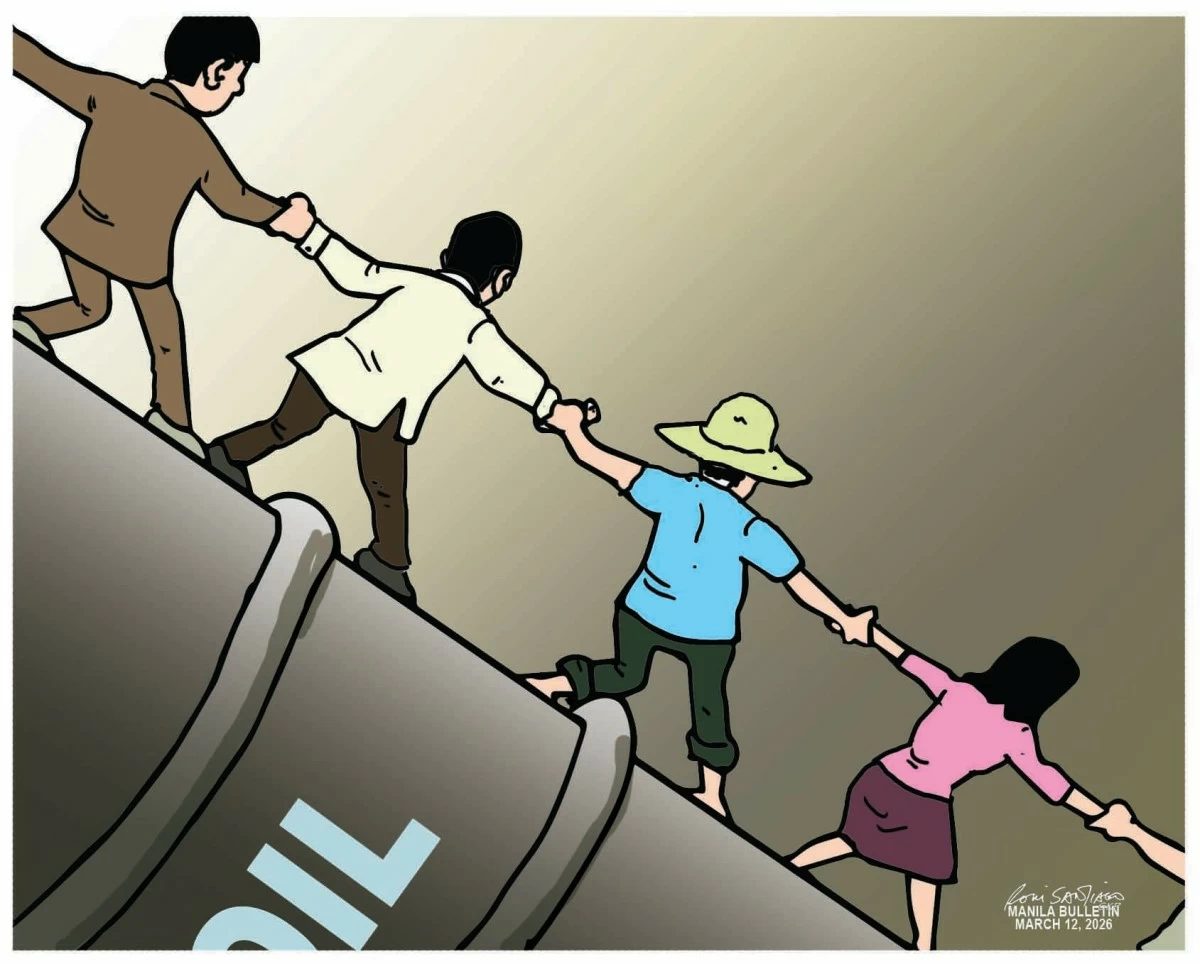
The warning could not have been clearer. As Economic Planning Secretary Arsenio Balisacan told lawmakers this week, escalating tensions among the United States, Israel, and Iran are tightening global oil supplies. And the ripple effects are already knocking at the country’s door. If crude oil prices surge to $100 per barrel, inflation could climb to 5.1 percent—well beyond the government’s two to four percent target. If the worst-case scenario of $140 per barrel materializes, inflation could soar to 7.5 percent, squeezing Filipino households and slowing economic growth.
Energy Secretary Sharon Garin captured this uncertainty bluntly: the worst may not yet have arrived.
But beyond the numbers and forecasts lies a deeper challenge. This oil shock is not just a problem for economists and energy officials. It is a test of the Filipino capacity for unity.
And this is precisely the moment when unity matters most.
For too long, national discourse has been consumed by political bickering—between parties, factions, and personalities. Social media amplifies every disagreement, turning governance into a constant battlefield of narratives. Yet an energy crisis does not care about political colors, campaign slogans, or partisan loyalties. When fuel prices surge, every Filipino pays the price—from jeepney drivers and factory workers to small entrepreneurs and farmers.
In times like this, the country cannot afford the luxury of division.
The government must lead with clarity, coordination, and courage.
The executive branch must move decisively to cushion the most vulnerable sectors. Targeted fuel subsidies for transport workers, strengthened energy conservation campaigns, and accelerated investment in renewable energy sources should be urgent priorities. Energy security requires both immediate relief and long-term transformation.
Congress, for its part, must rise above political theatrics. Lawmakers should focus on swift legislative measures that stabilize fuel supply, incentivize energy diversification, and strengthen consumer protection. This includes expediting the measure that gives the President power to cut fuel taxes in times of crisis.
The judiciary also plays a critical role. Legal clarity and swift resolution of energy-related disputes—whether involving infrastructure projects, regulatory decisions, or investment contracts—can help ensure that vital energy initiatives are not stalled by prolonged litigation. Efficiency within the justice system becomes an economic safeguard.
The private sector, meanwhile, must recognize that resilience is also its responsibility. Businesses, especially those in energy, transportation, and manufacturing, must invest in efficiency, innovation, and alternative energy solutions. Companies that reduce energy waste, shift to cleaner technologies, and stabilize supply chains are not only protecting their bottom lines—they are helping stabilize the nation.
Corporate leadership, in times like these, must be measured not only by profit margins but by public responsibility.
And then there is the role of every Filipino.
Energy crises are not solved solely in Cabinet meetings or boardrooms. They are also shaped by daily decisions—how we use fuel, how we conserve electricity, how communities adapt. Simple actions such as reducing unnecessary travel, conserving power, supporting public transport, and embracing energy-saving habits collectively make a difference.
A crisis can expose a nation’s fractures, but it can also reveal its strength.
The country has weathered many storms: financial crises, natural disasters, and global disruptions. Each time, what carried the nation forward was not perfect leadership or flawless policies, but the enduring spirit of bayanihan—the instinct to stand together when the road grows difficult.
Today’s looming oil shock calls for that same spirit.
This is not the hour for political grandstanding or ideological skirmishes. It is the hour for shared responsibility. The government must govern with urgency. Businesses must innovate with conscience. Citizens must act with discipline and solidarity.
When global turbulence threatens to shake our economy, the most powerful stabilizing force we possess is unity—the country’s most valuable national resource in times of crisis.

No comments:
Post a Comment