

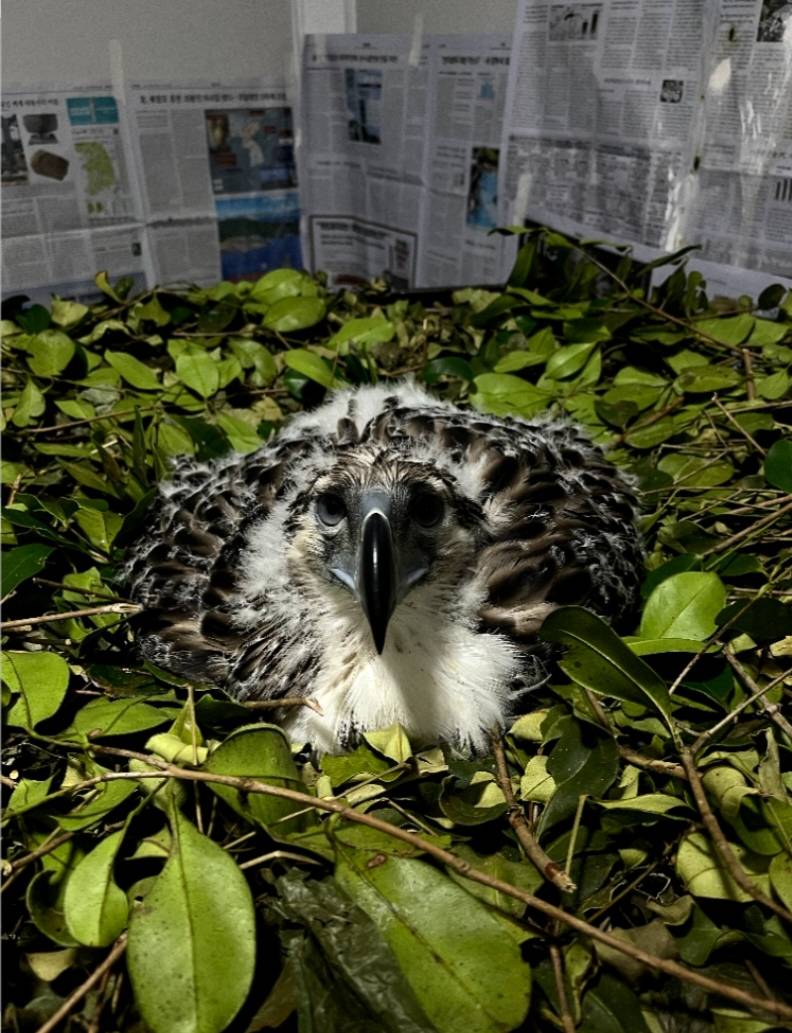
DAVAO CITY—The National Bird Breeding Sanctuary (NBBS) in Barangay Eden here has produced another eaglet, marking a breakthrough for the conservation of the critically endangered Philippine eagle (Pithecophaga jefferyi).
The Philippine Eagle Foundation (PEF) on Tuesday presented to the public 3-month-old Philippine eagle called “Chick 32,” produced through cooperative artificial insemination. It is the offspring of female eagle “Dakila” and male eagle “Sinag.”
“Chick 32 is a product of grit, patience and learning by doing,” Dennis Salvador, PEF executive director, told the Inquirer.
It is the third eaglet produced at the secluded NBBS, a facility off-limits to humans except for a few animal keepers. PEF transferred its captive breeding operations there in 2023, while keeping the Philippine Eagle Center in Malagos district for its educational programs on wildlife conservation.
The first eaglet produced at NBBS, “Chick 30,” died in November 2024 while only 17 days old due to complications from a retained yolk sac.
The second, “Chick 31,” came out through natural hatching and was named “Riley,” but it died in April last year while only three months old due to a metabolic bone disease.
“Those difficult experiences taught us lessons that helped us succeed this time,” said Salvador.
PEF improved its newborn screening procedures for every eaglet hatched after what happened to Chick 30 and Chick 31.
Dr. Jayson Ibañez, PEF director for operations, told the Inquirer that they now have tight biosecurity, improved husbandry techniques and diet planning for Chick 32.
Collaboration
The eaglet came out on Dec. 5, 2025, through the “help out” method in which NBBS facility manager Domingo Tadena assisted in pipping its eggshell.
“This hatch is also a testament to the spirit of international collaboration and the collective support of many partners—from funders to technical experts—who stood with us along the way,” Salvador said.
“But special credit goes to our breeding teams: the dedicated staff at the Philippine Eagle Center caring for the male eagle, and the team at the National Bird Breeding Sanctuary where the female is housed. Their precision, timing and unwavering commitment made this breakthrough possible,” he added.

PEF had said that Chick 32 was adopted by Nico Herth, owner and chief executive officer of Procon-Grumbach, a German manufacturer of high-precision electronics systems, who vowed to provide for the rearing of the raptor whom he named “Bayani,” a Filipino term for hero.
PEF relies heavily on donations, corporate partnerships and private groups to fund its conservation, breeding and education programs.
According to Salvador, Bayani’s name is apt as it celebrates the courage and hope carried by every young Philippine eagle which is facing extinction due to massive loss of natural habitat and human persecution.
The first captive-bred eagle was Pag-asa, born on Jan. 23, 1992. He died in 2021 at age 28.
In 1995, then President Fidel Ramos declared the Philippine eagle as the country’s national bird. Today, there are only about 392 pairs of Philippine eagles remaining in the wild.
