You plan to move to the Philippines? Wollen Sie auf den Philippinen leben?

There are REALLY TONS of websites telling us how, why, maybe why not and when you'll be able to move to the Philippines. I only love to tell and explain some things "between the lines". Enjoy reading, be informed, have fun and be entertained too!

Ja, es gibt tonnenweise Webseiten, die Ihnen sagen wie, warum, vielleicht warum nicht und wann Sie am besten auf die Philippinen auswandern könnten. Ich möchte Ihnen in Zukunft "zwischen den Zeilen" einige zusätzlichen Dinge berichten und erzählen. Viel Spass beim Lesen und Gute Unterhaltung!


Visitors of germanexpatinthephilippines/Besucher dieser Webseite.Ich liebe meine Flaggensammlung!

free counters

Total Pageviews

Saturday, March 21, 2026

Between then and now


By Shanell Jay Aguinald

I was listening to “I Have a Dream” by ABBA the other day, and man, it hit me like a ton of bricks and took me straight back to being a kid.

That was my school’s graduation song. It always reminds me of those weird, hazy days between February and March. I remember watching the kids just one year older than me, who seemed like actual adults at the time, practicing in the heat all month long for their big day.

“I have a dream, a song to sing. To help me cope with anything …”

I can still hear those kids. Their voices were always a little too high-pitched, but they sang with this devastatingly sincere intensity. They would mouth the lyrics with a sense of fulfillment that you can only really possess before you’ve had your first real heartbreak or your first soul-crushing job. Looking back, it’s wild how we were all just children with these massive, “oversized” dreams.

Back then, the world felt tiny but also impossible. Success wasn’t about tax brackets, LinkedIn “announcements,” or trying to figure out what the hell “work-life balance” actually looks like. It was simple: a gold star, the look on your parents’ faces, and the absolute certainty that by the time we reached the age we are now, we’d have it all figured out. We thought “growing up” was a destination—like a city you eventually reach—rather than this messy, exhausting trek through the woods that it actually is.

Watching those older kids practice, I didn’t see the stress of final exams or the anxiety of moving to a new, scarier school. I saw giants. To a child, a one-year age gap is an epoch. They were the “big kids,” the ones standing on the precipice of the future. As they sang about crossing the stream and seeing the wonder of a fairy tale, I felt a desperate, impatient hunger to be in their shoes.

I didn’t realize then that the fulfillment I saw on their faces was actually their first taste of a bittersweet goodbye. They weren’t just singing about dreams; they were singing to bridge the gap between the safety of childhood and the cold uncertainty of what came next.

As we grow, our dreams undergo a brutal process of distillation. At seven, your ambitions are boundless; you want to be an astronaut-teacher-princess. At 17, your world narrows; you just want to get into a good college or hope your crush notices you in the hallway. At 27, or 37, the dream shifts again. Now, you might just want a job that doesn’t make you want to scream into a pillow on Monday mornings. It’s not just the mornings, either; sometimes it’s a random Tuesday at 2 p.m. when the weight of “being an adult” feels like a backpack full of rocks.

But beneath that layer of cynicism, that kid from the graduation rehearsal is still there. We’ve all crossed the stream dozens of times by now. We’ve navigated the currents of heartbreak, the sharp rocks of career pivots, and the quiet, sobering realization that the future we were promised isn’t a fixed point on a map, but a moving target that keeps shifting every time we get close.

We often spend so much time mourning the loss of our childhood dreams that we forget to celebrate the fact that we actually survived the reality that replaced them. There is a specific kind of melancholy in realizing you are now the age of the people you once thought were “real adults.” You look in the mirror and realize there is no magical moment when you suddenly feel like you have all the answers. You’re just a kid with more bills to pay, a better vocabulary, and higher caffeine dependency.

However, there is also a profound beauty in that. Those kids in the courtyard weren’t singing because they knew they would win; they were singing because they believed they could. To hold on to that sense of wonder in a world that tries its absolute hardest to iron it out of you is its own quiet act of rebellion. It’s a choice to remain “un-ironed.”

ABBA knew something we didn’t quite grasp as children: having a dream isn’t about the destination. It’s about dreaming itself. It’s the “fantasy” that helps us move through the heavy sludge of reality.

If I could go back to those February afternoons, I wouldn’t tell those kids to study harder or warn them about the fluctuating economy. I’d just sit on those warm concrete steps, listen to those high-pitched voices one more time, and remind myself to breathe. I’d tell myself that it’s okay not to have it all figured out, because no one else does either.

We are still those kids. We are still practicing for a day that hasn’t come yet. We are still mouthing the lyrics to a future we haven’t quite mastered, hoping we don’t trip during the processional. And as long as the music is playing, as long as we can still see the wonder hidden in the mundane tasks of a Tuesday afternoon, we haven’t lost our way. We are just on a longer bridge than we expected, still crossing the stream, still carrying the dream.


Friday, March 20, 2026

SPECIAL REFLECTIONS

 SPECIAL REFLECTIONS

By Klaus Döring
302920120_10228112419026046_765278136637903952_n.jpg


Simply put, self-reflection (also known as “personal reflection”) is taking the time to think about, meditate on, evaluate, and give serious thought to your behaviors, thoughts, attitudes, motivations, and desires. That's what I do now.

Not long ago, I passed a milestone marking 55 years since I began writing my first published article in a daily newspaper. I started keeping all the clippings since then. Believe me, it's like a book. As I re-read my first articles, I was amazed, I ever kept it up. But now you couldn't pay me to stop.

Nowadays all my publications are stored in my electronic-archive. 

Back to my clippings. Can you imagine that there are some benefits from keeping them? From life experiences, I see that progress and failure are both parts of my journey. My columns are mostly a view into a mirror. I am reminded of God's grace when I read (and wrote before) how He helped me to find solutions to problems. I also gained insight from past struggles that help with issues I am currently facing. I remember one of my previous columns entitled "If failures get results". 

God has indeed been faithfully working in my life. 

I read a story by Dennis Fisher, who didn't keep publishing clippings but a spiritual journal. He advised: "Journalism may be useful to you too. It can help you see more clearly what God is teaching you on life's journey. To begin a journal, record your struggles, reflect on a verse that is especially comforting or challenging, or write a prayer of thankfulness for God's faithfulness."

The most awaited season of the year has finally come. For many of us, December is still a glow that blossoms across the eastern horizon bringing the promise of a new beginning. December and Christmas should be the song to awaken our hardened hearts, to touch those people around us, who might have waited a long time for such a move. Let's become "new people" at last.

+++


Email: doringklaus@gmail.com or follow me on Facebook or LinkedIn or visit my www.germanexpatinthephilippines.blogspot.com or www.klausdoringsclassicalmusic.blogspot.com .

Inflation remains top concern in Mindanao


By  Bea Gatmaytan

MindaNews


DAVAO City — Inflation remains the most urgent issue for Mindanawons, but concerns over illegal drugs, criminality, and support for farmers are rising in the region, according to a Pulse Asia survey released this week.

The survey — conducted from February 27 to March 2 — found that 62% of respondents in Mindanao identified inflation as a top concern, close to the nationwide figure of 59%.

However, beyond inflation, regional priorities diverge: concern over the widespread sale and use of illegal drugs (41%) and criminality (31%) ranks significantly higher in Mindanao than nationwide, where only 21% and 17% of Filipinos, respectively, cited these as urgent issues.

This places both issues among Mindanao’s most pressing concerns.

Urgency and political narratives

Issues that resonate more strongly in Mindanao — such as illegal drugs and criminality — are closely associated with the Duterte administration’s political messaging and policy focus. Read alongside this survey, this suggests that what people consider urgent can shape how leadership is viewed.

This gestures towards an alignment between public concern and political narratives, where priorities and perceptions reinforce and are reinforced by one another.

Gap between priorities and performance

At the national level, the survey highlights a consistent pattern: the issues Filipinos consider to be most urgent are also those where dissatisfaction with government performance is highest.

A majority of Filipinos (73%) disapprove of the administration’s handling of inflation — the country’s top concern.

Majorities also expressed disapproval of efforts to fight illegal drugs (68%), address corruption (67%), reduce poverty (53%), and reduce taxes and fight criminality (46% each).

Meanwhile, the only issue where the administration receives majority approval is in the protection of overseas Filipino workers (53%) — an issue only 3% of respondents identified as urgent.

For Mindanao, this overlap is particularly visible: inflation, illegal drugs, and criminality — all among the region’s top concerns — are also areas where national disapproval remains high.

Davao City dad appeals: Save gas on Araw ng Dabaw civic parade


By Ivy Tejano

Published Mar 19, 2026 10:34 pm


DAVAO CITY – The Davao City Council passed a resolution on Thursday, March 19, urging all participants in the 2026 Araw ng Dabaw Civic Parade to join the event on foot and refrain from using fuel-powered and electric vehicles.

Committee on Government-Owned Properties chairperson Councilor J. Melchor Quitain Jr. called on all participants to avoid deploying gasoline, diesel, oil-powered, and even electric vehicles in the parade on March 28.

Quitain said the initiative aims to underscore the importance of conserving energy resources amid ongoing global supply concerns stemming from the conflict in the Middle East.

According to the resolution, the Araw ng Dabaw celebration, observed annually in March, will culminate in a civic parade that traditionally draws hundreds of participants and often features motorized floats and displays.

The councilor cited the impact of the ongoing conflict in the Middle East, which he said has disrupted petroleum product supplies and contributed to rising fuel prices in the Philippines.

Quitain added that the resulting increase in transportation and production costs has also driven up the prices of basic commodities and utilities, including electricity.

The resolution emphasized that limiting fuel consumption, even during large public events, could help mitigate the economic strain brought about by these global developments.

It also noted that the situation remains uncertain, with no immediate signs of stabilization in fuel supply and pricing, amid continuing geopolitical tensions and volatile global oil market conditions.

Quitain appealed to Davaoeños to contribute in their own way by conserving fuel and resources, stressing that collective action can help cushion the broader economic impact.

Under the resolution, participants are strongly encouraged to take part in the parade without vehicles to promote awareness of energy conservation and responsible resource use.

What's the hardest truth of life?


1. You are replaceable. Period.

2. You are nothing to anyone. To everyone. (Repeat to yourself thrice a day)

3. If somebody doesn't reply you, never ever disturb them again. Forced relationships and friendships never work.

4. They say, "Never give explanation for loving someone, being over sensitive and your weirdness", and I say "don't ever give explanation for anything to anyone. Full stop.”

5. Never ever try to change people. No one's going to change for you, write this sentence on your fortitude.

6. If you have got a chance to choose between your self - respect and your close one, choose former one. I repeat choose self - respect, because the person who has brought you on this path is not close to you. That's it.

7. One sided love is going to destroy you.

8. Repetition is poison.

9. Never reveal yourself completely to anyone because 90% of people play with your weakness.

10. People are going to judge you anyhow, no matter how many times they say they love your imperfections.

Thursday, March 19, 2026

In transit


By Jullie Y. Daza

Published Mar 19, 2026 12:04 am | Updated Mar 18, 2026 04:25 pm
MEDIUM RARE
Somewhere I read a Japanese monk’s observation that as we are all travelers we must learn that separation awaits us at the end of the road.
Separation comes in many forms but it is inevitable. Some separations do us good, other times a separation breaks our hearts and turns our lives upside-down.
For Jenn Agrazada Schreiner, coming home to the Philippines from Germany for the first time in many years since she got married to a German was a bitter-sweet experience. It was the last time she would see and hug her mother, the first time she had to take care of such worldly matters as chasing a paper trail of documents to prove her identity, look for a buyer for the now empty house, and ask her Manila-based friends to help her find a team to renovate it for the next occupant.
For Evelyn Quiroz, from being a former president of the Malacañang press corps to taking over as president of Plaridel, the association of “senior” journalists, the transition was quick and painless – no election, no objections to Chairman Emeritus Roly Estabillo simply and formally relinquishing his presidency to EQ, as Evelyn is called. EQ took over with neither a whisper nor a battlecry. Plaridel members are holding their breath: When will EQ call her first general meeting?
If music shakes away the dust of everyday living, Mariel Ilusorio, aka Mrs. Abel Galang, must have gathered a fairly huge collection of feather dusters by now. Whether as a soloist or accompanist to vocalists such as Rachel Gerodias and Biyong Park, Mariel is also quite the pedagogue. Before any performance, she situates her audience in the time and place of the composer she is about to interpret on the pianoforte.
At her latest recital at Sunshine Place recently, Mariel announced she was now her own producer, as a result of which there were 10 ambassadors in the audience; in short, it was an international event!
If music is memories, I remember how as a kid enrolled in the Music Academy of Immaculate Conception Academy (ICA), Sister Margaret Mary, M.I.C. forced her students to join a contest for kids on a radio station. And we won! It was the last time I considered myself a pianist.

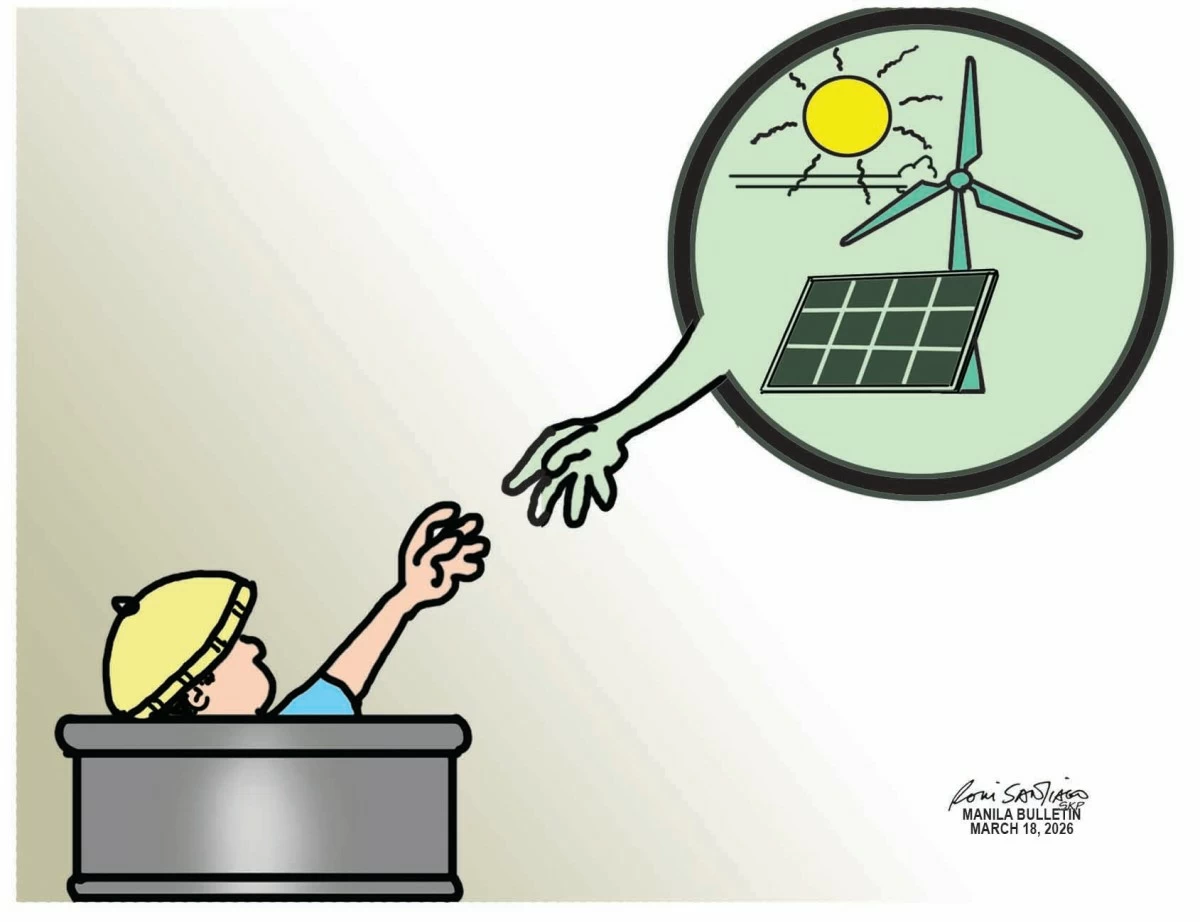
Ensure energy security; boost renewable power generation now


Published Mar 18, 2026 12:05 am | Updated Mar 17, 2026 06:11 pm
Everyone is feeling the pinch of the oil price shock.
Each escalation of conflict in the Middle East sends this familiar shock through the Philippine economy. Oil prices surge, fuel costs rise, and the consequences cascade quickly—from increased prices of basic goods and higher cost of transport to mounting inflation. These disruptions occur because the Philippines remains heavily dependent on imported fossil fuel. Every geopolitical tremor in oil-producing regions reverberates in the daily lives of Filipino consumers.
This recurring vulnerability should compel policymakers to reassess how the nation approaches energy policy. Renewable energy must no longer be treated simply as environmental compliance or as a regulatory requirement under the Renewable Energy Act of 2008. It must be recognized for what it truly is: a pillar of national economic security.
Countries that invested early in renewable energy have demonstrated how strategic foresight can reduce exposure to global oil shocks. Nations such as Denmark, Germany, and Iceland have built energy systems that rely heavily on wind, solar, and other renewable resources. Their economies are not immune to global energy fluctuations, but they are far less vulnerable because a significant share of their power is produced domestically from inexhaustible sources.
The Philippines possesses similar advantages. With its tropical climate and long coastlines, the country has vast potential for solar and wind energy. Sunlight is abundant around the archipelago, while strong wind corridors—from Northern Luzon to the Visayas and offshore waters—could support large-scale wind generation. In practical terms, the country has the natural resources required to reduce its reliance on imported fossil oil. What remains lacking is decisive policy momentum.
The executive branch must begin by elevating renewable energy development to a central national priority. Energy independence should be pursued with the same seriousness given to food security or fiscal stability. Clear and ambitious national targets for renewable generation would send a powerful signal to investors that the government is committed to a long-term transformation of the energy sector.
Equally urgent is the removal of regulatory barriers that slow investment. Renewable energy projects often face prolonged permitting processes, overlapping approvals, and bureaucratic uncertainty. A streamlined, single-window system for permits would dramatically speed up project timelines and reduce the financial risks that discourage investors.
Legislators also have a critical responsibility. Congress must strengthen the country’s policy framework by expanding fiscal incentives that encourage investment in renewable infrastructure. Tax holidays, duty-free importation of renewable energy equipment, and accelerated depreciation schemes can significantly reduce the cost of entry for developers. At the same time, lawmakers must support the modernization of the national grid so that electricity generated from remote wind and solar facilities can be efficiently transmitted to urban and industrial centers.
The private sector, for its part, should recognize that renewable energy is not merely a corporate social responsibility initiative. It is an economic opportunity. Large corporations can accelerate the transition by investing in rooftop solar installations, entering long-term renewable power purchase agreements, and supporting the financing of renewable projects. Such commitments create stable demand, which in turn encourages further investment and technological innovation.
Financial institutions likewise play an indispensable role. By expanding green financing and prioritizing capital for renewable ventures, banks and investment funds can help mobilize the resources necessary for large-scale energy transformation.
The lesson from today’s oil price volatility is unmistakable. Dependence on imported fossil fuel exposes the Philippine economy to risks it cannot control. Renewable energy offers not only environmental benefits but also strategic resilience.
The Philippines cannot control global oil prices or geopolitical tensions. But it can control its energy future—whether it continues to remain vulnerable to them, or it builds an energy system strong enough to withstand them.

How do you pronounce the German word 'ich'?


 · 
My proficiency bounces between fluent and conversational.

They are a combination of regional variation, and foreign accent, depending on the context.

When in the context of native speakers, what you are referring to is the Ich-Laut

Many Germans in regions which historically spoke Low German languages, such as Berlin, pronounce ich [ɪk]

Germans from regions which historically spoke Ripuarian-Germanic languages, or Germans who still speak a Ripuarian-Germanic language (such as Kölsch) as their first language, pronounce ich [ɪɕ], [iɕ] or [iʃ] [ɪʃ]. The vowel can change a bit.

Native High German speakers, from regions that have spoken High German for hundreds of years, and speakers who want to emulate them pronounce it [ɪç]. [ç] is sort of like the palatalized English h-sound in the word "hue", but at the end of a word.

From experience, many German speakers in Berlin will say it [ɪk] but mich [mɪç] because saying "Mick" is very stigmatized and sounds, as one German speaker put it, like "Mickey Mouse".


Native English speakers tend to pronounce those words like [ɪk] or [ɪʃ].

Doing things from the heart


In a world that constantly asks "what's in it for me?", choose to be the person who gives without expecting absolutely anything in return. True kindness isn't a transaction. When you do something out of pure love, compassion, or empathy, the beautiful energy you put out into the world is never wasted. Whether it's helping a stranger, supporting a friend, or giving water to a thirsty bird, acts done from the heart will always enrich your soul. 🐦🤍


EACH FOR HIMSELF


The phrase “every man for himself” has deep roots in English history. Its earliest known appearance is in Geoffrey Chaucer’s The Knight’s Tale (late 14th century), where he wrote “Ech man for him-self, ther is non other.” This conveyed the idea of individuals prioritizing their own survival or interests over collective responsibility. By the 16th century, the fuller proverb “Every man for himself and the Devil take the hindmost” was in circulation, emphasizing ruthless self-preservation in times of danger or competition. The expression became popular in contexts of escape, conflict, or scarcity, where helping others might jeopardize one’s own safety. Over time, it evolved into a broader cultural cliché symbolizing individualism and the abandonment of cooperation when stakes are high. Its endurance reflects both the darker side of human nature and the pragmatic instinct to survive. 


Yes, each person does what is best for himself or herself. Yes, times are getting tougher. I think you, my dear readers, know what I am talking about. No reason to list everything again. Sometimes, there is no team spirit in this office; it’s definitely every man for himself. Neighbors would tell each other: mind your own business. The tone between us humans is becoming more and more harsher.


Some people live alone because friends and families have abandoned them. Important helpline is Psalm 27:10 for them. “When my father and my mother forsake me, then the LORD will take care of me.”


And solitary survivors like Robinson Crusoe, or the hero in the movie Castaway, fascinate. But the loner is someone who purposely holds himself aloof, like the Unabomber, Mathematician Ted Kaczynski. People doggedly moving ever farther away from one another constitute hell in C.S. Lewis’ book, The Great Divorce.


Fact is  –  Proverbs 18:1 says:  A man who isolates himself seeks his own desires; he rages against all wise judgment.


Living in community and helping one another is foundational for all who wish to follow Christ. We know from Acts 2 that the early church took this seriously, seeing many examples of believers helping one another, including materially, so that there would be no one in need within their group.


Much has been written about the benefits of strong relationships. I wrote about it at this corner several years ago. People are healthier, live longer, and are generally happier if they have strong friendships beneficial for helping and encouraging each other. And let me repeat it – especially during these tough times … .