You plan to move to the Philippines? Wollen Sie auf den Philippinen leben?

There are REALLY TONS of websites telling us how, why, maybe why not and when you'll be able to move to the Philippines. I only love to tell and explain some things "between the lines". Enjoy reading, be informed, have fun and be entertained too!

Ja, es gibt tonnenweise Webseiten, die Ihnen sagen wie, warum, vielleicht warum nicht und wann Sie am besten auf die Philippinen auswandern könnten. Ich möchte Ihnen in Zukunft "zwischen den Zeilen" einige zusätzlichen Dinge berichten und erzählen. Viel Spass beim Lesen und Gute Unterhaltung!


Visitors of germanexpatinthephilippines/Besucher dieser Webseite.Ich liebe meine Flaggensammlung!

free counters

Total Pageviews

Tuesday, April 14, 2026

UPLIFT: Pragmatic crisis response for people's welfare


By Manila Bulletin

Published Apr 14, 2026 12:05 am


The government’s response to external shocks is often judged not by the scale of its spending but by the precision of its intervention. In this regard, the April 9 announcement by Ferdinand Marcos Jr. of targeted relief measures under the Unified Package for Livelihoods, Industry, Food, and Transport (UPLIFT) committee reflects a calibrated and pragmatic approach to a rapidly evolving crisis triggered by renewed conflict in the Middle East.

At the core of the initiative are two key components: the grant of a service contracting subsidy to 50,000 public utility vehicle (PUV) operators, and a 20 percent fare discount for commuters. These measures are clearly designed to stabilize public transportation, a critical artery of the Philippine economy,—while easing the burden on ordinary Filipinos already reeling from rising fuel costs and inflationary pressures.Philippine Travel Guides

Unlike broad-based ayuda or traditional dole-out schemes, the UPLIFT interventions are purposeful and sector-specific. They recognize that shocks such as surging oil prices do not affect all sectors equally. Transport operators face immediate cost escalations that threaten their viability, while commuters—especially minimum wage earners and informal sector workers—bear the brunt through higher daily expenses. By directly addressing both supply (PUV operators) and demand (commuters), the program strikes a balance that promotes continuity rather than mere temporary relief.

Targeted support ensures that limited government resources are deployed where they are most needed and where they can generate the greatest stabilizing effect. This approach is a welcome departure from past practices where blanket subsidies often led to inefficiencies, leakages, and fiscal strain.

However, the unfolding geopolitical situation underscores the need to extend this calibrated strategy to other vulnerable sectors.

Agriculture, for instance, remains highly sensitive to fuel and input cost increases. Farmers and fisherfolk require support mechanisms such as fuel subsidies, access to affordable credit, and investments in climate-resilient technologies to sustain productivity and prevent food price spikes.

In trade and industry, particularly among micro, small, and medium enterprises (MSMEs), rising energy and logistics costs can erode already thin margins. Targeted assistance—whether through tax relief, credit facilities, or supply chain support—can help businesses stay afloat and preserve employment.

The energy sector itself demands close attention. While the government has declared a national energy emergency, more granular interventions are needed to cushion consumers and encourage efficiency. Investments in renewable energy and incentives for conservation must be accelerated to reduce long-term vulnerability to global oil price volatility.

Tourism, which is still in recovery mode, is another sector at risk. Higher travel costs could dampen both domestic and international demand. Strategic promotions, infrastructure support, and targeted incentives can help sustain momentum.

Housing and urban development also warrant focus, particularly for low-income families whose budgets are squeezed by rising costs of living. Measures that ensure affordability and access to basic services will be crucial in maintaining social stability.

Finally, there is a compelling case for extending support to members of the Social Security System (SSS) and the Government Service Insurance System (GSIS). Temporary relief measures—such as loan payment moratoriums or flexible terms—can provide much-needed breathing space for workers navigating uncertain economic conditions.

The UPLIFT initiative demonstrates that government action need not be indiscriminate to be effective. On the contrary, precision, timeliness, and responsiveness are the hallmarks of sound policy in times of crisis. As external pressures mount, the challenge is to sustain this targeted approach across sectors, ensuring that no vulnerable group is left behind while preserving fiscal discipline.

In an increasingly volatile world, resilience is built not only on resources but on the wisdom to deploy them well.

Monday, April 13, 2026

Jessica Sanchez on balancing career comeback, motherhood: My daughter runs my schedule


Nathalie Tomada - The Philippine Star 
Jessica Sanchez on balancing career comeback, motherhood: My daughter runs my schedule
Jessica Sanchez has opened up how motherhood — she’s mom to months-old daughter named Eliana May with husband Rickie Gallardo — has completely changed her life.     

MANILA, Philippines — Following her “America’s Got Talent” big win late 2025, Jessica Sanchez is set to headline her Philippine homecoming concert on May 16 at the Smart Araneta Coliseum, marking the kickoff of her “Seasons” world tour.

And this time, the powerhouse vocalist is taking on more than rehearsals and recordings, she’s doing it all as a first-time mom.

She described how motherhood has quickly become both her biggest joy and her toughest challenge.   “I love it. It’s the most amazing thing. It’s the biggest challenge I think I’ve ever gone through. It’s taught me how to be a stronger woman and I just love it. I love my baby girl and I love being a mom,” she said during a recent virtual press interview.

“I have baby fever with my baby. And they grew up so fast. It feels like yesterday she was just a newborn and now she’s this chunky girl. So I’m like, what’s going on?

“And plus I want her to have a little brother, sister very, very soon. But hopefully, you don’t hear me announcing on the stage in May I’m pregnant,” she quipped.

One thing’s certain, this new role has reworked her everyday life in ways she never imagined.

“I thought being on ‘AGT’ nine months pregnant was a challenge. But the first two weeks postpartum was probably the craziest experience I’ve ever gone through in my life. The hardest. I had no sleep and I didn’t realize that, you know, after giving birth, you’re like, immediately a mom, and it’s like go time and there’s no stopping,” she shared.

Now past five months postpartum, Jessica said she’s learning to embrace the unpredictability that comes with parenting.

“And honestly, my daughter, she runs my schedule, so she’s the boss. And I’ve learned to love it and just kind of listen to her and get into a flow,” she said.

That adjustment comes as she prepares for a packed schedule, including a new album, her first all-Tagalog EP and an international tour.

“Preparation is crazy... This is like a whole new level. Being a new mom, like, has really, you know, strengthened me as a woman. It’s really fun and exciting and also crazy just trying to figure out how to navigate my days,” she admitted.

“Because not only am I a new mom, but I’m also working on an album and a Tagalog EP and getting ready for the concert. Also other gigs that are going on. I’m just trying to do my best.”

Even simple things like travel now come with added layers of planning.

“It has been a little crazy traveling. I’ve been trying to figure out my travel situation with the baby,” she said, noting that details for her tour stops are still being finalized.

Aside from these, motherhood likewise changed how she uses her voice.

“The hormones have been really difficult. I think it’s been harder to figure out my voice than it was when I was pregnant because of all the hormones that have been happening in my body.

“But I am working with, you know, an amazing vocal coach out here who really knows the scientific process of the vocal cords.

“He’s been teaching me a lot and helping me kind of regain that strength and how to sing in a healthier way. So I am giving you guys the best of the best for May.”

Amidst her hectic schedule nowadays, Jessica finds it fulfilling that she now has a mini-me to share her passion for music with.

“It’s so funny because here’s a little story. When I was on ‘AGT’ and I sang Golden Hour, that’s the song that she would really kick inside my belly to all the time. Every time. Every time I sing it now that she’s here, when we play it on YouTube, she calms down,” she shared.

“Every time she’s screaming, when we play it, she stops crying. She actually really enjoys my singing, which is really sweet.”

She continued, “I feel like she’s gonna naturally want to sing because I’m always singing to her and I’m always playing music. Whether she wants to be a singer professionally, like, that’s up to her, but I think she’s gonna love music,” she said.

Motherhood has also influenced her artistry, pushing her to venture into a more emotional direction in her music.

“I’m just embracing my emotional side and I really want to give my supporters what they’ve been asking for, which is the vocals and just the deeper lyrics,” she said.

“I’m excited to release more music and release those kind of songs.”

Jessica couldn’t stress enough how grateful she is for this phase in her life, experiencing personal fulfillment and career momentum.

“It’s been a little crazy, but I am so grateful and so blessed to be able to have these opportunities,” she said.

“And I just cannot wait to land in the Philippines, give you guys an amazing show.”

Tickets to the concert, presented by Wilbros Live and co-produced by RS Francisco of Frontrow, are now available on Ticket World outlets and website.

Women find success in a digital world


Linda Bolido

Women leaders who have successfully navigated an increasingly technology-driven world took center stage at the recent Inquirer Women of Power awarding ceremonies, an event that underscored how leadership today is being reshaped by both innovation and intent.

Across the two-part gathering, which included the Women of Power Summit themed Guarding Legacies, Guiding Generations, honorees and attendees demonstrated a shared understanding: leadership in this era demands the ability to apply technology with clarity, responsibility, and purpose.

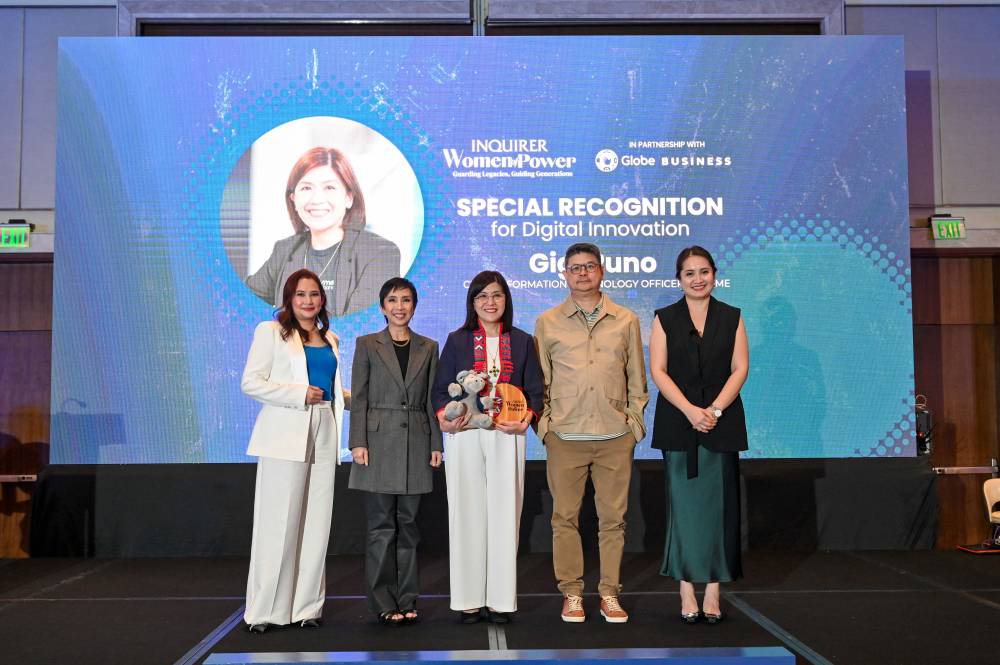
Globe Business Special Recognition for Digital Innovation recipient (center): Gigi Puno, chief information and technology officer of GoTyme with presenters.

As co-presenter, Globe Business highlighted women who are actively shaping this shift. Filipina leaders who are driving meaningful transformation within their organizations while ensuring that technology remains grounded in human insight and real-world impact need to be celebrated. These are women advancing their industries and influencing how innovation is designed, governed, and sustained.

Globe Business Special Recognition for Enterprise Excellence recipient (center): Leah Gonzales, artist and repertoire director of 1Z Entertainment with presenters.

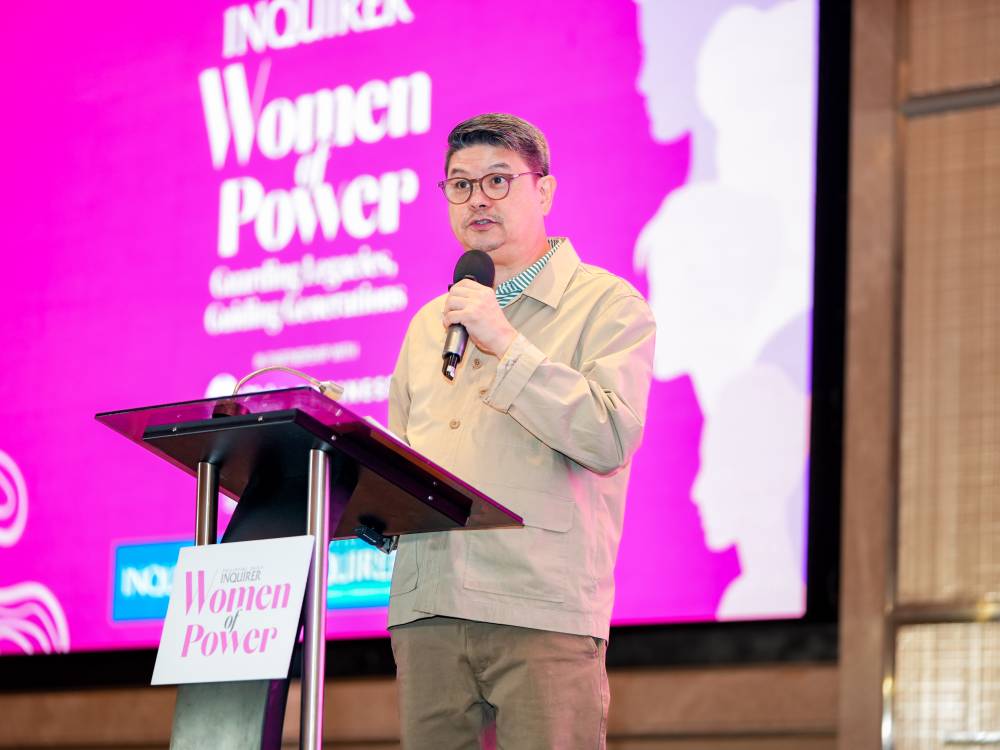
Globe Business shared that the strategic intent behind every innovation should be considered equally important as the pace of implementation. As KD Dizon, Vice President and Head of Globe Business, emphasized at the summit, true leadership is anchored in the “why” behind the technology. By focusing on how tools create meaningful value for enterprises and society, the company champions putting people first. This human-centric approach is fueled by a long-standing commitment to empathy, collaboration, and malasakit.

Paolo Prieto, president of Inquirer Interactive Inc., delivers the closing message at the 2026 Women of Power Awards.

At the heart of the celebration was the Globe Business Special Recognition, which honored women who exemplify leadership across three key areas:

DIGITAL INNOVATION – for leading initiatives that drive transformative change through technology and digital solutions

ENTERPRISE EXCELLENCE – for demonstrating leadership and strategies that advance business growth and organizational impact

EMPOWERMENT THROUGH INNOVATION – for harnessing innovation to uplift communities, teams, or industries

Alexandra Prieto-Romualdez, chairperson of Inquirer Interactive Inc., delivers the opening remarks at the 2026 Women of Power Awards.

Each awardee reflected a different facet of leadership in action, but all shared a common thread: the ability to turn technology into something purposeful, measurable, and inclusive.

Beyond the formal program, the event created space for connection and exchange. Attendees engaged in conversations with peers across industries, shared experiences, and built new networks. Moments of celebration—from candid interactions to creative photo installations—captured the energy of a community that continues to grow in both influence and impact.

SEE ALSO

Panel discussion on Passing the Torch: Leadership Across Generations

For the awardees, the evening marked a recognition of their contributions and the paths they have forged. For the broader audience, it offered something equally valuable: direct insight into how today’s most effective leaders think, adapt, and move forward.

More than a celebration, the Inquirer Women of Power served as a reminder that the future of leadership is already taking shape—driven by women who are choosing to lead with purpose, act with intention, and build systems that enable others to succeed alongside them.

******

Between dream and duty


By Sam Azalae Pepito

When I was a child, I carried a ready-made answer to a question adults loved to ask.

“What do you want to be when you grow up?”

I never paused. I never hesitated: “A civil engineer.”

It came out of my mouth as naturally as saying my name. No matter who asked—relatives, teachers, neighbors—the answer stayed the same. Maybe it was because I had relatives who were engineers. Maybe it was because I could already imagine myself in that world. Or maybe it was because, early on, I believed that building things meant I could also build a place for myself in this world.

In elementary school, I often brought home “Best in Math” ribbons. In junior high, I realized it was more than luck. Numbers felt familiar to me. I wasn’t afraid of them; in fact, I felt at home. I joined contests, sat in the front row during quizzes, and collected medals and certificates that quietly told me I belonged here.

Senior high school felt like confirmation. I took the STEM (Science, Technology, Engineering, and Mathematics) strand, survived calculus and physics, stayed on the principal’s list, and spent long nights with formulas and problem sets. Every recognition felt like a step closer to the person I had been claiming to be for years. College was no longer just a dream. It was a door I was about to open.

I’m almost a civil engineer, almost there.

Or so I thought.

A few weeks before enrollment, my mother talked to me. There was no sermon. No forcing. Just a simple conversation that carried unexpected weight.

“Have you considered accountancy?” she asked.

She mentioned my aunt. Stable job. Comfortable life. Able to travel. No constant worry about money. As she spoke, I realized it wasn’t really about a course. It was about security. About a future where I would not struggle the way she once did.

I didn’t want to agree. I never imagined myself working with financial statements. This was not the answer I had been rehearsing since childhood.

But another question slowly replaced my certainty: Whose dream have I really been chasing?

I have always wanted to make my mother proud. Many of my achievements, even the ones I rarely talk about, were partly for her. So when it came time to choose, I wasn’t just choosing a program. I was choosing between two versions of myself—the child with a dream, and the son who carries gratitude and responsibility.

I chose what she wanted.

Entering the Bachelor of Science in Accountancy (BSA) program was my first real shock. Being “good at math” was not enough. The world I knew disappeared. Variables were replaced by vouchers. Equations by transactions. Logic by layers of rules, standards, and procedures.

In high school, I studied hard, but I also studied with confidence. In accountancy, I studied with fear.

Not because I was stupid. But because I was humbled.

I used to rely on instinct. In BSA, instinct does not save you. You need discipline. You need process. You need to start over even when you feel you should already know better. And that hurts the ego.

I told myself it would be easy. It’s math-heavy after all. I was wrong.

There were nights I stared at the same problem for hours and still did not understand it. Days when I went straight to bed after class, not because my body was tired, but because my heart was. I cried to my parents more than once.

“Ma, I think I might fail.”

Sometimes they would ask, “Do you want to shift?”

And every time, something inside me tightened.

“I don’t want to.”

Not because I love accountancy. Not because this is my dream. But because shifting feels like losing to a decision I agreed to. Losing to the promise I want to keep. Losing to the version of myself who wants to be someone reliable.

So I stay.

Not heroically. Not beautifully. Most days, I stay simply because I’m tired but still breathing.

Here, I learned that sacrifice is not always dramatic. Sometimes it looks like sleepless eyes. Like coffee at dawn. Like walking into class even when you want to turn back.

I used to think success meant being excellent. Now I’m learning that sometimes, success means being resilient.

I cannot say I love this program. But it matters to me. Because it represents a choice I made not only for myself, but for the first person I ever loved in this world.

Still, I wrestle with a question: How far should a child’s duty go?

I care is a moral act, then choosing BSA is my way of caring. But I also wonder—does self-offering have a limit?

I don’t know the answer yet.

What I do know is this: every day I choose to continue, I repeat a promise to myself.

I will finish this degree.

I will take the board exam.

I will pass.

Not because this was my first dream. But because I have learned that dreams can change shape—and still carry meaning.


Sunday, April 12, 2026

Lady Falcons outclass Tigresses anew, bolster semis bid


 Adamson repeats over UST to boost its Final Four bid. (UAAP Media)


By Mark Rey Montejo


After two games, it appeared that Shai Nitura and Adamson had already identified the vulnerabilities of the University of Santo Tomas.

It was a tighter battle this time, but the outcome remained the same as Nitura and the Lady Falcons reaffirmed their mastery with a 27-25, 25-20, 26-24 win over the Golden Tigresses to boost their Final Four return bid in the UAAP Season 88 women’s volleyball tournament Saturday, April 11.

With a decent crowd inside the FilOil EcoOil Centre in San Juan City, Adamson, steered by Nitura and Frances Mordi, showed grace under pressure after unleashing timely counters to overcome UST’s late rally, especially in the third, to improve to 7-5.

Adamson tied the España-based squad in the standings where they stay within the Top Four race. Far Eastern University, which clashes with UST on Sunday, April 19, is still at No. 5 with a 6-5 card.

In the battle of former Rookie of the Year winners and this year’s MVP contenders, Nitura took the spotlight with a statline of 19 points, 10 excellent digs, and 14 excellent receptions, while Poyos led UST with 15 points, five digs, and 12 receptions in a losing effort.

Also impressive for the JP Yude-mentored crew was Mordi who tallied 18 points, five digs, and 11 receptions. Lhouriz Tuddao and MJ Aseo added eight and six points, respectively, while Fhei Sagaysay unloaded 21 excellent sets on top of seven points and seven digs.

Reg Jurado aided Poyos offensively with nine points that came with nine digs, while Avril Bron and Jonna Perdido conspired for 15 points.

Meanwhile, UST kept its poise as it withstood Adamson’s early surge and carved out a hard-earned 32-30, 18-25, 25-18, 25-17 win to secure its fourth straight semis appearance.

The Golden Spikers struggled to find their rhythm early despite prevailing in a tightly contested opening set. But behind Josh Ybañez and second-string setter Joshua Avila, UST regrouped in the third and fourth, where they seized enough separation they preserved to hold off a determined Soaring Falcons side.

UST’s 8-4 card is good for the No. 3 spot, joining Far Eastern University (10-1) and reigning champion National University (9-2) in the semis. One semis spot is left with either Ateneo (7-5) or De La Salle (5-7) taking the precious ticket depending on the results of their next games.


Why the PCC must act on oil prices now


At a time when global instability is driving fuel prices upward and ordinary Filipinos are forced to stretch already thin budgets, the warning from Economic Secretary Arsenio Balisacan should not be ignored. His candid invocation of “Economics 101” during a House hearing cut through layers of technical language and political caution: In markets dominated by only a few major players, coordination, implicit or explicit, becomes dangerously easy. And where coordination thrives, the line between competition and collusion can blur.
The Philippine oil industry, governed by the Downstream Oil Deregulation Law of 1998, was built on the promise that deregulation would unleash competition and deliver lower prices. Decades later, that promise rings hollow. Weekly price adjustments move almost in lockstep across companies, creating the widespread perception, fair or not, that competition is more illusion than reality.
Balisacan stopped short of making a definitive accusation, but his logic was unmistakable, something that was not lost on House Legislative Energy Action Development (LEAD) Council presiding officer Marikina City Rep. Miro Quimbo, who had asked him to repeat it for clarity. A highly concentrated market structure creates fertile ground for cartel-like behavior, Balisacan explained. He even pointed to the Organization of the Petroleum Exporting Countries as an example of how coordination among a few dominant players can shape outcomes. The implication for the Philippines is troubling. If similar dynamics are at play locally, then the burden of proof, and action, falls squarely on regulators.
Yet the Department of Energy is structurally limited. Its mandate under deregulation prevents it from directly controlling prices. It can monitor, it can explain, it can appeal—but it cannot intervene decisively when market behavior raises red flags. This leaves a dangerous gap at a time when decisive oversight is most needed.
That gap must be filled by the Philippine Competition Commission (PCC).
The PCC was created precisely for moments like this—to ensure that markets remain fair, competitive, and free from abuse. It has the legal authority, investigative tools, and independence to determine whether parallel pricing behavior is the natural outcome of global cost pressures or the product of anti-competitive coordination. And if violations are found, it has the power to prosecute and penalize those responsible.
We should not dismiss this simply as a technical or economic issue. This is a moral one. Every peso added to fuel costs ripples through the economy, raising transport fares, inflating food prices, and eroding the purchasing power of millions. For jeepney drivers, delivery workers, and minimum-wage earners, these increases are existential. To exploit such vulnerability, whether deliberately or through indifference, is to deepen inequality and hardship. So, let’s not widen the economic and social gaps.
The oil industry, for its part, must also reflect. Profit is not inherently unjust, but profit divorced from social responsibility, especially during a crisis, invites public outrage and regulatory backlash. These companies do not operate in a vacuum; they exist because of the very consumers now bearing the brunt of rising costs. Moderation, transparency, and genuine competition are not acts of charity, they are social obligations.
The moment calls for vigilance and courage. The PCC must act swiftly to investigate patterns, scrutinize pricing behavior, and, if warranted, bring cases forward without hesitation. At the same time, oil companies must recognize that public trust is as vital as profit margins. Social responsibility must always be paramount.
When markets fail to protect the people, institutions must rise to the occasion. The Filipino public deserves nothing less.

PHILIPPINES IS ON FIRE

As of 10:00AM, April 12, 2026
Hot, humid weather is currently prevailing across the Philippines, driven by a ridge of a high-pressure area (HPA).
This system Brings warm, dry, and stable air, restricting cloud formation and increasing temperatures, often resulting in dangerous heat indices between 42°C and 51°C in certain areas.
The temperatures in the Philippines area are increasing due to man-made global warming.
May be an image of tornado and text that says 'Manila To. Batangas ឆី रववेय อ oButuan otaKinabalu abalu Zamboanga Seri wan Sandakan General GeneralSantos Santos'

All reactions:
315

4 dead as cargo truck crashes into gym in Davao City


By Keith Bacongco


FOUR persons were killed in a horrific accident in Barangay Marilog, Davao City on Saturday. (Iroy Wrecker the Rescuer)

DAVAO CITY – Four persons were killed after a cargo truck crashed into a gymnasium in Barangay Marilog here on Saturday morning, April 11.

The Davao City Police Office said a tire of the 10-wheel truck reportedly burst and the driver lost control of the vehicle. The truck hit the gymnasium where an activity was ongoing.

The driver, helper, and two bystanders died on the spot. Their identities are pending verification as of posting time.

The truck hit several parked vehicles before it turned upside down in front of the barangay hall.

Photos and videos online showed the partially damaged gymnasium on the Bukidnon-Davao Highway. The steep and winding sections of the road is an accident-prone area.

'Pantropiko' to the world: BINI conquers Coachella


Published Apr 12, 2026 08:48 am
ABS-CBN’s girl group BINI made history as the first Filipino act to perform at the Coachella Valley Music and Arts Festival, taking the stage on Friday, April 10, in the United States — a landmark moment for OPM and Philippine music on the world stage.
BINI (Images courtesy of ABS-CBN/Coachella)
They performed 10 songs during their 45-minute set at the Mojave stage of the festival, held in Indio, California, which drew music fans from all over the world.
BINI opened with “Shagidi,” then moved through “Zero Pressure” and “Out Of My Head.” They brought the crowd to their feet with Filipino favorites “Karera” and “Salamin, Salamin,” before delivering “Blink Twice” and “Cherry on Top.” The set also featured the live debut of new track “Blush,” followed by “Bikini,” and a rousing finale with “Pantropiko.”
Throughout the set, members Aiah, Colet, Maloi, Gwen, Stacey, Mikha, Jhoanna, and Sheena took moments to express their gratitude for the chance to represent the Philippines on one of music’s grandest stages.
“We are so grateful to be here to represent the Philippines on a global stage and to share with you guys our music,” said Aiah.
“Being here with all of you has been the sweetest ‘cherry on top’ of our journey so far,” shared Maloi.
Fan support flooded in before, during, and after the performance, which was livestreamed live on the official Coachella YouTube channel.
#BINI_CoachellaWk1 shot to the top of worldwide trending topics on X, topping charts in the Philippines and the United Arab Emirates, reaching #2 in Canada and Singapore, #5 in Australia, and #6 in both Puerto Rico and the United States.
Several other BINI-related topics also trended, including Pinoy Pride, BINICHELLA, Mojave, Walo, Blink Twice, Salamin Salamin, Karera, Zero Pressure, Cherry on Top, Shagidi, and Pantropiko. The headline “BINI Makes History as First All-Filipino Act at Coachella 2026” further trended under X’s Today’s News section.  

Back home, fans — known as Blooms — gathered for watch parties across Metro Manila and surrounding cities, organized by the fan group BLOOM Philippines.
BINI is set to return to the Coachella stage for their second weekend performance on Saturday, April 18 (PHT).
Catch a replay of BINI's performance on the Coachella YouTube channel. For the latest updates, follow BINI on Facebook, X (Twitter), Instagram, TikTok, and YouTube, or visit bini.abs-cbn.com. Join the BINI superfan community on WeVerse — available on the website or via the WeVerse app.

Saturday, April 11, 2026

Ancient seafarers' story of love, identity, and belonging takes center stage in this ballet


Ballet Philippines to close its 56th season with 'Paglalakbay: 

The Journey of the Sea People'

Published Apr 9, 2026 10:54 pm
Ballet Philippines successfully concluded the world premiere run of "Paglalakbay: The Journey of the Sea People," a full-length original Filipino ballet that captivated audiences from April 10 to 12, 2026, at The Theatre at Solaire. The production marked a defining close to the company’s 56th season and a bold step in championing Filipino narratives on the classical stage.
Inspired by the Austronesian Migration, “Paglalakbay” tells an epic yet intimate story of movement, identity, and belonging. It follows ancient seafarers in search of a new home, centering on Ama and Kaman in Batanes, whose love endures trials of loss, transformation, and renewal, reflecting a timeless search for home across generations.
Choreographed by artistic director Mikhail Martynyuk, with a libretto by Sheree Chua and music by Ronald Vincenzo Khaw de Leon, the ballet reimagines classical technique through a distinctly Filipino lens.
“Academic technique is a form, not a style,” Mikhail shared. “In ‘Paglalakbay,’ choreographic language becomes the main narrator,” grounding movement in the forces of wind, land, and sea.
For Sheree, the work is both cultural and deeply personal. “Migration is often framed as displacement, but it can also be expansion,” she said. “This ballet becomes both historical and intimate.”
The production’s immersive design, led by Leeroy New, brought Batanes to life onstage, drawing from the team’s firsthand cultural immersion with local communities. This experience stemmed from Ballet Philippines’ Ballet Brigade outreach in Batanes, where artists engaged with over 200 locals.
“‘Paglalakbay’ was a bold investment for the company,” said Ballet Philippines president Kathleen Liechtenstein. “It reflects our belief that local indigenous stories deserve the grand scale and artistic rigor of the classical stage.”
Praised for its powerful storytelling and cultural resonance, “Paglalakbay” reinforces Ballet Philippines’ continuing mission: to bring Filipino stories to the forefront—epic, resilient, and universally human.
For more information on Ballet Philippines and its upcoming productions, visit www.ballet.ph
.