You plan to move to the Philippines? Wollen Sie auf den Philippinen leben?

There are REALLY TONS of websites telling us how, why, maybe why not and when you'll be able to move to the Philippines. I only love to tell and explain some things "between the lines". Enjoy reading, be informed, have fun and be entertained too!

Ja, es gibt tonnenweise Webseiten, die Ihnen sagen wie, warum, vielleicht warum nicht und wann Sie am besten auf die Philippinen auswandern könnten. Ich möchte Ihnen in Zukunft "zwischen den Zeilen" einige zusätzlichen Dinge berichten und erzählen. Viel Spass beim Lesen und Gute Unterhaltung!


Visitors of germanexpatinthephilippines/Besucher dieser Webseite.Ich liebe meine Flaggensammlung!

free counters

Total Pageviews

Tuesday, March 31, 2026

Remove excise tax, VAT on oil products and essentials


Published Mar 31, 2026 12:05 am | Updated Mar 30, 2026 06:21 pm
UNDER THE MICROSCOPE
With the bill granting the president emergency powers regarding the energy crisis already passed, the president should not just reduce the excise tax on fuels. Rather, he should totally remove it, even temporarily, to give the people some breathing space amid the tightening fuel supply and soaring fuel prices.
He should also suspend the value-added tax, not only on fuels but on all necessities. Although VAT is levied on all purchases, its effects are far greater on those who are on the fringes (laylayan) who can barely keep body and soul together. It is a regressive tax, taking a larger percentage of income from low-income households compared to higher income households. The poverty incidence in the Philippines (those unable to buy both basic food and non-food needs) was 22.4 percent, or three million families. On the individual level, it was 15.5 percent, or 17.54 million individuals in 2023. These rates are higher in Mindanao and the Cordilleras. Those three million families reported experiencing involuntary hunger. They may not have anything to eat at all soon.
The middle-income earners are not exempt from the effects of VAT. The more you consume, the higher the amount of VAT you pay. With the oil crisis, we can expect more middle-income earners at the lower level to join the impoverished. Although the middle class are 39.8 percent of the population, those earning ₱24,000 and even a little higher will be in danger of joining the poor. They are also be vulnerable to economic shocks, such as a serious illness in the family, or losing their jobs.
Subsidies are generally limited in amounts. The transport sector will be given subsidies, but these are more often one-time dole-outs and have no lasting effects. They are also very limited in scope. More often than not, politicians make a big show out of handing out subsidies, in aid of re-election.
At the country level, a one percentage point increase in the VAT rate is associated with a 2.802 percent decline in average nominal wages. The same increase will produce a 1.444 percent decline in employment. So, while the government enjoys a windfall with VAT collection, the people, especially the great majority of Filipinos, will suffer more.
We are not in the critical phase of this war-induced economic downturn yet but it will definitely get a lot worse before it gets better. Already, we are feeling the inflationary effects of the oil price increases in terms of higher prices on practically everything that needs to be imported or transported to the point of sale.
The mass transport sector was the first to be affected, with jeepney drivers and operators staging strikes. They were the first to clamor for removing excise taxes and VAT. But the inflationary price spiral will surely hit the average consumer hard. Daily wages which are hardly enough to keep body and soul together, will be even more inadequate in the face of price increases on all necessities-food, clothing and shelter.
As the inflationary effects of the Mid-East crisis accelerate, many more will sink into poverty. The divide between the haves and the have-nots will widen. People will be driven to commit crime to make ends meet in desperation. Parents cannot stand seeing their children starve. There will be social unrest which fringe elements will make the most of and agitate for regime change. This nation, already divided, will face even more fragmentation. The administration, already besieged by multiple crises, should act to ameliorate the effects of this crisis, or it will face challenges to its authority and possibly, destabilization efforts by its enemies, including its former partners. This does not augur well for the Marcos Jr. administration.
The government is set to have a revenue shortfall of ₱121.4 billion with a suspension of the excise tax. Definitely, suspending the VAT on fuel and necessities will cost the government more. The total revenue losses will be around ₱330 billion. It will result in a fiscal deficit, increase national debt, reduce spending on essential social services and development projects, and further reduce government income due to reduced indirect taxation. But we should weigh the costs of lost government revenue with the cushioning of the crisis-induced inflation that will hit every Filipino hard, more so the daily income earner. It’s time to reduce spending on other services. Development projects can wait. Everyone should tighten their belts.
Besides, the revenue shortfall will primarily affect the provision of unprogrammed funds, which are the primary target of corrupt government officials. For the year’s budget, unprogrammed funds have been trimmed to ₱150.9 billion. Without any unprogrammed funds to tinker with, politicians will have less opportunities for dipping their dirty fingers into government coffers. That may well be the silver lining in this scenario.

Over 2,200 personnel deployed nationwide as Philippine Red Cross goes on high alert


Over 2,200 personnel deployed nationwide as Philippine Red Cross goes on high alert

Philippine Red Cross personnel assist travelers at a first aid station during Holy Week operations as millions of Filipinos journey nationwide. (PRC photo)

With millions of Filipinos expected to head to provinces, pilgrimage sites, and vacation destinations, the Philippine Red Cross (PRC) will remain on high alert from March 29 to April 5. Read more

Church urges faithful to practice simplicity this Holy Week


Published Mar 30, 2026 10:11 pm
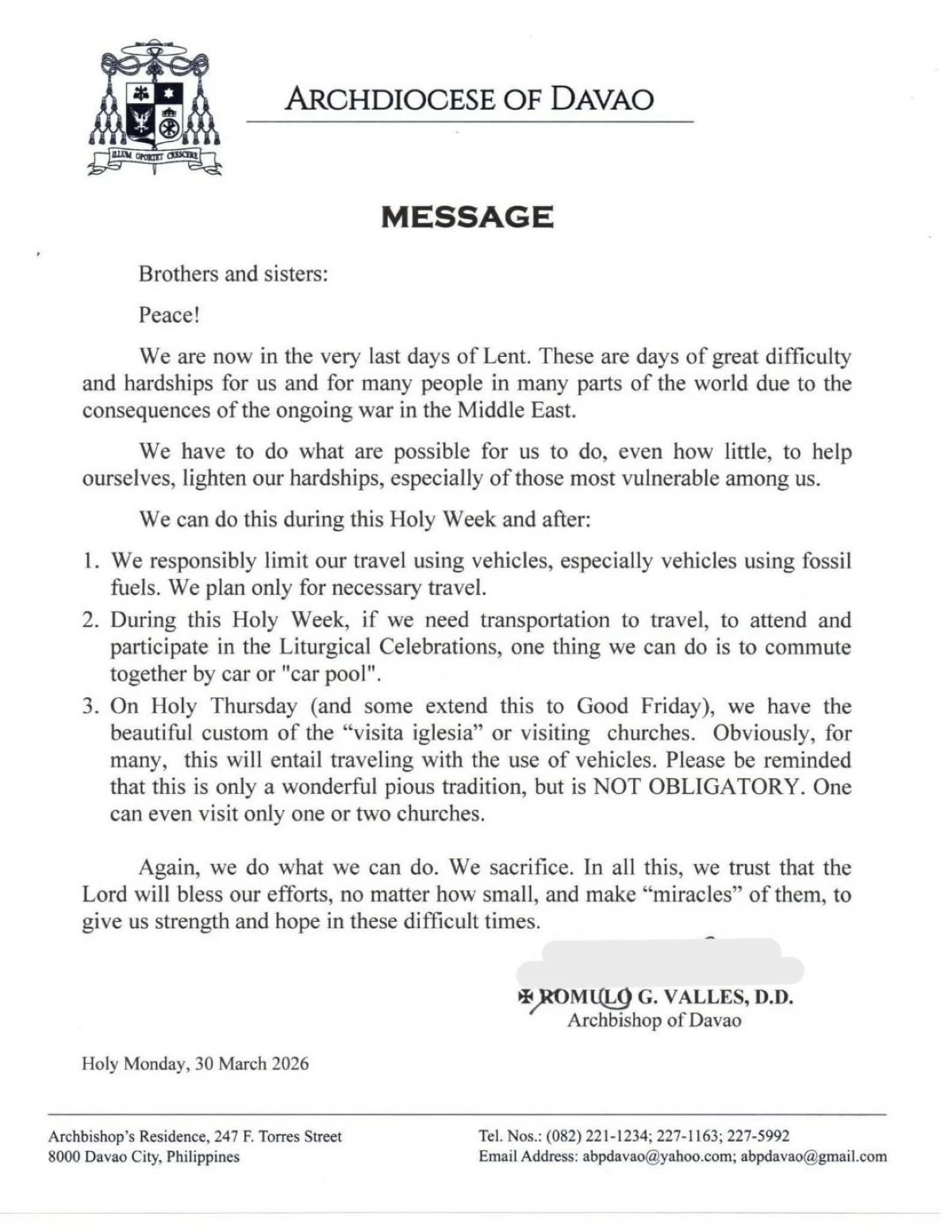
DAVAO CITY – The Archdiocese of Davao called on the faithful on Monday, March 30, to practice responsible travel and simplicity this Holy Week amid global hardships, including the ongoing war in the Middle East.
Archbishop of Davao Romulo G. Valles reminded Catholics to do what they can to help themselves and support the most vulnerable, even in small ways, during Holy Week and beyond.
Valles encouraged limiting vehicle use, particularly those powered by fossil fuels, and suggested planning travel only for essential purposes. He also recommended carpooling when attending liturgical celebrations.
He addressed the tradition of Visita Iglesia or visiting churches on Maundy Thursday and sometimes Good Friday, noting that while this is a beautiful custom, it is not obligatory.
He said the faithful may visit only one or two churches if needed, emphasizing that the spirit of sacrifice and mindfulness matters more than the number of churches visited.
“We do what we can do. We sacrifice. In all this, we trust that the Lord will bless our efforts, no matter how small, and make ‘miracles’ of them, to give us strength and hope in these difficult times,” Valles said.
Valles underscored the Church’s call for reflection, simplicity, and care for the community and the environment during the solemn season of Lent.

Should I share my money?


No, not if we’re talking about a two wage earner household. I’m 55 (almost 56) and I’ve been married twice.

In my first marriage, my wife did whatever she wanted. She spent money freely and racked up huge amounts of credit card debt. I felt betrayed by her not willing to compromise or live well within our means. It was a one-sided relationship. Because I felt like an unequal partner, I treated her differently. I loved her but there was no spark, romance, or interest really. That led to her also being dissatisfied. She eventually met another man that swept her off her feet. The end result, she divorced me, moved to his home state of New Jersey, and left our two teenagers for me to continue raising (not that I would’ve been okay with them moving away from family and friends in their birth city regardless).

I eventually remarried. My wife and combined everything and we have monthly budget meetings. We have a joint checking account where are salaries are direct deposited, savings, CDs, and even joint brokerage accounts. We share the financial burden of operating our household as well as the joy of preparing for eventual retirement and everything in between.

It hasn’t been easy. In fact, the first 10 years of our marriage had quite a few challenges: blended family and in-laws being the biggest but of course money has been up there (how to spend it, where, and how much is okay or not). I’ll say in the last 1–2 years, our relationship has dramatically improved. We decided to be 100% open, transparent, and willing to accommodate our partner’s requests- listen and do our best to come to a compromise. Even if the other person doesn’t really “feel it”. We’ve both had to temper ourselves, our responses, and learn to be better spouses.

So. To answer your second question - should you share your money? If you look at it as yours and not “ours”, then I’d say that’s the first mental challenge you need to overcome. Some things are meant to be shared equally. I think that includes money and certainly time (chores, household responsibilities, etc).