You plan to move to the Philippines? Wollen Sie auf den Philippinen leben?

There are REALLY TONS of websites telling us how, why, maybe why not and when you'll be able to move to the Philippines. I only love to tell and explain some things "between the lines". Enjoy reading, be informed, have fun and be entertained too!

Ja, es gibt tonnenweise Webseiten, die Ihnen sagen wie, warum, vielleicht warum nicht und wann Sie am besten auf die Philippinen auswandern könnten. Ich möchte Ihnen in Zukunft "zwischen den Zeilen" einige zusätzlichen Dinge berichten und erzählen. Viel Spass beim Lesen und Gute Unterhaltung!


Visitors of germanexpatinthephilippines/Besucher dieser Webseite.Ich liebe meine Flaggensammlung!

free counters

Total Pageviews

Sunday, March 15, 2026

Why is the Philippines successful with gender equality?

 · 


Here’s the thing about the Philippines. We don’t actually have Gender Equality. Men and women are definitely treated differently in society. This is hardly even debatable. It’s clear as day to see.

But what we do have is a society that doesn’t make a big deal out of it like many Western countries (in particular the United States) do. You see, in the Philippines people realize that men and women are different, women are to be valued and treated with respect, and men are there to protect and provide for women and their families. This is the traditional view of Philippine culture, and everyone realizes that this is a smart, intelligent, logical, and fair point of view to take.

While some of this is starting to change and there are some radical feminists creeping onto my Facebook feed thanks to being “infected” by the feminist nonsense that the younger generation is picking up from Western culture, by and large most Filipinos still have this reasonable, traditional outlook on balance between genders.

Most Filipinos generally don’t make a big stink out of feminism, and thank God we don’t, but still have a core gender view in our culture that is for the most part compatible with liberal gender equality ideas — meaning that most Filipinos are perfectly fine with women working, doing well in the work place, but recognizing that they are different from men and should be protected, afforded protection, and things like that.

You could say that the reason for this is because the Philippines is generally a conservative society — meaning that we honor the traditional view of things. It’s important to note that even in Western societies where there is now a terrible slant of gender inequality thanks to crazy radical feminists and liberals, these societies used to have similar ideas of chivalry and protecting women. But Western societies tend to be more liberal than Asian societies, and the results are pretty clear: you have mass hysteria and crazy feminists who think all white men are guilty. It’s this crazy ultra-liberal outlook that throws away the mores and culture that brought us to this point in civilization through the past several centuries that is causing this crazy gender wars issue.

The Philippines for the most part has managed to retain that traditional outlook that preserves the order of society, but managed to also realize many of the liberal values that allowed women to have suffrage, voting rights, and be career women without stifling women for the most part. And why is that?

In my view, the real reason Filipino women are afforded such “equality” in Philippine society can probably be traced to pre-colonial timesi.e. - the time before Spaniards conquered the Philippines.

Back in pre-colonial times, in other words the original culture of Filipinos, women were given such a big, important role in society. We never lost this trait. Before the Spaniards came, Filipinos lived in a mostly agricultural society with very little concern for building structures, gaining prestige, and other excessively prideful things. It was a simple life organized into social units known as barangays, and women in this age were given a lot of importance, and were capable of holding leadership positions.

Women could be healers (known as babaylan), priestesses, even warriors and leaders. A daughter of the Datu (the equivalent of a King or village chief) would be the heiress of the tribe, unlike in European society where a woman was just something to be wedded off to make alliances and not seen as the rightful heir to the throne. Women in pre-colonial times could inherit property, and were usually skilled as well, able to do weaving, pottery, jewelry and other things, and these were valued skills in society. In addition, it’s said in the Philippines that while a man may be the ruler, the woman is the governor. This was certainly the case in pre-colonial times, and is still the case today: a man cannot spend money on a big transaction without the wife’s approval. Women control the finances in a household, even to this day. I have many friends who hand over their entire paychecks to their wives each kinsenyas.

You could go so far as to say that Western society and culture tried to poison this beautiful culture of the original Filipinos, but thankfully it didn’t completely take root to stamp it out.

Even after Spanish culture (and American culture) took root, Filipinos still dote way too much on our women. We grow up loving our moms. We love women. There’s even a term in the Philippines called under de saya” which literally means “under the skirt,” and the closest translation would be “hen-pecked.” Men who are “under de saya” are often ridiculed but they’re pretty common, it’s because Filipino women are strong and many can easily assert their dominance over men. It has always been this way, it seems, as I noted in the pre-colonial bit earlier.

This is further reinforced by how women in the Philippines really just tend to do better than men in many things, from grades and studies back in school, to finding jobs and getting promotions. It’s pretty easy for Filipino men to just sit back and admire the Filipina, because she really is worth fighting for and fawning after.

Some say that women still have a glass ceiling in the Philippines, but this isn’t true in my experience. When I used to work for General Electric here in the Philippines most of our middle managers and leadership band executives were women. Out of 4 executive posts one was a man and three were women. Among the middle managers only two were men (and they were both gay) and the other five were women. Glass ceiling shattered.

So while I’d say that gender equality isn’t really a thing (I don’t believe in Gender Equality), Filipinos have a culture that respects and gives importance to women, recognizes that they are different but worthy of respect and reverence. This is better than an artificial notion of gender equality where men and women are the same and to be treated exactly the same.

I don’t want to see my mother or my wife have only one week of maternity leave, I don’t want her lifting the heavy weights at home (I’ll do it for her gratefully), and other things. That’s our role as men. Women have their own role, and that’s how it should be.

Saturday, March 14, 2026

Some disadvantages of women


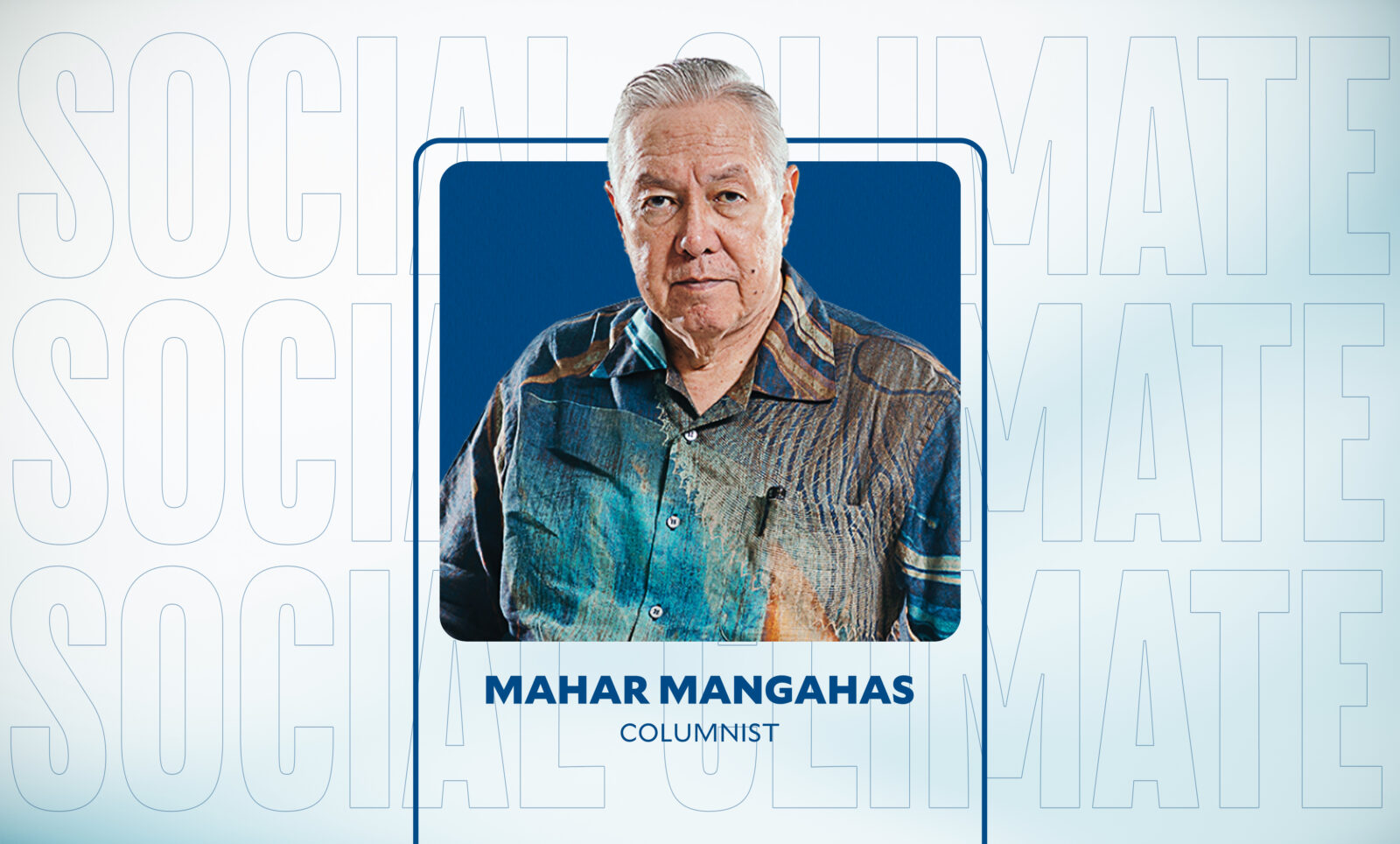
Mahar Mangahas

In line with National Women’s Month, let me recall some experiences that most impressed me about the disadvantages of being a woman.

In some countries, the women may not eat until the men are finished. Long ago, at an international meeting in Bangkok, probably at lunchtime, I was surprised when a South Asian lady asked me, “Mahar, is it true that, in the Philippines, the women have their meals together with the men?” This lady was newly arrived, from either India or Bangladesh, on her very first posting abroad. She explained that in her country, the men and boys are served first, and only after they are through eating do the women and girls take their meal.

What shocked me was her saying that, furthermore, all the food cooked for the family’s meal must be placed on the dining table together, with nothing reserved in the kitchen. This means that the womenfolk depend on what food the menfolk remember to leave behind for them when it’s their turn to eat. (How hard it is to be a male guest for a meal, and not knowing how many women are waiting to eat! I suppose the guest should eat as little as good manners allow.)

A woman is a riskier investment for advanced training abroad. When I was a very young and single economics faculty member at the University of the Philippines Diliman (UPD), I was once with our dean, José “Pepe” Encarnación Jr., having coffee in the lounge, where he was brooding over whether to allot a foreign scholarship grant to a woman. I myself was in line for such a grant, but he said he wasn’t worried about me, whatever my plans about getting married (which I did, just before leaving for foreign studies).

It takes four to five years to do an economics Ph.D. abroad, which is quite expensive in terms of both time and money. In such a long absence, there’s no guarantee that a scholar won’t get married, and perhaps get married to a foreigner! (Pepe himself had returned with an American wife from his studies at Princeton University.) If she gets married, he pointed out, that brings the husband—possibly a foreigner—into the decision-making process about the wife’s finishing the designated study program successfully and then coming back to render the agreed service of two years on the UP faculty for every one year abroad. Even though the money comes from an American foundation, UP needs a good track record to maintain its scholarship program.

I don’t know if Pepe had to refuse a foreign scholarship to any women candidates, but in my time—I got my Ph.D. in 1970, and stayed with the UP faculty until 1981—there were many more men than women who got them. Thanks to its faculty buildup, UP began producing its own economics PhDs in 1975 (the first graduate was a woman, by the way). Brain drain doesn’t seem to be as big an issue as before. The main economics building in UPD is named after Pepe; there’s no doubt he did an outstanding job as its dean for nine years.

Women’s natural disadvantage is in their participation in the labor force. Women naturally take time off for childbearing, and then for child-raising. In the Social Weather Surveys, the joblessness rate among female adults can easily be double that of male adults. Joblessness in Social Weather Stations (SWS) surveys literally means having no job (“walang trabaho”) but at the same time looking for one; those not looking for work are not part of the labor force.

The mere fact of having a job or being at work is not an indicator of women’s well-being; it’s just part of life. How much one’s work is enjoyed for its own sake is another matter, that is researchable and measurable.

In the Philippines, the state of women’s well-being is not far from that of men. As of last November, the percentage of women saying their personal quality of life (QOL) got better from the year before was 31, while that saying it got worse was 36, or a net-gainers score of -5. For men, the corresponding percentages were 28 and 36, or net -8, or slightly less than that for women.

The percentage of women expecting their personal QOL to get better in the next year (optimists) was 45, while the percentage expecting it to get worse (pessimists) was only 6, or a net-optimists score of +39. For men, the corresponding percentages were 44 and 10, or net +34, or slightly less than that for women.

SEE ALSO

The SWS surveys also track expectations about the progress of the economy as a whole. When sorted by gender, the women’s scores are likewise a little better than those of men.

—————-

mahar.mangahas@sws.org.ph.

Senior citizens' pension payouts to require National ID starting April 1


Published Mar 14, 2026 10:23 am
DSWD PHOTO
DSWD PHOTO
The Department of Social Welfare and Development (DSWD) will start using the Philippine Identification System (PhilSys), or National ID, as the primary identification for the Social Pension for Indigent Senior Citizens beginning April 1.
Senior citizens who have not yet registered with PhilSys are encouraged to sign up at the nearest office of the Philippine Statistics Authority (PSA).
To make the process easier for beneficiaries, PhilSys registration will also be conducted during scheduled pension payout activities.
For bedridden senior citizens who are unable to travel, PSA personnel will conduct home visits to facilitate their registration.
The SocPen program provides a monthly stipend of P1,000 to indigent Filipinos aged 60 and above who are frail, sickly, or living with disabilities, and who have no regular income, pension, or financial support from their families.
Under Republic Act No. 11916, or the law increasing the social pension of senior citizens, the monthly stipend for indigent elderly beneficiaries was doubled from P500 to P1,000.
The law lapsed into effect in July 2022, with the increased pension implemented starting January 2024.
Qualified beneficiaries receive their stipend on a quarterly basis.
In 2025, a total of 4,113,050 indigent senior citizens received their social pension from the DSWD, exceeding the original target of 4,085,066 beneficiaries.

Peso nears ₱60:$1; Maynilad, Manila Water to raise rates due to weak peso


Peso nears ₱60:$1; Maynilad, Manila Water to raise rates due to weak peso

Surging oil prices stemming from the ongoing war in the Middle East continued to injure the peso, causing it to shed 35 centavos against the United States (US) dollar on Friday, March 13, ending the week at a new record-low close of ₱59.735. Read more

Meanwhile, millions of residents in Metro Manila face higher water costs starting next month as the industry regulator approved tariff hikes for both of the region’s main concessionaires to account for fluctuations in foreign exchange. Read more

Do German-speaking Swiss people consume standard German media (TV, books, films, internet forums, etc.) often?


 · 

Sure.

Swiss German isn’t a written language. It is oral only, and although some people do write in Swiss German in Whatsapp messages and on Reddit, they are simply typing phonetically, and I find it tiring to read. Books written by Swiss German writers, news articles and so on are written in what passes for German German”. The only difference is that we don’t use “ß” Like in “Straße”, but we use a double “s”, as in “Strasse”. And we use different vocabulary for certain things. We would say “Trottoir” instead of “Gehsteig” (=pavement), “Billet” instead of “Fahrkarte” (=public transport ticket), and so on. But a German would have no trouble reading it. They might just find some terms quirky.

Does anybody actually watch TV nowadays? I thought it was all streaming… And yes, we watch German films, and can communicate perfectly normally with Germans on social media platforms.

Senator Bong Go urges traders to uphold bayanihan as food prices climb amid looming fuel hikes, warns against burdening ordinary Filipinos

 Senator Bong Go urges traders to uphold bayanihan as food prices climb amid looming fuel hikes, warns against burdening ordinary Filipinos

Food prices have begun climbing in several markets even before major fuel price adjustments take effect, prompting Senator Christopher "Bong" Go to call on traders and suppliers to refrain from exploiting the situation through hoarding, overpricing, and other practices that place additional strain on consumers, particularly low-income households, on Monday, March 9.
The senator noted that the looming fuel price hikes are partly driven by global tensions and disruptions in oil supply following ongoing missile attacks in West Asia, which have added pressure to markets and contributed to rising transportation and logistics costs.
Reports monitored over the weekend indicated that prices of several food items have already started increasing. At the Bulungan Seafood Market in Parañaque City, the per-kilo price of lapu-lapu rose from PhP300 to PhP400, while bakoko increased from PhP250 to PhP400 per kilo. Similar developments were observed in other areas, including Balintawak Market in Quezon City, where a container of fish reportedly became PhP500 more expensive.
Go emphasized that while rising fuel costs may affect the movement of goods, some traders may take advantage of the situation by prematurely increasing prices or manipulating supply, actions that ultimately hurt ordinary consumers.
"Sa ganitong panahon, kailangang magtulungan tayo. Huwag nating samantalahin ang sitwasyon para kumita nang sobra habang nahihirapan ang ating mga kababayan," Go said. "Bawat piso, bawat sentimo, mahalaga lalo na sa mga pamilyang kapos ang kinikita."
He also reiterated his long-standing position against hoarding and supply manipulation that worsen price instability.
“As a member of the Committee on Agriculture, two things ang dapat nating gawin. Unang-una, dapat po ay labanan natin, go against hoarders and smugglers. Dapat po ay walang makinabang na mga smugglers dito,” the senator said in a previous interview.
According to reports, some vendors have begun selling fish in bundles instead of by the kilo so customers can still afford them. In other markets, the prices of vegetables have also gone up, including eggplant, which increased from PhP250 to PhP400 per pack, squash from PhP27 to PhP35 per kilo, and calamansi from PhP100 to PhP120 per kilo.
Traders said some produce comes from the Ilocos Region, and transportation costs could rise further if fuel prices continue to increase.
Transport groups have warned that shipping fees may also rise as much as 20% to 30%, citing the heavy reliance of trucking operations on petroleum products.
Despite these developments, Go appealed to traders, suppliers, and other stakeholders in the food supply chain to exercise fairness and responsibility.
"Hindi naman natin maiiwasan ang paggalaw ng presyo ng langis, pero sana huwag itong gawing dahilan para manamantala," the senator pointed out. "Kung may kakayahan tayong magpigil at maging patas sa presyo, malaking tulong na 'yan sa ating kapwa Pilipino."
Go stressed that responsible pricing and ethical trading practices are especially important during periods of economic pressure, when many households are already struggling to stretch their daily budgets.
"Maraming pamilya ang nagtitipid na lang. May mga bumibili na lang ng kalahating kilo o kaya ay kaunting piraso para lang magkasya ang pera," he noted. "Kaya sana isipin din natin ang kalagayan ng ordinaryong mamamayan."
He also reminded traders that food and basic goods are necessities, making fairness in pricing a matter that directly affects people's daily survival.
"Huwag nating kalimutan na ang mga bumibili sa palengke ay mga kapwa natin Pilipino na nagsisikap ding itaguyod ang kanilang pamilya," Go said. "Kung magtutulungan tayo at paiiralin ang malasakit sa isa't isa, mas malalampasan natin ang mga ganitong pagsubok."
The senator encouraged the public to remain mindful of their spending and to support responsible vendors who continue to keep prices reasonable despite market pressures.
"Ang tunay na lakas ng bansa ay nasa pagkakaisa ng mga mamamayan. Kung may malasakit tayo sa isa't isa, makakahanap tayo ng paraan para magtulungan sa gitna ng anumang hamon," Go said. "Sa huli, ang mahalaga ay walang maiiwan at sama-sama nating malalampasan ang mga pagsubok na ito."
May be an image of text that says 'DURIAN Op POST Regerikantana RagerikantanaBalan Salanza BONG GO APEALS TO TRADERS Amidst US vs. IRAN WAR food crisis "Don't burden ordinary Pinoys as high price zoom up."'