This might not be the typical expat blog, written by a German expat, living in the Philippines since 1999. It's different. In English and in German. Check it out! Enjoy reading!
Dies mag' nun wirklich nicht der typische Auswandererblog eines Deutschen auf den Philippinen sein. Er soll etwas anders sein. In Englisch und in Deutsch! Viel Spass beim Lesen!
You plan to move to the Philippines? Wollen Sie auf den Philippinen leben?
There are REALLY TONS of websites telling us how, why, maybe why not and when you'll be able to move to the Philippines. I only love to tell and explain some things "between the lines". Enjoy reading, be informed, have fun and be entertained too!
Ja, es gibt tonnenweise Webseiten, die Ihnen sagen wie, warum, vielleicht warum nicht und wann Sie am besten auf die Philippinen auswandern könnten. Ich möchte Ihnen in Zukunft "zwischen den Zeilen" einige zusätzlichen Dinge berichten und erzählen. Viel Spass beim Lesen und Gute Unterhaltung!
Visitors of germanexpatinthephilippines/Besucher dieser Webseite.Ich liebe meine Flaggensammlung!
Aproposal to shut down ABS-CBN Corp. had been raised during board discussions but was ultimately rejected, as tensions within the Lopez family continue to escalate.
In a statement on Wednesday, the broadcasting firm cited records showing that “one of our directors proposed shutting down ABS-CBN without so much as discussing how it would meet its obligations to its people.”
But the company quickly pointed out that majority of directors had rejected the proposal and instead pushed for continued financial support to sustain operations and protect employees, retirees and other stakeholders.
The statement comes after the majority shareholders of family holding firm Lopez Inc., led by Eugenio “Gabby” Lopez III, said the network “will survive and grow once more” despite the family rift.
Gabby’s faction earlier claimed that Federico “Piki” Lopez had proposed shutting down the network last year, adding that such a move could have jeopardized thousands of jobs.
For its part, ABS-CBN did not identify the director but confirmed that a shutdown proposal had been raised during internal discussions.
But it stressed that the board had instead chosen to support the company’s operations, citing its obligations to employees and other stakeholders.
The company also refuted claims about preferential retirement payments, describing them as “repeated lies designed to sow intrigue among employees.”
It said most of the 68 individuals cited were retirees who had “received only partial or no retirement benefits” and had agreed to defer payment until the company’s financial position improves.
“These continued public PR attacks against ABS-CBN are a disservice to the employees and to the public,” the company said.
ABS-CBN added that the decline in its pension fund was largely due to payouts to nearly 6,000 employees who had been retrenched following the loss of its franchise in 2020.
Remittances from Filipinos abroad are expected to remain resilient even after posting their slowest growth in nearly two years in February, before the Middle East conflict heightened fears of labor displacement.
Latest data from the Bangko Sentral ng Pilipinas (BSP) showed money sent home through banks rose 2.6 percent from a year earlier to $2.79 billion. That was the weakest pace of growth since June 2024, when remittances increased by 2.5 percent and the lowest monthly inflow since May 2025, when they totaled $2.66 billion.
In the first two months of the year, remittances reached $5.81 billion, up 3.1 percent.
Domini Velasquez, chief economist at Chinabank, said the slower remittance growth in February was partly due to weaker inflows from the United States, where 40 percent of the total cash transfers came from. To note, a common practice of remittance centers in various cities abroad is to course remittances through correspondent banks, most of which are located in the United States.
“The 1 percent excise tax on remittance transfers from the US introduced at the start of 2026 under the One Big Beautiful Act may have weighed on remittances and may have pushed some overseas Filipinos to use alternative transfer channels,” Velasquez said.
The slowdown came ahead of a widening war involving Iran, the United States and Israel that has rattled energy markets and raised fears of job displacement for migrant workers. Inflows from the Middle East accounted for about 18 percent of total remittances to the Philippines last year.
For now, the BSP is sticking to its year-end forecast of 3-percent remittance growth to $36.7 billion, noting that “there remain no signs of mass repatriation or widespread deployment bans” despite the geopolitical turmoil.
The risk extends beyond households to banks, as potential job losses in the Gulf could weaken the financial buffers of workers’ families and their ability to repay loans. In a report on Wednesday, S&P Global Ratings warned that Philippine banks could face pressure on loan quality.
“If labor markets in the Gulf are disrupted, it could affect remittances, which could in turn erode deposit growth and repayment capacity in the Philippines, India and Bangladesh,” S&P said, adding that a widening Middle East conflict poses a $180 billion downside risk to Asia-Pacific banks.
Looking ahead, Robert Dan Roces, group economist at SM Investments, said remittances were likely to show their countercyclical nature during difficult periods. Unlike private capital, which typically retreats during economic downturns or natural disasters, remittances often swell as expatriates step in to provide relief to their families back home.
“The Middle East conflict adds risk, but flows tend to hold as they are need-driven,” he said. “Remittances should remain as a steady support for consumption, just with less momentum.”
Velasquez shared the same view. “In the near term, rising domestic consumer prices—driven largely by increased fuel costs—could prompt OFWs to send more money home to help cover rising household expenses,” she said. “This could offset the losses from repatriation of some OFWs from the Middle East.”
Published Apr 15, 2026 12:04 am | Updated Apr 14, 2026 05:06 pm
THE VIEW FROM RIZAL
As we write, reports say the United States will mobilize naval vessels to blockade the Strait of Hormuz—the world’s most critical waterway. This follows the US Vice President's declaration that negotiations with Iran were a “failure” just hours earlier.
The US Veep’s statement had earlier doused cold water on hopes that the ongoing dispute in the Middle East could be headed to a resolution, that cargo ships might be able to resume their safe and uninterrupted passage through the Strait of Hormuz, and that prices of petroleum products in the country and in the world might finally experience a downward slide.
Indications are that none of that is likely to happen soon. Peace, at this point, seems to be elusive, and all-out hostilities may resume soon. We can only pray that a possible resumption of hostilities when the ceasefire expires on the 21st of this month may be averted, that the lives of people in the affected regions of the world are spared, and that the global economy survives.
It is interesting that in the face of the wild upward spiral of gasoline prices in the country, there has been no howl on the part of the public. Yes, there are fewer cars on the streets, and more families have decided to stay at home during the long Holy Week holiday. There are posts on social media sharing the pain caused by the upward surge in fuel prices, but there is no anger directed towards a specific person or country.
It seems there is a widespread, silent admission that these adverse developments, fueled by the conflict in the Middle East, are beyond our control. It appears there is a quiet resignation to the fact that we are “collateral damage.” We can only reel under the effect of the conflict and from the absence of the proverbial “light at the end of the tunnel.”
Those who were already born when two earlier “Gulf Wars” erupted and disrupted the global economy appear to be more hopeful in the face of the ongoing conflict in the region. Our elders in Rizal recall that in 1973, the member-countries of the Organization of Arab Petroleum Exporting Countries slapped an embargo on countries that sided with Israel in the war against Egypt.
This was the first “oil crisis,” which, our elders recall, caused a major spike in gasoline prices in our country. This served as a reminder to all that some countries hold a stranglehold on the supply of vital energy resources the world badly needs.
There was another “oil crisis” in 1979, after petroleum supplies dropped sharply following the Iranian revolution, which brought down the then-powerful Shah.
Reflecting on these experiences, our elders say, “Humanity has navigated more difficult geopolitical events.” They believe no country wants to trigger an apocalyptic event that could risk the annihilation of mankind. In their view, “The warring parties will always seek a way out of the conflict and resort to more pragmatic compromises.”
They pointed out that, from a sober, rational perspective, the failure of the talks between the US and Iran “disappointed us but does not surprise us.”
They reinforced this by explaining, “We have to understand that there have been decades of deep mistrust between these two countries. We cannot expect that to be resolved in 21 hours.”
The point is clear. Negotiations, whether in business or in geopolitics, require a reasonable level of mutual trust. They also require a clear, solid intention to negotiate and openness to softening positions, bargaining, and crafting a compromise. When both sides issue “demands” and “conditions” right at the start of the supposed “negotiation,” we can anticipate such talks to “fail,” even if only temporarily.
Our elders are “optimistic” that the “door is not fully shut” to a resumption of negotiations. They pointed out that mediators in Pakistan and Oman are pushing for the extension of the ceasefire and using indirect channels. They said they believe both Iran and the US have “compelling reasons” to have a longer period of “truce.” Iran’s economy is under serious strain, and the US has domestic priorities that its government must attend to. Neither can afford to keep the current conflict raging indefinitely.
The same realities apply to us and the rest of the world. With these uncertainties, the pressing question is: what do we do in the meantime?
We have previously written about developing a “resilient mindset.” To build on that, let us add strategies based on the counsel of our elders, who “have been there.”
To recall, we must have a clear idea about what we can influence and what we cannot. For example, cutting down on unnecessary trips and expenses – that is within our control. The events in the Strait of Hormuz are not. It is good to have a list of what we must start doing today to buffer us from the possible effects of a prolonged stand-off in the conflict areas. That perspective should reduce the anxiety and fear.
Our elders also advised us to keep in mind that the world has had to absorb fallouts from similar conflicts: The previous Gulf crises, the war in Ukraine, among others. We survived them. Our country had weathered so-called “energy shocks” in the past. We adapted; our government responded with policies and programs. We emerged scathed but sometimes even better.
In sum, we can aspire to achieve the same resilience in the current situation. The elusive peace will eventually come—no matter when and at what cost.
(The author is a Doctor of Medicine, an entrepreneur and the mayor of Antipolo City, former Rizal governor, and DENR assistant secretary, LLDA general manager. Email: antipolocitygov@gmail.com)
DAVAO CITY – To help cushion the impact of the ongoing oil crisis, the municipality of Hagonoy in Davao del Sur will implement “No Movement Sunday” aimed at conserving fuel.
Mayor Jesus Dureza Jr. explained that the measure encourages residents to refrain from unnecessary travel on Sundays, following similar moves in other municipalities across the province.
“It is not a lockdown. We are simply requesting the community to limit travel during Sunday to save fuel,” he said in an interview Tuesday.
Dureza noted that an estimated 150,000 to 160,000 motorcycles and vehicles ply the province’s roads on Sundays.
“If each motorcycle consumes one liter of fuel, we can save 150,000 to 160,000 liters in just one day,” he said.
Residents were urged to walk or use bicycles for short trips to markets or churches. The municipality’s efforts align with Executive Order (EO) 110, signed by President Ferdinand R. Marcos Jr. on March 24, which declared a State of National Energy Emergency.
The EO activates the Unified Package for Livelihoods, Industry, Food, and Transport (UPLIFT) to stabilize energy supply and protect vulnerable sectors.
To further conserve energy, municipal offices now operate under a four-day work week, Monday to Thursday with extended hours from 8 a.m. to 6 p.m.
Air conditioning use is limited to Mondays through Wednesdays, between 10 a.m. and 3 p.m.
The local government has also placed village road maintenance equipment on standby as a precautionary measure and encouraged households to plant vegetables in their backyards to strengthen food security.
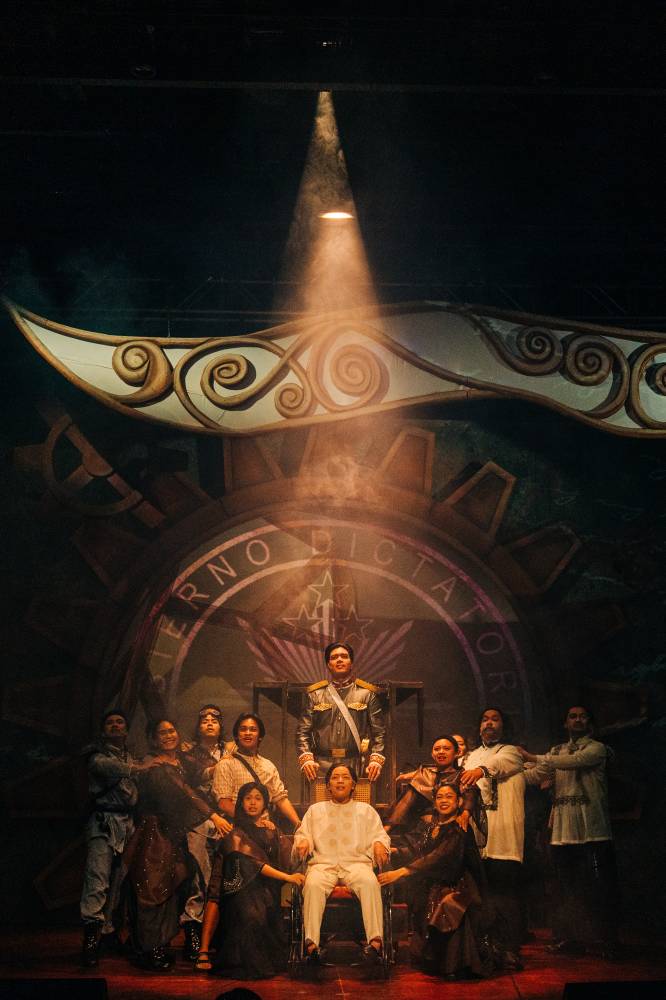
Iwas able to catch Tanghalan Pilipino’s “Mabining Mandirigma: A Steampunk Musical” on its last weekend at the Tanghalan Ignacio Gimenez Theater, and it was marvelous. The musical, written by Nicanor Tiongson with music by Joed Balsamo and directed by Chris Millado, is a complete theatrical experience. It has extensive musical numbers with great singing and dancing (choreography by Denisa Reyes and Richardson Yadao), intricate and playful set design by Toym Imao, and stunning projections by the late GA Fallarme and JM Jimenez.
“Mabining Mandirigma,” first produced in 2015, is a story about Apolinario Mabini as he navigates through the political challenges and the strife that followed during the Philippine Revolution against Spain and the subsequent Philippine-American War.
And through his story, we bear witness to the ravages of imperialism and how, in landmark moments of our history, the greatest enemy of the Filipino, oftentimes, is the Filipino himself.
A counterpoint to masculinity (and the patriarchy)
The show, with Shaira Opsimar as Mabini, has always cast a woman in the role. On that wheelchair, Opsimar is a commanding presence, and for all intents and purposes within the play, Mabini is a man.
But with Opsimar in his shoes, Mabini has a more caring, nurturing presence that plays counterpoint with all the masculine energy in the play; everyone from Aguinaldo (the show I saw had David Ezra, but Arman Ferrer is an alternate) to the illustrados who formed Aguinaldo’s congress (MC Dela Cruz, Roby Malubay, Jonathan Tadioan, Marco Viana).
There’s an inflection here that pushes against the patriarchy—that the oligarchy that meddled in Aguinaldo’s politics is primarily a masculine affectation, and having Mabini played by a woman provides a stunning counterpoint to this.
“Mabining Mandirigma” | Photo by May Celeste, courtesy of Tanghalang Pilipino
A wakeup call
The play is meant to be seen by students and adults alike, but because it’s written for a large audience, it means that the play is more forward with its themes. It doesn’t hold back with its criticism against what is wrong with Philippine politics then and, invariably, Philippine politics today. It also comments against patronage politics, the elite class shaping public policy to protect their own interests, and paints the imperialism of the West as our main enemy.
This is a truly Filipino production with the intention to wake its audience up from its slumber. It’s a call to action that speaks directly to our history and connects this with our present.
What’s more, the stylized “steampunk” aesthetic and tone allow the play to take modern elements in order to retell the past in ways that connect us to our issues today. This is the kind of theater that Gilda Cordero Fernando champions—and one that I really look for when watching a local production: How our shows utilize the medium’s urgency to speak directly to its audience and not just some form of entertainment.
The Filipinization of revivals
Also in its closing week last week was Theatre Group Asia’s “A Chorus Line.” The multiple Tony award-winning play by Michael Bennett—based on a book by James Kirkwood Jr. and Nicholas Dante, with music by Marvin Hamlisch and lyrics by Edward Kleban—celebrates its 50th anniversary this year. And the only show in the world to stage it (as of this writing) is the one held at the Samsung Performing Arts Theater with a cast composed completely of Filipinos, both here and abroad.
Directed by Emmy award-winning choreographer Karla Puno Garcia, the show is a heartfelt love letter to the ensemble. “A Chorus Line” is set in an empty theater as 17 dancers audition to get a part of a chorus in a new play. The show is demanding of its actors, requiring a high level of dance skills, complex acting portions, and some really beautiful songs to sing.
“A Chorus Line” | Photo by Jyllan Bitalac
Theatre Group Asia’s production of “A Chorus Line” is a triumph in every sense: great direction, great choreography, and great performances. This is a show I grew up listening to as a kid, so seeing it live is such a treat for me.
But outside that, what good reason would we have to stage “A Chorus Line” in the Philippines other than it being such an entertaining show? This is a show about dancers trying to get into Broadway. How could we relate? How could this show reflect upon our own realities?
What Puno Garcia and her cast lean into is their own backgrounds. The Filipinos in the cast who live and grew up outside the Philippines easily slip into American accents, but when they perform their monologues and mimic their parents’ speech, they give them a Filipino accent. Some exaggerate their eccentricities, leaning into the Filipino campiness that’s prevalent in our social media and our movies and series.
What happens is that, as we watch this revival of “A Chorus Line,” we are seeing Filipinos on the world stage, sacrificing everything to do what they love. We are reminded of how many successful Filipinos have made it on the world stage as actors, dancers, and singers. It’s a very American musical, but by allowing the actors to dig from their own realities, Puno Garcia builds a show that speaks to all our hopes and dreams about making it big somewhere, anywhere.
“Ang Linangan” | Photo by May Celeste
The universality of theater
While not an adaptation, Scene Change’s “Linlangan,” directed and translated by Guelan Varela-Luarca, is a staging of New York-based playwright Davis Alianielo’s play “The Farm.” This two-hander, a brother and a sister, happens entirely in New York state in the middle of winter. But what Varela-Luarca does is to just translate all the dialogue into Filipino. He doesn’t adapt it into a Filipino setting or situation; the siblings, Tyler and Sasha, are Americans and try to reconnect after Tyler has separated from a cult. Brian Sy and J-mee Katanyag play Tyler and Sasha, and as they inhabit the siblings, they make this world real: a long drive in the winter, a brother and sister skirting around difficult subject matters, but a love for each other evident in every little gesture or look.
With Varela-Luarca’s translation and Sy and Katanyag’s comfortable delivery of these lines, I kept forgetting that they were playing Americans. What I saw on that simple stage—a table and two chairs meant to approximate the front half of a car—were two Filipino siblings bonding, catching up, taking into account the struggles of their lives. It was when Sasha made a call to Triple A (the car got stuck in the snow), and she delivered the whole dialogue in Filipino that I was taken out of my focus.
I was reminded that this story is set in America. These are Americans. They are only speaking Filipino because it’s a translation. They are not Filipino immigrants. This is not an adaptation.
Varela-Luarca delivers this Western play to us in a language that makes it accessible to us—very much like the Tanghalan Ateneo shows I’ve seen that stage Rolando Tinio’s translations of Shakespeare (again, not adaptations but just translated)—but by doing so, we see that in our tongue, there are similarities between the bonds of siblings with Americans and Filipinos.
It’s the power of theater—whether translated or adapted—that shows us that the lives of people somewhere else are not much different from here.
And for theater to really have an impact that goes beyond making us laugh and making us cry—for entertaining us—it has to take the urgency of the live performance and speak directly to our realities. It’s what I’m always looking for in any stage production.