You plan to move to the Philippines? Wollen Sie auf den Philippinen leben?

There are REALLY TONS of websites telling us how, why, maybe why not and when you'll be able to move to the Philippines. I only love to tell and explain some things "between the lines". Enjoy reading, be informed, have fun and be entertained too!

Ja, es gibt tonnenweise Webseiten, die Ihnen sagen wie, warum, vielleicht warum nicht und wann Sie am besten auf die Philippinen auswandern könnten. Ich möchte Ihnen in Zukunft "zwischen den Zeilen" einige zusätzlichen Dinge berichten und erzählen. Viel Spass beim Lesen und Gute Unterhaltung!


Visitors of germanexpatinthephilippines/Besucher dieser Webseite.Ich liebe meine Flaggensammlung!

free counters

Total Pageviews

Monday, April 13, 2026

Between dream and duty


By Sam Azalae Pepito

When I was a child, I carried a ready-made answer to a question adults loved to ask.

“What do you want to be when you grow up?”

I never paused. I never hesitated: “A civil engineer.”

It came out of my mouth as naturally as saying my name. No matter who asked—relatives, teachers, neighbors—the answer stayed the same. Maybe it was because I had relatives who were engineers. Maybe it was because I could already imagine myself in that world. Or maybe it was because, early on, I believed that building things meant I could also build a place for myself in this world.

In elementary school, I often brought home “Best in Math” ribbons. In junior high, I realized it was more than luck. Numbers felt familiar to me. I wasn’t afraid of them; in fact, I felt at home. I joined contests, sat in the front row during quizzes, and collected medals and certificates that quietly told me I belonged here.

Senior high school felt like confirmation. I took the STEM (Science, Technology, Engineering, and Mathematics) strand, survived calculus and physics, stayed on the principal’s list, and spent long nights with formulas and problem sets. Every recognition felt like a step closer to the person I had been claiming to be for years. College was no longer just a dream. It was a door I was about to open.

I’m almost a civil engineer, almost there.

Or so I thought.

A few weeks before enrollment, my mother talked to me. There was no sermon. No forcing. Just a simple conversation that carried unexpected weight.

“Have you considered accountancy?” she asked.

She mentioned my aunt. Stable job. Comfortable life. Able to travel. No constant worry about money. As she spoke, I realized it wasn’t really about a course. It was about security. About a future where I would not struggle the way she once did.

I didn’t want to agree. I never imagined myself working with financial statements. This was not the answer I had been rehearsing since childhood.

But another question slowly replaced my certainty: Whose dream have I really been chasing?

I have always wanted to make my mother proud. Many of my achievements, even the ones I rarely talk about, were partly for her. So when it came time to choose, I wasn’t just choosing a program. I was choosing between two versions of myself—the child with a dream, and the son who carries gratitude and responsibility.

I chose what she wanted.

Entering the Bachelor of Science in Accountancy (BSA) program was my first real shock. Being “good at math” was not enough. The world I knew disappeared. Variables were replaced by vouchers. Equations by transactions. Logic by layers of rules, standards, and procedures.

In high school, I studied hard, but I also studied with confidence. In accountancy, I studied with fear.

Not because I was stupid. But because I was humbled.

I used to rely on instinct. In BSA, instinct does not save you. You need discipline. You need process. You need to start over even when you feel you should already know better. And that hurts the ego.

I told myself it would be easy. It’s math-heavy after all. I was wrong.

There were nights I stared at the same problem for hours and still did not understand it. Days when I went straight to bed after class, not because my body was tired, but because my heart was. I cried to my parents more than once.

“Ma, I think I might fail.”

Sometimes they would ask, “Do you want to shift?”

And every time, something inside me tightened.

“I don’t want to.”

Not because I love accountancy. Not because this is my dream. But because shifting feels like losing to a decision I agreed to. Losing to the promise I want to keep. Losing to the version of myself who wants to be someone reliable.

So I stay.

Not heroically. Not beautifully. Most days, I stay simply because I’m tired but still breathing.

Here, I learned that sacrifice is not always dramatic. Sometimes it looks like sleepless eyes. Like coffee at dawn. Like walking into class even when you want to turn back.

I used to think success meant being excellent. Now I’m learning that sometimes, success means being resilient.

I cannot say I love this program. But it matters to me. Because it represents a choice I made not only for myself, but for the first person I ever loved in this world.

Still, I wrestle with a question: How far should a child’s duty go?

I care is a moral act, then choosing BSA is my way of caring. But I also wonder—does self-offering have a limit?

I don’t know the answer yet.

What I do know is this: every day I choose to continue, I repeat a promise to myself.

I will finish this degree.

I will take the board exam.

I will pass.

Not because this was my first dream. But because I have learned that dreams can change shape—and still carry meaning.



Sunday, April 12, 2026

Lady Falcons outclass Tigresses anew, bolster semis bid


 Adamson repeats over UST to boost its Final Four bid. (UAAP Media)


By Mark Rey Montejo


After two games, it appeared that Shai Nitura and Adamson had already identified the vulnerabilities of the University of Santo Tomas.

It was a tighter battle this time, but the outcome remained the same as Nitura and the Lady Falcons reaffirmed their mastery with a 27-25, 25-20, 26-24 win over the Golden Tigresses to boost their Final Four return bid in the UAAP Season 88 women’s volleyball tournament Saturday, April 11.

With a decent crowd inside the FilOil EcoOil Centre in San Juan City, Adamson, steered by Nitura and Frances Mordi, showed grace under pressure after unleashing timely counters to overcome UST’s late rally, especially in the third, to improve to 7-5.

Adamson tied the España-based squad in the standings where they stay within the Top Four race. Far Eastern University, which clashes with UST on Sunday, April 19, is still at No. 5 with a 6-5 card.

In the battle of former Rookie of the Year winners and this year’s MVP contenders, Nitura took the spotlight with a statline of 19 points, 10 excellent digs, and 14 excellent receptions, while Poyos led UST with 15 points, five digs, and 12 receptions in a losing effort.

Also impressive for the JP Yude-mentored crew was Mordi who tallied 18 points, five digs, and 11 receptions. Lhouriz Tuddao and MJ Aseo added eight and six points, respectively, while Fhei Sagaysay unloaded 21 excellent sets on top of seven points and seven digs.

Reg Jurado aided Poyos offensively with nine points that came with nine digs, while Avril Bron and Jonna Perdido conspired for 15 points.

Meanwhile, UST kept its poise as it withstood Adamson’s early surge and carved out a hard-earned 32-30, 18-25, 25-18, 25-17 win to secure its fourth straight semis appearance.

The Golden Spikers struggled to find their rhythm early despite prevailing in a tightly contested opening set. But behind Josh Ybañez and second-string setter Joshua Avila, UST regrouped in the third and fourth, where they seized enough separation they preserved to hold off a determined Soaring Falcons side.

UST’s 8-4 card is good for the No. 3 spot, joining Far Eastern University (10-1) and reigning champion National University (9-2) in the semis. One semis spot is left with either Ateneo (7-5) or De La Salle (5-7) taking the precious ticket depending on the results of their next games.


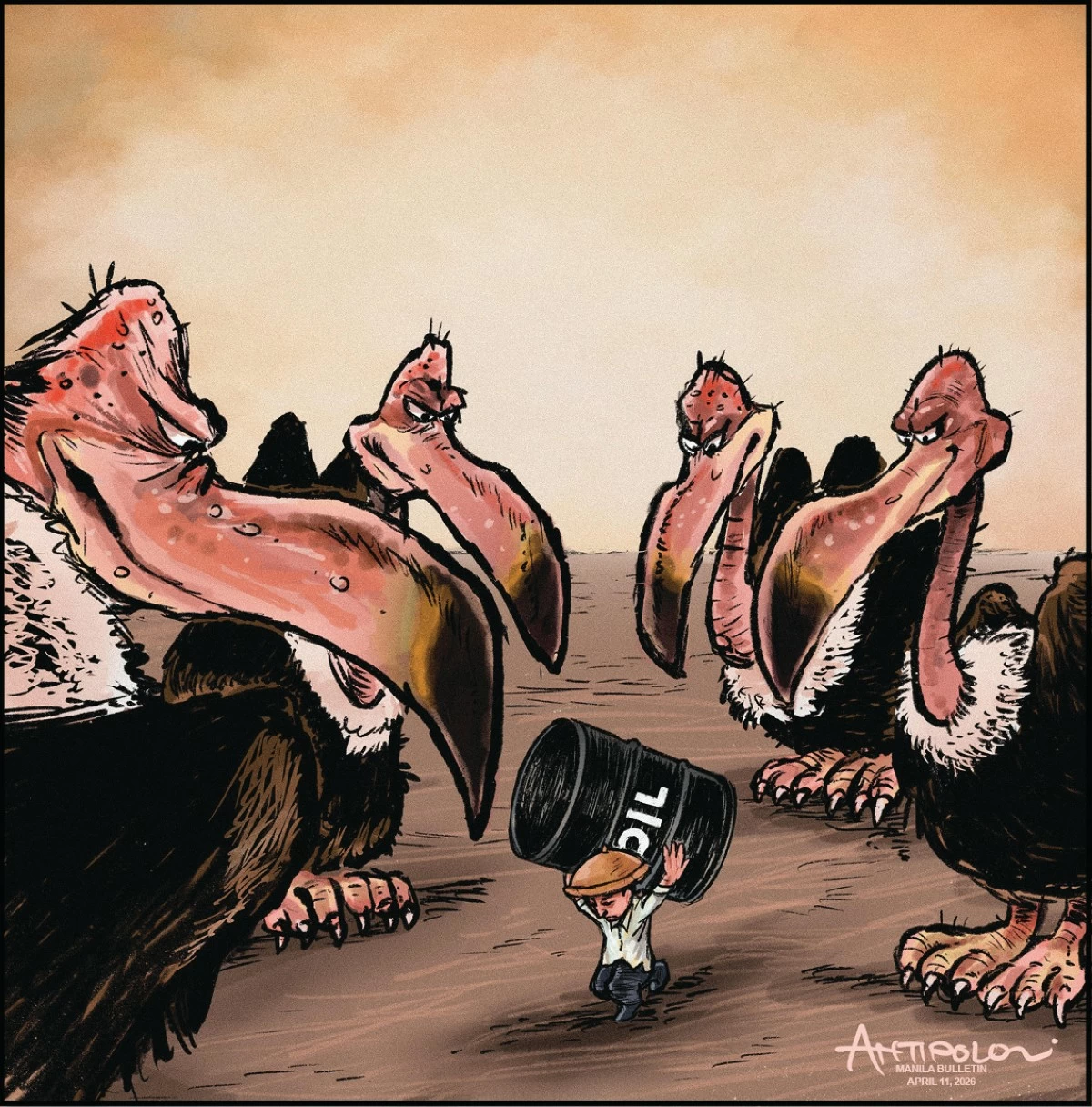
Why the PCC must act on oil prices now


At a time when global instability is driving fuel prices upward and ordinary Filipinos are forced to stretch already thin budgets, the warning from Economic Secretary Arsenio Balisacan should not be ignored. His candid invocation of “Economics 101” during a House hearing cut through layers of technical language and political caution: In markets dominated by only a few major players, coordination, implicit or explicit, becomes dangerously easy. And where coordination thrives, the line between competition and collusion can blur.
The Philippine oil industry, governed by the Downstream Oil Deregulation Law of 1998, was built on the promise that deregulation would unleash competition and deliver lower prices. Decades later, that promise rings hollow. Weekly price adjustments move almost in lockstep across companies, creating the widespread perception, fair or not, that competition is more illusion than reality.
Balisacan stopped short of making a definitive accusation, but his logic was unmistakable, something that was not lost on House Legislative Energy Action Development (LEAD) Council presiding officer Marikina City Rep. Miro Quimbo, who had asked him to repeat it for clarity. A highly concentrated market structure creates fertile ground for cartel-like behavior, Balisacan explained. He even pointed to the Organization of the Petroleum Exporting Countries as an example of how coordination among a few dominant players can shape outcomes. The implication for the Philippines is troubling. If similar dynamics are at play locally, then the burden of proof, and action, falls squarely on regulators.
Yet the Department of Energy is structurally limited. Its mandate under deregulation prevents it from directly controlling prices. It can monitor, it can explain, it can appeal—but it cannot intervene decisively when market behavior raises red flags. This leaves a dangerous gap at a time when decisive oversight is most needed.
That gap must be filled by the Philippine Competition Commission (PCC).
The PCC was created precisely for moments like this—to ensure that markets remain fair, competitive, and free from abuse. It has the legal authority, investigative tools, and independence to determine whether parallel pricing behavior is the natural outcome of global cost pressures or the product of anti-competitive coordination. And if violations are found, it has the power to prosecute and penalize those responsible.
We should not dismiss this simply as a technical or economic issue. This is a moral one. Every peso added to fuel costs ripples through the economy, raising transport fares, inflating food prices, and eroding the purchasing power of millions. For jeepney drivers, delivery workers, and minimum-wage earners, these increases are existential. To exploit such vulnerability, whether deliberately or through indifference, is to deepen inequality and hardship. So, let’s not widen the economic and social gaps.
The oil industry, for its part, must also reflect. Profit is not inherently unjust, but profit divorced from social responsibility, especially during a crisis, invites public outrage and regulatory backlash. These companies do not operate in a vacuum; they exist because of the very consumers now bearing the brunt of rising costs. Moderation, transparency, and genuine competition are not acts of charity, they are social obligations.
The moment calls for vigilance and courage. The PCC must act swiftly to investigate patterns, scrutinize pricing behavior, and, if warranted, bring cases forward without hesitation. At the same time, oil companies must recognize that public trust is as vital as profit margins. Social responsibility must always be paramount.
When markets fail to protect the people, institutions must rise to the occasion. The Filipino public deserves nothing less.

PHILIPPINES IS ON FIRE

As of 10:00AM, April 12, 2026
Hot, humid weather is currently prevailing across the Philippines, driven by a ridge of a high-pressure area (HPA).
This system Brings warm, dry, and stable air, restricting cloud formation and increasing temperatures, often resulting in dangerous heat indices between 42°C and 51°C in certain areas.
The temperatures in the Philippines area are increasing due to man-made global warming.
May be an image of tornado and text that says 'Manila To. Batangas ឆី रववेय อ oButuan otaKinabalu abalu Zamboanga Seri wan Sandakan General GeneralSantos Santos'

All reactions:
315

4 dead as cargo truck crashes into gym in Davao City


By Keith Bacongco


FOUR persons were killed in a horrific accident in Barangay Marilog, Davao City on Saturday. (Iroy Wrecker the Rescuer)

DAVAO CITY – Four persons were killed after a cargo truck crashed into a gymnasium in Barangay Marilog here on Saturday morning, April 11.

The Davao City Police Office said a tire of the 10-wheel truck reportedly burst and the driver lost control of the vehicle. The truck hit the gymnasium where an activity was ongoing.

The driver, helper, and two bystanders died on the spot. Their identities are pending verification as of posting time.

The truck hit several parked vehicles before it turned upside down in front of the barangay hall.

Photos and videos online showed the partially damaged gymnasium on the Bukidnon-Davao Highway. The steep and winding sections of the road is an accident-prone area.

'Pantropiko' to the world: BINI conquers Coachella


Published Apr 12, 2026 08:48 am
ABS-CBN’s girl group BINI made history as the first Filipino act to perform at the Coachella Valley Music and Arts Festival, taking the stage on Friday, April 10, in the United States — a landmark moment for OPM and Philippine music on the world stage.
BINI (Images courtesy of ABS-CBN/Coachella)
They performed 10 songs during their 45-minute set at the Mojave stage of the festival, held in Indio, California, which drew music fans from all over the world.
BINI opened with “Shagidi,” then moved through “Zero Pressure” and “Out Of My Head.” They brought the crowd to their feet with Filipino favorites “Karera” and “Salamin, Salamin,” before delivering “Blink Twice” and “Cherry on Top.” The set also featured the live debut of new track “Blush,” followed by “Bikini,” and a rousing finale with “Pantropiko.”
Throughout the set, members Aiah, Colet, Maloi, Gwen, Stacey, Mikha, Jhoanna, and Sheena took moments to express their gratitude for the chance to represent the Philippines on one of music’s grandest stages.
“We are so grateful to be here to represent the Philippines on a global stage and to share with you guys our music,” said Aiah.
“Being here with all of you has been the sweetest ‘cherry on top’ of our journey so far,” shared Maloi.
Fan support flooded in before, during, and after the performance, which was livestreamed live on the official Coachella YouTube channel.
#BINI_CoachellaWk1 shot to the top of worldwide trending topics on X, topping charts in the Philippines and the United Arab Emirates, reaching #2 in Canada and Singapore, #5 in Australia, and #6 in both Puerto Rico and the United States.
Several other BINI-related topics also trended, including Pinoy Pride, BINICHELLA, Mojave, Walo, Blink Twice, Salamin Salamin, Karera, Zero Pressure, Cherry on Top, Shagidi, and Pantropiko. The headline “BINI Makes History as First All-Filipino Act at Coachella 2026” further trended under X’s Today’s News section.  

Back home, fans — known as Blooms — gathered for watch parties across Metro Manila and surrounding cities, organized by the fan group BLOOM Philippines.
BINI is set to return to the Coachella stage for their second weekend performance on Saturday, April 18 (PHT).
Catch a replay of BINI's performance on the Coachella YouTube channel. For the latest updates, follow BINI on Facebook, X (Twitter), Instagram, TikTok, and YouTube, or visit bini.abs-cbn.com. Join the BINI superfan community on WeVerse — available on the website or via the WeVerse app.

Saturday, April 11, 2026

Ancient seafarers' story of love, identity, and belonging takes center stage in this ballet


Ballet Philippines to close its 56th season with 'Paglalakbay: 

The Journey of the Sea People'

Published Apr 9, 2026 10:54 pm
Ballet Philippines successfully concluded the world premiere run of "Paglalakbay: The Journey of the Sea People," a full-length original Filipino ballet that captivated audiences from April 10 to 12, 2026, at The Theatre at Solaire. The production marked a defining close to the company’s 56th season and a bold step in championing Filipino narratives on the classical stage.
Inspired by the Austronesian Migration, “Paglalakbay” tells an epic yet intimate story of movement, identity, and belonging. It follows ancient seafarers in search of a new home, centering on Ama and Kaman in Batanes, whose love endures trials of loss, transformation, and renewal, reflecting a timeless search for home across generations.
Choreographed by artistic director Mikhail Martynyuk, with a libretto by Sheree Chua and music by Ronald Vincenzo Khaw de Leon, the ballet reimagines classical technique through a distinctly Filipino lens.
“Academic technique is a form, not a style,” Mikhail shared. “In ‘Paglalakbay,’ choreographic language becomes the main narrator,” grounding movement in the forces of wind, land, and sea.
For Sheree, the work is both cultural and deeply personal. “Migration is often framed as displacement, but it can also be expansion,” she said. “This ballet becomes both historical and intimate.”
The production’s immersive design, led by Leeroy New, brought Batanes to life onstage, drawing from the team’s firsthand cultural immersion with local communities. This experience stemmed from Ballet Philippines’ Ballet Brigade outreach in Batanes, where artists engaged with over 200 locals.
“‘Paglalakbay’ was a bold investment for the company,” said Ballet Philippines president Kathleen Liechtenstein. “It reflects our belief that local indigenous stories deserve the grand scale and artistic rigor of the classical stage.”
Praised for its powerful storytelling and cultural resonance, “Paglalakbay” reinforces Ballet Philippines’ continuing mission: to bring Filipino stories to the forefront—epic, resilient, and universally human.
For more information on Ballet Philippines and its upcoming productions, visit www.ballet.ph
.

The hard truth about oil


Published Apr 11, 2026 12:05 am | Updated Apr 10, 2026 06:07 pm
The headlines might suggest that the worst of the Middle East conflict is over, but for the Filipino consumer, the relief is likely to be an illusion. While a pause in hostilities between the United States (US), Israel, and Iran is always welcome, the Department of Energy’s (DOE) latest assessment showed that the damage to the global oil market is serious and, in many ways, permanent.
President Marcos’ energy chief did not sugarcoat the situation this week, saying fuel prices are not going back to where they were before the fighting started. We are no longer just dealing with a “war premium” or temporary market jitters. The infrastructure that moves oil from the Middle East to the rest of the world has been physically battered. Even if every shipping lane stayed open tomorrow, the refineries and storage hubs needed to fill those ships would take years to rebuild.
For the average motorist, this is a bitter pill. We have seen fuel prices jump by 100 percent in a single month—the fastest spike on record. While there is talk of a slight “U-turn” in the coming days, the floor has moved. We are now looking at a world where 20 percent of the global supply is effectively offline. In the Philippines, where we rely on these imports, the reality is that diesel could soon hit over ₱175 per liter.
The economic fallout is already showing up in the numbers. Inflation hit 4.1 percent in March, but the real story is the month-on-month jump. Prices for basic goods are rising at their fastest pace in years because everything we eat or use has to be transported. When the peso’s purchasing power drops to ₱0.75, it is not just a technicality; it’s a direct hit to every family’s ability to put food on the table.
But there is some good news on the government side, though it offers cold comfort at the pump. The country’s fiscal health is actually holding up. The Department of Finance (DOF) has noted that tax collections are up and the budget deficit is narrowing. This gives the Marcos administration the “safety net” it needs to fund subsidies for the most affected sectors without going into a debt spiral. The early remittance of dividends from government-owned corporations has also provided a much-needed cash buffer at exactly the right time.
However, the Bangko Sentral ng Pilipinas (BSP) is in a difficult position. If inflation continues to bleed into every other part of the economy, the central bank’s Monetary Board will likely have to raise interest rates again. Higher rates might help control prices, but they also make it more expensive for businesses to grow and for families to take out loans. It’s a delicate balancing act with no easy exits for the BSP.
The reality is that we are in a state of national energy emergency, and there is no quick fix. The government’s plan to diversify where we buy our oil—bringing in shipments from places like India and Oman—is a necessary step, but it will not lower energy prices overnight.
We have to face the fact that the global energy landscape has changed after the conflict. The “structural change” the DOE mentioned means that the era of cheap and predictable fuel is over for now.
As a nation, we have to move past the hope of a quick rollback and focus on how to manage an economy where high energy costs are the new baseline. Relief will be slow, and the path back to stability will likely be measured in years, not just months.

Friday, April 10, 2026

Baguio under calamity state due to fuel crisis


BAGUIO CITY—Residents dealing with long lines at jeepney terminals here on their way home at night found some relief on Wednesday when more units were deployed—financed by the city government after Baguio was placed under a state of calamity.

Mayor Benjamin Magalong on Tuesday signed City Resolution No. 257 declaring a state of calamity which he asked the city council to pass before it adjourned on March 30 for the Holy Week break.

Councilor Peter Fianza, a former city administrator, had informed the local legislature that a resolution may no longer be necessary after President Marcos placed the country under a state of national energy emergency on March 24.

The Philippines is among the Southeast Asian countries hit hardest by unstable world oil prices triggered by the war launched by the United States and Israel against Iran starting on Feb. 28. The crisis worsened as Iran blocked the Strait of Hormuz where 20 percent of global oil supply, especially those bound for Asia, passes through.

Resolution No. 257, which the Baguio council passed unanimously, provides authority to Magalong to use the city’s quick response fund (QRF) representing 1.5 percent of the city’s P3.26-billion budget, and secures a share from the national disaster relief standby fund.

Part of the QRF will be spent on Baguio’s emergency transport support fund, said Amy Gas-ib, chief of the traffic division at the City Engineers Office, during a Wednesday briefing.

Under an arrangement drawn up in a March 18 dialogue and formalized on Wednesday, 295 units of the total 1,154 public utility jeepneys serving Baguio would be assigned to ferry passengers from 6 p.m. to as late as 11 p.m. in exchange for subsidies covering their trips back to the central business district, Gas-ib said.

The price of diesel, which public transport vehicles consume, has shot up, discouraging many of the jeepney drivers to serve passengers after 7 p.m. to stretch their fuel when they resume work the following day.

As of April 9, diesel sold for P165.70 a liter, maintaining the same high rates recorded on Tuesday and Wednesday by the Baguio police.

Gas-ib said the subsidy would be based on the prevailing diesel prices and would adjust should prices rise again next week.

SEE ALSO

She also announced that subsidies for taxi drivers are being prepared once her office completes the list of 3,346 taxi units in Baguio.

Subsidies in CDO

In Cagayan de Oro City, the local legislature approved an emergency declaration during a special session on Tuesday, allowing Mayor Rolando Uy to use the QRF to provide fuel subsidies to transport workers.

Public utility vehicles have been reeling from the fare hike moratorium imposed by the national government hence the city government is providing P2,000 on top of the P5,000 provided by the Department of Social Welfare and Development.

Jeepney drivers have also asked commuters to voluntarily increase the fare they give at every ride, from P12 per passenger to P15. —WITH A REPORT FROM FROILAN GALLARDO

Why Spirituality Matters in the Digital Age


A modern society is defined as a social structure characterized by a market-based economy, a democratic political system, and autonomous knowledge-producing institutions that develop empirical-analytical sciences.

However one looks at this range of dates, a considerable tension between any historical description of a rupture and conceptual understandings of modernity comes immediately to the fore. The conceptual imagery of a ‘modern society’ characterized by a market-based economy, a democratic polity, and autonomous knowledge-producing institutions developing empirical-analytical sciences sits in an uneasy relation to these historical dates. Were one to insist that the full set of those institutions needs to exist before a society can be called modern, social modernity would be limited to a relatively small part of the globe during only a part of the twentieth century.

This tension between conceptuality and historicity was resolved by introducing an evolutionary logic in societal development. Based on the assumption of a societally effective voluntarism of human action, realms of social life were considered to have gradually separated from one another according to social functions. Religion, politics, the economy, and the arts all emerged as separate spheres in a series of historical breaks—known as the scientific, industrial, democratic revolutions, etc.—that follows a logic of differentiation.

Money is one of the most essential in today’s world. Money allows us to meet our basic needs: buy food, shelter, and pay for health care. Meeting these needs is essential and if we don’t have enough money to do so, our individual happiness and the well-being of the community as a whole will be severely affected.

Why are values important in today’s world? Our values inform our thoughts, words, and actions. Every individual and every organization is involved in making hundreds of decisions every day. The decisions we make are a reflection of our values and beliefs, and they are always directed towards a specific purpose.

Values are the fundamental beliefs that govern our lives. They inspire how we act and speak. They guide our decisions about everything from career to personal growth. They embody the person we want to be, influencing how we treat others and how we interact with the world.

What is the most important thing in the world? Health – Without health, there is nothing worth it. Physical and mental health go hand in hand; if we don’t give importance to our physical health, it will have consequences for our mental health and vice versa.

Human life is the means to get rid of the cycle of birth and death, old age and travel. Devotion and liberation are possible in this life. Only in the human body, a person can reach God by knowing his form. We have forgotten the purpose for which life was given.

It’s important to prioritize making space for quiet, for real connection, and for reflection —both psychological and spiritual — in order to feel more grounded in ourselves and more open to a deeper, richer experience of life beyond the screen.