You plan to move to the Philippines? Wollen Sie auf den Philippinen leben?

There are REALLY TONS of websites telling us how, why, maybe why not and when you'll be able to move to the Philippines. I only love to tell and explain some things "between the lines". Enjoy reading, be informed, have fun and be entertained too!

Ja, es gibt tonnenweise Webseiten, die Ihnen sagen wie, warum, vielleicht warum nicht und wann Sie am besten auf die Philippinen auswandern könnten. Ich möchte Ihnen in Zukunft "zwischen den Zeilen" einige zusätzlichen Dinge berichten und erzählen. Viel Spass beim Lesen und Gute Unterhaltung!


Visitors of germanexpatinthephilippines/Besucher dieser Webseite.Ich liebe meine Flaggensammlung!

free counters

Total Pageviews

Wednesday, June 3, 2026

PULP Group launches newest girl group MEI MEI


The newly-minted P-pop group MEI MEI poses for a photo with PULP Group bosses Vernon Go and Happee Sy during the grand media launch.


Charmie Joy Pagulong - The Philippine Star 

June 3, 2026 | 12:00am


MANILA, Philippines — Another P-pop girl group has emerged in the music scene. Meet MEI MEI, whose members are Alexa, Jhamayka, Ada, Aerise, Thea, Jessie, Yuni and Dina.

The eight-member act, under Groovy Garden Records, the newest record label of PULP Group, was officially introduced during a grand media launch on Wednesday at the Skydome, SM North EDSA. The girls also performed the novelty pop-track Telebong live for the first time, serving as the key track of their soon-to-be-released EP, “HELLO PO.”

During the event, each member has revealed their official personas: Alexa as the purple “Spark MEI MEI,” Jhamayka as the blue “Cool MEI MEI,” Ada as the yellow “Dolly MEI MEI,” Aerise as the lilac “Sweet MEI MEI,” Thea as the baby pink “Princess MEI MEI,” Jessie as the red “Power MEI MEI,” Yuni as the green “Groovy MEI MEI” and Dina as the hot pink “Diva MEI MEI.”

Debuted under Groovy Garden Records, the new music label of PULP Group, MEI MEI is made up of eight members, namely Alexa, Jhamayka, Ada, Aerise, Thea, Jessie, Yuni and Dina.

These personas, according to the group, represent the “individuality of each member while collectively embodying the spirit of MEI MEI — a group that celebrates authenticity, self-expression and the many personalities of the modern Filipina.”

“Each member manages to exude a unique character, showing diversity and how beauty can be so varied. The group strikes me as a cutesy-patoosy manifestation of ‘Voltes V!’ Today, I am still stunned by the development and progress they have made,” chairman and president of PULP Group Vernon Go remarked in his welcome speech.

Looking back on their modest beginnings and the journey leading to their debut, MEI MEI Thea shared, “Sobrang nakaka-touch and nakaka-proud po because we worked hard for this. We waited so long, ‘yung mga pagod po namin worth it po.”

The groups’ name, MEI MEI, was inspired by the Filipino practice of repeating names and nicknames, such as, “Jan-Jan,” “Len-Len ” and “Mai-Mai” as “expressions of familiarity and affection.”

Expounding on the meaning behind their name, MEI MEI member Jhamayka shared, “Gusto namin instantly relatable and familiar sa mga Filipino. We hope that when you hear MEI MEI, it feels like home. It’s a tribute po kung saan po kami nanggaling and it describes us being so out there and confident.”

Jessie, the group’s leader, said that their main goal is to share their brand of music to the fans and represent young Filipinas. “We want to use this platform to share our individual stories,” she asserted.

On what makes them stand out among emerging P-pop groups, the rising artists shared, “We don’t stick to one image or personality. We all have different personalities and that makes us MEI MEI — our individuality. We are encouraged to show our true selves. No pretention, just simple embracing who we are. Most importantly, we have a strong focus on storytelling through a Filipino lens.”

MEI MEI member Ada added that their dream is to perform “in every street of the Philippines” because they want people across the country to enjoy their music with them as one collective experience.

The girls also shared this simple yet empowering message to today’s youth, “Huwag kayo matakot magpakatotoo. Be one of us. Be MEI MEI.”

For their upcoming record, “HELLO PO,” fans and P-pop supporters can look forward to songs like Filipina and Sinta. Telebong, on the other hand, officially marked the beginning of their musical journey.


Magnificent humanity challenged by the digital revolution

By Fr. Shay Cullen, Founder since 1974

The strong and clear challenge posed by Pope Leo XIV in his first encyclical, “Magnifica Humanitas (Magnificent Humanity),” is declaring the sacred value of every human life. It’s a strong statement of moral value that asserts the dignity and rights of every person. It comes at a time when people, especially women and children, are being deprived of their humanity and treated as objects to be exploited and abused, their rights eroded or denied. Human lives are damaged almost beyond repair by a new kind of tyrant. Not the human one that maims and kills, but a powerful, electronic one that has begun invading the mobile phones — and by extension, the hearts and minds — of thousands of children and other vulnerable people. It is called artificial intelligence (AI).

AI can be a great tool for education, research, programming machines, and computers, but it’s also a dangerous one that can be used to harm, exploit and oppress people. In the hands of unscrupulous tycoons and pedophiles, it can be abused for mass digital manipulation and exploitation, and for making child-abuse materials. It can also be used to program drones and other aircraft, as well as lethal weapons in autonomous warfare. Pope Leo makes clear the dangers inherent in AI abuse.

Government agencies around the world use AI algorithms to discriminate against some people. These algorithms can be designed to identify and systematically eliminate or block certain people from gaining access to education, employment, loans and health care. AI programs can discriminate based on a person’s color, race, social status, and educational or ethnic background. This is what is behind the social justice crisis that Pope Leo talks about in his encyclical. It puts people, and their dignity and rights, before digital power and challenges the tycoons who use AI without control or constraint to earn billions of dollars. The AI-based decisions made on the data collected from people are “tainted by prejudice and injustice,” the pope says.

What Pope Leo is saying is that the tech tycoons have a monopoly of powerful technology programs, and billions of people are now dependent on them. These tycoons are in control of the content that people read, listen to and experience. Many have been manipulated and exploited by these AI programs. This is what Pope Leo is denouncing. The AI-driven algorithms used by the tycoons are gathering personal data and working like secret law enforcers, treating people’s private lives as raw material to be exploited, owned, and monetized without their participation or consent. Pope Leo considers this massive collection of personal information a digital form of imperialism, calling it “digital neocolonialism.”

Using the AI capabilities of their search engines, these tech companies acquire, through their platforms, the personal health records, genetic data, and demographic information of millions of people, especially in politically weaker or developing nations like the Philippines, where users are unaware they are being digitally exploited every time they open their computers or mobile phones. Their data is used to train predictive AI models that expand this exploitation and generate profit for corporations through advertising, and even political manipulations to influence elections. Connectivity between people through their social media platforms may be helpful, but they do not, in general, serve humanity.

‘Mere cogs in a system’

Some corporations are using AI to gather personal information on millions of people and sell this to corporations and government agencies for surveillance use. Other bad actors can also use that information to harass and threaten, and blackmail or extract money or sexual favors from other people, especially children. It can be said personal privacy is almost nonexistent for millions of people using AI-driven tools. This is what Pope Leo is challenging in “Magnifica Humanitas.” He clearly denounces a business mindset that reduces people to commodities, in which every human choice is dictated exclusively by measuring efficiency and profit. Pope Leo warns that this reduces human beings to “mere cogs in a system” and risks making society view vulnerable lives — like the sick, elderly or impoverished — as less useful, even disposable.

Among those leading the AI industry and promoting the technology’s benefits for humanity is Chris Olah, co-founder of the company Anthropic, which developed an AI tool called Claude AI. It’s an AI assistant capable of highly advanced reasoning, document analysis, and math. Olah joined Pope Leo in the Vatican Synod Hall, where he said AI companies must follow an ethical code of conduct, and AI developers must be held accountable.

“We need informed critics who will tell the labs when we are failing. We need moral voices that the incentives cannot bend,” Olah said, speaking for AI developers with a moral conscience and living by a code of ethics. Olah acknowledged that computer scientists cannot alone determine ethical boundaries. He said the driving forces behind these developers were not of a spiritual or ethical nature, but were continuously influenced by “incentives,” such as ambition, competition and financial pressure. He also said companies like his needed structured moral guidance to guard against “incentives and constraints that can sometimes conflict with doing the right thing.”

Doing the “right thing” is to develop AI software that can serve humanity and protect both children and adults by detecting, blocking and erasing damaging child-abuse images. The work of the Preda Foundation is helping young victims of sexual abuse, in which 12- and 13-year-old boys rape 6-year-old girls. The abusers have been influenced by easily available sexual-abuse images viewed on their phones. Pope Leo, in “Magnifica Humanitas,” explicitly warned that providing personal mobile devices to children at too early an age without supervision “exacerbates their vulnerability to online exploitation, grooming, and extortion.”

We can add to that the moral corruption of the youth over the AI-driven internet that cannot distinguish right from wrong and is driven by AI-generated images to sexually assault children. Pope Leo said modern corporate AI algorithms were designed to propagate and display images that would attract viewers, especially young ones, to buy digital connections to get online and view the illegal images. This is designed to maximize profits.

The addiction of children and adults to social media platforms and illegal content is a corrupting influence that must be stopped. Some countries like Australia and Indonesia have passed legislation restricting minors from accessing social media platforms, and more nations are planning similar measures. The Philippines should do likewise to protect its children and national dignity.

Falling out of the fairytale


Andrey Kim G. Malabed 

I was once 16—a foolish one. I chased love, craving it like a hungry dog. I used to believe it was easy, quick, and free of problems, just like the movies. A fairy tale. A pilgrimage that one takes to find true love, to find company, to find “the one.”


My naivety got the better of me, and I succumbed to the idea that teenage love would teach me what true love is. Often, while watching Korean dramas, romance movies, and TV shows, I grew deeply fond of the idea. The intimacy, the comfort of having someone by your side, the thrill of saying “I love you” to someone who mattered most—got me on chokehold.


In 12th grade, I met a girl. She was beautiful, kind, and smart with eyes that seemed to hold the universe. I loved the way she smiled, the way she spoke, the way she’d excitedly talk about her day. I was in love. I followed her on every social media platform—Facebook, Messenger, Instagram, and Threads—constantly checking her through her stories, notes, and posts. Before I knew it, my impulsive side got the better of me, and I made the first move.


We got along, and before I knew it, we were in a “situationship.” I was new to it—I had no prior experience and did not know what to do. I had only seen this kind of love in movies, but I tried my best. I loved her deeply. In every competition, I supported her. Whenever she had a bad day or was in a rough mood, I did everything I could just to cheer her up through words, advice, and sometimes food and flowers. On the days she felt unlovable, I showered her with affirmation, took her out to dates, and spent quality time with her. I did things I never thought I was capable of, just for her.


And it hit me. Love was no longer the same. It once brought me comfort, but now it only lingers, quiet, unfamiliar, and heavy in a way I couldn’t explain. That day, I contemplated. We were moving so fast that I never stopped to think if this feeling was real, not just a passing infatuation. I began to distance myself from her. My head was full of questions I had no answers to.


But a line from a movie got me: “Infatuation fades when things get quiet, but what I feel for you only grows louder in the silence. That’s how I know this is real.” In silence, I came to a realization. I had always longed for her presence when I had no one to talk to. She always brought out a version of me that was sweet and caring. I always longed for the warmth she made me feel. And I knew then that this was real love.


My decision was firm, I will love this girl for eternity. A promise was made—If I am ever reborn, I will love her over and over again.


And just when things were about to get better, she became cold, distant and unsure. I tried everything to fill the cracks, to light the void that was bothering her. I changed, but none of it worked. She only grew colder and more distant. I begged. I swallowed my pride just to keep her. But at the end of the day, her choice was the one that mattered—we parted ways.


The days that followed were grueling. I suffered. I could not eat, I could not talk, and I could not believe that the girl who brought me firsts now parted ways with me. Love was cruel. I kept waiting for the feeling to make sense again, as if love would explain itself if I just endured long enough. But it never did.


And then I remembered the very thing I started with. Movies, dramas, and stories lie about teenage love. Not because love is fake, but because they never show what happens when it stops being what you imagine. They never show the silence after the “forever,” or how quickly something so intense can become something so distant.


I used to think I was living a story worth telling. Now I realize I was just living something I did not yet understand. I did not fall into a fairy tale. I fell into my own expectations of one.


Looking back, I realize I did not love her perfectly. I loved her intensely. I gave everything I had, even the parts of me I had not learned how to hold yet. And maybe that was the problem. Not that I loved her too little, but that I believed love alone could stop two people from slowly becoming strangers. I thought devotion meant permanence. I thought effort meant outcome. I thought if I loved her enough, the ending would change. But love does not work like that. It never did.


Now I understand something I once refused to see. Love is not proof that something will stay. It is only proof that it mattered while it was there. And if there is one truth I cannot escape, it is this: Movies, dramas, and stories did not lie about teenage love being beautiful.


They just never warned me it could end quietly, with everything still feeling real inside you, even when it is already gone outside of you. Love is not proof that something will stay.


3-month fishing ban starts in Davao Gulf for spawning season


By Philippine News Agency
Published Jun 2, 2026 01:55 pm
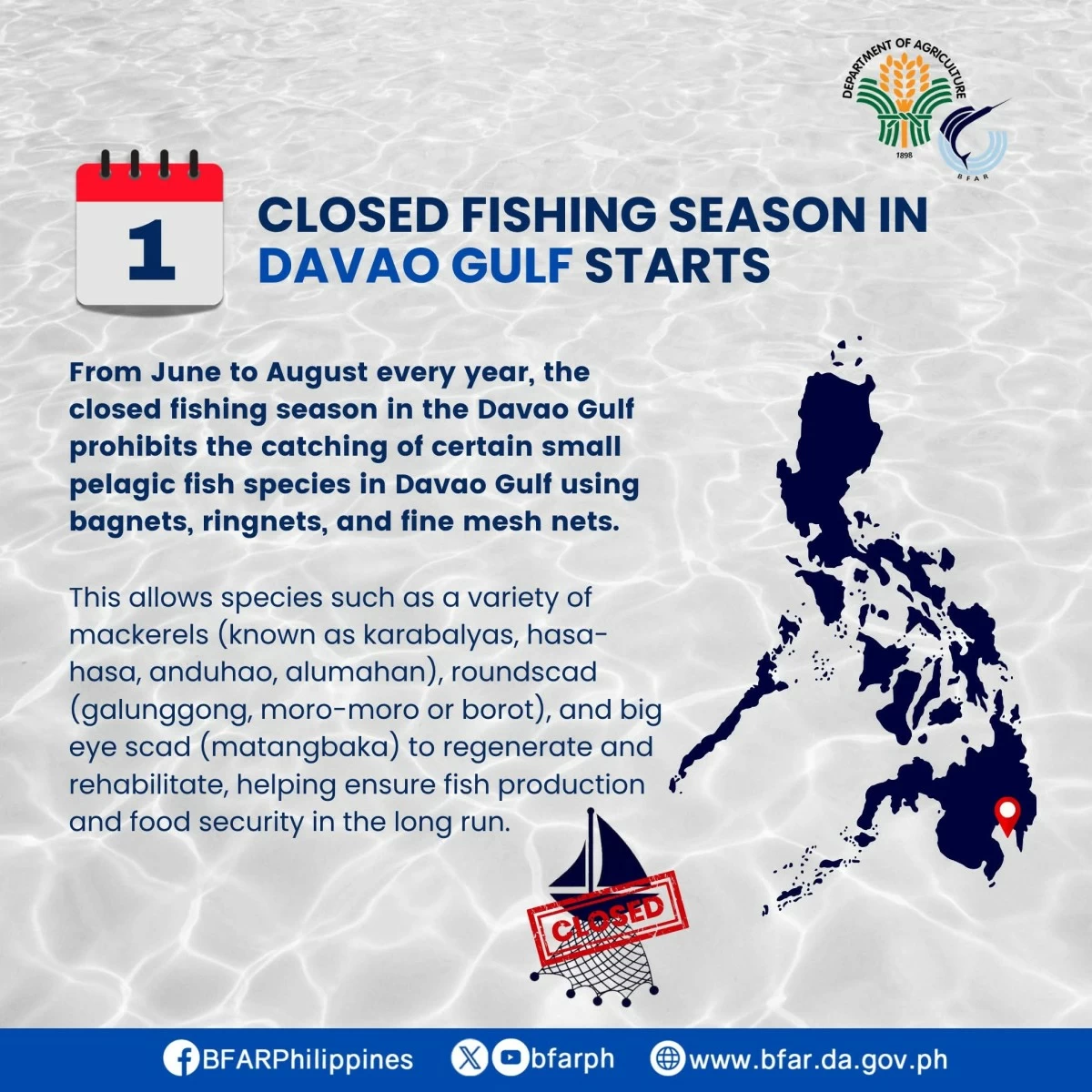
‎DAVAO CITY – The Bureau of Fisheries and Aquatic Resources-Davao (BFAR-11) has officially commenced the 2026 Davao Gulf closed season, enforcing a strict three-month ban on specific commercial fishing gear to protect small pelagic fish species during their peak spawning period until Aug. 31.
‎The ban spans from Cape San Agustin in Gov. Generoso, Davao Oriental, to Talagotong Point in Don Marcelino, Davao Occidental.
‎In a statement Tuesday, BFAR-11 said the closed season aims to ensure the long-term sustainability of the gulf's marine resources.
‎Under Department of Agriculture–Department of the Interior and Local Government Joint Administrative Order No. 2, Series of 2014, and Republic Act 10654, the use of bagnets (basnig or tapaytapay) and ringnets (kubkuban or likom) is strictly prohibited regardless of vessel tonnage. Modified fishing gear with similar operations is also banned.
‎Registered municipal fisherfolk using authorized, low-impact municipal gear are exempted from the ban. Permitted methods include hook and line, gillnet, and fish pots.
‎BFAR-11 has teamed up with the Philippine Coast Guard, the Philippine National Police-Maritime Unit 11, and local government units to step up monitoring and surveillance. Authorities are utilizing Vessel Monitoring System track analysis to detect illegal fishing activities.
‎Enforcement operations are currently concentrated in strategic coastal zones, including the Island Garden City of Samal, Banaybanay, Lupon, San Isidro, Gov. Generoso, and Don Marcelino.
‎Violators face severe penalties under Section 100 of RA 10654, including fines ranging from P20,000 to P500,000, imprisonment, confiscation of catch and gear, and cancellation of fishing licenses.
‎"Since 2015, the BFAR Regional Adjudication Committee Secretariat has docketed 13 closed-season violation cases, resulting in more than P1 million in total fines," BFAR-11 added.
‎BFAR-11 reaffirmed its commitment to protecting and conserving the marine ecosystem of Davao Gulf to ensure sustainable fisheries resources for future generations. The agency also urged the public to report fisheries violations to support enforcement efforts against illegal, unreported, and unregulated fishing in the region. (PNA)

Habagat to bring up to 100 mm of rain over Metro Manila, several Luzon provinces—PAGASA


By Jel Santos

Published Jun 2, 2026 10:30 am

Despite the absence of a tropical cyclone, PAGASA said that moderate to heavy rains are possible in several areas due to the habagat.

The southwest monsoon or habagat may bring up to 100 millimeters (mm) of rainfall over Metro Manila and several provinces in Luzon on Wednesday, June 3, the Philippine Atmospheric, Geophysical and Astronomical Services Administration (PAGASA) said.

PAGASA weather specialist Veronica Torres said the weather system remains the dominant weather disturbance affecting the country after Tropical Storm Domeng (international name: Jangmi) exited the Philippine Area of Responsibility (PAR).

“Ang southwest monsoon o habagat ay nakakaapekto na ngayon sa Luzon at sa may kanlurang bahagi ng Visayas (The southwest monsoon or habagat is now affecting Luzon and the western portion of the Visayas),” Torres reported on Tuesday, June 3.

“Itong southwest monsoon [ay] nagpapaulan pa rin sa malaking bahagi ng Luzon at ilang bahagi ng Visayas area (The southwest monsoon continues to bring rains over a large part of Luzon and some areas of the Visayas),” she added.

Despite the absence of a tropical cyclone, PAGASA said that moderate to heavy rains are possible in several areas due to the habagat.

“Bukas naman, 50 to 100 mm na pag-ulan ay posible sa may Occidental Mindoro, Batangas, Cavite, Metro Manila, Bulacan, Pampanga, Bataan, Zambales, Tarlac, pati na rin sa may Pangasinan (Tomorrow, 50 to 100 millimeters of rainfall is possible over Occidental Mindoro, Batangas, Cavite, Metro Manila, Bulacan, Pampanga, Bataan, Zambales, Tarlac, and Pangasinan),” said Torres.

The state weather bureau warned that such rainfall could trigger flooding and landslides in vulnerable areas.

“Kapag 50 to 100 mm ‘yung mga pag-ulan, ‘yung pagbaha ay posible sa mga areas na urbanized, low-lying, at malapit sa river. At ang landslide ay posible sa mga landslide-prone areas (When rainfall reaches 50 to 100 millimeters, flooding is possible in urbanized, low-lying, and riverside areas, while landslides may occur in landslide-prone areas),” Torres said.

Likewise, she noted that Domeng had already left the PAR and that PAGASA is not monitoring any tropical cyclone or low-pressure area within or near the country’s area of responsibility.

“Samantalang ‘yung mino-monitor nating bagyo noong mga nakaraang araw na pumasok sa ating Philippine Area of Responsibility na binigyan natin ng local name na Domeng ay lumabas na nga ng ating PAR kahapon ng 11:30 a.m. (Meanwhile, the tropical cyclone we had been monitoring in recent days, which entered the Philippine Area of Responsibility and was given the local name Domeng, exited the PAR yesterday at 11:30 a.m.),” Torres said.

“Kaya sa ngayon, wala na tayong mino-monitor na low-pressure area or bagyo sa loob or malapit sa ating PAR (As of now, we are not monitoring any low-pressure area or tropical cyclone within or near the PAR).”

Davao City plans to deploy AI-powered robots

 Davao City plans to deploy AI-powered robots to revolutionize government processes and public service delivery.

The technology is strictly designed to assist, rather than replace government personnel by managing:
Long queues and crowd flow
Repetitive paperwork
Routine administrative tasks
By automating these bottlenecks, human staff can focus on higher-level responsibilities, ultimately delivering more efficient and effective services to residents.
If fully realized, this integration could establish the city as a pioneering hub for public safety, disaster response, and advanced information services.
However, the proposal remains in the planning phase, pending formal budget allocation and approval through ongoing committee hearings.
Ultimately, this initiative highlights a strong local commitment to adopting emerging technologies to modernize governance.
May be an image of text that says '.lill မ C3OVCIMIEW .ahill AIAI -mtu -TNE PREENER LEWER AIA DAVAO CITY ADVANCES TOWARD BECOMING A PREMIER AI-ROBOTICS NEXT-GEN GEN GOVERNANCE FOR THE MODERN DAVAO WOW! DAVAO OFFICIAL WoW! DAVAO'
All reactions:
Rodora Briggs and 868 others

Peso at risk of hitting 64:$1 level–MUFG


Ian Nicolas P. Cigaral

The Philippine peso could weaken past the 64-per-dollar level if the Middle East conflict reescalates and oil prices reach new highs, MUFG Global Markets Research warned.

In a note to clients, the global bank said its baseline outlook still sees the peso gradually strengthening to 61 per dollar, assuming war de-escalation and US dollar softening.

Why is German significantly harder for English speakers to learn compared to other Germanic languages?


 · 

Because of the grammar.

The grammar structures of the German language are much more complex in comparison to the the grammar structures present in the English language.

German has four grammatical cases present in nouns and articles, it's one of the fewer Germanic languages that has preserved that grammar structure, the system of grammatical cases grants a much freer word order in the sentences with more freedom of combining them according to the context. German has also three grammatical genders in the nouns.

On the contrary English lacks of the system of declensions present in German, the only grammatical cases that English has preserved are the genitive and nominative, besides the word order in the English sentences is by far the strictest among all Germanic languages with mostly SVO pattern, allowing in very fewer cases a different word order in the sentences that it isn't this one.

English also lacks of grammatical gender distinction in nouns and adjectives, being among the fewer Germanic languages that has this characteristic.

Also the phonology of German could be harder to master for English speakers, since that there are many phonological sounds in the German language that they're not present in English.

Coincidentally Old English had grammar structures very similar to present day German with three grammatical genders and a system of declensions for grammatical cases, but all those features were lost during the transition from Old English to Middle English, Middle English had no longer those grammar features.

But it doesn't mean that German is harder to learn for English speakers overall since that it also depends according to the individual perception of the person and their personal experience with the studying of the language.