This might not be the typical expat blog, written by a German expat, living in the Philippines since 1999. It's different. In English and in German. Check it out! Enjoy reading!
Dies mag' nun wirklich nicht der typische Auswandererblog eines Deutschen auf den Philippinen sein. Er soll etwas anders sein. In Englisch und in Deutsch! Viel Spass beim Lesen!
You plan to move to the Philippines? Wollen Sie auf den Philippinen leben?
There are REALLY TONS of websites telling us how, why, maybe why not and when you'll be able to move to the Philippines. I only love to tell and explain some things "between the lines". Enjoy reading, be informed, have fun and be entertained too!
Ja, es gibt tonnenweise Webseiten, die Ihnen sagen wie, warum, vielleicht warum nicht und wann Sie am besten auf die Philippinen auswandern könnten. Ich möchte Ihnen in Zukunft "zwischen den Zeilen" einige zusätzlichen Dinge berichten und erzählen. Viel Spass beim Lesen und Gute Unterhaltung!
Visitors of germanexpatinthephilippines/Besucher dieser Webseite.Ich liebe meine Flaggensammlung!
This question was originally posted 15 years ago but its been revised and merged by Quora moderation. If I’m going to answer this base on my situation 15 years ago, I would say life in the Philippines is like living in a bubble.
Btw I’m not an expat, so my answer is base on a different perspective. But living outside the Philippines for a short while, I can see the difference how Filipino culture makes them standout, but at the same time, its the same reason preventing them/us from overcoming poverty.
Your quality of lifestyle there depends on your capability to sustain a certain “average” standard of living. There are rich, upper/middle/lower class, poor, “poorest” of the poor. So which one? Speaking as someone who live in the rural north, I can say its pretty exciting and challenging. I experienced the perks of simplicity living in the rural.
Life is good for sure to those rich and in those living the middle class range. They can afford to travel, unwind from time to time and they don’t worry that much when calamity strikes. The Philippines is a tropical paradise to those who can afford it but a total shithole to those who can’t.
At least that’s how I can see it. The only thing that makes the Philippines “remarkable” is how friendly and approachable most people are. You can ask anyone for, say, a direction of specific location and they don’t hesitate to help you.
Now, the reason why I say living there is like living inside a bubble is almost everyone is super occupied with themselves. Gossip. Systemic problems. There's nothing wrong with that, only we are distracted with all those systemic problems and how to survive on our own, we don’t know what’s happening outside our perimeter, we focus on how we provide the next dinner on the table – and honestly, that’s convenient for those in power. When was the last time Filipinos talked as a country about where the world is going?
We tend to explain today’s instability in geopolitical terms—conflict zones, trade routes, shifting alliances. But beneath all of that runs a deeper strain: trust.
When trust breaks at the level of nations and institutions, the consequences don’t stay abstract. They show up in higher fuel costs, tighter margins and consumers whose purchasing power steadily erodes.
We are, in many ways, downstream of that collapse.
What we are witnessing globally is not simply a failure of diplomacy or policy. It is the erosion of the basic conditions that makes cooperation possible.
When trust collapses, negotiation gives way to force—and the cost doesn’t stay with leaders. It moves outward into markets, into systems, into everyday life.
This is not new. It is a pattern as old as exchange itself.
Trust: Original infrastructure
Long before contracts and currencies existed, exchange had depended on credibility.
Early communities traded out of necessity, but survival rested on something deeper than the goods themselves. You had fish. I had rice. We made a deal.
But the real transaction was never just about goods—it was about belief. Will you cheat me?
If you gave me bad fish today, I might not live through tomorrow. If I cannot trust you, I cannot trade with you. And if I cannot trade, neither of us survives.
Trust was not the soft side of early commerce. It was the entire infrastructure.
This held not only between individuals but across communities with every reason to distrust one another. The groups that found a way to build trust—despite risk, despite difference—were the ones that grew. The rest disappeared.
The question “Can I trust you?” has never left commerce. It has only grown more complex.
The same question, digitized
In the Philippines, that ancient logic persisted in everyday life. The sari-sari store was not merely a retail model—it was a trust system.
When the lola said “utang muna, babayaran ko sa Biyernes ( Put it on my tab, I will pay on Friday)” and the manang said yes, there was no paperwork, no formal enforcement mechanism beyond reputation and relational accountability.
Trust functioned as currency. Relationships acted as collateral. Consistency became credit.
Today, we operate in a digital marketplace defined by speed and scale. Yet behavior tells a different story. We spend disproportionate time validating sellers, choosing payment methods and documenting proof of transactions.
In a market where online scams are prevalent, the caution is justified. And yet, participation continues—because consumers are not necessarily naive. They engage because they are still willing to believe that someone, somewhere, is worth trusting.
That willingness is not a weakness. It is latent demand.
And that hunger to trust is the biggest business opportunity in the room today.
The market is not asking organizations to be perfect. It is asking them to be predictable.
Trust is not built through messaging. It is built through repeated, consistent delivery—especially when it is inconvenient.
Culture starts it. Systems sustain it.
Filipino culture provides a strong foundation: kapwa, loob and malasakit (shared identity, mutual trust and care). These values shape what people believe is right. But under pressure —when incentives shift, when costs rise, when no one is watching—belief alone is not enough.
Systems determine behavior
Organizations consistently overestimate the power of culture and underestimate the power of governance.
Values statements are easy to articulate. Designing structures where honesty is safe, accountability is enforced and the right action is also the easiest one—that is far harder.
Consider Toyota’s production system, where any worker can stop the assembly line without penalty. That andon cord makes honesty safer than silence and quality a shared responsibility. Consider Grab’s localized platform decisions—cash payments, transparent pricing, safety features—which are designed around real user constraints, lowering the barriers to participation and trust.
Consider Singapore’s institutional discipline, where accountability is not selective but systemic and integrity is predictable rather than optional.
In each case, trust is not assumed. It is deliberately engineered.
From virtue to advantage
This is the shift leaders must make.
Stop treating trust as a communications strategy. Trust is not what organizations say—it is what their systems do when commitments are tested.
Stop assuming that culture alone will sustain it. Culture is where trust begins; systems are where it is proven.
And start measuring trust with the same rigor as financial performance. In markets where consumers demand proof before belief, trust is not a soft metric. It is a driver of growth.
The question that governed early barter still governs today’s most advanced transactions. It determines whether customers convert, whether partners stay, whether institutions endure.
The world has not run out of resources. It has run out of trust.
Rebuilding it will not happen through declarations at the top. It will happen through decisions on the ground—in the way organizations design their systems, enforce their standards and behave when tradeoffs become real.
It grows the way it always has: between two people trading fish and rice, between a manang and a lola at the sari-sari store, between an online seller and a buyer with screenshots as their only assurance.
Organizations that get this right will not just grow. They will be the ones still standing when others are not.
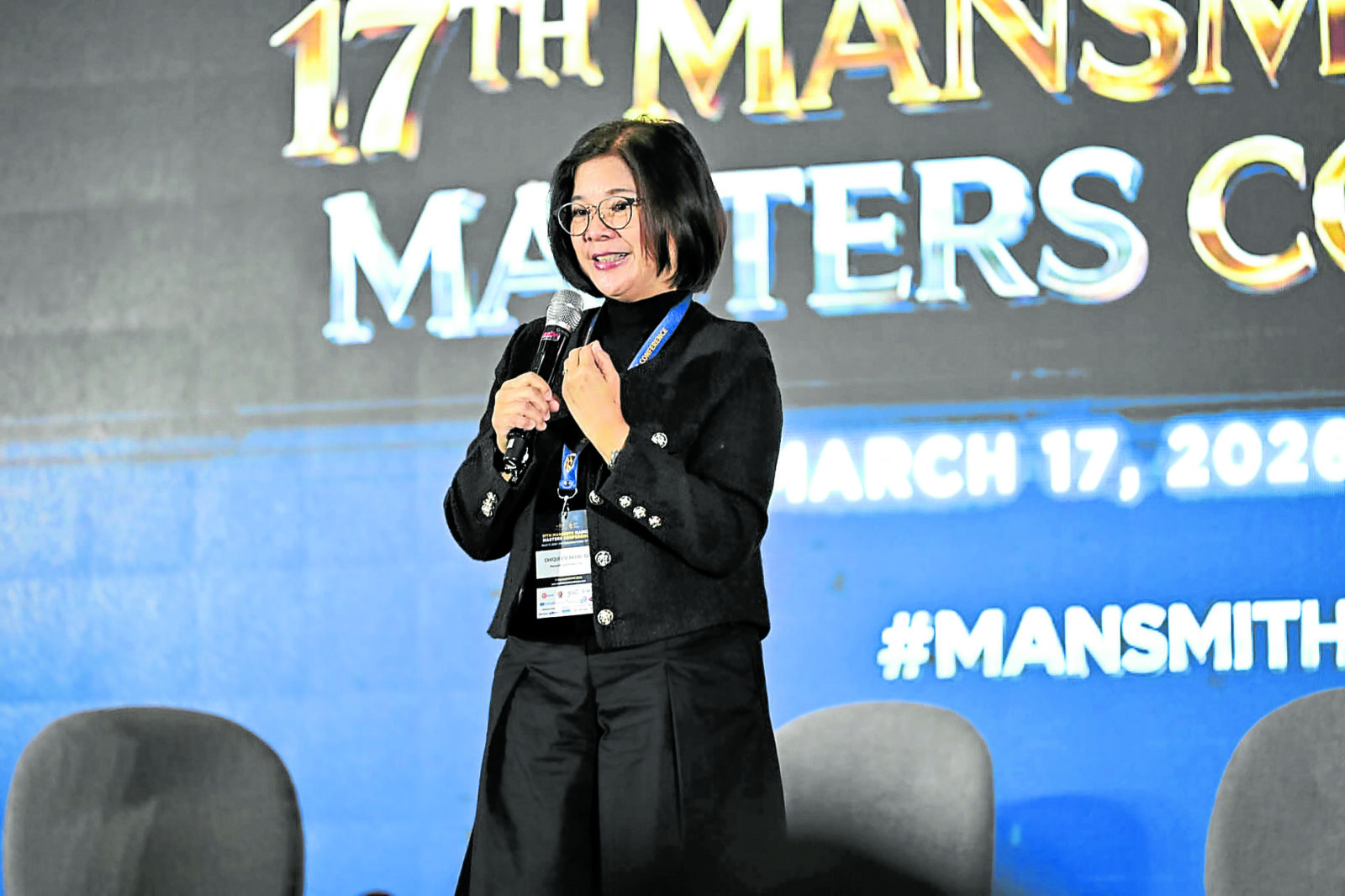
Chiqui Escareal-Go is a marketing anthropologist and CEO of Mansmith and Fielders Inc. This piece was delivered at the opening of the 17th Mansmith Market Masters Conference. For in-house invitations or inquiries, please email info@mansmith.net.
Published Apr 16, 2026 12:02 am | Updated Apr 15, 2026 04:24 pm
The fuel crisis is formidable, no doubt about it. But addressing it is as formidable for lack of concerted effort.
But what if, in the face of this deepening crisis, we choose unity over division, action over accusation, cooperation over conflict? What if, even for a brief moment, we set aside the noise of politics and focus instead on the urgent needs of the Filipino people? We raise these questions as they are necessary reflections in a time that demands not just leadership, but collective resolve.
The ongoing global fuel crisis, brought about by tensions in the Middle East, has rippled through every layer of society. From transport workers struggling to make ends meet, to families tightening already strained budgets, to businesses grappling with rising costs—the burden is shared. And because it is shared, the response must be shared as well. A fragmented approach will not suffice. What we need is a whole-of-society effort grounded in unity and purpose.
What if the House of Representatives, recognizing the urgency of the moment, temporarily sets aside impeachment proceedings and redirects its energy toward fast-tracking legislation that could provide immediate relief? Don’t get us wrong. This is not a call to abandon accountability or disregard constitutional duties. Rather, it is a call to prioritize and to recognize that in times of crisis, the most pressing needs of the people must come first. Governance, at its core, is about service. And service, especially now, requires focus and sacrifice.
What if critics of the administration paused their relentless fault-finding, not to silence dissent, but to channel their insights into constructive solutions? Healthy criticism is the lifeblood of democracy. It sharpens policy, exposes weaknesses, and ensures transparency. But there are moments when criticism must evolve into collaboration. When pointing out problems, these must be matched with proposing remedies. The fuel crisis is one such moment.
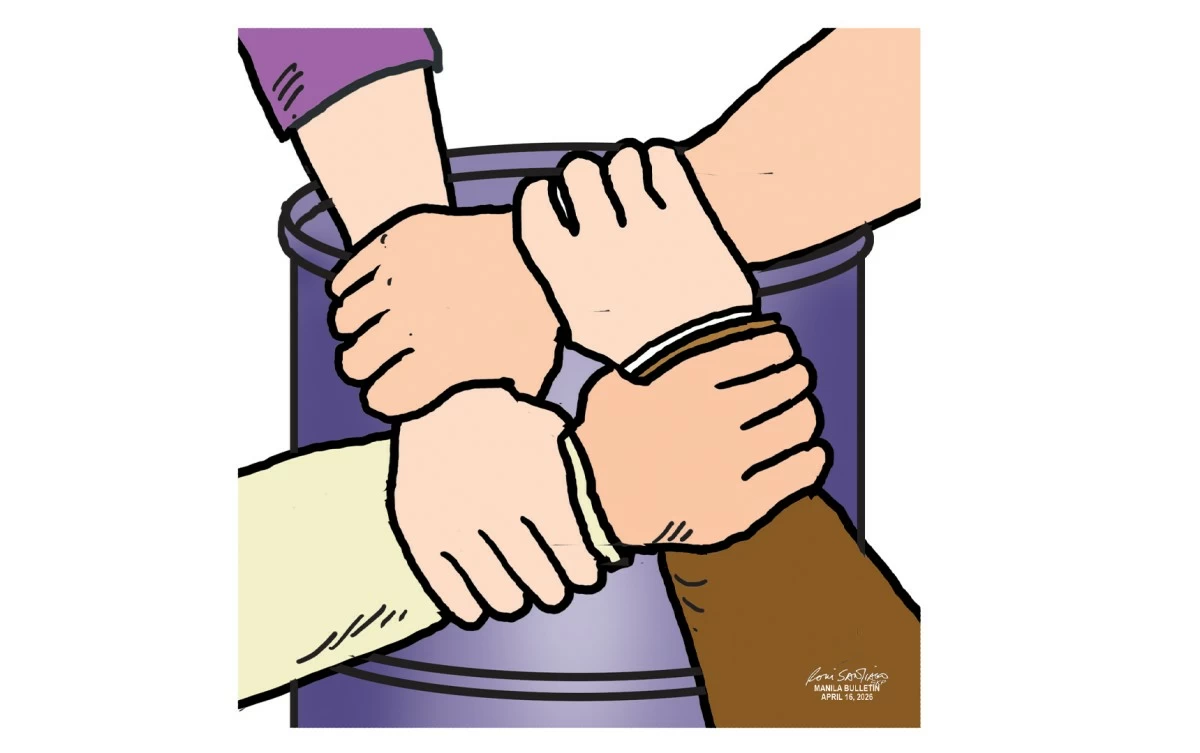
Let us be clear. This is not about suppressing voices or discouraging debate. It is about recalibrating our energies. A temporary pause in political hostilities does not weaken democracy; it strengthens it by proving that, when necessary, we can rise above partisanship for the common good. The Filipino spirit has always been defined by resilience and bayanihan, the willingness to help one another in times of need. Now is the time to embody that spirit once more.
Imagine a nation where lawmakers, regardless of affiliation, work hand in hand to pass measures that cushion the impact of rising fuel prices. Imagine private sectors stepping up with innovative solutions, and citizens doing their part through conservation and community support. Imagine a chorus of voices—not in discord, but in harmony—working toward a single goal of weathering this storm together.
The Bible reminds us in Psalm 133:1, “Behold, how good and how pleasant it is for brethren to dwell together in unity!” The message delivers a spiritual ideal and is a practical necessity. Unity fosters strength. It builds trust. It enables swift and decisive action. In contrast, division only deepens the crisis, prolonging the suffering of those who can least afford it.
The road ahead will not be easy. The challenges posed by the fuel crisis are complex and far-reaching. But they are not insurmountable. If we choose unity, if we choose to act not as divided factions but as one Filipino nation, we can overcome. The question is not whether we are capable. The question is whether we are willing.
DAVAO CITY – The Davao City government strongly opposed any proposal to construct United States military infrastructure within its jurisdiction, warning that such plans would meet resistance.
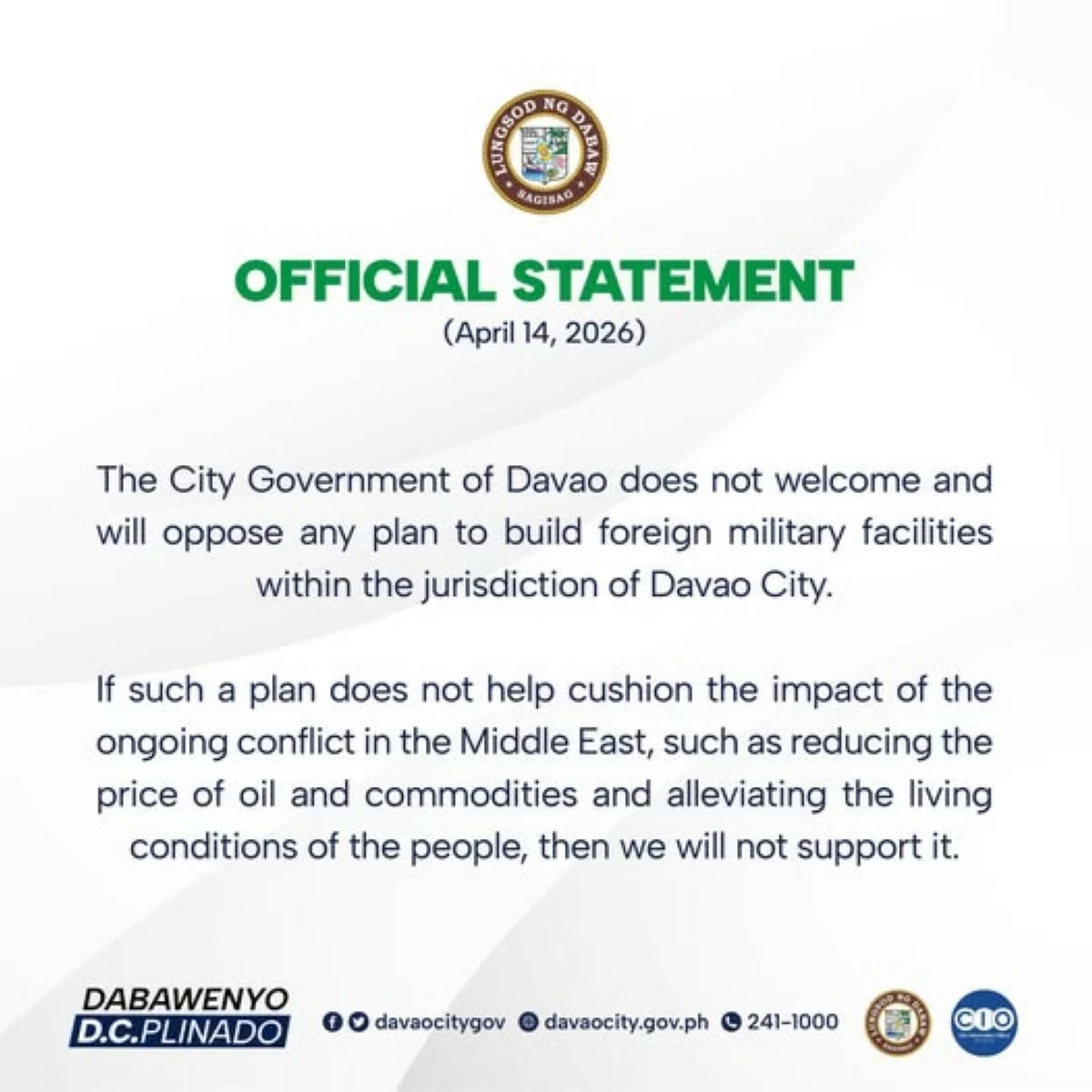
In a statement released on Tuesday, April 14, City Information Office head Harvey Lanticse said the local government does not support the establishment of foreign military facilities in the city.
"The City Government of Davao does not welcome and will oppose any plan to build US military facilities within the jurisdiction," Lanticse said.
Davao City's position came amid national discussions on the possible expansion of the US military presence in the Philippines under the 2014 Enhanced Defense Cooperation Agreement.
Reports said that the 2014 Enhanced Defense Cooperation Agreement allows rotational deployment of American forces and the construction of support facilities in approved locations.
At present, nine sites in the country have been designated under the agreement. The Davao Gulf is not included among those locations.
The Davao Gulf has surfaced in recent discussions as a potential site for a large fuel storage facility reportedly backed by the US, prompting the city to reiterate its opposition.
Davao City did not elaborate on specific actions that may be taken should a proposal formally materialize, but maintains opposition to foreign military facilities within the city.