Simplicity is not about having less in life. It is about making room for peace, focus, gratitude, better choices, and real happiness.
This might not be the typical expat blog, written by a German expat, living in the Philippines since 1999. It's different. In English and in German. Check it out! Enjoy reading! Dies mag' nun wirklich nicht der typische Auswandererblog eines Deutschen auf den Philippinen sein. Er soll etwas anders sein. In Englisch und in Deutsch! Viel Spass beim Lesen!
You plan to move to the Philippines? Wollen Sie auf den Philippinen leben?
Ja, es gibt tonnenweise Webseiten, die Ihnen sagen wie, warum, vielleicht warum nicht und wann Sie am besten auf die Philippinen auswandern könnten. Ich möchte Ihnen in Zukunft "zwischen den Zeilen" einige zusätzlichen Dinge berichten und erzählen. Viel Spass beim Lesen und Gute Unterhaltung!
Total Pageviews
Friday, May 29, 2026
Simplicity is not about having less in life
'Domeng' enters PAR; PAGASA warns of heavy rains from enhanced southwesterly wind flow
The cyclone may strengthen the southwesterly winds, leading to prolonged heavy rains over the western section of the country.
By Ellalyn De Vera-Ruiz
Published May 29, 2026 07:15 am
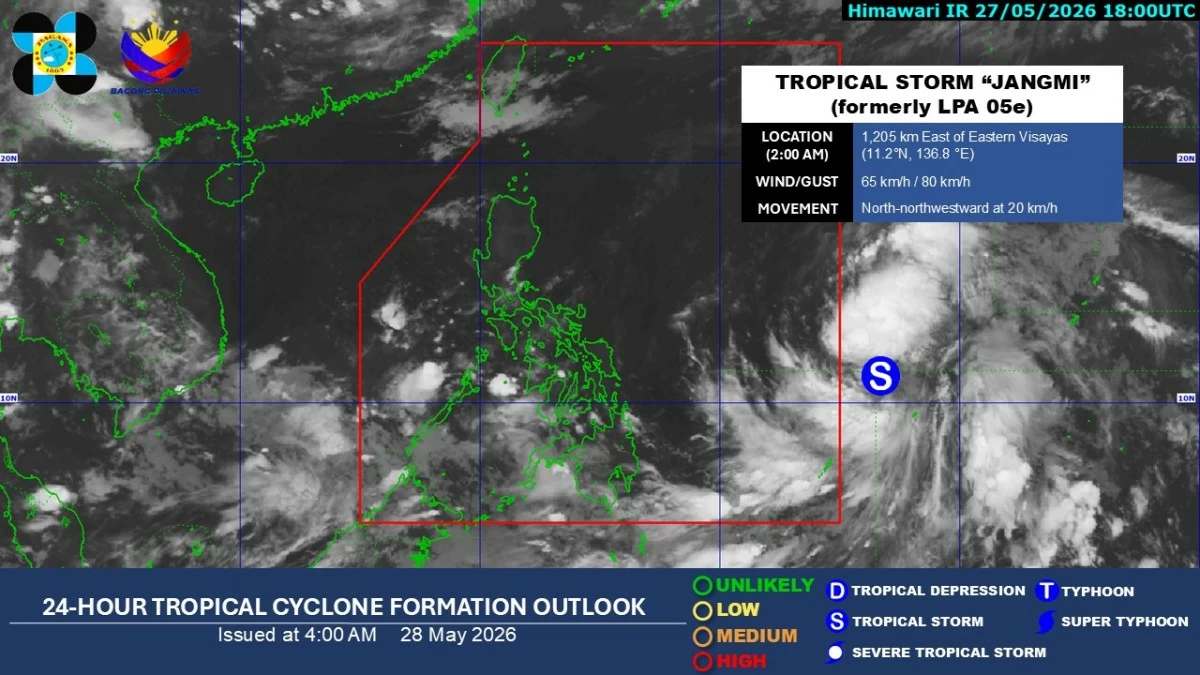
Tropical Storm Domeng (international name: Jangmi) entered the Philippine Area of Responsibility (PAR) early Friday, May 29, and is expected to enhance the southwesterly wind flow in the next 24 hours, the Philippine Atmospheric, Geophysical and Astronomical Services Administration (PAGASA) said.
In its 5 a.m. bulletin, PAGASA said the center of Domeng was estimated at 1,345 kilometers east of Southeastern Luzon, moving northwestward at 20 kilometers per hour (kph).
It packed maximum sustained winds of 75 kph near the center and gustiness of up to 90 kph.
The weather bureau said the cyclone is expected to continue moving generally northwestward until Sunday, May 31, before turning north northwestward to northward.
It is forecast to exit the PAR by Monday, June 1.
PAGASA said Domeng may further intensify and reach typhoon category while remaining over the Philippine Sea before gradually weakening afterward.
Based on its forecast track, the hoisting of tropical cyclone wind signals over Extreme Northern Luzon remains less likely, although not ruled out.
While Domeng is unlikely to make landfall, PAGASA weather specialist Leanne Loreto said its trough or extension may still bring cloudy skies with moderate to heavy rains and thunderstorms over Eastern Visayas and Caraga over the weekend.
The cyclone may also strengthen the southwesterly winds, leading to prolonged heavy rains over the western section of the country.
The southwesterly wind flow, described as the initial surge of the southwest monsoon or “habagat,” is expected to bring moderate to heavy rains over Western Visayas, Negros Island Region, Zamboanga Peninsula, Soccsksargen, Bangsamoro Autonomous Region in Muslim Mindanao, Lanao del Norte, and Palawan.
“Doble ingat dahil posible po ito magdala ng mga pagbaha at pagguho ng lupa (Exercise double caution as this may bring flooding and landslides),” Loreto warned.
Despite the weather disturbance, PAGASA said warm and humid conditions will persist across most of Luzon.
“Other parts of the country naman po kahit may bagyo po tayo ay magiging mainit pa rin at maalinsangan lalong-lalo na po sa malaking bahagi ng Luzon. So meron pa rin tayong matataas na heat index ngayong araw (In other parts of the country, even with a storm, conditions will still be hot and humid, especially across much of Luzon. High heat index levels are still expected today),” Loreto said.
Metro Manila and the rest of the country may experience partly cloudy to cloudy skies with isolated rain showers or thunderstorms, although flash floods or landslides remain possible during severe thunderstorms.
Moral and human values
By Klaus Döring
Human values are virtues — desirable character traits — that guide us to consider the human element when interacting with other people. Human values are those that enable people to live in harmony with the rest of the world. Without values, human life would be devoid of meaning, devolving into a bland, textureless existence without distinction. Human values are the deepest moral aspirations of humanity, and they are the foundation of our lives as individuals and societies. Human values are universal in nature because they are shared by all people, regardless of religion, nationality, or cultural background. Human values encourage consideration for one another.
Moral and human values are the fundamental beliefs and principles that guide our behavior, define our character, and help us distinguish right from wrong. While human values are universal and promote overall well-being and dignity, moral values are specific guidelines shaped by cultural and societal norms.
In these eventful times, with calls for peace all around the globe but also with “lust after war,” with corrupt politicians and terrorist attacks against innocents, and with cries for justice, it is very easy to forget moral and human values. People, don’t let this happen!
Allow me to ask you a question: “What makes a modern person?” Technology and knowledge, for sure? If not, we couldn’t operate our computers or other devices. Skills, of course, are part of it. But more important are attitudes and values, and our readiness for new ways of reacting, feeling, and looking at things.
I am afraid that we have to look first into ourselves. Many of us can notice our sense of group feeling alongside terrible egoism. We care so much for the good of our own families and ourselves by making great sacrifices, even for a long time. Charity starts and ends mostly at home. Why are we not able to develop fidelity that expands into a wider field of action so that we can go beyond the limits of our unsocial system and reach others around us?
We easily blame our government. This happens in almost every country worldwide. But don’t we only get the government that we deserve? Misuse, improper treatment, rude language and behavior, and corruption — these are all reflections of ourselves. Mistakes, injustice, the wrong sense of values, and the lack of priorities caused by arrogance and ignorance are with us daily and are simply our own.
A nation might have been rich with abundant blessings; it is only unfortunate that these blessings could not be made useful because of some flaws in the entire system. Why do we have collapsing economies or huge foreign and national debts? Because human values are not put in place. It’s easier to fill your own pockets than to care for a neighbor. Aren’t we paid for the service we render, so why do we resort to other unlawful and shameful activities? Are we really prioritizing material things over and above spiritual satisfaction?
We are becoming weaker and weaker when we lack punctuality, honesty, and responsibility. We have to improve as human persons with national pride, discipline, and consistency, because skills, knowledge, and technology are not enough. We have to avoid too many subjective comments, excessive sensitivity, and being fancy and conceited. If a nation like the Philippines is still rich in natural resources and intelligent, highly creative people, its people should guard against know-it-all criticism about insufficiency, imbalance, or inequality.
Moral and human values can only grow if we are willing to undergo renewal of will, mind, and heart. Let us give moral and human values a try. They could do great things to alleviate economic life, to save us all from imminent spiritual degradation, and to allow us to live in peace and harmony.
***
Email: doringklaus@gmail.com, follow me on Facebook, LinkedIn, or X — Twitter, or visit www.germanexpatinthephilippines.blogspot.com or www.klausdoringsclassicalmusic.blogspot.com.
Thursday, May 28, 2026
Yet not as I will, but as you will

Storm trough, southwesterly wind flow drench parts of VisMin, Palawan
At A Glance
- The tropical storm with the international name "Jangmi" was located 1,195 kilometers east of Eastern Visayas as of 3 a.m.
- Once it enters PAR between Thursday evening and Friday morning, the cyclone will be given the local name "Domeng."
- PAGASA said the weather disturbance currently has a low chance of making landfall in the country but may enhance the southwesterly wind flow.

Foreign Exchange Rate as of May 28, 2026
Klea Pineda speaks out after receiving disturbing online threats
By Neil Ramos
At A Glance
- Klea Pineda addressed disturbing online threats from a netizen, earning support from Janella Salvador, fans, and GMA's management arm, Sparkle, which strongly condemned online harassment and hate.
Actress Klea Pineda has spoken out after receiving disturbing and offensive messages from a social media user, prompting support from fans, fellow celebrities, and her talent management agency, Sparkle.
Klea shared a screenshot on Facebook showing an inappropriate message allegedly sent by an unidentified netizen. While the actress noted that she is no stranger to criticism online, she emphasized that certain comments cross the line and should never be normalized.
“I’m used to criticism, but some people are getting way too comfortable with their words. Nobody deserves to be on the receiving end of jokes like this,” Klea wrote.
The post quickly gained attention online, with many netizens expressing support for the actress and condemning toxic behavior on social media.

Among those who reacted was actress Janella Salvador, who reposted the official statement released by the team behind the queer film "Open Endings," where she stars alongside Klea.
In the statement, the film’s production team strongly denounced all forms of harassment and hateful remarks directed at the actress.
“Threats and harmful statements are never acceptable and should never be normalized, especially against members of the LGBTQIA+ community, who continue to face discrimination and harassment,” the statement read.
The group also emphasized the importance of promoting safety, respect, and inclusivity for everyone, regardless of identity.
Janella later shared the statement on her Instagram Stories with the caption:
“There is a fine line.”
Meanwhile, Sparkle GMA Artist Center also released an official statement reaffirming its commitment to maintaining a safe and respectful environment for all artists.
“Sparkle advocates for safety, dignity, and kindness for all. We do not condone acts of hate and intimidation and reaffirm our commitment to fostering a safe and inclusive environment for our artists,” the agency stated.
The Philippine Flag
On May 28, 1898, the Philippine Flag was proudly unfurled and waved for the first time following the Philippine Revolutionary Army's victory over Spanish forces in Imus, Cavite.
Wednesday, May 27, 2026
The resilient woman defining fiscal policy By Derco Rosal
By Derco Rosal
Often one of the few women representing the Philippines on the global stage, Maria Teresa Habitan reflects on her rise through the Department of Finance. Comparing her experience to Hidden Figures, Habitan credits the “strength and clash of principles” among female leaders for navigating the country through historic economic hurdles and legislative battles.
Who knew that helping a friend find her way to a finance job application on Mabini Street could launch a long-term career in fiscal management? For Maria Teresa Habitan, that chance act was the first of many “happy accidents” that would shape her rise to veteran status.
Habitan first stepped through the gates of the Department of Finance (DOF) in the waning years of dictator Ferdinand Marcos Sr.’s collapsing administration. She would exit decades later, shortly after the election of the dictator’s son, Ferdinand Marcos Jr., to the presidency.
Fresh out of university in the 1970s, Habitan soon found herself standing before a whirring, scraping xerox machine, reproducing finance documents, or feeding papers into screeching fax machines to send scanned files.
Moments later, she would find herself seated in a meeting, representing the DOF, being asked— while spooning soup—about matters she barely understood. She would evenetually get quietly rescued by someone else in the room.
Habitan readily admits that, despite earning an economics degree from the University of the Philippines (UP), much of the discussion in those early high-level meetings went over her head.
For the long-serving finance assistant secretary, the first five years of her nearly four-and-a-half-decade career at the DOF were spent reconciling classroom theory with the realities on the ground.
She recalls her first flight to Washington, braving America’s cold weather in a borrowed jacket.
Before long, however, the pressure of navigating the Philippines’ mounting foreign debt set in, forcing Habitan to fully grasp the weight of helping manage a nation’s fragile economy.
“I felt the pressure when the Philippines had a debt crisis in October 1983,” Habitan told this author. Under the fading rule of Marcos Sr., the country became the first in Asia to be swept into the debt crisis of the 1980s—an economic blow compounded by political uncertainty.
To gain breathing room amid swelling obligations to foreign lenders, the Philippines sought a three-month moratorium on debt servicing. Three years later, the International Monetary Fund (IMF) slightly eased its terms, though only within limits, as the country’s debt continued to balloon despite ongoing reforms.
Defense
Several times, Habitan felt the urge to defend the Philippines from foreign ridicule—yet she and her colleagues also shared the instinct to disappear from the judging gaze.
She recalled one such moment during a debt seminar in Thailand, where reports showed ASEAN economies in solid fiscal shape—except for the Philippines. The Mexican resource person repeatedly singled out the country, prompting Habitan and her colleagues to quietly retreat from view.
“There were four of us from the Philippines, all women, and at first we just wanted to go home,” she said. “But over lunch, we ended up at a table with a Mexican speaker—he didn’t even realize there were Filipinos in the seminar.”
After that shared meal, the speaker noticeably eased his focus on the Philippines. “That’s when I realized that charm can actually work,” Habitan told Manila Bulletin, her chin-length, medium-brown bob framing a face that has since become familiar in fiscal circles.
Habitan is often seen in sleeveless tops paired with slacks, or a blazer matched with a knee-length skirt, finished with closed-toe pumps. She typically accents her composed presence with golden pearl stud earrings and a matching necklace.
Standing beside her were three other female officials—a scene reminiscent of the film Hidden Figures, with one crucial difference: these women were not working behind the scenes. They were visibly present, holding their ground in direct dialogue with multilateral lenders.
“Almost all the secretaries and economic managers were men, but all their deputies and undersecretaries were women—and they were incredibly strong,” Habitan said.
“You could see them in action during IMF negotiations, and in the Development Budget Coordination Committee (DBCC) meetings as well. You could really witness the clash of principles—it was impressive,” she added.
Habitan spoke of this with unmistakable feminist pride—a disposition perhaps shaped by her fondness for strong-minded heroines in the novels she read, or maybe by her own taste for the boldly spicy flavors of pinangat.
Still, she acknowledged the difficulty of negotiating with the country’s creditors.
“You feel like a victim. You know you’re at fault—but it’s their fault too. They’re the creditors. So why did they keep lending to us without doing their due diligence?” she said, noting that the hardship was heightened by the fact that the Philippines stood alone with a debt problem at the time.
Part of her regular work involved presenting the more positive developments in Philippine economic policy to debt watchers and the IMF. “It’s like defending your thesis every quarter—with the IMF,” she said.
“We knew what we wanted to do technically—but Congress had to legislate it,” Habitan explained, adding that this legislative hurdle was often the main obstacle to reforms the Department of Finance sought to implement.
‘Lost’ battles
Guided by her philosophy on taxation, Habitan believes that no tax measure is ever truly wasted, given that the legislative process is long and far from instant. If anything, she says, patience is essential, as the passage of future laws is often delayed.
“Pushing for policy reform isn’t instant noodles—it’s a slow burn. You can’t do it all at once. You need to study, and you need to work with people who don’t always agree with you,” she told this author.
Among the reforms that have faced repeated deferment since the DOF’s push in the 1990s are CREATE MORE, fiscal incentives reform, and amendments to the mining law.
Even with this reality, Habitan said the country needs fiscal authorities who are principled enough to firmly hold the DOF’s ground amid public pressure. This, she noted, is often where fiscal managers are misunderstood—mistaken for being “heartless” or “arrogant,” labels she herself has received.
“One can listen and, at the same time, stay firm in one’s position,” she said. “Even if I know I’ll lose the hearing, I put the DOF position on record.”
Now vice chancellor of the Philippine Tax Academy (PTA), overseeing the Local Government Finance Institute (LGFI), Habitan continues to stand by the tax philosophy that defined her career.
For her, “everybody should pay at least a minimum tax—no matter what,” underpinning her belief that taxes are the lifeblood of government, funding services ultimately meant to benefit the people who pay them.
At the same time, she stressed that tax authorities must de-complexify the process of paying taxes. She stressed compliance should be simpler, fairer, and more humane, as red tape only hinders efficient tax collection.
Habitan keeps her fingers crossed for a more informed citizenry, particularly on why tax revenues are collected. For the DOF, meanwhile, she hopes for a corps of staff deeply invested in policy work—engaging stakeholders and advancing comprehensive tax education.
“Taxes are unpopular. Be ready to be unpopular if you’re with the DOF. You’re not here to be loved. You should aim to be respected,” the veteran said, adding that clear principles must be matched with political courage and savviness, as taxes remain “the most difficult kind of legislation.”
Perhaps what would truly make this veteran happy—aside from solving puzzles and binge-watching K-dramas—is witnessing a renewed sense of patriotism, expressed through progressive tax measures.
Pride-worthy, even, if foreign players could take a closer look at how the Philippine government operates and consider it as a model—as was the case with the Philippines being a model of transparency for the extractive industries that Habitan once headed.