You plan to move to the Philippines? Wollen Sie auf den Philippinen leben?

There are REALLY TONS of websites telling us how, why, maybe why not and when you'll be able to move to the Philippines. I only love to tell and explain some things "between the lines". Enjoy reading, be informed, have fun and be entertained too!

Ja, es gibt tonnenweise Webseiten, die Ihnen sagen wie, warum, vielleicht warum nicht und wann Sie am besten auf die Philippinen auswandern könnten. Ich möchte Ihnen in Zukunft "zwischen den Zeilen" einige zusätzlichen Dinge berichten und erzählen. Viel Spass beim Lesen und Gute Unterhaltung!


Visitors of germanexpatinthephilippines/Besucher dieser Webseite.Ich liebe meine Flaggensammlung!

free counters

Total Pageviews


Sunday, July 20, 2025

To help end flooding, let us stop our addiction to plastics


By Manila Bulletin


The weather forecast for this weekend is heavy rains in many parts of the country. And with rains, we see the same heartbreaking images – streets flooded, rivers clogged, homes submerged, and livelihoods ruined.

We also see images of the common culprit behind many of these floods—plastic waste. Plastic bags, sachets, straws, and packaging waste that are improperly disposed of find their way into our drainage systems, esteros, and rivers. Over time, they block waterways, prevent water from flowing freely, and turn even a short downpour into a disaster.

The Philippines is already among the world’s worst contributors to ocean plastic pollution. But this isn’t just an environmental issue—it’s a direct threat to our safety, our health, and our future.

We have enough laws on paper to address this problem. Republic Act 9003 or the Ecological Solid Waste Management Act has been around since 2000. More recently, the Extended Producer Responsibility (EPR) Act of 2022 compels big companies to take responsibility for their plastic packaging. Across the country, many local governments have passed ordinances banning single-use plastics such as plastic bags, straws, and styrofoam.

Yet flooding persists, plastic pollution continues, and garbage remains a common sight in our rivers and estuaries. Why? Because laws alone cannot solve this crisis. Real change demands action from everyone: individuals, businesses, and government.


If we want to stop plastics from choking our waterways and worsening floods, we need to begin with ourselves. We can no longer hide behind excuses of convenience or habit. Refusing single-use plastics is one of the most basic yet powerful actions we can take. Bringing our own eco-bags, reusable containers, utensils, and tumblers might seem small, but multiplied across millions of Filipinos, it becomes transformative.

Consumers wield enormous influence. By supporting brands that offer sustainable alternatives and shunning those still wrapped in layers of unnecessary plastic, we send a strong message. Businesses listen to where we spend our money.

We must also educate those around us. In our homes, schools, and workplaces, let’s talk about the link between plastic waste and flooding. Teach children the value of refusing, reducing, reusing, and recycling. Speak up in stores and restaurants when unnecessary plastic is offered.

Plastic bans often fail because businesses—especially small vendors—continue using plastic out of habit or perceived necessity. But change is possible. As customers, we can ask store staff to offer alternatives like paper bags, banana leaves, or reusable containers. We can support local governments by reporting violations and pushing for better enforcement.

Businesses must also understand that they have a role to play. Those who refuse to adapt to the plastics ban should face penalties, while those who innovate and embrace circular economy solutions should be rewarded. The government, for its part, must ensure that the rules are not just written, but followed.

Ending our addiction to plastic isn’t just about carrying our own bags—it’s about changing the system. A true circular economy—where products are reused, refilled, and repurposed—must be the goal. Government policies should encourage and support businesses shifting to sustainable practices. Infrastructure such as recycling plants and composting facilities must be built to handle waste more effectively. Local ordinances should be standardized to avoid confusion and loopholes.

The challenge is clear. The choice is ours. Will we continue to let plastic waste choke our rivers and flood our streets? Or will we take responsibility, change our habits, and demand accountability from those around us?


Do Germans, Austrians and German-speaking Swiss people all understand each other?


 · 

Normally they wouldn’t, but they do anyway because of training.

This is because all of us learn to speak Standard German and are exposed to other dialects at an early age, we learn to pick up on and track the grammatical changes that occur between these dialects.

This means that, when faced with a new dialect that we don’t understand, we can often listen to it, discern patterns in their grammar that are similar to another variation that we have heard before, and figure out what they are doing.

Natural German dialects also all have a kind of lyrical lilt that varies enormously between regions and even within regions. You have to hear your way into the song to parse where words end and begin. As far as I can tell, the only German dialect I’ve heard with no music in it is the artificially constructed, prescriptivist, academic, Standard German.

Once you figure out a few of those features, you can begin to follow what they are saying, because despite these obfuscations, you will usually recognize the roots portions of the words they are using, even if they are very archaic in your own dialect, or familiar from a completely different Germanic language.

For example, in Swiss German they say “Widder Luaga!” which is their equivalent of “Auf wiedersehen”.

Cognates of “luaga”, like the English word “look”, are not common in other German dialects, though you do have “lugen” (to take a peek) in Standard German, but I still instantly understood what they meant without having to think about it because my mind is trained to be flexible enough to accept a guess based on my knowledge of the related Germanic language: English.

Using this skill, speakers of significantly different dialects can learn to understand each other moderately well with a few hours or days of heavy exposure to the other dialect. That’s not the competence to speak it, mind you. That would be way more difficult.

It also helps to speak French because of all the loanwords in the Southern dialects.

Saturday, July 19, 2025

𝐌𝐀𝐘 𝐍𝐀𝐊𝐀𝐁𝐔𝐍𝐓𝐎𝐓 𝐊𝐀𝐘 𝐂𝐑𝐈𝐒𝐈𝐍𝐆!

🌀🌧️⚠️
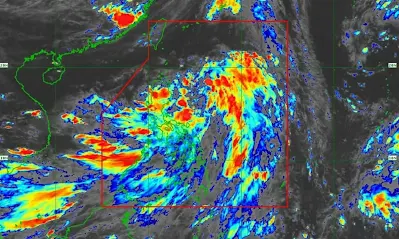
Habang papalabas na ng PAR ang binabantayang Severe Tropical Storm #CrisingPH (#WIPHA), isang potensyal na panibagong sama ng panahon o LPA ang nagbabadya namang pumalit at mabuo sa loob ng PAR.
Mataas rin ang tsansa nitong maging bagyo next week at patuloy na hahatakin at palalakasin ang #Habagat na magdadala pa rin ng mga pag-ulan partikular sa kanlurang bahagi ng #Luzon.
Tatawagin itong #DantePH sakaling mabuo na bilang bagyo — ang ika-apat na bagyo sa loob ng PAR ngayong taon.
May be an image of text that says 'PWS PSU 8 STS 'CRISING' (WIPHA) Potential LPA'

Cyclone-enhanced 'habagat' rainfall makes up a third of total rain during Philippines' southwest monsoon season — study


 (SANTI SAN JUAN/MANILA BULLETIN FILE PHOTO)


By Ellalyn De Vera-Ruiz

Published Jul 18, 2025 03:28 pm


While the southwest monsoon, or “habagat,” remains the main source of rain from July to September, scientists say the “indirect” effect of distant tropical cyclones accounts for about a third of total rainfall during this season.

Researchers from Ateneo de Manila University (AdMU); Manila Observatory; Philippine Atmospheric, Geophysical and Astronomical Services Administration; and Japanese partner institutions analyzed 62 years of weather data and found that tropical cyclones hundreds of kilometers away can strengthen the habagat, resulting in heavy rains, even without making landfall.

On average, 33.1 percent of rainfall during the habagat season is attributed to this “indirect” effect, more than twice the 15.4 percent caused by tropical cyclones that directly hit the country.

The remaining 51.5 percent comes from the monsoon itself, without tropical cyclone influence.

Cyclone origin matters

The study pointed out that the cyclone’s genesis point, or location where a tropical cyclone forms, also affects its potential to enhance rainfall.

Tropical cyclones that form farther from the Philippines tend to move northeast of Luzon, where they more effectively intensify monsoon winds.

In contrast, cyclones that form closer often take a shorter westward track and have a weaker effect.

“During the peak months of the southwest monsoon season, from July to September, the prevailing winds over the Philippines are from the southwest. In itself, these moisture-laden southwesterly winds can still produce isolated rainfall events over land,” explained Dr. Lyndon Mark Olaguera, assistant professor at AdMU’s Department of Physics and climate scientist at the Manila Observatory.

“When a tropical cyclone passes to the northeast of the Philippines, these southwesterly winds intensify since the tropical cyclone can pull these winds as a result of its counterclockwise circulation. Stronger southwesterly winds usually mean more intense rainfall over land,” he said.

Most at risk

The researchers cited Typhoon Gaemi (locally known as Super Typhoon Carina) in July 2024 as an example of a tropical cyclone that stayed well away from the Philippine landmass but significantly enhanced the habagat.

During that event, Quezon City received nearly a month’s worth of rain within 24 hours, resulting in floods that killed 48 people and caused over P8 billion in damages.

Olaguera said the western coast of Luzon is particularly vulnerable to indirect cyclone rains.

“This is because winds from the enhanced southwest monsoon are from the southwest; therefore, the western coast is the region that gets affected the most,” he explained.

“Additionally, the high mountains near the western coast of Luzon, like the Cordillera Mountains and the Zambales mountain range, force these moist, southwesterly winds upwards as they flow over the mountains. When these winds are forced upwards, they cool and condense, thus producing rainfall,” he said.

Forecasting challenges

While direct landfalling cyclones remain deadlier, Olaguera emphasized the need to pay closer attention to the impacts of cyclone-enhanced monsoon events.

“More importance should be given to tropical cyclones that enhance the southwest monsoon since the rainfall experienced during these indirect events is comparable to the rainfall experienced during direct tropical cyclone events,” he said.

He noted that indirect effects are harder to predict, as not all distant cyclones enhance the monsoon enough to cause extreme rainfall.

“More research should be done in order to increase the forecast accuracy of these enhanced southwest monsoon events,” he added.

Recommendations

To improve early warning systems, Olaguera recommended expanding the Philippine Area of Responsibility (PAR) westward and northward to include more tropical cyclones that can affect the country’s weather even from afar.

“Extending the northern border to 30°N will include regions where tropical cyclones are still able to produce rainfall over the Philippines. An example is Typhoon Haikui (2012), since it produced extreme rainfall over the Philippines despite being around the latitudes of 26-28°N,” he said.

He also cited Typhoon Danas (2025), which briefly exited the PAR but still caused rainfall over Luzon while located outside the current monitoring zone.

He also recommended the monitoring of moisture flows originating from as far as west, such as the Arabian Sea or Bay of Bengal, which could help in the forecasting of enhanced southwest monsoon events.

Midyear reset: Conquer the rainy day blues with this 10-minute cardio fix

 Midyear reset: Conquer the rainy day blues with this 10-minute cardio fix


Now that the rainy season has arrived, it’s common to feel a bit off—moods can shift, energy may dip, and staying consistent with healthy habits becomes more challenging. After making it through the first half of the year, you might be feeling the urge to hit reset—to boost your motivation, take better care of your well-being and finish the year feeling strong, grounded, and more like yourself. 


By Mitch Felipe Mendoza

Friday, July 18, 2025

COME ON: GIVE ME A SMILE!


I have been writing columns for several papers from all over the world since the early 1980's. Since 1999, while residing in the Philippines for good, I experienced many ups and downs. Sometimes, while writing, I am indeed not in a good mood. I rewrote and rewrote... .


A genuine smile involves the muscles around your eyes (the "Duchenne smile"), conveying positive emotions and strengthening social bonds according to Verywell Mind. Smiling also triggers the release of endorphins, which can improve mood and reduce stress.


Smiling is a powerful expression that can have both physical and social benefits. Here's why:

Positive emotions: Smiling is often a result of experiencing happiness, and it can also be a way to express positive emotions to others according to Verywell Mind.


Smiling can signal friendliness and approachability, making it easier to connect with others.


Smiling, even a forced one, can trigger the release of endorphins, which have mood-enhancing effects.


Smiling can lower levels of stress hormones like cortisol and adrenaline, promoting relaxation.


Smiling is linked to lower blood pressure and improved overall well-being. 


Anyway, I will try my best. It's actually a sweet day today, so sunny, so calm, so bright, it's like the bridal of earth and heaven.  The grandeur  of  God flames out like shining from shook foil. I feel like the waves make towards the pebbled  shore.


I observed again a multi national couple somewhere in my neighborhood fighting each other. Gosh. Stupid people have an uncanny way of hitting the right nail on the head with the wrong hammer!


Maybe, you are also angry right now, while reading this. You are angry, even for others it's a beautiful day. Are you angry? It's okay. We are all battling against one of the most powerful emotions known to man - anger! Anger. A day rarely goes by without us feeling angry. Or,  maybe seldom a day goes by without feeling anger... .


Anger is the main part of our daily life. That's why it's really important to talk about this phenomenon. What is anger, what does it do and how does it affect our lives? Where does it come from and how can we learn to handle it in a constructive instead of destructive way? Only, if the roots of our anger are exposed and explained, can we defuse its explosive and dangerous potentials. 


As I said earlier, anger is one of the most basic emotions. Everyone can get angry. You and me? Now, later, tomorrow...! It's a feeling of being against something or someone.


Anger is a hostile emotion that sets people against one another, or even themselves. By its nature, anger involves opposition, hostility, hatred and dislike. It happened between Filipinos, and between Filipinos and foreigners as well, living here in the Philippines. It even happened at the political level right nowadays.


Anger, however, is simpler to define than to identity. Emotions of antagonism can take a wide variety of faces. Expressions of anger range from the overt, in-your-face brand of open hospitality to the cold indifference of a silent individual. At times, anger can be felt like an inner fire... .


Millions of defense, not a damned penny for tribute. Anger between people: the one side remains cold as ice while the opposite plays meek as a lamb. Sige, burn the midnight oil! And what was the result at the end? A shadow of doubt remains after each fight getting its origin out of anger.


The silent withdrawal and lack of understanding  and innumerable shortcomings of one or both partners are often an indication that one is angrily punishing the other for not doing things his or her way.


We are all selfish! Yes, me too! That's why we see the cause of anger as something outside of ourselves. Life is unfair! Life is hard!

Signal No. 2 to be raised as 'Crising' nears tropical storm status —PAGASA


(Photo from Phivolcs-DOST FB page)

The Philippine Atmospheric, Geophysical and Astronomical Services Administration said on Thursday, July 17, that higher wind signals are expected over parts of Luzon as tropical depression “Crising” nears tropical storm strength. It is forecast to reach tropical storm status early Friday morning, July 18, and may intensify further into a severe tropical storm by Saturday morning or afternoon, July 19. Read more 

The weather bureau also issued a storm surge warning on coastal areas of Northern Luzon including Cagayan, Ilocos Norte, and Isabela within the next 48 hours. Read more 

Meanwhile, classes were suspended in various regions including Western VisayasEastern Visayas, and Negros Occidental due to Tropical Depression “Crising.”

The Pacific Ring of Fire is WAKING UP

Volcanic and seismic activity is rapidly increasing across the Pacific — and it’s no longer isolated.
⚠️ Klyuchevskoy just erupted in Russia
⚠️ Mount Rainier in USA recorded its strongest earthquake swarm on record
⚠️ Great Sitkin and Spurr are active in Alaska
⚠️ Sakurajima is erupting again in Japan
⚠️ Lewotobi and Merapi are stirring in Indonesia
⚠️ Popocatépetl continues to erupt in Mexico
This is not a random cluster. It’s a pattern — a seismic chain reaction stretching across continents.
Even mainstream sources like USGS, Smithsonian GVP, and NHK Japan are beginning to report on the rise.
Is something larger building beneath the surface? We don’t know yet. But the signs are growing — and we’re watching closely.
📌 Stay alert. Stay informed.
📸 This image is AI-generated for visual storytelling purposes. The events and locations mentioned are real, based on official reports from geological and seismic monitoring agencies.
May be an image of map, crater and text that says 'Great Sinkin Klyuchevskoy Russia USA Sakurajima Sakurajima Levitobi Mexipl Popecatépoti atépeti Spum Spumi MexaplAauinhe Mexapl Aauinne Mevntobi ntobi Mev JOEMAR SOMBE'