You plan to move to the Philippines? Wollen Sie auf den Philippinen leben?

There are REALLY TONS of websites telling us how, why, maybe why not and when you'll be able to move to the Philippines. I only love to tell and explain some things "between the lines". Enjoy reading, be informed, have fun and be entertained too!

Ja, es gibt tonnenweise Webseiten, die Ihnen sagen wie, warum, vielleicht warum nicht und wann Sie am besten auf die Philippinen auswandern könnten. Ich möchte Ihnen in Zukunft "zwischen den Zeilen" einige zusätzlichen Dinge berichten und erzählen. Viel Spass beim Lesen und Gute Unterhaltung!


Visitors of germanexpatinthephilippines/Besucher dieser Webseite.Ich liebe meine Flaggensammlung!

free counters

Total Pageviews

Thursday, July 30, 2026

Jerome Lorico's 'Alembong' reclaims stories of womanhood, heritage, and self-expression

By John Legaspi

Published Jul 29, 2026 09:19 am
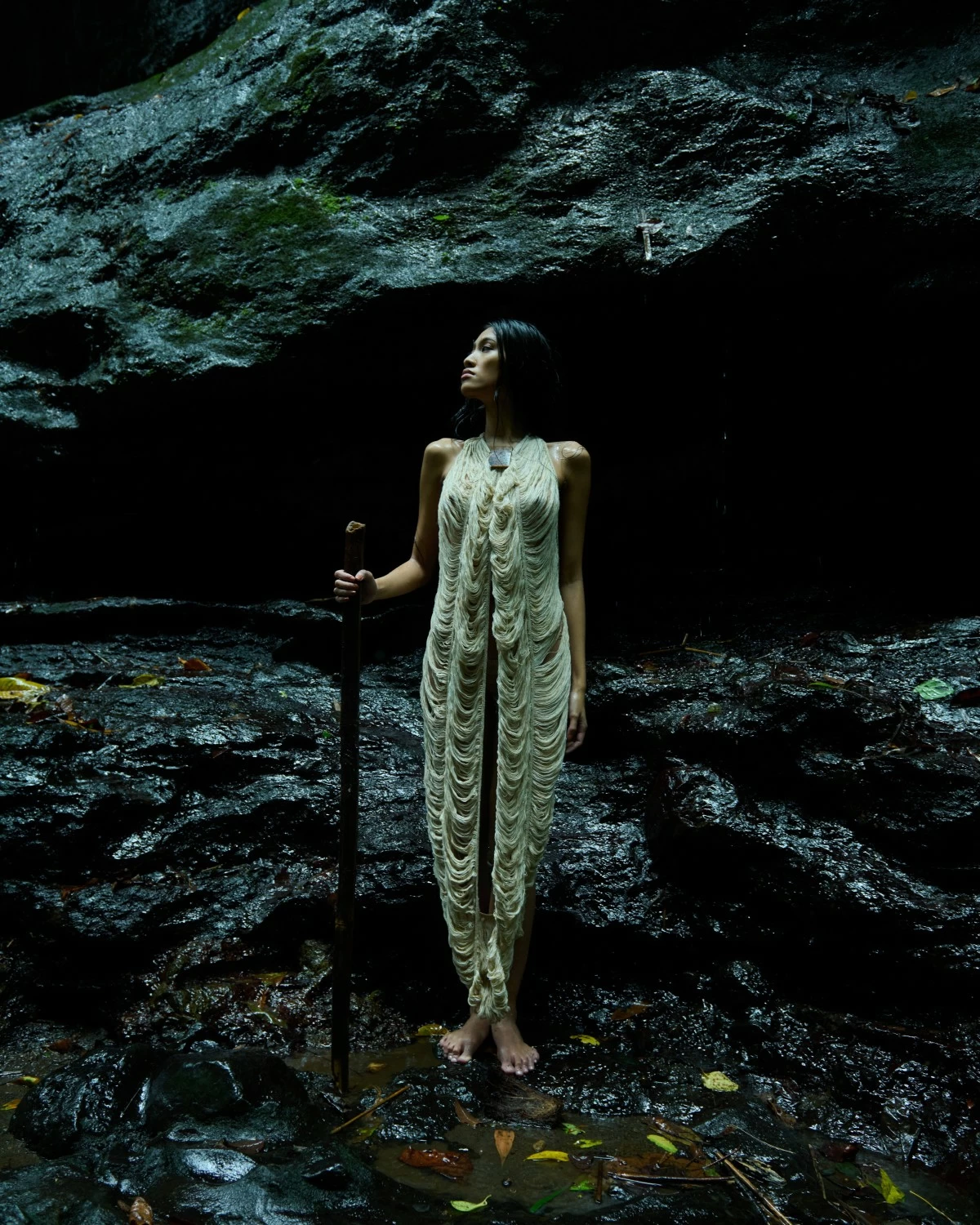
It is an image of a woman bathing, lounging in a lush rainforest that immediately captures your attention. Her enigma and sensuality will remind anyone who has witnessed Rody Vera’s "Ang Unang Aswang" play that reimagines the origin story of a Philippine folkloric character. But there is grace and poetry in the way she poses, much like the subjects of early Filipino paintings.
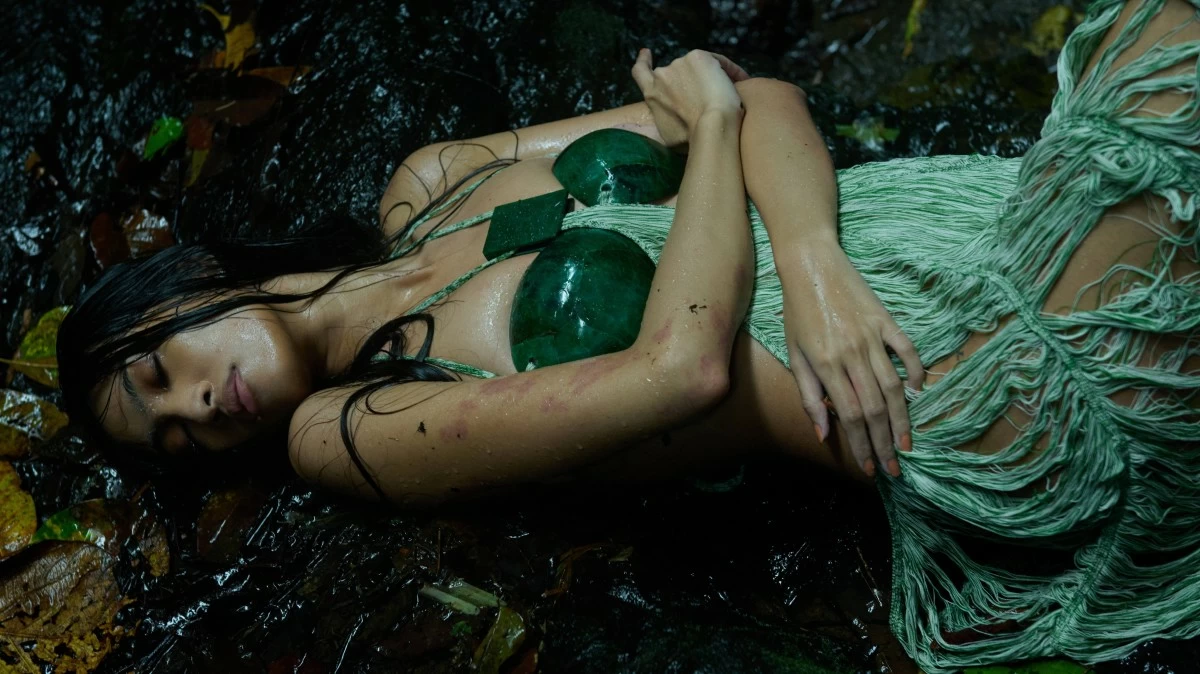
Jeromo Lorico's 'Alembong' collection (Photos: Jerick Sanchez | Make-up: Zidjian Paul | Muse: Sidney Flores)
The image we are talking about is part of Jerome Lorico’s editorial campaign for his latest collection, dubbed “Alembong.” Captured by photographer Jerick Sanchez, the photos transport viewers to a time when freedom was not just a spoken word, but something lived and expressed without prejudice.
“It's a little ironic that, although we are living in an era where there should be more freedom, our culture still seems to censor a lot of different things. Part of this problem, I noticed, is the inability of a Filipino woman to freely express herself sexually and physically. Being brazen or aware of one's energy and confidence still seems to merit a few disapproving opinions within the Filipino community,” Jerome tells Manila Bulletin Lifestyle. “A century ago, Filipinas could bathe in the river with complete freedom, their golden-brown skin shining under the summer sun, as depicted in many of the works of our National Artist for Visual Arts, Fernando Amorsolo.”
“Alembong,” for Jerome, is an interpretation of the raw and naked beauty of the country's islands and women. He quotes curator and typography designer Ric Gindap of Design for Tomorrow, who says, “‘Alembong’ is a word that, in its modern aftertaste, carries the sly curl of a lip: flirt, coquette, frivolous.”
“Historically and anthropologically, before the weight of colonization and the catechism of virtue, it was something else,” the designer muses. “‘Alembong’ was ebullience itself, a feminine street-smartness that brightened the barangay.”

Knitted symmetric tension draped top in cotton and piña with mother of pearl clip in forest jade color.
Knitted one-shoulder fringe dress in cotton and piña with mother of pearl clip in tropical jade color
Knitted symmetric tension draped dress in cotton and piña
Knitted fringe dress in cotton and piña
Knitted draped top in solihiya pattern in cotton, piña (pineapple fiber) with mother of pearl clip in forest jade color
Mirroring the sense of liberation embodied by the word, Jerome translates Alembong into garments that balance softness with strength. Airy silhouettes, sheer layers, hand-finished textures, and fluid draping evoke the effortless beauty of island living while celebrating the confidence of the modern Filipina.
To create something that is truly Filipino, it was only natural for Jerome to present a collection crafted by Filipino hands using materials sourced from across the country. For at least a month, the designer experimented with artisanal materials. The collection features elements such as brass buttons specially made by an anting-anting craftsman in Lipa, Batangas. The pineapple and cotton yarns came from Iloilo and the Philippine Textile Research Institute. Meanwhile, the woven abaca and cotton yarns are sourced from the place where the designer grew up—Albay in the Bicol Region.

Knitted draped sleeve cape in cotton and piña; mother of Pearl bikini top in amber tortoise color; and knitted draped skirt in cotton and piña
Knitted draped dress in cotton and piña and draped local silk top
Knitted fringe dress in cotton and piña
“I believe it is very important to support whatever has a deep connection to our culture, heritage, and history,” Jerome explains. “Artisans create with soul, and that is why I always love working and collaborating with them. Creation, for me, is a sacred ritual that connects the past and the future.”
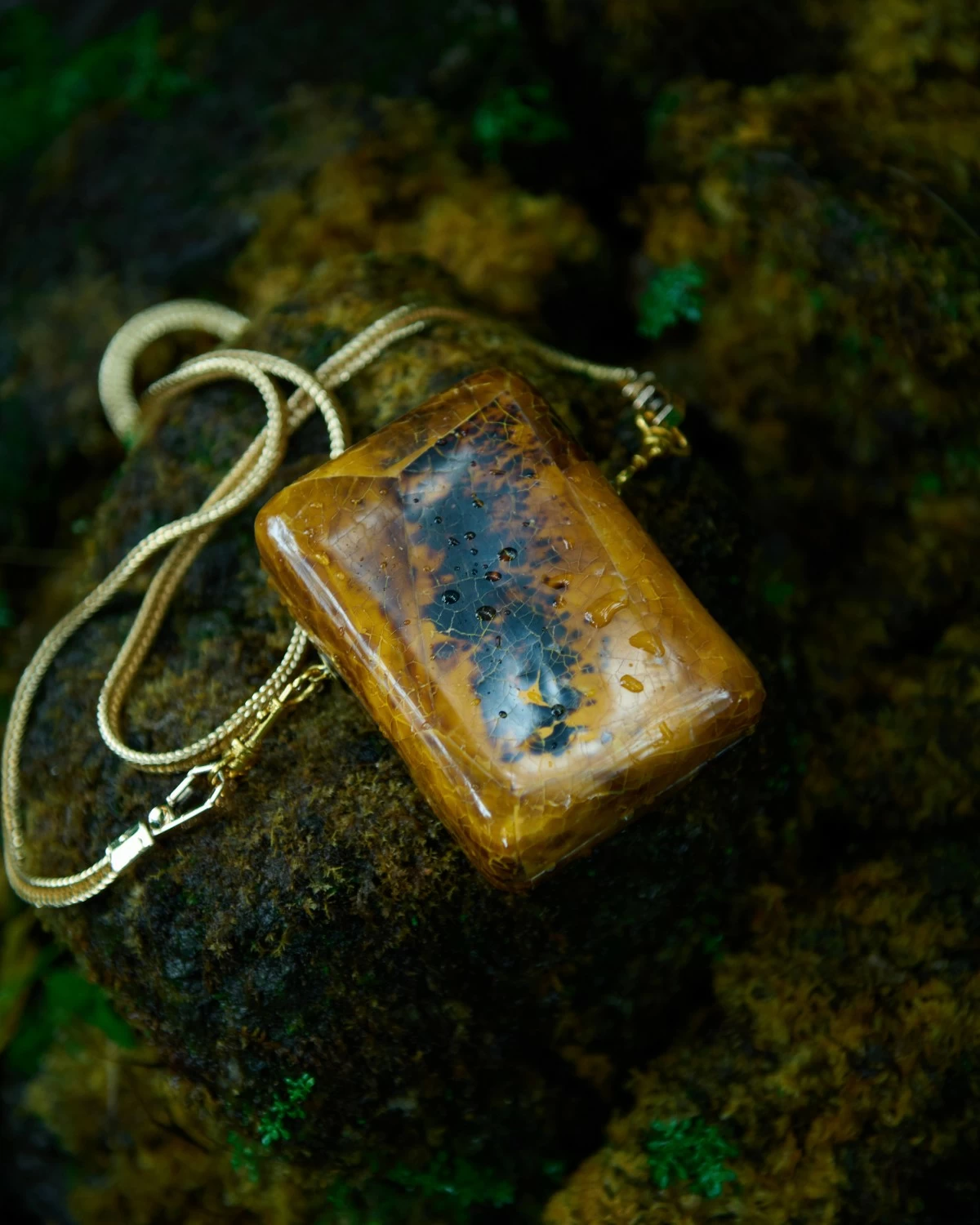
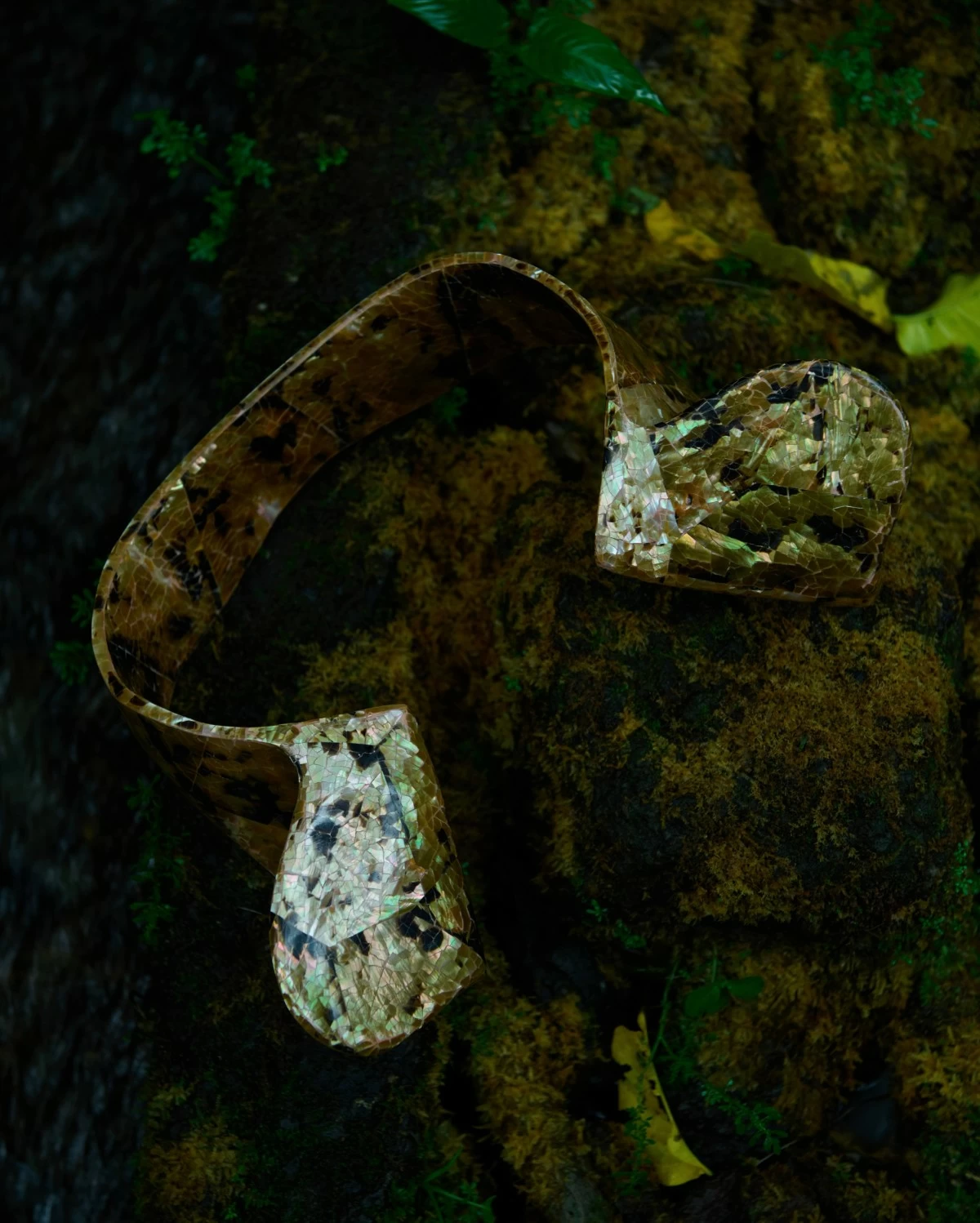
Accessories are just as important as the clothes because they are also part of the collection’s story. “Alembong” spotlights pieces made from mother-of-pearl sourced in Cebu. Although they echo natural and organic shapes, they are designed through a contemporary lens, allowing them to be both abstract and utilitarian.
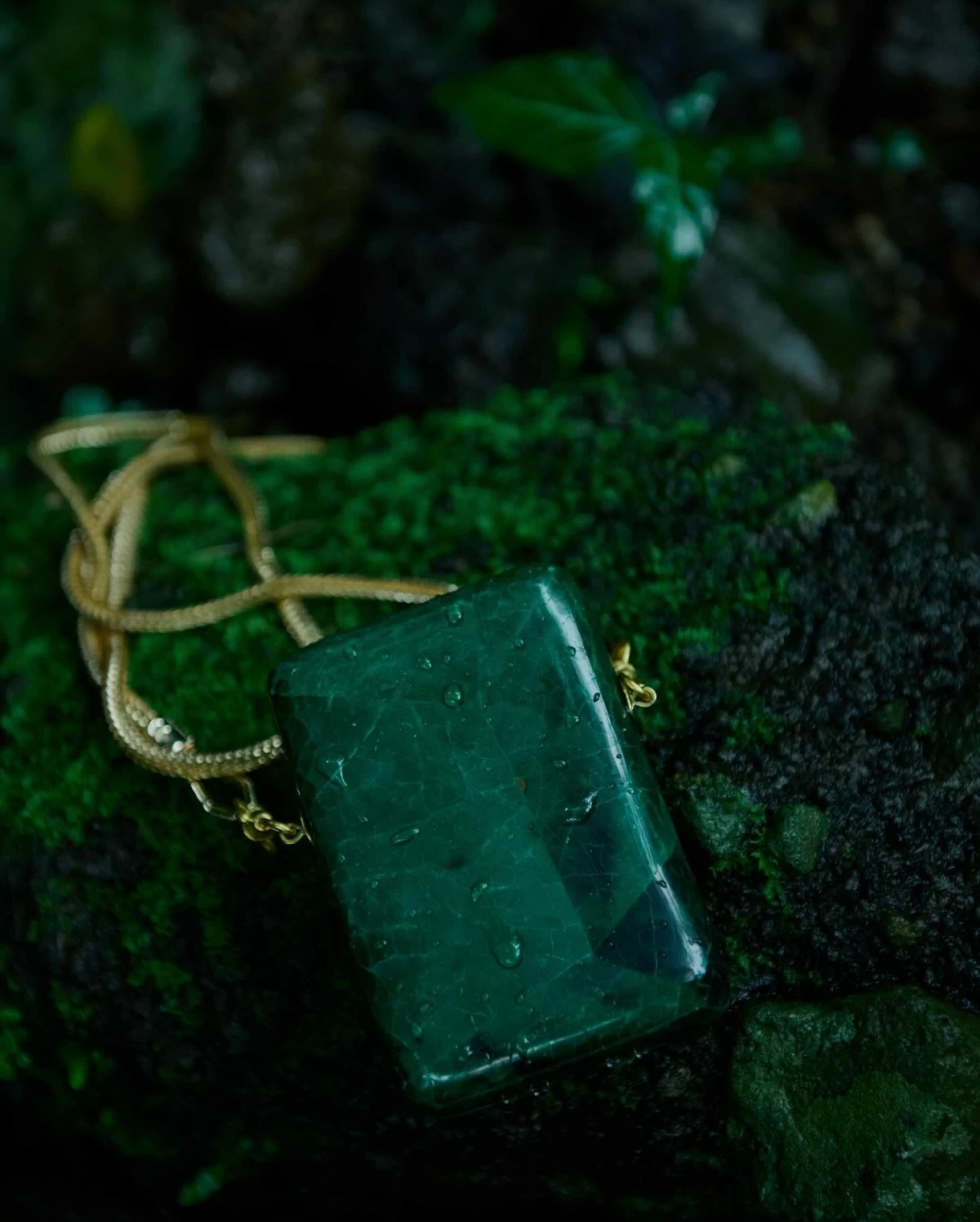
Mother of pearl mini minaudiere in forest jade color
Mother of pearl mini minaudiere in amber tortoise color
Mother of pearl obi belt in gold tortoise color
While “Alembong” celebrates the beauty of the Filipina and the richness of the country's natural resources, Jerome also treats it as a form of rebellion—a call to reconnect with what is primal, natural, and human.
“Our skin is like a landscape of stories, histories, and possibilities. The modern Filipina is someone who is now more aware of her own energy and capabilities. She knows that nothing can set boundaries for her and that the world is waiting for her. This collection is a way to help her express herself in any way that she wants,” Jerome concludes.


Collects fish of every kind


Published Jul 30, 2026 12:02 am | Updated Jul 29, 2026 03:42 pm
REFLECTIONS TODAY
What is striking about the parable of the dragnet as a metaphor for the Kingdom is that it does not simply “catch” the good fish, but also the bad or undesirable ones. The net catches all sorts of fish and non-fish in the process.
This implies that the Kingdom is offered to everyone, both good and bad. Which reminds us of Jesus’ pointing to the sun and the rain which shines or falls upon everyone, both good and bad.
However, while on the one hand, the Kingdom welcomes everyone, the parable also warns of the day of “sorting out,” of separating between the good fish and bad fish, or the fish and the non-fish, like weeds, pieces of wood, garbage, etc.
This hides, therefore, an invitation to reflect on what kind of “fish” we are, or what kind of life we are living.
At the same time, it should also awaken us to the fact that in this world we need to know how to navigate in the sea where bad fish also abound or co-exist with us.
Nowadays, the call and desire for inclusivity is very strong—which is a good thing.
But this does not mean eliminating discernment or attentiveness as we relate with various types of people.
At the same time, we also have the responsibility to be good examples so that more “good” fish can be sorted out for the Kingdom.
First Reading • Jer 18:1-6
This word came to Jeremiah from the Lord: Rise up, be off to the potter’s house; there I will give you my message.
I went down to the potter’s house and there he was, working at the wheel.
Whenever the object of clay which he was making turned out badly in his hand, he tried again, making of the clay another object of whatever sort he pleased.
Then the word of the Lord came to me: Can I not do to you, house of Israel, as this potter has done? says the Lord. Indeed, like clay in the hand of the potter, so are you in my hand, house of Israel.
Responsorial Psalm • Ps 146
“Blessed is he whose help is the God of Jacob.” or “Alleluia.”
Gospel • Matthew 13:47-53
Jesus said to the disciples: “The Kingdom of heaven is like a net thrown into the sea, which collects fish of every kind.
“When it is full they haul it ashore and sit down to put what is good into buckets. What is bad they throw away.
“Thus it will be at the end of the age. The angels will go out and separate the wicked from the righteous and throw them into the fiery furnace, where there will be wailing and grinding of teeth.”
“Do you understand all these things?” They answered, “Yes.”
And he replied, “Then every scribe who has been instructed in the Kingdom of heaven is like the head of a household who brings from his storeroom both the new and the old.”
When Jesus finished these parables, he went away from there.
Source: “365 Days with the Lord 2026,” St. Paul’s, 7708 St. Paul Rd., SAV, Makati City (Phils.); Tel.: 632-895-9701; E-mail: publishing@stpauls.ph; Website: http://www.stpauls.ph.

Nadine Lustre announces music comeback with new single 'PERSONAL'


Published Jul 27, 2026 08:05 pm

At A Glance

  • Nadine Lustre is ending her three-year music hiatus with the release of her new single "PERSONAL" on July 31, marking her long-awaited return to the recording scene.

After three years away from releasing new music, Nadine Lustre is finally making her long-awaited return to the recording scene.

The actress-singer announced that her new single, "PERSONAL," will be released on July 31, sending fans into a frenzy and marking her first official music release since 2023.

Nadine made the announcement on Instagram with a striking close-up portrait that immediately caught the attention of her followers.   

The post quickly gained traction online, with fans flooding the comments section to express their excitement over her comeback.

Even celebrities joined in the anticipation.

Miss Universe 2018 Catriona Gray wrote, "Can't wait!!!" while content creator Sassa Gurl also showed support for the highly anticipated release.

"PERSONAL" will be Nadine's first single since "Overgrown," which came out in 2023.

Before that, she earned praise for her 2020 visual album "Wildest Dreams," released under Careless Music. 

Although she has kept a low profile musically in recent years, Nadine remained busy with acting and other creative pursuits.

Rente im August 2026: Diese vier Änderungen betreffen Millionen Rentner direkt

Im August 2026 greifen mehrere Änderungen für Rentner: höhere Bezüge, steigende Krankenkassenbeiträge, neue Jahrgänge in der Altersrente und ablaufende Steuerfristen. Was wirklich zählt.

München – Der August 2026 bringt für Millionen Rentner gleich mehrere Veränderungen auf einmal. Die Rentenerhöhung vom Juli wirkt erstmals einen vollen Monat, die IKK classic hebt ihren Zusatzbeitrag an, bestimmte Jahrgänge können erstmals in Rente gehen – und wer seine Steuererklärung für 2025 noch nicht abgegeben hat, riskiert Verspätungszuschläge.   Content-Partnerschaft

Dieser Artikel entstand in einer Content-Partnerschaft mit Business Punk

Nicht alle vier Punkte sind neue Gesetze, die am 1. August in Kraft treten. Teilweise werden Beschlüsse aus dem Juli erst jetzt auf dem Konto sichtbar oder durch ablaufende Fristen spürbar.     

Die Rente ist immer im Wandel
Im August 2026 greifen mehrere Änderungen für Rentner. © IMAGO/Michael Bihlmayer

Im Juli 2026 steigen die gesetzlichen Renten um 4,24 Prozent. Der aktuelle Rentenwert kletterte von 40,79 Euro auf 42,52 Euro. Bei 1.000 Euro Bruttorente bedeutet das ein Plus von 42,40 Euro, bei 1.500 Euro sind es 63,60 Euro mehr. Was tatsächlich ankommt, hängt von Kranken- und Pflegeversicherung sowie möglicher Steuerlast ab.

Rentenerhöhung: Jetzt wirkt sie komplett

Wer seine Rente vorschüssig erhält – das betrifft alle mit Rentenbeginn bis März 2004 –, bekommt die August-Zahlung bereits am 31. Juli 2026. Bei nachschüssiger Zahlung, also Rentenbeginn ab April 2004, geht das Geld am 31. August aufs Konto. Die Rentenanpassungsmitteilungen wurden bis Ende Juli verschickt.   

Wer Anfang August noch kein Schreiben hat, sollte beim Rentenversicherungsträger nachfragen. Geprüft werden müssen Bruttorente, Erhöhungsbetrag und Abzüge für Kranken- und Pflegeversicherung. Auch die Kinderzahl kann wichtig sein, weil Eltern mit mehreren berücksichtigungsfähigen Kindern niedrigere Pflegeversicherungsbeiträge zahlen.

Die Mitteilung ist eine verbindliche Entscheidung – Widerspruch ist innerhalb eines Monats möglich. Da viele Schreiben im Juli zugestellt wurden, endet die Frist in zahlreichen Fällen im August.

IKK classic erhöht Zusatzbeitrag ab August

Die IKK classic hebt ihren Zusatzbeitrag zum 1. August 2026 von 3,40 auf 3,85 Prozent an. Zusammen mit dem allgemeinen Beitragssatz von 14,6 Prozent würde das rechnerisch einen Gesamtbeitrag von 18,45 Prozent ergeben – sofern die IKK classic die Erhöhung tatsächlich umsetzt. Die Erhöhung um 0,45 Prozentpunkte trifft Beschäftigte, Selbstständige und Rentner gleichermaßen.

Bei pflichtversicherten Rentnern teilen sich Rentenversicherungsträger und Rentner den Beitrag je zur Hälfte. Der eigene Anteil steigt damit um 0,225 Prozentpunkte der Bruttorente – bei 1.500 Euro sind das rund 3,38 Euro monatlich, bei 2.000 Euro etwa 4,50 Euro. Allerdings greifen die höheren Abzüge bei pflichtversicherten Rentnern erst zwei Monate später.

Die Erhöhung zum 1. August wird regulär erst mit der Rentenzahlung für Oktober berücksichtigt. August und September werden noch mit dem alten Zusatzbeitrag berechnet. Bei freiwillig Versicherten oder weiteren beitragspflichtigen Einnahmen können andere Zeitpunkte gelten, so Gegen Hartz.

Betroffene sollten nicht nur den Rentenbetrag, sondern auch Schreiben und Beitragsbescheide der Krankenkasse prüfen. Bei Erhöhung des Zusatzbeitrags besteht ein Sonderkündigungsrecht. Für den Wechsel wird die Mitgliedschaft bei der neuen Kasse beantragt, die dann das Verfahren übernimmt.

Der Rente-Newsletter: Wege in die Frührente
Wichtige Entwicklungen rund um Ihre Rente erhalten Sie wöchentlich am Mittwoch. Eine kurze Registrierung genügt.

Ein niedriger Zusatzbeitrag allein sollte aber nicht entscheidend sein. Unterschiede bei Bonusprogrammen, Satzungsleistungen, Geschäftsstellen und Erreichbarkeit können für ältere oder chronisch kranke Menschen wichtiger sein. Wer einen Wahltarif abgeschlossen hat, muss mögliche Bindungsfristen prüfen.

Jahrgang 1960: Regelaltersrente beginnt

Der Geburtsjahrgang 1960 erreicht die Regelaltersgrenze mit 66 Jahren und vier Monaten. Menschen des Jahrgangs 1960 erreichen ihre Regelaltersgrenze mit 66 Jahren und vier Monaten. Je nach genauem Geburtsdatum können sie bei erfüllter Wartezeit ab August 2026 oder in den Folgemonaten die reguläre Altersrente beziehen.  

Wer genau am 1. April 1960 geboren wurde, erreicht die Altersgrenze bereits mit Ablauf des Vortages und kann ebenfalls zum 1. August in die Regelaltersrente wechseln. Voraussetzung sind mindestens fünf Jahre mit anrechenbaren Versicherungszeiten. Die Rente muss beantragt werden und beginnt nicht automatisch. Auch ein vorzeitiger Rentenstart ist im August möglich. Langjährig Versicherte mit mindestens 35 Versicherungsjahren können die Altersrente ab 63 beziehen.

Wednesday, July 29, 2026

Cinema isn’t cheap anymore


Mark Luther P. Saturion


The first thing you notice is not the screen, but the price.


It waits for you before the lights dim, before the trailers begin, before the movie even has a chance to speak. Printed neatly on the kiosk, it asks a quiet question: How much are you willing to give up just to sit in the dark for hours?


When I was younger, my grandmother would talk about going to the movies as if it were an ordinary thing. Something you didn’t have to plan for.


“Barato ra kaayo sauna,” she would say. “Maski kinsa, makatan-aw (It was cheap back then. Anyone could watch).”


Cinema, to her, was not a luxury. It was part of life. A shared habit. You lined up, bought a ticket, shared snacks, and went home replaying scenes in your head. The price did not decide who belonged inside.


Now, going to the movies feels like a calculation.


Recently, my friends and I went to the cinema together. We stood in front of the ticket booth, joking loudly while quietly counting our money. When we finally bought the tickets, there was relief but also hesitation. At the concession stand, the prices spoke for themselves. Popcorn in BBQ and cheese flavors, the ones we used to fight over, had suddenly become a luxury. Gummies, Potato Corner fries, and other small snacks that once made the experience complete were now out of reach.


We looked at each other, and quietly, one of us whispered, “Pautanga sa ko bes, bih, bayran ra taka (Let me borrow from you, friend, I’ll pay you back).”


It was never about shame, just survival. We pooled our small funds for snacks we could barely afford after paying for fare and tickets. The smell of popcorn, warm and buttery, filled the air. It teased us, a reminder of what the experience used to mean. The sweet aroma of caramel mingled with the salty crunch of cheese popcorn, the faint tang of BBQ seasoning lingering in the theater. We laughed and nudged each other, sharing the small bucket carefully, counting kernels like tiny treasures.


Watching a movie has always been more than just watching. It was the sharing, reaching into the same bucket, whispering reactions, bonding while the story unfolded. That part now feels optional, trimmed away by cost. You pay for the seat, and everything else becomes negotiable. The joy of snacking together, teasing over flavors, laughing while feeding each other popcorn—those were the details that made the memory. Now, they are luxuries, sidelined in favor of just entering the theater.


They give out free water now. A small mercy, perhaps but also a quiet confession. That after paying for a ticket, there is little left to offer. The popcorn, gummies, fries: these cinema food that once completed the experience has become optional: affordable only if you planned for it. Watching a movie is no longer about indulging; it is about enduring.


This is not about wanting more. It is about what has slowly been taken away.


Cinema used to be one of the few places where stories were shared equally. You sat beside strangers, all paying roughly the same amount to feel something together. Today, that equality feels fragile. The price filters who comes in comfortably and who must settle for just the screen—no extras, no space for enjoyment beyond the bare minimum.


My grandmother once shook her head and said, “Karon, mura’g kinahanglan pa nimo magpili: sine o pagkaon.”(Now, it feels like you have to choose: movies or food.)


She said it lightly, almost joking. But the truth lingered. Her words echo in my mind each time we pool our money, each time we whisper about who can cover the extra pesos just to buy a small bucket of popcorn. She did not complain about prices when she was younger; she simply noted the fairness in access. Today, fairness feels distant.


We talk often about supporting films and keeping cinema alive. But love alone cannot carry it. Culture cannot survive if experiencing it feels like a sacrifice. People do not stop going to the movies because they no longer care—they stop because caring has become expensive.


When the credits rolled, my friends and I stayed seated, talking about the film and scenes we liked. We made do without popcorn, gummies, or fries, as we always do. Still, I noticed the quiet discomfort in our jokes, the way we avoided glancing at the concession stands and whispered about borrowing coins from one another. Even among friends, the cost cast a shadow over the joy.


But as we walked out of the theater, I couldn’t stop thinking about who wasn’t there. About how many people chose to stay home—not because they didn’t want to watch, but because they had already counted what it would cost.


The lights come back on. The seat empties. The price has already been paid.


And sometimes, that is enough to make people decide that the dark is no longer worth entering. Survival, in those moments, has itself become the experience.


Watching the film, sharing a whispered laugh, dividing kernels and fries carefully among friends, I remembered my grandmother’s words again. Cinema was meant to belong to everyone, not just those who could afford the extras. And even when it feels too expensive, that memory lingers, like the scent of popcorn in a theater long after the lights return.


It reminds me that joy and togetherness were never meant to be limited to those with enough money. The dark room, the movie playing on the screen, and the shared laughter are the true treasures, not the food. But food made the experience complete, and now the struggle to afford that completion reveals the subtle fractures in what was once simple, accessible happiness.


A MISTAKEN BELIEF


By Mindanao Daily News -July 28, 20260235


Examples of mistaken beliefs that you might hold are “I’m powerless,” “Life is a struggle,” or “I should always look good and act nice, no matter how I feel.” There is nothing new about the idea of mistaken beliefs-they are a part of what people have in mind when they refer to your “attitude” or “outlook.”


A mistaken belief accompanies each and every one of us daily. Incorrect decisions and wrong doings are part of our daily life.A mistaken belief is an idea, conviction, or assumption that is not true and is built on faulty reasoning, bad data, or personal bias. It can lead to poor choices, false judgments, and unhelpful feelings.


Resilience involves being able to recover from difficulties or change—to function as well as before and then move forward. Many refer to this as “bouncing back” from difficulties or challenges.


It is almost a ridiculous fact that man wants to know certain truths about mundane things. But really he seems least interested in even mundane truths as can be read many times in newspapers for example. There seem to be too many rash judgments, and the readers absorb these and make these their own. A fatal attraction!


This is sometimes referred to as journalistic mentality wherein accusations are generously made without proof. Evolution started this trend, when scientists stated for example that man evolved from the apes, without proof. The only proof they had was the missing link, and if I am not mistaken, it’s still a missing proof until now.


To look for proofs is a mental activity, which is no longer a common thing nowadays, because it takes really time, effort and is too serious to think about. Yet in Christian education, thinking right is very important.That’s why Philosophy is important in Christian life. To avoid error in thinking, the rules of right reasoning must be studied and mastered. Is it really totally neglected in today’s modern education?


Thinking is actually an enjoyable activity but when one is pressured to get a good job for one’s sustenance, then the other more mundane becomes attractive. After all, great thinkers often do not get (good?) jobs… .


Spiritual writers like the British Samuel Taylor Coleridge (1772-1834) noticed that mankind had stopped thinking even two centuries ago. That was during his age. Man probably stopped thinking even earlier. He has ceased many times to search for the truth. It’s easier to listen to gossip and believe in it. What a sign of weak minds!


Too often are we blind to the truth and as a consequence we easily believe in lies we only have to like it. Too bad, if people always like to close their eyes and ears especially while experiencing the delusion of error.