


1. First Totality on Earth for 28 Months
Before 2026, the last time the Moon completely covered the Sun was the total solar eclipse across Mexico, the United States, and Canada on April 8, 2024.
It’s been a longer-than-average wait! A total solar eclipse happens somewhere in the world once every 16 months on average.
Protect your eyes!2. First Totality for Mainland Europe Since 1999
Three decades ago, at the total solar eclipse of August 11, 1999, the path of totality clipped the southwest tip of the United Kingdom, then crossed continental Europe from France to Bulgaria.
Since then, however, the only places in Europe to see totality have been parts of Georgia and Russia in 2006, and the Faroe Islands and Svalbard in 2015.
3. Totality Visible from 5 Countries
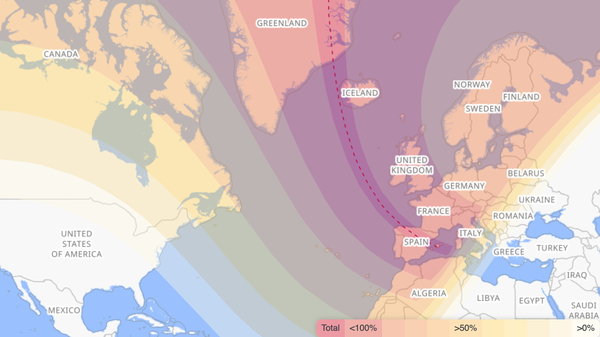
On August 12, 2026, the path of totality begins in the far north of Russia, crosses Greenland and the western edge of Iceland, then sweeps across northern and eastern Spain.
Did we say 5 countries? Yes—just! The path of totality also takes in a few square miles of the northeast corner of Portugal.
How to use eclipse glasses4. A Huge Partial Eclipse Across Europe
Nearly the whole of Europe will get a partial solar eclipse on August 12. This list shows how much of the Sun’s disk will be covered by the Moon in five European capital cities.
- Madrid, Spain: 99.9%
- Dublin, Ireland: 94.0%
- Paris, France: 92.1%
- London, UK: 91.4%
- Berlin, Germany: 84.8%
5. North America Gets a Slice of the Action
It’s not only Europe that gets to see an eclipse on August 12: a partial eclipse will be visible across northern parts of North America.
New Yorkers, for instance, might have a chance to see the Moon take a lunchtime bite out of the Sun. At maximum eclipse in the Big Apple—at 13:54 (1:54 pm) local time—9.4% of the Sun’s disk will be covered by the Moon.
The northwest corner of the African continent is involved, too. Morocco’s biggest city, Casablanca, has an 86.9% partial eclipse in the evening of August 12.
6. A Billion People Will Fall Under the Moon’s Shadow
For every solar and lunar eclipse, the timeanddate.com population tool calculates the number of people who live in areas where the eclipse is visible.
Our tool takes raw population data provided by the Center for International Earth Science Information Network (CIESIN) at Columbia University in New York City, and combines it with our own eclipse data. (CIESIN’s numbers are based on population estimates from the year 2000 to 2020.)
For the August 2026 solar eclipse, we calculate that:
- Around 980 million people live in areas that will get a partial or total eclipse;
- Of these, around 15.2 million people live along the path of totality.
7. A Polar Eclipse
The Moon’s shadow only just strikes the Earth this August—it skims across the top of the Northern Hemisphere.
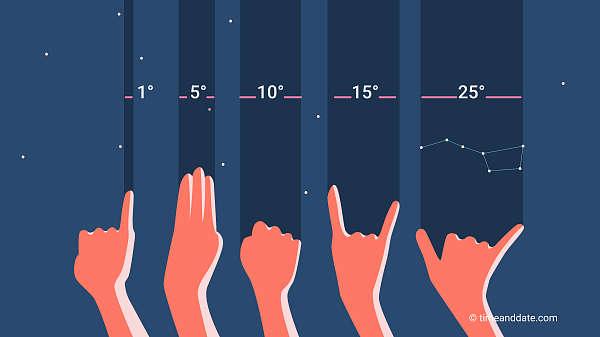
One consequence of this is that nobody will get to see totality with the Sun and Moon high in the sky. At the point on the globe with the longest totality—2 minutes 19 seconds, just off the west coast of Iceland—the Sun will be 26.0° above the horizon when totality begins.
In the Spanish city of Valencia, near the end of the path of totality, the Sun will be just 4.6° above the horizon when totality begins, at 20:32 (8:32 pm) local time.
This means that across the European continent—and particularly in Spain—skywatchers will need to make sure they have a clear line of sight toward the western horizon. There is a risk that people’s view of the eclipse may be blocked by hills, buildings, trees, and other obstructions.
Another consequence of this polar eclipse: some places will be given a magical, fleeting glimpse of the stars and planets for the first time in months.
At Mount Clarence Wyckoff in northern Greenland, for instance, the Sun has been up—all day, every day—since the beginning of April. But during totality on August 12, the sky will darken and be filled with stars for an oh-so-brief 2 minutes… Have a look at the view during totality on our sky map (including Jupiter and Mercury just to the right of the hidden Sun).
8. The First of 3 Big Total Solar Eclipses in 23 Months
If you miss the total eclipse of August 2026, there are two more big Sun and Moon shows coming up.
On August 2, 2027, the path of totality will sweep across the southern tip of Spain, and parts of north Africa, the Arabian peninsula, and the Somali peninsula.
One year later, on July 22, 2028, totality will sweep across Australia and New Zealand—including 3 minutes 48 seconds of totality over Sydney Harbour.
9. It Coincides with the Perseid Meteor Shower
Solar eclipses happen at New Moon. This means the nights just before or after a solar eclipse are ideal for skywatching, since there’s no bright Moon to wash out the dark sky.
Happy coincidence: the moonless night of August 12–13, 2026, will be the peak of the Perseids—the Northern Hemisphere’s big summer meteor shower.
10. You Can Watch It on timeanddate.com
As always, you can follow the eclipse LIVE on timeanddate.com. We’ll have our telescopes on the ground in both León and Mallorca in Spain. We’ll also be teaming up with our friends and collaborators in Iceland, and across Europe and North America.

