You plan to move to the Philippines? Wollen Sie auf den Philippinen leben?

There are REALLY TONS of websites telling us how, why, maybe why not and when you'll be able to move to the Philippines. I only love to tell and explain some things "between the lines". Enjoy reading, be informed, have fun and be entertained too!

Ja, es gibt tonnenweise Webseiten, die Ihnen sagen wie, warum, vielleicht warum nicht und wann Sie am besten auf die Philippinen auswandern könnten. Ich möchte Ihnen in Zukunft "zwischen den Zeilen" einige zusätzlichen Dinge berichten und erzählen. Viel Spass beim Lesen und Gute Unterhaltung!


Visitors of germanexpatinthephilippines/Besucher dieser Webseite.Ich liebe meine Flaggensammlung!

free counters

Total Pageviews

Tuesday, August 18, 2026

THE RIGHT TO DISCONNECT


THE “RIGHT to disconnect” is a legal or workplace concept that allows employees to ignore work-related messages, calls, and e-mails outside of regular working hours without facing negative consequences. It aims to reduce burnout and establish a clear boundary between personal life and professional duties.

The right to disconnect is not yet a standalone law in the Philippines. While lawmakers have repeatedly filed measures like House Bill No. 9735 to amend the Labor Code, these bills remain pending in Congress. However, labor officials maintain that employees are not required to face disciplinary action for ignoring non-urgent work messages off-hours.

A LIFE WITHOUT CELL PHONE?

I remember the time when one of my first Japanese friends kept on complaining why I didn’t operate a cellphone. Believe me, during that time, sometime in 2000 or 2001, I was even typing my articles on an old typewriter from Germany.

My Japanese friend then bought me a computer – and a cellphone! Some other friends congratulated me: “Welcome back to the world!”

Sometimes, I observe business-people operating with two or even more cellphones at the same time. I ask them: “How did you survive doing business before without these units?” Believe me or not, the answers have been mostly, “I really don’t know!”

Doing business nowadays without a cellphone? Even a very private life? I can’t imagine it anymore. The Philippines’ cellphone companies really provide us with the widest distribution and the broadest coverage to very affordable charges or even for free. I really enjoy, for example, the unlimited call experience – just to mention one.

Two handsets or even three. Okay lang, as long as it keeps my business running. 

Journalist Chris Stokel-Walker explained it very well: for the average working person, there’s no greater feeling than powering down your computer and kissing goodbye to your avalanche of work e-mails for the day. If we’re lucky enough to disconnect from the job on evenings and weekends, we’re overjoyed to leave work e-mails and the stress that comes with it in the office.

But experts say we’re increasingly failing to do so, instead bringing the burden home with us and fielding emails during our free time. Unsurprisingly, this routine has some serious consequences.

Now, it is a reflex, like checking my Facebook or Twitter timeline. Yes, it’s indeed so – but never 24/7.

Working abnormal or long hours has long been linked with depression, anxiety and even coronary heart disease. Crucially, the importance of weekend recovery has also been correlated with weekly job performance and personal initiative, while further research revealed psychological detachment during off-work time reduced emotional exhaustion caused by high job demands and helped people stay engaged.

So, if we know all this, it begs the question: why are we still letting work invade our precious weekends? 

According to Cary Cooper, professor of organizational psychology at Manchester Business School and president of the CIPD, the recent trend even spills into the way we access our work communications and projects.

Today, says Cooper, work emails are just a tap of a smartphone away. “You don’t carry your laptop around when you’re out to dinner, but you do carry your mobile phone,” he says. “The smartphone changed everything.”

The right to disconnect is a proposed human right regarding the ability of people to disconnect from work and primarily not to engage in work-related electronic communications such as e-mails or messages during non-work hours. The modern working environment has been drastically changed by new communication and information technologies. The boundary between work life and home life has shrunk with the introduction of digital tools into employment. While digital tools bring flexibility and freedom to employees, they also can create an absence of limits, leading to excessive interference in the private lives of employees

If we don’t switch off from work we don’t recover from work. We should get the right to be disconnected. At night or during weekends.

***

Email: doringklaus@gmail.com or follow me on Facebook, X – Twitter or LinkedIn or visit my www.germanexpatinthephilippines.blogspot.com or www.klausdoringsclassicalmusic.blogspot.com./PN

Monday, August 17, 2026

Never a dull moment


By Fr. Roy Cimagala

Chaplain

Center for Industrial Technology and Enterprise (CITE)

Talamban, Cebu City

Email: roycimagala@gmail.com


THAT is what happens when everything we do begins and ends with God. We no longer labor by ourselves but allow him to work through us. Then it is less our strength than his grace that shapes every thought, every word, and every deed.


With him, nothing remains impossible. Even life's darkest moments can be woven into something beautiful and life-giving. Love becomes our constant motive, because love is who God is and the very way he acts.


That is why we should never allow our bond with God to weaken amid the busyness of life. Every task, every responsibility, every ordinary moment can become a meeting place with him. Working piety is not an option but a vital necessity.


Of course, we carry our frailties wherever we go. We stumble, grow weary, and sometimes collapse beneath the weight of worries and disappointments. Yet faith assures us that God can transform every burden into a hidden blessing.


He wastes nothing—not even our failures. What appears to be a setback can become the seed of grace. Every cross, accepted with him, quietly blossoms into new life and deeper holiness, preparing our hearts for a joy the world cannot give.


The secret is simple yet inexhaustible: remain in love. Not merely with human affection or sheer determination, but with the very love that flows from God's own heart. Only that love never runs dry.


Our willpower alone has limits, and even the strongest sense of duty can grow tired. But when divine love becomes the fire within us, we continue the journey. Even when the body weakens, the soul keeps moving forward.


Let Christ remain always before our eyes and within our hearts. Contemplate him most especially as he stretches out his arms upon the Cross, revealing the fullest measure of love. There we learn how to love without counting the cost.


For this reason, we need a living spiritual life. Prayer, the sacraments, spiritual reading, and continuing formation are not mere devotions. They are the breath that keeps Christ alive and active within us.


We should also learn the beautiful art of constant conversation with him. Let it become natural, intimate, and full of purpose. May our hearts seek him with the same spontaneity by which flowers turn toward the sun.


That dialogue should awaken our faith, strengthen our hope, and set charity ablaze. These divine gifts must inspire our intellect and will. They should also illuminate our memory, imagination, feelings, passions, and every human power.


When faith quietly guides every human faculty, even the smallest duties become offerings of love. The ordinary is gradually transformed into something holy. Our daily work then becomes a silent hymn rising to God.


We should be careful not to let these faculties draw life merely from earthly sources. Still less should they revolve around ourselves and our own interests. Their deepest energy must always come from God.


Whenever we feel empty, restless, or exhausted, it is often because we have drifted from Christ. He himself invites the weary to come to him for rest. His presence restores what fatigue and anxiety have quietly stolen.


Let us never ignore that loving invitation. Let us return to him again and again, drawing fresh strength from his heart. Then we can begin anew, renewed in spirit and eager to fill the world with goodness.


Indeed, a life lived with Christ never loses its wonder. Every ordinary day becomes touched by eternity. And every moment, however hidden, becomes another chance to love as he loves.


Viva Hot Babes to also hold reunion concert

Kristofer Purnell - Philstar.com

Viva Artists Agency via Instagram

SAN JUAN, La Union — From "Spaghetti" to "Kikay."

After months of speculation, another iconic girl group the Viva Hot Babes are reuniting for a special concert.  

VAA Live Inc., the event production company of the Viva Group of Companies, announced on social media that the P-pop would stage a show on October 23 at Quezon City's New Frontier Theater.

"Labas mga Kikay! Nagbabalik sila in one iconic reunion concert," said the company of the "Bulaklak: Viva Hot Babe Reunion Concert," referencing two of the group's real songs.

Past members Maui Taylor, Katya Santos, Andrea Del Rosario, Gwen Garci, Sheree, Jaycee Parker, Ella V. and Jennifer Lee are all expected to perform as indicated in a released poster, and several guests teased.

Tickets for the show to be directed by GB Sampedro will be available beginning August 29 via the Ticketnet website or VAA Live's hotlines.

The prices per section are as follows:

  • Balcony - P1,500
  • Loge - P2,800
  • Orchestra - P4,000
  • VIP - P5,200
  • SVIP - P6,800   

The Balcony and Loge sections are inclusive of a one-month voucher subscription to Viva's streaming platform VMX, while the rest include a three-month voucher subscription and soundcheck early access.

VIP ticketholders will also have a "hi-bye" session with the group. SVIP ticketholders, meanwhile, will get a photo opportunity with the participating members.

The Viva Hot Babes debuted back in 2003 and became a pioneering novelty P-pop act in the early aughts, drawing comparisons with the Sexbomb Girls, who recently had a successful string of reunion shows locally and globally.

Former members also include Jen Rosendahl, Myles Hernandez, Kristine Jaca, Hazel Cabrera, Asia Agcaoili, and Anna Leah Javier. 

Apart from "Kikay" and "Bulaklak," the Viva Hot Babes are also known for their songs "Basketbol," "Batuta ng Pulis," "Cola-Cola Body" and "Pag-ibig Ang Kailangan."


50 areas under state of calamity


50 areas under state of calamity; 'Habagat' to continue affecting Luzon, western Visayas over next 5 days

A total of 50 areas were already placed under a state of calamity due to the combined effects of "habagat" and tropical cyclones "Luis" and "Maymay," including 24 areas each in Central Luzon and Calabarzon, and two in Ilocos Region. The death toll also rose to 23, with 17 others injured and three still missing. The disaster has affected 4.9 million people across 10 regions. Read more

Meanwhile, the southwest monsoon or “habagat” is expected to continue affecting Luzon and parts of Visayas over the next five days, bringing moderate to heavy rains to several areas, the Philippine Atmospheric, Geophysical and Astronomical Services Administration (PAGASA) said on Sunday, Aug. 16. Read more

Third date added to Regine Velasquez's 'FINALE' concert series amid overwhelming demand


Published Aug 16, 2026 05:57 pm

More fans will get a chance to see Regine Velasquez celebrate 40 years in the music industry after a third date was added to her “FINALE” concert this October.

The additional show will be held October 19 at the SM Mall of Asia Arena.

Tickets for the new date will go on sale on August 30, 6 p.m. through SM Tickets outlets and the official SM Tickets website.  

The third show comes after an overwhelming response to the first two concert dates.

Note the second “FINALE” show sold out in just nine minutes. 

Meanwhile, tickets for the October 17 show were gone within 45 minutes.

The strong demand prompted the addition of the October 19 performance. 

“FINALE” will feature Paolo Valenciano as stage director and Raul Mitra as musical director.

The concert is part of a celebration of Velasquez’s 40-year career.

Her upcoming documentary, “SONGBIRD,” will also give fans a closer look at her life, career and preparations for the milestone concert.
It is scheduled for release next year.

Fuel discount could reach up to P17/L in some gas stations, LTFRB says


Published Aug 16, 2026 03:37 pm
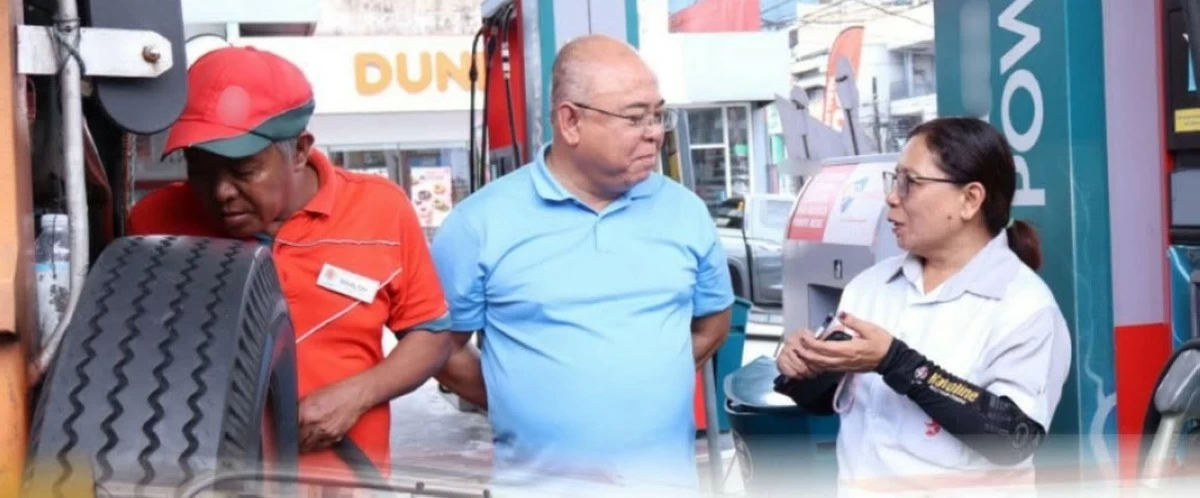
LTFRB chairman Vigor D. Mendoza II talks with a gas station employee during the first day of the nationwide implementation of the P12 per liter fuel discount on Saturday, Aug. 15, 2026 for passenger jeepneys and UV Express. (photo: LTFRB)
The Land Transportation Franchising and Regulatory Board (LTFRB) vowed to expedite the payment process to participating gas stations as the national government started the implementation of the P12 per liter fuel discount on Saturday, Aug. 15.
LTFRB chairman Vigor D. Mendoza II said he also instructed all the agency’s regional offices to continuously monitor and submit reports of the status of the fuel discount program in their areas of responsibility.
“The instruction is for all of us in the LTFRB to be responsive in immediately addressing whatever concerns that may come in the implementation,” said Mendoza.
Part of it, he said, is the LTFRB’s prompt action on all the documentary requirements for the immediate payment to the participating gas stations across the country,“ We are now preparing the credit memos so we can pay gas stations without delay.”
President Marcos earlier extended and increased the fuel subsidy discount—from P10 to P12 per liter covering jeepneys and UV Express, two of the most patronized public utility vehicles (PUVs) in the country.
During his visit to gas stations in Metro Manila on Saturday, Mendoza said jeepney drivers also informed him that they also get additional discounts in some gasoline stations through loyal customer promotion.
This is on top of the government’s fuel subsidy program.
Mendoza said the maximum discount per liter in the loyal customer program is as high as P5 per liter—which means that jeepney and UV Express operators could get as high as P17 per liter discount.
Currently, the price range of gas stations that were visited is between P81 to P89 per liter and with the discount and the loyal customer promo, he said the discount will drop to P64 to P72 per liter.
Over 143,000 jeepney and UV Express units were already listed in the fuel discount program in over 5,000 gas stations across the country.
Based on the guideline, jeepney and UV Express operators could avail of a maximum of 150 liters discounted petroleum products every week, or a savings of around P1,800 every week.
All the drivers would do is to give the license plate before gassing up and the discount is automatically deducted.

30 AND ON FIRE

🔥😍
Actress Chie Filomeno marked her 30th birthday with a series of stunning and sultry photos.
📸Instagram/Chie Filomeno
| via SunStar Cebu


Why is English grammar so different from other Germanic languages?


Old English originally had three grammatical genders and complex noun cases, just like modern German. It lost them because England was conquered—twice.

If you look at a manuscript from before these invasions, you will likely not recognize it as English at all.

The first folio of the Beowulf manuscript, written in the West Saxon dialect of Old English. Source: Wikimedia Commons.

The shift away from this complex Germanic structure started with the Vikings. In the 9th and 10th centuries, Norsemen settled across northern and eastern England in an area known as the Danelaw. Old Norse and Old English were closely related Germanic languages. Their core vocabularies were similar enough that a Norse settler and an Anglo-Saxon farmer could recognize the roots of each other's words, but their grammatical endings—the suffixes that indicated gender and case—were entirely different. To make trade and daily life possible, speakers of both languages began dropping these confusing endings. This contact smoothed away the complex inflectional system, leaving a simplified grammar that relied on word order rather than suffixes to convey meaning.

The second wave came in 1066 with the Norman Conquest. William the Conqueror replaced the English ruling class with French-speaking Norman nobles. For the next 300 years, French and Latin were the languages of government, law, and the church. English was relegated to the peasantry.

Because English was no longer the language of the educated elite, it stopped being formally taught and lost its standardized written form. Unmoored from the conservative influence of scribes and scholars, the spoken language evolved rapidly. The remaining grammatical genders vanished entirely. To compensate for the loss of noun cases, English locked into a strict Subject-Verb-Object word order and began relying heavily on prepositions like "to," "for," and "by."

By the time English reclaimed its status as the national language in the 14th century, it had transformed from a synthetic language that built meaning through word endings into an analytic one that built meaning through word order. It also absorbed about 10,000 French words in the process, leaving modern English with a Germanic foundation, a massive Romance vocabulary, and a grammar that operates like neither.