The water elevation of Angat Dam continued to go down on Monday, inching closer to its lowest recorded water level in 2010. https://tinyurl.com/jn46ndey
Visitors of germanexpatinthephilippines/Besucher dieser Webseite.Ich liebe meine Flaggensammlung!

Tuesday, July 7, 2026

'%3E%3Cpath d='M15.9943 8.0004c0 4.4181-3.5815 7.9996-7.9996 7.9996-4.418 0-7.9996-3.5815-7.9996-7.9996 0-4.418 3.5816-7.9995 7.9996-7.9995 4.4181 0 7.9996 3.5815 7.9996 7.9995Z' fill='url(%23paint0_linear_15251_63610)'/%3E%3Cpath d='M15.9973 7.9992c0 4.4178-3.5811 7.9992-7.9987 7.9992C3.5811 15.9984 0 12.417 0 7.9992S3.5811 0 7.9986 0c4.4176 0 7.9987 3.5814 7.9987 7.9992Z' fill='url(%23paint1_radial_15251_63610)'/%3E%3Cpath d='M15.9943 8.0004c0 4.4181-3.5815 7.9996-7.9996 7.9996-4.418 0-7.9996-3.5815-7.9996-7.9996 0-4.418 3.5816-7.9995 7.9996-7.9995 4.4181 0 7.9996 3.5815 7.9996 7.9995Z' fill='url(%23paint2_radial_15251_63610)' fill-opacity='.8'/%3E%3Cpath d='M12.3964 9.0861c0 1.1142-.3999 1.1142-1.1999 1.1142-.7999 0-1.2 0-1.2-1.1142 0-.8205.5373-1.4856 1.2-1.4856s1.1999.6651 1.1999 1.4856ZM5.9965 9.0861c0 1.1142-.4 1.1142-1.1999 1.1142-.8 0-1.2 0-1.2-1.1142 0-.8205.5373-1.4856 1.2-1.4856s1.2.6651 1.2 1.4856Z' fill='%231C1C1D'/%3E%3Cpath fill-rule='evenodd' clip-rule='evenodd' d='M7.9946 11.2002c1.6447 0 2.3999 1.0936 2.3999 1.4122 0 .1095-.084.1877-.2248.1877-.3152 0-.752-.4-2.1751-.4s-1.8599.4-2.175.4c-.1409 0-.2249-.0782-.2249-.1877 0-.3186.7552-1.4122 2.3999-1.4122Z' fill='%234B280E'/%3E%3Cpath fill-rule='evenodd' clip-rule='evenodd' d='M10.7861 6.3078a3.3942 3.3942 0 0 1 1.8777 1.0409.4.4 0 0 0 .5892-.5411 4.1944 4.1944 0 0 0-2.3202-1.2862.4.4 0 1 0-.1467.7864ZM5.206 6.3078a3.3946 3.3946 0 0 0-1.8777 1.0409.4.4 0 1 1-.5891-.5411 4.1946 4.1946 0 0 1 2.3202-1.2862.4.4 0 0 1 .1467.7864Z' fill='%23E0761A'/%3E%3Cg filter='url(%23filter0_i_15251_63610)'%3E%3Cpath d='M2.9952 11.2004c-.2647-.003-.435.1598-1.1536 1.3088-.3267.5231-.6468 1.0515-.6468 1.691 0 .994.8 1.7999 1.8 1.7999.9999 0 1.8008-.8 1.8008-1.7999 0-.6395-.32-1.1679-.6468-1.691-.7186-1.149-.8887-1.3118-1.1536-1.3088Z' fill='%2302ADFC' fill-opacity='.9'/%3E%3C/g%3E%3C/g%3E%3Cdefs%3E%3CradialGradient id='paint1_radial_15251_63610' cx='0' cy='0' r='1' gradientUnits='userSpaceOnUse' gradientTransform='matrix(0 7.9992 -7.99863 0 7.9986 7.9992)'%3E%3Cstop offset='.5637' stop-color='%23FF5758' stop-opacity='0'/%3E%3Cstop offset='1' stop-color='%23FF5758' stop-opacity='.1'/%3E%3C/radialGradient%3E%3CradialGradient id='paint2_radial_15251_63610' cx='0' cy='0' r='1' gradientUnits='userSpaceOnUse' gradientTransform='rotate(45 -4.5287 10.9195) scale(10.1818)'%3E%3Cstop stop-color='%23FFF287'/%3E%3Cstop offset='1' stop-color='%23FFF287' stop-opacity='0'/%3E%3C/radialGradient%3E%3ClinearGradient id='paint0_linear_15251_63610' x1='2.395' y1='2.4007' x2='13.5944' y2='13.6001' gradientUnits='userSpaceOnUse'%3E%3Cstop stop-color='%23FFF287'/%3E%3Cstop offset='1' stop-color='%23F68628'/%3E%3C/linearGradient%3E%3CclipPath id='clip0_15251_63610'%3E%3Cpath fill='%23fff' d='M-.003.0009h15.9993v15.9984H-.003z'/%3E%3C/clipPath%3E%3Cfilter id='filter0_i_15251_63610' x='1.1948' y='11.2003' width='3.6006' height='4.7998' filterUnits='userSpaceOnUse' color-interpolation-filters='sRGB'%3E%3CfeFlood flood-opacity='0' result='BackgroundImageFix'/%3E%3CfeBlend in='SourceGraphic' in2='BackgroundImageFix' result='shape'/%3E%3CfeColorMatrix in='SourceAlpha' values='0 0 0 0 0 0 0 0 0 0 0 0 0 0 0 0 0 0 127 0' result='hardAlpha'/%3E%3CfeOffset/%3E%3CfeGaussianBlur stdDeviation='1.1999'/%3E%3CfeComposite in2='hardAlpha' operator='arithmetic' k2='-1' k3='1'/%3E%3CfeColorMatrix values='0 0 0 0 0.278431 0 0 0 0 0.196078 0 0 0 0 0.952941 0 0 0 0.1 0'/%3E%3CfeBlend in2='shape' result='effect1_innerShadow_15251_63610'/%3E%3C/filter%3E%3C/defs%3E%3C/svg%3E)
'/%3E%3Cpath d='M16.0001 7.9996c0 4.418-3.5815 7.9996-7.9995 7.9996S.001 12.4176.001 7.9996 3.5825 0 8.0006 0C12.4186 0 16 3.5815 16 7.9996Z' fill='url(%23paint1_radial_15251_63610)'/%3E%3Cpath d='M16.0001 7.9996c0 4.418-3.5815 7.9996-7.9995 7.9996S.001 12.4176.001 7.9996 3.5825 0 8.0006 0C12.4186 0 16 3.5815 16 7.9996Z' fill='url(%23paint2_radial_15251_63610)' fill-opacity='.5'/%3E%3Cpath d='M7.3014 3.8662a.6974.6974 0 0 1 .6974-.6977c.6742 0 1.2207.5465 1.2207 1.2206v1.7464a.101.101 0 0 0 .101.101h1.7953c.992 0 1.7232.9273 1.4917 1.892l-.4572 1.9047a2.301 2.301 0 0 1-2.2374 1.764H6.9185a.5752.5752 0 0 1-.5752-.5752V7.7384c0-.4168.097-.8278.2834-1.2005l.2856-.5712a3.6878 3.6878 0 0 0 .3893-1.6509l-.0002-.4496ZM4.367 7a.767.767 0 0 0-.7669.767v3.2598a.767.767 0 0 0 .767.767h.767a.3835.3835 0 0 0 .3835-.3835V7.3835A.3835.3835 0 0 0 5.134 7h-.767Z' fill='%23fff'/%3E%3Cdefs%3E%3CradialGradient id='paint1_radial_15251_63610' cx='0' cy='0' r='1' gradientUnits='userSpaceOnUse' gradientTransform='rotate(90 .0005 8) scale(7.99958)'%3E%3Cstop offset='.5618' stop-color='%230866FF' stop-opacity='0'/%3E%3Cstop offset='1' stop-color='%230866FF' stop-opacity='.1'/%3E%3C/radialGradient%3E%3CradialGradient id='paint2_radial_15251_63610' cx='0' cy='0' r='1' gradientUnits='userSpaceOnUse' gradientTransform='rotate(45 -4.5257 10.9237) scale(10.1818)'%3E%3Cstop offset='.3143' stop-color='%2302ADFC'/%3E%3Cstop offset='1' stop-color='%2302ADFC' stop-opacity='0'/%3E%3C/radialGradient%3E%3ClinearGradient id='paint0_linear_15251_63610' x1='2.3989' y1='2.3999' x2='13.5983' y2='13.5993' gradientUnits='userSpaceOnUse'%3E%3Cstop stop-color='%2302ADFC'/%3E%3Cstop offset='.5' stop-color='%230866FF'/%3E%3Cstop offset='1' stop-color='%232B7EFF'/%3E%3C/linearGradient%3E%3C/defs%3E%3C/svg%3E)
'%3E%3Cpath d='M15.9953 7.9996c0 4.418-3.5816 7.9996-7.9996 7.9996S-.004 12.4176-.004 7.9996 3.5776 0 7.9957 0c4.418 0 7.9996 3.5815 7.9996 7.9996Z' fill='url(%23paint0_linear_15251_63610)'/%3E%3Cpath d='M15.9973 7.9992c0 4.4178-3.5811 7.9992-7.9987 7.9992C3.5811 15.9984 0 12.417 0 7.9992S3.5811 0 7.9986 0c4.4176 0 7.9987 3.5814 7.9987 7.9992Z' fill='url(%23paint1_radial_15251_63610)'/%3E%3Cpath d='M15.9953 7.9996c0 4.418-3.5816 7.9996-7.9996 7.9996S-.004 12.4176-.004 7.9996 3.5776 0 7.9957 0c4.418 0 7.9996 3.5815 7.9996 7.9996Z' fill='url(%23paint2_radial_15251_63610)' fill-opacity='.8'/%3E%3Cpath d='M12.5278 8.1957c.4057.1104.6772.4854.623.9024-.3379 2.6001-2.5167 4.9012-5.1542 4.9012s-4.8163-2.3011-5.1542-4.9012c-.0542-.417.2173-.792.623-.9024.8708-.237 2.5215-.596 4.5312-.596 2.0098 0 3.6605.359 4.5312.596Z' fill='%234B280E'/%3E%3Cpath d='M11.5809 12.3764c-.9328.9843-2.1948 1.6228-3.5841 1.6228-1.3892 0-2.6512-.6383-3.5839-1.6225a1.5425 1.5425 0 0 0-.016-.0174c.4475-1.0137 2.2-1.3599 3.5999-1.3599 1.4 0 3.1514.3468 3.5998 1.3599l-.0157.0171Z' fill='url(%23paint3_linear_15251_63610)'/%3E%3Cpath fill-rule='evenodd' clip-rule='evenodd' d='M13.3049 5.8793c.1614-1.1485-.6387-2.2103-1.7872-2.3717l-.0979-.0138c-1.1484-.1614-2.2103.6388-2.3717 1.7872l-.0163.1164a.5.5 0 0 0 .9902.1392l.0163-.1164c.0846-.6016.6408-1.0207 1.2424-.9362l.0978.0138c.6016.0845 1.0207.6407.9362 1.2423l-.0164.1164a.5.5 0 0 0 .9903.1392l.0163-.1164ZM2.6902 5.8793c-.1614-1.1485.6387-2.2103 1.7872-2.3717l.0979-.0138c1.1484-.1614 2.2103.6388 2.3717 1.7872l.0164.1164a.5.5 0 1 1-.9903.1392l-.0163-.1164c-.0846-.6016-.6408-1.0207-1.2423-.9362l-.098.0138c-.6015.0845-1.0206.6407-.936 1.2423l.0163.1164a.5.5 0 0 1-.9902.1392l-.0164-.1164Z' fill='%231C1C1D'/%3E%3C/g%3E%3Cdefs%3E%3CradialGradient id='paint1_radial_15251_63610' cx='0' cy='0' r='1' gradientUnits='userSpaceOnUse' gradientTransform='matrix(0 7.9992 -7.99863 0 7.9986 7.9992)'%3E%3Cstop offset='.5637' stop-color='%23FF5758' stop-opacity='0'/%3E%3Cstop offset='1' stop-color='%23FF5758' stop-opacity='.1'/%3E%3C/radialGradient%3E%3CradialGradient id='paint2_radial_15251_63610' cx='0' cy='0' r='1' gradientUnits='userSpaceOnUse' gradientTransform='rotate(45 -4.5272 10.9202) scale(10.1818)'%3E%3Cstop stop-color='%23FFF287'/%3E%3Cstop offset='1' stop-color='%23FFF287' stop-opacity='0'/%3E%3C/radialGradient%3E%3ClinearGradient id='paint0_linear_15251_63610' x1='2.396' y1='2.3999' x2='13.5954' y2='13.5993' gradientUnits='userSpaceOnUse'%3E%3Cstop stop-color='%23FFF287'/%3E%3Cstop offset='1' stop-color='%23F68628'/%3E%3C/linearGradient%3E%3ClinearGradient id='paint3_linear_15251_63610' x1='5.1979' y1='10.7996' x2='5.245' y2='14.2452' gradientUnits='userSpaceOnUse'%3E%3Cstop stop-color='%23FF60A4'/%3E%3Cstop offset='.2417' stop-color='%23FA2E3E'/%3E%3Cstop offset='1' stop-color='%23BC0A26'/%3E%3C/linearGradient%3E%3CclipPath id='clip0_15251_63610'%3E%3Cpath fill='%23fff' d='M-.002 0h16v15.9992h-16z'/%3E%3C/clipPath%3E%3C/defs%3E%3C/svg%3E)

Swimming with whale sharks in Pintuyan
Why Southern Leyte is your 'sharky pitstop' to Siargao
We call them butanding, but they’re also known as balilan, kaytan tokke, and balyiran. Here in the province of Southern Leyte, they’re known as tiki-tiki.
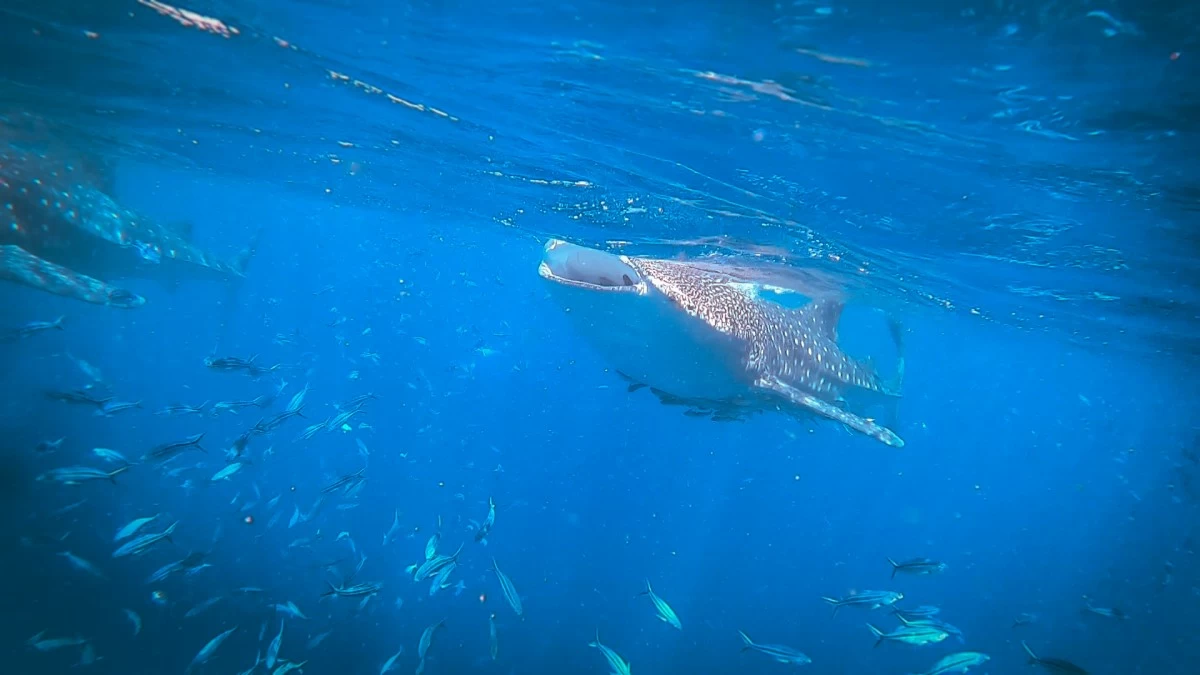
GENTLE GIANTS A pair of tiki-tiki or whale sharks cruises near the water’s surface in Pintuyan, Southern Leyte. (Photos: Gregg Yan)
Whale sharks (Rhincodon typus) are the most commonly seen fish in the Philippines, not because they’re found in markets like tilapia or bangus, but because they’re printed on the back of the new P100 bill (which is my daily allowance from my wife).
Though certainly large enough, they aren’t whales. They’re the largest of the three known filter-feeding sharks, growing over 50 feet and weighing as much as six adult elephants. While they are the Earth’s largest fish, they’re completely harmless, eating only plankton, tiny fish, shrimp, and squid.
These harmless giants have since transitioned from mere wildlife to money magnets, generating millions of pesos through ecotourism. Donsol in Southern Luzon remains the country’s traditional hotbed for wild whale shark encounters. Oslob in Southern Cebu is the cash cow, raking in big bucks and huge crowds through a controversial feeding practice that alters natural shark behavior and keeps sharks in place for most of the year.
Pintuyan in Southern Leyte’s Sogod Bay is the newcomer, working quietly to establish itself as an ethical whale shark destination, modeled after Donsol. Other whale shark watching destinations include Palawan and Bohol.

Pintuyan, Southern Leyte
Pintuyan’s whale sharks
“In the old days, our fishers drove off or even killed whale sharks or tiki-tiki because they scared away smaller fish and plowed through our nets,” recalls Pintuyan Mayor Ricarte Estrella. “In 2006, we saw how Donsol was leading the way in terms of sustainable ecotourism. We wanted to emulate their adventure-based system, which doesn’t rely on feeding. We’re still a long way from the commercial scale of Oslob or Donsol, but we’re content to take things slow and give our visitors a simpler, but more ethical experience.”
Pintuyan in Southern Leyte annually welcomes less than 5,000 visitors, mostly European divers. “But this is something we hope to build on, since we have lots of unique experiences to offer our guests,” promises Mayor Ricarte.
For one, Pintuyan sits just an hour away from Surigao, a jump-off for wayfarers headed to Siargao, one of the world’s most renowned surf spots. Travelers headed to Siargao can first fly to Tacloban, then travel three to four hours south to Pintuyan to dive with whale sharks. Visitors can stay a few days as ferries sail to Surigao daily.
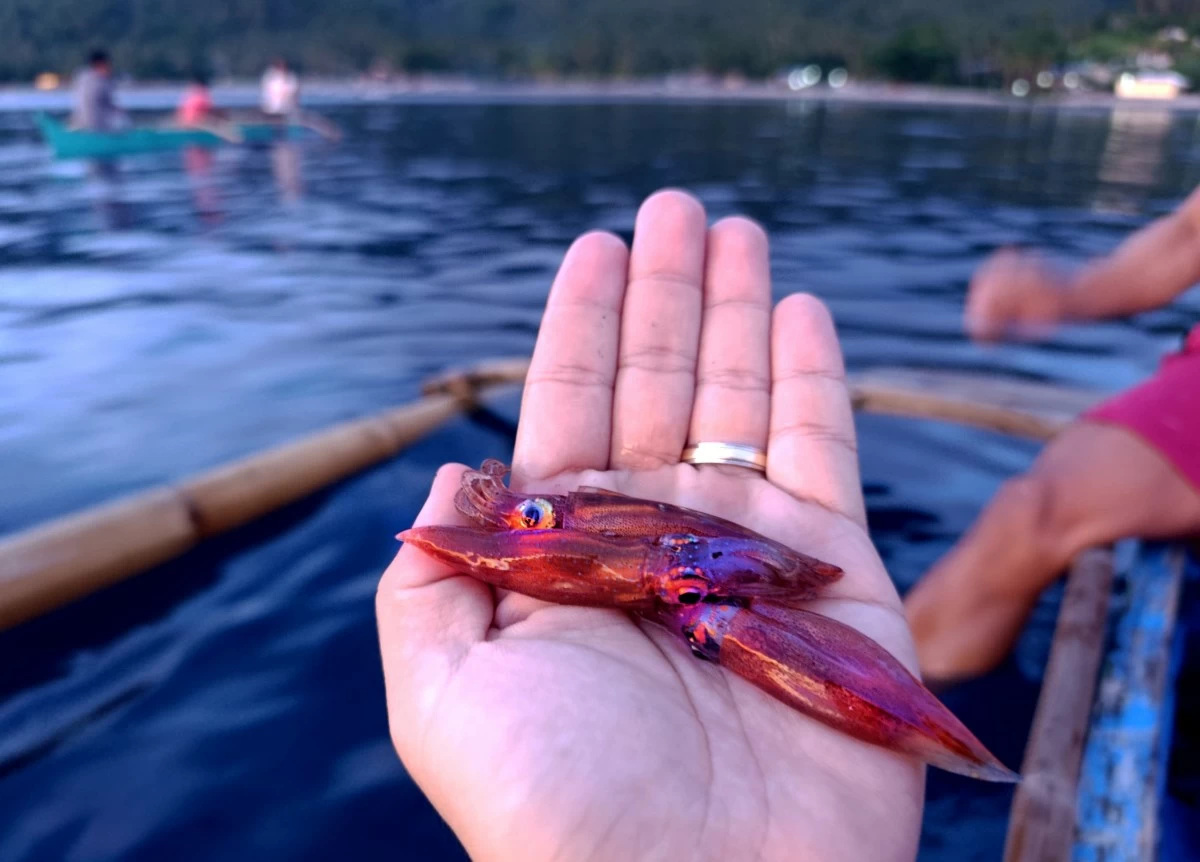
Pintuyan pygmy squid
“Aside from diving, we also offer our guests a unique experience in the form of ‘squidding’ or squid fishing,” adds Mayor Ricarte. “Guests can board a ‘bangka’ (boat) to catch and eat tiny squid at sunset.”
Locally called buko-buko, the pygmy squids grow no larger than a finger, glow in the dark, and can be eaten raw (careful though, for they can bite like a maya bird with their little beaks).
“They taste great, and we can catch as many as we like every summer,” says local fisher Mario Mateo. “Tourists love buko-buko, but our main attraction is really the whale sharks.”
Taking the plunge
“Ready to jump? Always stay three to five meters away from them,” instructs our guide Carlito Mosot, donning a mask and snorkel. “Go, go, jump in!”
We jump into the water and are immediately surrounded by the gentle giants of Pintuyan.
Unlike Oslob, where the water carries the lingering scent of dead shrimp, or Donsol, where thick plankton blooms limit visibility to a dozen feet, Pintuyan offers clear water. Morning sunrays slice the blue to illuminate the curious constellations on the backs of the sharks.

Adventurers Gregg Yan, Erwin Lim, Renzo Maano, Boboi Costas, Aldo Banaynal and Anna Barlam before diving with the gentle giants of Pintuyan. Whale shark interactions usually take place in the morning, within a few hundred meters from the shore.
At around five meters apiece, they’re smaller than the sharks of Donsol, some of which exceed 10 meters in length. Some also exhibit scars and cuts, evidence of accidental hits from boat propellers, but on the whole, they seem happy, healthy, and most of all, wild.
For 30 magical minutes, we swim alongside tiki-tiki, several rising to the surface to gorge on plankton, which also attracts smaller fish like fusiliers and mackerel. I’ve swum with whale sharks all over the country, and this is among the best experiences I’ve had.
For surfers and adventurers heading to Siargao, make Pintuyan your pitstop. Swim with friendly sharks and catch a palmful of tiny squid before battling Cloud Nine’s monster waves.
“Pintuyan has much to offer, from rugged mountains to vibrant coral reefs,” shares Boboi Costas, an ecotourism guru who has been quietly helping communities nationwide discover and market the beauty of their hometowns. “I hope to see it flourish as a premier marine destination where local communities, the government, and the private sector work hand-in-hand to benefit both the people and the environment.”
Gregg Yan is an explorer and the founder of environmental group Best Alternatives.
A BETTER CALLING IN MY LIFE?

Finding a better calling in life is about aligning your daily actions with your unique passions and strengths. It is a personal journey of trial and error that transitions a career into a meaningful purpose.
What is a calling? Your life's calling is what makes you feel that life is meaningful. It helps you live a purposeful life. Callings look different for everybody. Some people, for example, want to help others as part of their calling.
It's important to understand that a calling is not limited to a specific job or career, but it's a deeper sense of purpose that encompasses all aspects of life. It's not just about what we do to make a living, but rather it's about who we are and what we're meant to do in this world.
God’s calling on your life is a personal, evolving invitation to partner with Him. It generally spans two parts: your primary calling (to know Him and follow Jesus) and your secondary calling (using your unique gifts, passions, and everyday circumstances to love and serve others).
Have you ever felt a sense of purpose or direction in your life that you couldn't quite explain? Some people refer to this feeling as a “calling.” It's a sense that there is something you were meant to do or become, a mission or a destiny that is unique to you.
Career is a rapid motion. A course of action. Sure! A professional conduct in life. Even a progress through life. Here we are! That means, a careerist is one, who rushes widely and makes his own personal advancement as well as his (or her) own aim in life!
What can we do, if "career doubts" won't go away? First allow me to quote my bible, especially Jude (Watching out! Sounding an alarm!), who writes in the style of a teacher who is watching a freight train bear down on his student's driver. Yes, bells ring out: "Be merciful to those who doubt." (Jude 2:22).
What does my calling in life mean? Your calling can be thought of as the urge to share your gifts with the world. When you express your gifts for the sake of others, you often experience the joy of being fully alive.
A true calling is a career or walk of life that a person feels compelled or meant to do. Finding meaning in life is something people often spend a lot of time contemplating. Or some individuals may feel the passion so strong that they know quickly in their heart what they were born to do.
"The way that people pick up careers is incredibly primitive," said Nicholas Lore, founder of the Rockport Institute, a career coaching firm, and author of "The Pathfinder". Strong tobacco, indeed. That's why so many people are indeed dissatisfied with their jobs.
Believe me, I always thought about a true calling for myself. Sure, people, whose careers aren't the fight fit, often feel like impostors, as Professor Robert I. Sutton, an organizational psychologist at Stanford University in Palo Alto, said. Very, very well said, Sir.
Notice dreams and signs. Prioritize creative expression. Think about what you used to love. Notice what feels good. Turn down the distractions.Pay attention to what keeps coming back. Try new things regularly.
How about you, my dear reader of this column? Are you also placing too high a value on the external rewards of a job, like money, prestige and power? Of course, for many of us (most?). These things are indeed important. Hold on, please! The work you do and the skills your opportunity requires and the value of your work are really more vital to fulfillment. Paper work, or not... . You think, you find a better career fit? Go ahead - but don't expect that this is your life's career!
I waited for my "better calling" (what a terrible term!) experiencing many even better and wonderful moments in life. I also experienced that several professional things I did in the past had not been very much compatible with me. But I stored many valuable experiences.
Today, I am what I am. And, I am proud of it. Almost 73. A retiree with still so many opportunities in the Philippines.
Psychology needs a proper spirituality
.jpg)
By Fr. Roy Cimagala
Chaplain
Center for Industrial Technology and Enterprise (CITE)
Talamban, Cebu City
Email: roycimagala@gmail.com
FOR years, psychology has helped us understand the labyrinth of the human mind. It explains why we fear, why we love, why we break, and sometimes even why we heal. Yet amid its remarkable advances, one uncomfortable question persists: Is understanding the mind enough to understand the person?
The Christian tradition would answer with a firm no.
Psychology excels at describing human behavior. It identifies patterns, diagnoses disorders, and offers therapies that restore emotional balance. These are invaluable contributions. Mental health deserves serious attention, and the growing acceptance of psychological care is one of the healthier developments of modern society.
But emotional wellness is not the summit of human fulfillment.
This is where spirituality enters—not as psychology's rival but as its indispensable partner. It anchors psychology in its proper place.
We, of course, know that that the human person cannot be reduced to biological impulses, emotional reactions, or cognitive processes. We are created for communion with God. Every human experience—joy, work, suffering, success, even failure—finds its deepest meaning only when connected to that relationship. A purely psychological reading of life may explain our emotions, but it cannot answer the question of their real meaning and ultimate purpose.
Personal growth involves much more than emotional equilibrium. Authentic maturity includes the formation of virtues, the exercise of freedom, and the cultivation of one's relationship with God. Mental health is essential, but holiness remains the higher horizon.
The distinction matters. It should not be forgotten.
A person may be psychologically well-adjusted yet spiritually adrift. Another may carry emotional wounds while displaying extraordinary faith, hope, and charity. The two dimensions intersect, but they are not identical.
We have to be wary when we confuse feeling good with being good. Our modern culture tends to fall into this trap.
That confusion carries consequences. We increasingly evaluate decisions by asking, "Does this make me feel better?" rather than "Is this true?" or "Is this the right thing to do?" Comfort has quietly become the new moral compass.
Psychology, when detached from a sound understanding of the human person, can unintentionally reinforce this tendency. Therapy risks becoming an endless pursuit of self-satisfaction instead of a path toward genuine self-giving.
Christian spirituality proposes a radically different vision.
It teaches that the deepest fulfillment comes not from constant self-focus but from self-transcendence. Love demands sacrifice. Freedom requires responsibility. Peace grows from reconciliation—with God, with others, and with oneself. These realities cannot be measured on a psychological scale alone.
None of this diminishes the importance of professional mental health care. On the contrary, spiritual directors should know when psychological intervention is needed, just as therapists should recognize that many of life's deepest questions belong to the realm of meaning, conscience, and faith. The healthiest approach is not competition but collaboration between psychology and spirituality.
Perhaps the greatest lesson psychology and spirituality can teach each other is humility.
Psychology reminds believers that grace builds on nature. Emotional wounds deserve compassion, not simplistic moral judgments. Spirituality reminds psychology that human beings are more than the sum of their neurons, memories, and emotions. We possess a soul that longs for truth, goodness, beauty, and ultimately, God.
In an age fascinated by wellness, perhaps what we need is not merely better coping mechanisms but a fuller vision of the human person.
The mind deserves healing.
The heart deserves meaning.
And the soul deserves nothing less than God!
FISH AND OCEAN

Religion and music belong together like fishes and the ocean – like light and life, like a voice and ears… .
Fish are the backbone of ocean life. They range from tiny reef fish to giant predators. Fish keep the sea healthy by balancing food chains and maintaining habitats. Sadly, overfishing and warming waters threaten these vital creatures.
Why fish are important for the health of our planet.
Fish play important roles in the health of our ecosystem. Despite this, many people believe them to be boring, when the truth is fish are feeling, smart, and complicated beings.
Given their ability to feel both physical and emotional pain, it’s not a far stretch to say that fish suffer. Little causes so much suffering to so many fish as fishing, including the recreational variety.
We know that fish suffer when they’re caught because they try frantically to get away, a classic sign of pain. As they pull against the hook stabbing through the flesh of their mouth, the injury gets worse.
But the pain doesn’t end there. Eventually they’ll likely be reeled out of the water and into a boat where they immediately start to suffocate, unable to breath without water. Everything down to their organs and blood flow are impacted by the stress of being taken out of the water.
In the entire universe, we humans are probably the only beings capable of creating and listening to music. The ability to hear is one of the specific gifts that our Creator gave us. Our fragile blue planet is surrounded by a thin layer of gases only a few kilometers high. Only this atmosphere is the reason why sound waves can spread through the air. Everything behind this atmosphere is ruled by the sheer endless vacuum of outer space, where galaxies and stars explode and implode in impenetrable silence.
Politics(Right)
According to the biblical narrative, the world began when God broke through thies deadly quiet: “And God said: Let there be light!” (Genesis 1:1). God spoke – and light and life resulted from his audible voice. Because life was created by the word. That is why it is in the nature of every person to listen. Like a parabolic mirror, our souls are created to listen to the eternal space of the hereafter, to try and sense whether a word, a sound or a voice is trying to reach us from there, in order to fill us with a meaning.
It’s nothing new that I love music. And, I know that Filipinos also love big tunes with great words and beautiful melodies, especially when it comes to classical music.
MY PRAYERS AND ME

Your prayers and you have a special bond. Prayer is simply talking to God. It is like a close talk with a good friend. You can ask for His help, thank Him for your day, or just share your feelings.Here is how you can make your prayer time special:Find a quiet place.
This time we live in has not only made our lives more difficult, but has killed many people. We are thus living in panic and feeling helpless and pray more desperately for family protection, for faith in difficulties, and for our lives and work.
Prayer is how we as Christians draw close to God as well as a necessary condition for us to be moved by the Holy Spirit, and enlightened and illuminated by God. If we genuinely pray to God, and understand the principles and practices of prayer, when we encounter difficulties or dilemmas in our life, we’ll be able to face them in a relaxed way.
"The Power of Prayer" is a 2020 song by Bruce Springsteen from his album Letter to You. It was only released as a radio single, and a promotional video was released on November 23, a month after the release of the album.
The song has a spiritual language. Springsteen was born in a Roman Catholic household, and that turned him off religion, but he didn't lose his faith. The video features archival footage from his youth and clips of Springsteen and the E Street Band working on the song in the studio. The message of the video is about old friends he’s lost and the optimism of that era, reflected in the footage of Jersey Shore in the summertime during Springsteen’s youth.
The song has a spiritual language. Springsteen was born in a Roman Catholic household, and that turned him off religion, but he didn't lose his faith. The video features archival footage from his youth and clips of Springsteen and the E Street Band working on the song in the studio. The message of the video is about old friends he’s lost and the optimism of that era, reflected in the footage of Jersey Shore in the summertime during Springsteen’s youth.
When tragedy strikes, it's easy to harden our hearts and cry out, "God, why did you let this happen?" Maybe then, we started praying. Before, when everything went smoothly, we would not even think a minute about praying... .
"To be a Christian without prayer, "said Martin Luther, "is no more possible than to be alive without breathing." Prayer is the only way of becoming what God wants us to be. This is the reason why Jesus spent many hours praying.
Unquestionable, our needs bring us to a place of prayer. Confronted with danger or tragedies, as I mentioned earlier, we look for God's help. Difficult times always cause the hearts of men to turn to God into prayer.
Let me ask you: How long has it been since you've brought your burdens to God? Since you asked His forgiveness for your shortcomings?
In his very interesting book "People in Prayer", Dr. John White reminds us that prayer is a divine-human interaction and it is always God who takes the initiative. White writes: "God speaks and we respond. God is always speaking. To hear his voice is not usually a mystical experience. It consists merely of a willingness to pay heed to God who lays a claim to our lives."
Yes, God always speaks. It is up to us whether we will listen and respond to Him. Many think we are the ones who initiate prayer. But prayers begin and end with God.
There was a time, I wasn't in the mood to pray any more. It seemed that God didn't listen to my prayer any more. I didn't get what I prayed for. Of course, not... ! That's not the meaning of praying to God. Will all my wishes be granted? Heaven forbid!
Sometimes, after we have prayed, God's answers may puzzle us. But as time goes by and as events unfold we see God's purpose in His answers. We might get a larger vision, what HE likes. Not what WE like... .
Think about it for a moment: How does the idea that prayer begins and ends with God affect me now? Do I have the habit of listening to God? How do I respond to Him? How do I usually pray?
I confess that a long time ago I have been trying to persuade God to change other people in my surroundings or circumstances. Nothing changed. Of course not, what a fatal attraction? I got confused because God never granted my requests. Meanwhile I got God's answers to my prayers. Maybe very simple: I was willing to let God change me... .This is how each one of us should start. Happy endings. Because I prayed according to His will... .
Nowadays, I live a wonderful life in my second and last home, the Philippines. I never regretted moving here for good. I have everything I could ask for. I can do everything I wish to do. Thank you Lord for all the blessings.
Email: doringklaus@gmail.com
"To be a Christian without prayer, "said Martin Luther, "is no more possible than to be alive without breathing." Prayer is the only way of becoming what God wants us to be. This is the reason why Jesus spent many hours praying.
Unquestionable, our needs bring us to a place of prayer. Confronted with danger or tragedies, as I mentioned earlier, we look for God's help. Difficult times always cause the hearts of men to turn to God into prayer.
Let me ask you: How long has it been since you've brought your burdens to God? Since you asked His forgiveness for your shortcomings?
In his very interesting book "People in Prayer", Dr. John White reminds us that prayer is a divine-human interaction and it is always God who takes the initiative. White writes: "God speaks and we respond. God is always speaking. To hear his voice is not usually a mystical experience. It consists merely of a willingness to pay heed to God who lays a claim to our lives."
Yes, God always speaks. It is up to us whether we will listen and respond to Him. Many think we are the ones who initiate prayer. But prayers begin and end with God.
There was a time, I wasn't in the mood to pray any more. It seemed that God didn't listen to my prayer any more. I didn't get what I prayed for. Of course, not... ! That's not the meaning of praying to God. Will all my wishes be granted? Heaven forbid!
Sometimes, after we have prayed, God's answers may puzzle us. But as time goes by and as events unfold we see God's purpose in His answers. We might get a larger vision, what HE likes. Not what WE like... .
Think about it for a moment: How does the idea that prayer begins and ends with God affect me now? Do I have the habit of listening to God? How do I respond to Him? How do I usually pray?
I confess that a long time ago I have been trying to persuade God to change other people in my surroundings or circumstances. Nothing changed. Of course not, what a fatal attraction? I got confused because God never granted my requests. Meanwhile I got God's answers to my prayers. Maybe very simple: I was willing to let God change me... .This is how each one of us should start. Happy endings. Because I prayed according to His will... .
Nowadays, I live a wonderful life in my second and last home, the Philippines. I never regretted moving here for good. I have everything I could ask for. I can do everything I wish to do. Thank you Lord for all the blessings.
+++
Email: doringklaus@gmail.com
The most down-to-earth book

By Klaus Döring
When tragedy strikes, it’s easy to harden our hearts and cry out, “God, why did you let this happen?” Maybe then, we started praying. Before, when everything went smoothly, we would not even think for a minute about praying.
The book is a student anthology of poetry, fiction, nonfiction, and drama. It was written to express concerns about global warming and environmental destruction. The book has two strands: The first warns about environmental destruction, and the second promotes a new awe of nature.
The title of “most famous book in the world” universally belongs to the Bible, which is both the most widely distributed and best-selling book of all time, with an estimated 5 billion to 7 billion copies sold or distributed worldwide.
“To be a Christian without prayer,” said Martin Luther, “is no more possible than to be alive without breathing.” Prayer is the only way of becoming what God wants us to be. This is the reason Jesus spent many hours praying.
Unquestionably, our needs bring us to a place of prayer. Confronted with danger or tragedies, as I mentioned earlier, we look for God’s help. Difficult times always cause the hearts of men to turn to God in prayer.
Let me ask you: How long has it been since you’ve brought your burdens to God? Since you asked His forgiveness for your shortcomings?
In his very interesting book “People in Prayer,” Dr. John White reminds us that prayer is a divine-human interaction, and it is always God who takes the initiative. The author takes 10 biblical prayers and expounds on them. Well-written, interesting, and quite thought-provoking. White writes: “God speaks and we respond. God is always speaking. To hear his voice is not usually a mystical experience. It consists merely of a willingness to pay heed to God who lays a claim to our lives.”
Yes, God always speaks. It is up to us whether we will listen and respond to Him. Many think we are the ones who initiate prayer. But prayers begin and end with God.
There was a time I wasn’t in the mood to pray anymore. It seemed that God didn’t listen to my prayer anymore. I didn’t get what I prayed for. Of course not! That’s not the meaning of praying to God. Will all my wishes be granted? Heaven forbid!
Sometimes, after we have prayed, God’s answers may puzzle us. But as time goes by and as events unfold, we see God’s purpose in his answers. We might get a larger vision of what HE likes. Not what WE like.
Think about it for a moment: How does the idea that prayer begins and ends with God affect me now? Do I have the habit of listening to God? How do I respond to Him? How do I usually pray?
I confess that a long time ago, I was trying to persuade God to change other people in my surroundings or circumstances. Nothing changed. Of course not — what a fatal attraction! I got confused because God never granted my requests. Meanwhile, I got God’s answers to my prayers. Maybe very simple: I was willing to let God change me. This is how each one of us should start. Happy endings. Because I prayed according to His will.
Talking about prayer, we also have to mention probably the most down-to-earth book in the Bible, which is Proverbs. Its education prepares you for the street and the marketplace, not the schoolroom. The book offers the warm advice you get by growing up in a good family. It covers small questions as well as large ones: talking too much, visiting neighbors too often, and being unbearably cheerful too early in the morning. Proverbs simply tells how life works most of the time.
I always love to quote proverbs, which express the truth about life in an elegant, witty kernel. You should not hunt through it for proverbs you might like. You should study the whole book to get its overall point of view. This takes time, for Proverbs covers dozens of subjects in subtle detail.
***
Email: doringklaus@gmail.com, follow me on Facebook, LinkedIn, or X, formerly Twitter, or visit www.germanexpatinthephilippines.blogspot.com or www.klausdoringsclassicalmusic.blogspot.com.
Subscribe to:
Posts (Atom)