You plan to move to the Philippines? Wollen Sie auf den Philippinen leben?

There are REALLY TONS of websites telling us how, why, maybe why not and when you'll be able to move to the Philippines. I only love to tell and explain some things "between the lines". Enjoy reading, be informed, have fun and be entertained too!

Ja, es gibt tonnenweise Webseiten, die Ihnen sagen wie, warum, vielleicht warum nicht und wann Sie am besten auf die Philippinen auswandern könnten. Ich möchte Ihnen in Zukunft "zwischen den Zeilen" einige zusätzlichen Dinge berichten und erzählen. Viel Spass beim Lesen und Gute Unterhaltung!


Visitors of germanexpatinthephilippines/Besucher dieser Webseite.Ich liebe meine Flaggensammlung!

free counters

Total Pageviews

Saturday, August 15, 2026

PAPER AND POWER


by Klaus Döring


Paper still matters, as I could learn from fellow Inquirer staff writer Phyllis Korkki. Yes, paper still matters. The frequent whirring of printers in offices - despite the Internet, Microsoft Word, social media (I love Facebook and Twitter), scanners, smart phones applications and many much more - attest to that.

Paper is a quiet yet profound invention that transformed human history. It allowed ideas to spread past elite circles, preserved scientific and cultural knowledge, and fueled global revolutions from the printing press to modern democracy. Even today, physical paper offers unique cognitive and practical benefits that screens cannot replace.

I am very old fashioned in many things. I was still typing on an old manual typewriter, when my colleagues in different publishing houses already used electric units. I loved my antique typewriter. I love it till today. Yes, it's still here in my office in Davao City. I can't use it anymore, because no more ribbons are available in the Philippines. It's okay. My electric typewriter is also here. Just beside the manual unit. Those were the days, my love... .

It has been sometimes at the end of the 1990s. I worked in an international publishing house in Berlin with branches in Amsterdam and New York. I still used one of those wonderful electric typewriters - and tried to avoid a personal computer. Already during that time I needed to hold paper in my hands. Paper, says the productivity expert David Allen, is "in your face". I strongly agree with David. He said, "Its physical presence can be a goal to completing tasks, whereas computer files can easily be hidden and thus forgotten. I am also returning to paper planners for this very reason. Please, don't laugh at me, my dear readers!

The power of paper lies in its unique ability to preserve human thought, foster deep cognitive focus, and act as a tangible, sustainable medium for communication and art that transcends the digital world.

David Allen, the author of "Getting Things Done", does much of his writing on a computer. So I do meanwhile. But, there are still times when writing with a fountain pen on a notepad. It allows "us" to get "our" heads in the right place. When I tried to learn more from David Allen, I really got surprised, that we have many things in common. Old fashioned or not? I don't care. Here are some facts:

Paper print outs serve an important function. For long texts, a print out can allow a reader to better understand relationships between sections and writings. Paper handouts are still a presence at meetings partly because they are useful for taking notes. Reading a long document on paper rather than on a computer screen helps people "better understand the geography of the argument contained within, "said Richard H.R. Harper, a principal researcher for Microsoft in Cambridge/England and co-author with Abigail J. Sellen of "The Myth of the Paperless Office," published already in 2001.

I also strongly agree with Sellen, saying that using more than one computer screen can be helpful for all this cognitive juggling. But when workers are going back and forth between points in a longer document, it can be more efficient to read on paper.

How about "e-reading a book"? A novel, a drama, whatever? What do you prefer, my dear reader? You wanna know my opinion? I am sure, you can imagine. Yes guys, I still need a book in my hands for my leisure reading. I need to feel the book as well as I need to smell a fresh-printed newspaper. Environment savers might start yelling at me now, though I am one of them. So, where is the edge and borderline?

Paper can be indeed a luscious and beautiful thing - the way we savor fine food and wine, as Steve Leveen, co-founder and CEO of Levenger, said. People complain that writing by hand is slow (yes I am really!), BUT that can be good for thinking and creating! Here we are again!

Yes, it matters still: in defence of the power of paper! What do you think, my dear readers, while holding this newspaper right now in your hands?


P-Beauty: The fourth force in Asian beauty

From tropical-friendly formulations to the global Filipino diaspora, several factors could help Philippine beauty brands make a lasting mark on the international market

Published Aug 15, 2026 10:53 am
Recently, I saw local beauty brands like Ever Bilena, Issy, Vice, and Sunnies Face make the headlines, basically covering what’s happening in the Philippines’ cosmetics industry and fe from the outside looking in.   Dr. Christine Hall (Photo: Dr. Christine Hall/Instagram)
Dr. Christine Hall (Photo: Dr. Christine Hall/Instagram)
I first met Dr. Christine through a friend at a coffee shop in BGC in July. She was just as she is on social media: deeply knowledgeable and culturally grounded without ever feeling intimidating. She was kind enough to accommodate my questions.
The rise of P-Beauty
I asked Dr. Christine where she thought Philippine beauty fit in the broader Asian beauty landscape. “I genuinely believe P-Beauty is the fourth force in Asian beauty,” she told me. When we say Asian beauty, K-beauty, J-beauty, and C-beauty are usually the first ones that come to mind. Each of them has its own distinct identities, ranging from Korean innovations to Japanese rituals and China’s power in scale. “The Philippines has something equally distinctive to contribute, and I think we’re only beginning to see the scale of it.”
She pointed out that the Philippines’ tropical climate creates genuinely different skincare needs than the colder markets that shaped K-beauty and J-beauty. Citing heat, humidity, sun exposure, and sweat, these “make P-Beauty much more than just a variation of K-Beauty,” she said. “It can be a response to a different environment, a different culture and a different understanding of beauty. P-Beauty doesn’t need to sit underneath another country’s beauty category. It can stand proudly in its own right.”

Don’t copy Korea
With K-Pop culture deeply integrated in our society, I thought it would be natural to consult her expertise on best practices that the Philippines can take from how K-beauty went global.
“I don’t think the lesson for the Philippines is to copy Korea. Quite the opposite,” she remarked. K-beauty’s rise came from a philosophy around skin health, constant innovation, sharp branding, and an entertainment export machine most countries simply don’t have.
But the Philippines, she expressed, already has its own unique proposition. Particularly, “an incredibly engaged domestic audience, a huge and passionate Filipino diaspora, a powerful creator culture, and an enormous amount of pride in Filipino identity.”
Social media, she explained, has bridged a gap that a generation ago would have been nearly impossible to close. “The opportunity is to build on what is already uniquely Filipino, not to recreate K-Beauty.”

Reining in the power giants


Published Aug 15, 2026 12:05 am | Updated Aug 14, 2026 04:32 pm
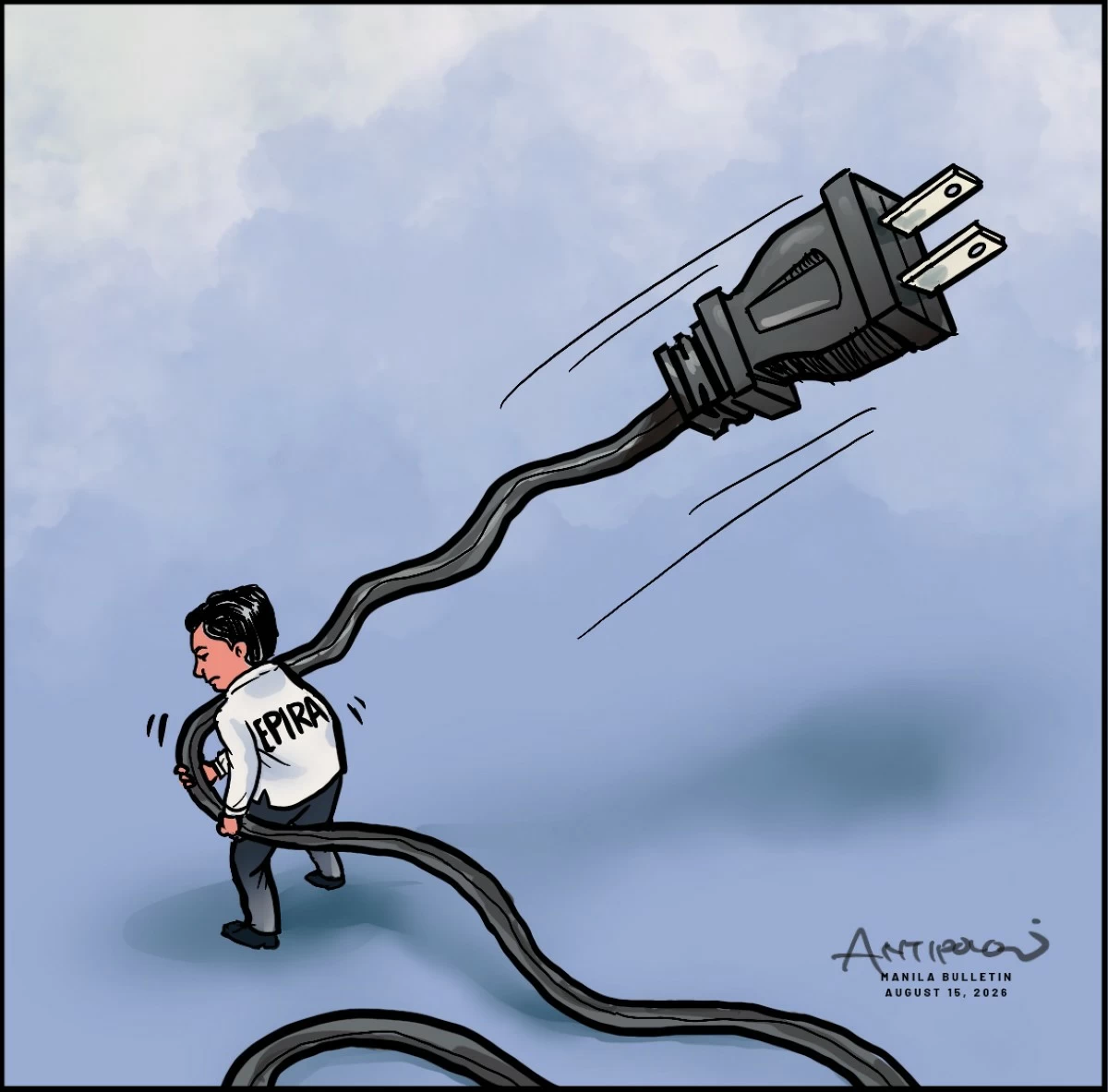
When the Philippines passed the Electric Power Industry Reform Act (EPIRA) in 2001, the promise was to privatize state power assets, unleash open competition, and lower electricity rates for Filipino consumers burdened by some of the highest utility bills in Asia. Twenty-five years later, that promise remains unfulfilled.
Instead of a dynamic energy market, the reform gave rise to a tight corporate oligopoly. According to recent research from the state-run Philippine Institute for Development Studies (PIDS), just five conglomerates control roughly 85 percent of the country’s installed generation capacity—with the two largest groups accounting for 43 percent alone.
As President Marcos and lawmakers move to amend the two-decade-old law, the government must admit that the original EPIRA rules failed to stop market concentration, and consumers pay for that failure every month. If Congress wants to lower power costs and protect the grid, it must use the pending EPIRA amendments to tighten competition safeguards, overhaul regulatory oversight, and close the loopholes that allow power giants to police themselves.
The core issue comes down to how EPIRA defined market caps. On paper, the generation sector looks reasonably competitive because a long tail of small suppliers dilutes the math. But in reality, a handful of mega-conglomerates hold all the leverage. The PIDS paper points out that these incumbents often act as “pivotal suppliers”—meaning their plants must run to meet peak demand, giving them outsized influence over spot market prices. To make matters worse, these same fossil-fuel giants are moving quickly to lock down renewable energy projects, threatening to block new competitors as the country shifts toward clean power.
Fixing this requires targeting the ways power companies pass costs onto everyday customers. The most glaring conflict of interest occurs when a power distributor buys electricity from its own sister company. Current rules allow a utility to source up to 50 percent of its power from affiliated generators. That threshold is far too loose, offering virtually no protection against self-dealing and inflated pricing.
Lawmakers should back proposals like Senate Bill 1950, which applies the strict definition of corporate “control” established by the Philippine Competition Act. Crucially, the antitrust watchdog—the Philippine Competition Commission—should lead investigations into unfair business practices, while the Energy Regulatory Commission (ERC) focuses on penalizing offenders based on those findings.
Of course, better rules will not matter if the referee lacks teeth. The ERC has struggled for years with backlogs, regulatory capture, and shortage of technical expertise. Congress should raise the maximum fine for anti-competitive behavior from a harmless ₱50 million to half a billion pesos, index it to inflation, and require companies to refund consumers. Penalties must actually hurt the corporate balance sheet rather than serve as a minor cost of doing business. Adding a dedicated economist to the commission and setting firm deadlines for decisions would also help clear the backlog.
At the same time, lawmakers must avoid taking steps backward. Proposals to let the state-owned National Power Corp. build and operate power plants nationwide risk driving away private capital, warping market prices, and sticking taxpayers with the bill. State power generation should remain strictly limited to off-grid areas and islands where private companies refuse to go.
EPIRA was originally written to dismantle a slow and expensive state monopoly, but it has created a private cartel instead. By adopting the practical reforms put forward by PIDS, Congress has a chance to fix this broken system. It is time to rewrite the rules so the power sector serves the public rather than a few powerful business interests.

One ducked under the addict's net: A review of 'People, Places and Things'

By Philip Cu Unjieng

Published Aug 15, 2026 12:37 pm

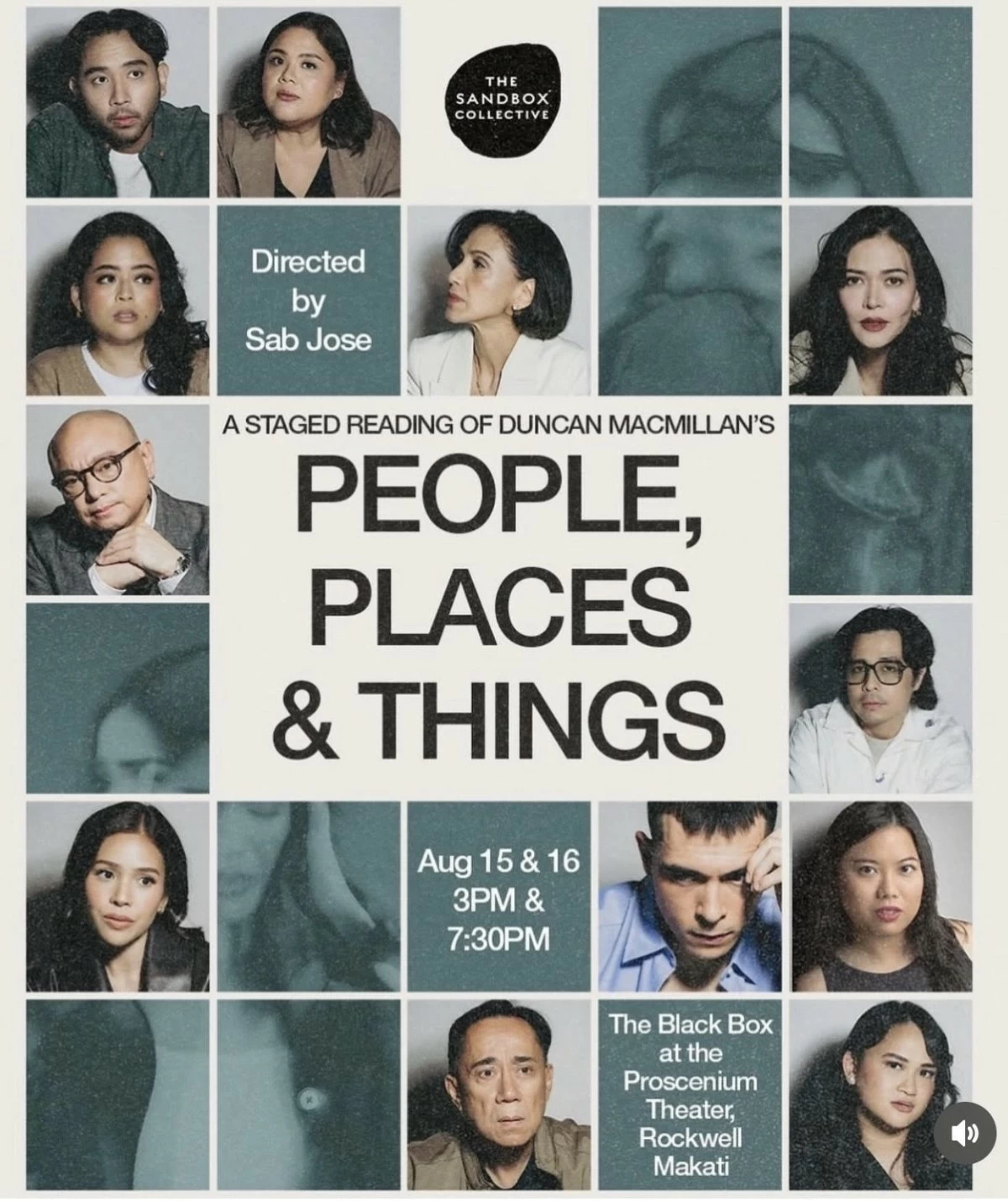
Written by Duncan MacMillan, whose "Lungs" and "Every Brilliant Thing" have previously been mounted by The Sandbox Collective, the staged reading of "People, Places and Things" takes place over two days, Saturday, August 15, and Sunday, August 16, at the Black Box of the Proscenium Theater.

Performances on both days are at 3 p.m. and 7:30 p.m.

The opening scene takes us right into the self-destructing life of stage actress Emma. What follows is her attempt at rehabilitation in a clinic where other addicts of substance abuse are similarly facing their demons.

The title comes from one of the steps to recovery, which has to do with facing head-on the "people, places and things" that trigger your addiction and the need to turn to these substances, whether alcohol or hard drugs.   

Screenshot
Screenshot

So yes, it is a staged reading, and one knows that I've always been a believer in having plays be staged and performed as they were meant to be. But as directed by Sab Jose-Gregorio, I have to admit this was the next best thing.

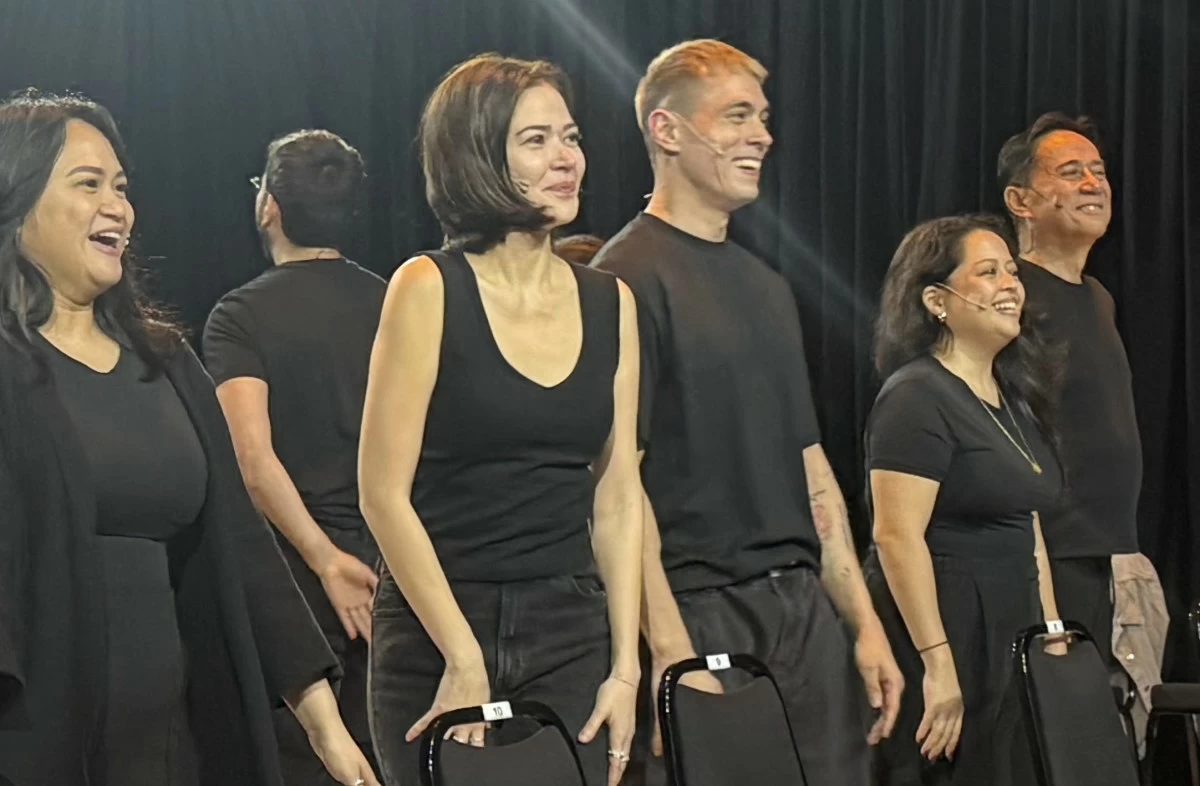
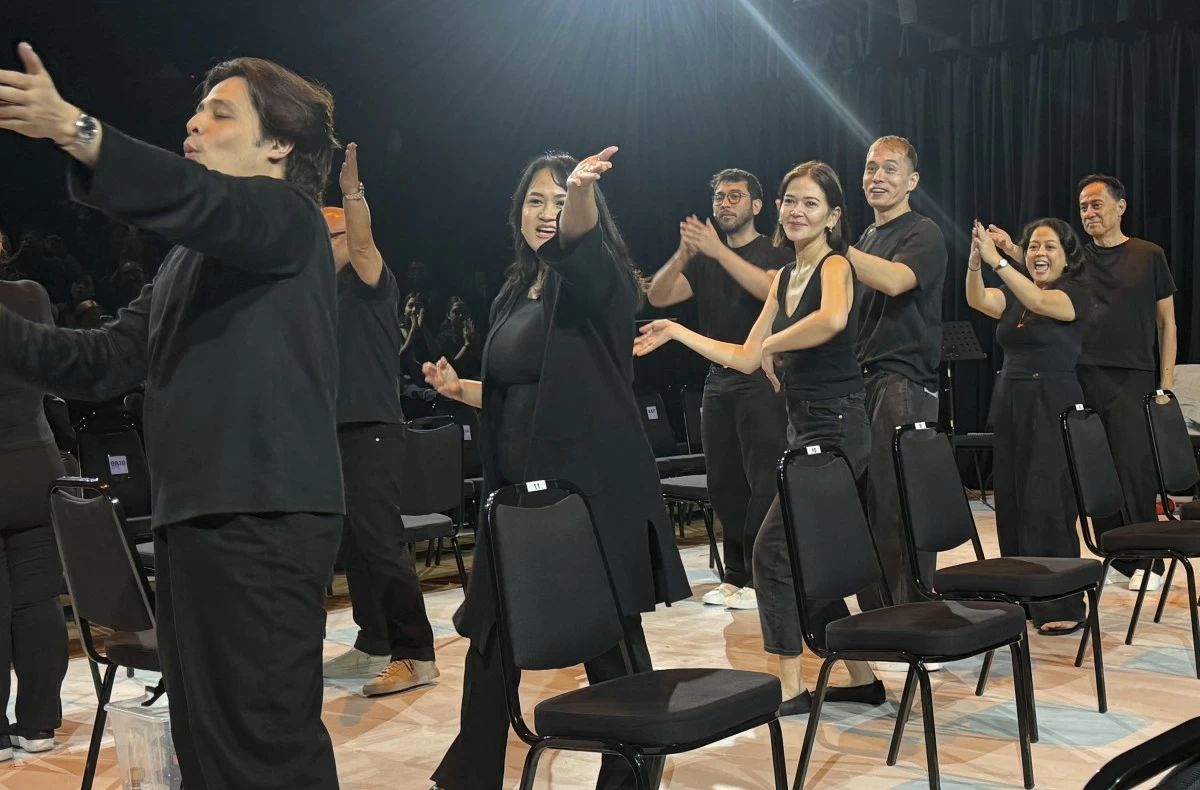
It is a curious hybrid that goes beyond a mere reading, with cast members seated around a table. This production does employ a modicum of movement with book in hand, giving a strong picture of what it would have been like if properly staged. I, for one, would welcome that happening in the near future.

My major reason would be the revelation that is film actress Bela Padilla as Emma.

Bela alternates with Gabby Padilla in the lead role. While Gabby is a proven force in both theater and cinema, this is Bela's first spin on the stage. And what a powerhouse she turns out to be.   

Her constant motion, little tics, firm grasp of her lines, and capacity to play Emma as both stubborn and vulnerable, together with her command of her scenes in delivery and in occupying physical space, all point to a great future on stage, if she so chooses.

Her stage presence was through the roof, and the audience watching the TDR (Technical Dress Rehearsal) with me obviously agreed.

Jake Cuenca, Audie Gemora, Menchu Lauchengco-Yulo, Robbie Guevara, Reb Atadero, Brian Sy, Mariella Laurel, Pamela Imperial, Miel Abong, and Salve Van Schoonhoven complete the cast.

As an ensemble, with books in hand, they still go through the motions and prove to be a very tight bunch, given the time they've had to rehearse this drama.

Centered on addiction, deluding oneself, the factors that create the psychological crutch that these substances offer, and the difficult path to recovery, the drama tackles serious subject matter with shafts of dark humor.

But yes, it is a "bleak house" kind of play, and the shadow of mental health looms continuously throughout the running time of close to three hours.    

Do make the effort to watch this, and you will be rewarded.

And while I do praise Bela for her work here, I'm now actually curious to watch Gabby, as I've admired her work in the past. In other words, no matter who will be playing Emma when you watch, you'll be coming out a winner, having witnessed a great performance.

Kudos to director Sab Jose-Gregorio, as I believe this is her directorial debut.

THE WAY OF THE WORLD


By Mindanao Daily News -August 14, 20260238


The Way of the World is a comedy play written by the English playwright William Congreve, first performed in 1700. It premiered in the theatre in Lincoln’s Inn Fields in London. It is widely regarded by critics as one of the finest works of Restoration comedy ever written, and has often been called a centrepiece of the genre. Initially, however, the play struck many audience members as continuing the “immorality” of the previous decades, and was not well received. Public perception of the play gradually changed over time, and it eventually became noted for its important role in shaping the comedy of manners genre during the Restoration period, and continues to be adapted for performances in operas, concerts, and theatres. The Restoration period was a time of “fashionable facade.”


William Congreve’s The Way of the World (1700) is the peak of Restoration comedy and the comedy of manners. It satirizes upper-class hypocrisy, greed, and marital economics, tracing the witty lovers Mirabell and Millamant as they out-maneuver social traps and secure their fortunes.


 Englishmen condemned sexual promiscuity in public, but in private took a liking to the well-executed French wit, and such is reflected in the subject matter of the play. This may have contributed to the play not being well received when it initially came out.


Sometimes, we might ask ourselves: What is the sense of doing this and that? What is the meaning of life? I am sure, each and every one of us looks for a good life. 


When you’re struggling in life, take assurance in the fact that everyone else struggles like you do. We may not have similar struggles, but it’s still a struggle nonetheless. If struggles didn’t exist, we’d have no way to appreciate the beauty and wonders of life.


Sometimes, we seem to remain very optimistic. We think it’s easy to always find a good life. Most of the time, we are in doubt or, we even choose to be unhappy without any reason at all. To wake up in the morning with pessimism and fall asleep at night, dissatisfied and unhappy – yes, that makes life miserable.


Face it: Living a good life is not living a life without problems. Living a good life comes from acknowledging, facing, and then transcending each problem as it comes. If you let the problems get you down, you’ll always be down. Choose instead to let the problems get you up, get you going, and get you working on solving them


On the other hand: Without happiness and satisfaction there is indeed no space for peace in our hearts and minds. Therefore there is no domestic harmony and logically, no peace on earth. The meaning of happiness is trying to manage life even with big problems, difficulties and trials. I learned this from Filipinos after staying in the Philippines as an expatriate for good since 1999.I was really surprised to experience mutual happiness, friendship, love, unity and communal spirit with relatives  in my surroundings. Even during the really not easy last three years.


Of course, I also found myself in very negative situations. I observed people, who seem to live an easy go lucky way of life. But, they were like actors and actresses on stage, wearing incredible masks and pretending to be what they are not. 


Hence, in Greek, they are the so-called hypocrites. Maybe also you and I belong to them from time to time. Fear of rejection or displeasure of other people are becoming our daily friends. In society, it’s called “good public relations”. Politely greeting and smiling with a set of purpose: to win them there for business.


So, what really counts for us in life? Success? Power? Strength? Money? Is it contentment? Is it peace on earth? Is it peace in our homes? Zest for life?


Let us go through life’s journey: From time to time, we have been babies bubbling like a brook on the first blush of spring. We hurried up, unaware of problems and troubles, being unconscious of time, as adults we worried and became conscious of money. Then, suddenly, we looked at our faces, the first wrinkles, and the bald patch on the forehead, the first grey hair. We observed our teeth falling out and our eyeglasses got thicker and our bones crack here and there. 


We start the familiar line: “When I was young… .” And we realize our mortality. Death could knock at our door any time. We feel humbled. We have mellowed. 


Have I done no wrong? Have I been selfless or selfish? Have I been mission-oriented since then? Have I lived a life worthy in God’s eyes? What really counted for me? Ano ang mahalaga? Paniniwala? Pag-asa? O kaya pagbibigayan at pagtutulungan?


‘Habagat’ puts 47 localities under state of calamity


‘Habagat’ puts 47 localities under state of calamity; PAGASA explains reason behind heavy rains

FLOOD swamps Dagupan City due to the enhanced 'habagat.' (Mayor Belen Fernandez FB)

A total of 47 cities and municipalities were declared under calamity status as enhanced habagat and tropical cyclones Luis and Maymay affected 4.34 million people in 3,768 barangays nationwide. There were 21 people who died, 17 were injured, and three remained missing while flooding was reported in 450 area, rendering 165 roads and 13 bridges impassable. Read more

Meanwhile, Philippine Atmospheric, Geophysical and Astronomical Services Administration (PAGASA) weather specialist Dr. John Manalo said the southwest monsoon or “habagat” remains active over western Luzon, as strong southwesterly winds continue to bring moisture toward the country. Read more

What are the top 3 places in the world to visit, and why?


 · 

What are the top three places in the world to visit, and why?

For anyone who has traveled the world extensively, it is excruciatingly difficult to eliminate all the scenic beauty, fascinating culture, and stunning cuisine we’ve enjoyed, narrowing down a lifetime of adventures to only three recommendations.

Sorting through my memories around the globe - the mountains of New Zealand, Montenegro, and Switzerland, the remote regions of Argentina, Peru, and China, the oceanfront of northern Norway, southern Chile, and Australia’s Lord Howe Island, and the exotic aura of India, Brazil, and Egypt - all of this is so diverse and unique and worthwhile. It’s so unfathomable to reduce the planet to only a few of the world’s highlights.

Within the United States alone, I cannot imagine overlooking the stunning scenery of Alaska, Hawaii, Utah, Wyoming, Montana, California, Oregon, and Washington! America has its own impressive highlight reel, which I’ll set aside for the purposes of recommending the planet’s most ideal, exotic, far-flung places off the radar of many.

If I must attempt this impossible task, I won’t need to necessarily select the three most beautiful places I’ve witnessed. I must simply choose three locales of great variety that will offer a tremendous adventure to anyone who takes my advice, not only the final destination but the experience along the way. With that in mind, I’ll give you three examples whose photo ops will make all your friends envious, places with staggering terrain and stunning water features, sufficiently life changing enough to ignite a passion for travel if not already, and even the opportunity to glimpse unique wildlife as a bonus.

  • GPS coordinates -23.148672, 14.443982
  • Sandwich Harbour, Namibia

This is one of the most majestic places you’ll see in the world. The massive sand dunes of the Namib Desert are juxtaposed against the mighty South Atlantic Ocean in one of the planet’s most surreal scenes.

Lions, cheetahs, leopards, elephants, black rhinos, and oryx are among hundreds of species that roam the barren desert landscape and even the coastline itself. The endless stretch of crashing waves and lunarlike topography without the intrusion of resorts and high-rises is simply stellar.

  • GPS coordinates -64.847812, -62.948225
  • Paradise Bay, Antarctica

See as much of Antarctica as you can. Quite simply, these are the most indelible travel memories I retain. In Paradise Bay, the water is as smooth as glass, the black mountains offer an eerie intrigue, and the glacial cliffs of stunning proportion rise like frozen skyscrapers towering above the bay. Turn off the boat engine and you won’t hear a sound. It’s the only place in the world I’ve ever felt the experience of going deaf. There is literally not one speck of noise pollution in this remote place at the bottom of the world. And my goodness, the journey along the way!

  • GPS coordinates 63.775764, -18.175476
  • Reynisfjara Beach, Iceland

Just tour all of Iceland from top to bottom and your mind will be blown. But a personal highlight was strolling along the southern coast of this magical island, with jet-black sandy shores, waves reaching for the foothills of Reynisfjall mountain, and basalt sea stacks towering in the ocean. The orange-beaked roosting puffins and odd rocky formations along the cliffside known as Columnes Reynisfjara complete this otherworldly trek, as if you’ve stumbled into a fairytale.

Of all my travels, these three places are perhaps the most unforgettable and most likely to inspire!

You may also be interested in my list of the most exquisite and lesser-known places in the world.

 Ein herzlichen Dankeschön an ALLE Leserinnen und Leser auf der ganzen Welt.

❤❤❤

A heartfelt thank you to all readers around the world.

Visitors of germanexpatinthephilippines/Besucher dieser Webseite.Ich liebe meine Flaggensammlung!

free counters

What is an anti-aging secret that not many people know about?

 · 

A dermatologist once enlightened me on something that has completely shifted my view of aging:

"People waste far too much effort trying to eliminate wrinkles rather than focusing on the reason behind them."

While working as a doctor for decades, one of the most underrated aspects of aging concerns persistent and low-grade inflammation.

It does not have to be painful and you might not even sense its presence, but over years, the persistent inflammation will lead to problems associated with blood vessels, metabolism, the brain, joints, and skin.

Here is another thing that I did not expect – there is no need for expensive supplements to take care of it.

The things that most people ignore are crucial – regular physical exercises, good sleep, quitting smoking, maintaining a proper weight, dealing with stress, and consuming mostly minimally processed foods such as vegetables, fruit, legumes, nuts, grains, and fish.

One small change that I have made long ago involved switching one processed snack for a more nutritious food that I actually liked. It looked too trivial to be effective. But once I started comparing my feelings when eating healthily and unhealthily, I finally understood why it pays to stick to your diet.

If you are looking for some anti-aging secret, here is one that should definitely be among the top:

Don't just think about how you can make yourself appear younger?

Think about how you can prevent your body from undergoing unnecessary damage?

Wrinkles will show up.

But inflammation won't.

Friday, August 14, 2026

LIFE IS TOUGH


Ever since I could read I have been obsessed with the power of words, and it’s words that invariably turn things around for me when life gets tough. The phrase "life is tough, but so are you" is a popular reminder of human resilience, overcoming past hardships, and finding inner strength.


The quote means that even though life brings hard challenges and pain, you have the inner strength and power to survive and beat them. It is a message of hope and courage.


Life is full of ups and downs. It's okay to find yourself feeling frustrated and lost when you're going through some hard times. Accept whatever negativity you have to face, and choose to face them with a positive attitude.


Life can be tough, and it's not your fault. Despite what many people might say, you are not responsible for the challenges that come your way. There are many factors that contribute to the difficulties we face in life, and it's important to recognize that they are not always within our control.


When you make your way through tough times, you'll become stronger and more successful in life. That's why the phrase “what doesn't kill you, makes you stronger” really does ring true. The wisest and most well-rounded people you meet are usually those who have gone through tough times themselves.


Putting yourself through hard things, and holding yourself accountable will automatically build discipline and mental strength. You will be so locked in, and disciplined, that exercise will be an essential part of your day. Because of that, you will become stronger and in better shape than you've ever been in.


“In this life, people will love you and people will hate you and none of that will have anything to do with you.” — Abraham Hicks


So important to remember when life gets tough.


Every time I speak at a public event, give an opinion at a meeting, go to a networking event, or just meet new people, I think of this quote.


At the end of the day, what other people think doesn’t matter as much as we think it does.


Haters gonna hate, likers gonna like, and life goes on.


There were some tough days, there were some good days, but you have to just keep going, keep dreaming, and keep believing.


Buddha’s famous saying tells us: “It is your resistance to ‘what is’ that causes your suffering.” Think about that for a minute. It means that our suffering only occurs when we resist how things are. If you can change something, then take action! Change it! But if you can’t change it, then you have two choices: (1) either accept it and let go of the negativity, or (2) make yourself miserable by obsessing over it.