
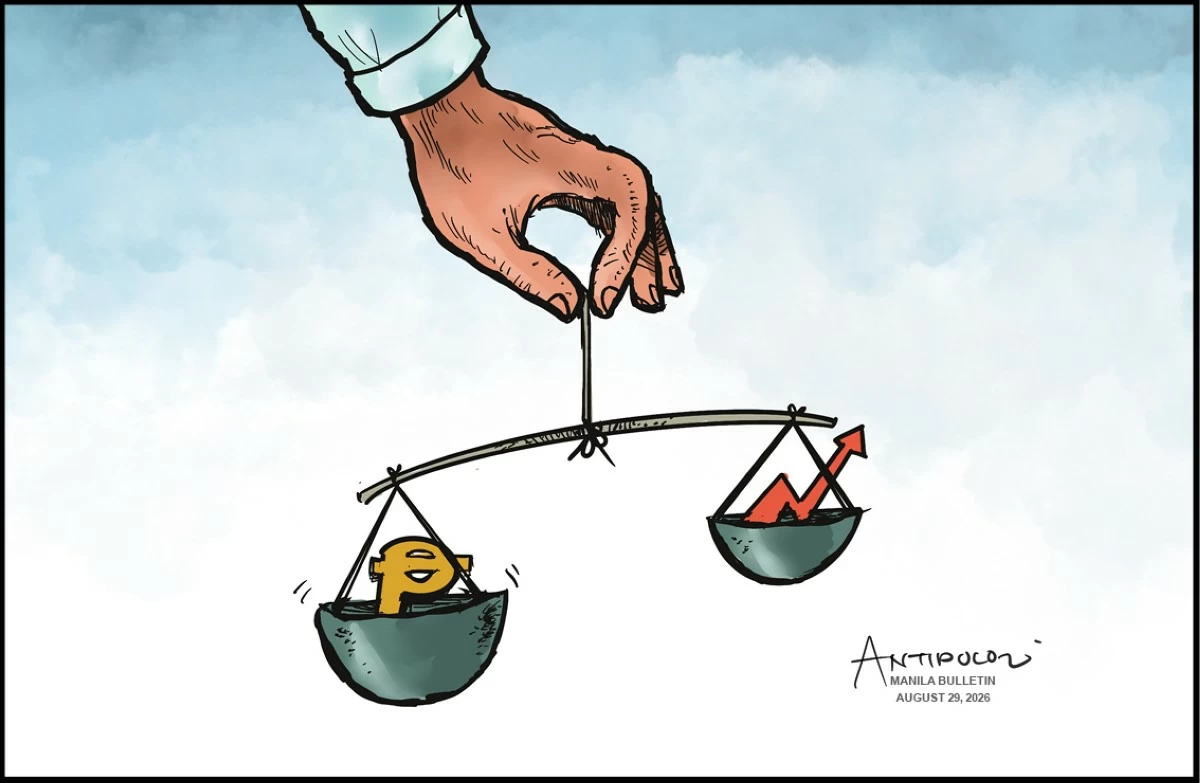
With first-half gross domestic product (GDP) growth dragging at a paltry 2.6 percent, the Bangko Sentral ng Pilipinas’ (BSP) decision to hike its benchmark policy rate by 25 basis points to five percent—its third rate increase this year, bringing cumulative tightening since April to 75 basis points—runs directly counter to the chorus demanding cheap credit to stimulate the Philippines’ stalled economy.
Immediately after the announcement of the central bank’s decision, local financial markets reacted with predictable fury. The Philippine Stock Exchange index (PSEi) tumbled 2.16 percent to 6,004.58, while the peso slipped to a historic low of ₱61.888 against the United States (US) dollar.
Yet the BSP governor was entirely right to declare that the choice “wasn’t so hard.” In executing a preemptive strike against stubborn price pressures, the seven-member Monetary Board (MB) proved it understands the core boundary of its constitutional duty. The BSP’s primary mandate is price stability, not short-term growth engineering.
The instinct among politicians and equity investors to demand monetary easing during economic slumps ignores a fundamental truth that the central banks lack the mechanical apparatus to generate sustainable and long-term wealth out of artificially suppressed interest rates.
As the BSP governor candidly noted during Senate budget deliberations on Thursday, Aug. 28, monetary policy simply does not possess the tools to boost short-run output without stoking inflation. Attempting to force economic growth via cheap money while inflation expectations remain unanchored is a recipe for stagflation, a scenario far more destructive to businesses and household incomes than a temporary tightening cycle.
The central bank’s inflation projections underline why urgency was required. While price growth has cooled from its brutal peak of 7.2 percent in April to 6.2 percent in July, and the 2026 forecast was trimmed to 6.1 percent, the medium-term outlook has worsened. The BSP raised its 2027 inflation forecast from 4.5 percent to an elevated 5.4 percent, far above the official target band of two percent to four percent, with headline figures not expected to normalize until 2028.
These revised forecasts are not abstract academic exercises because they reflect the country’s real structural vulnerabilities. As an oil-importing economy lacking a high-tech export engine like artificial intelligence (AI) to absorb external shocks, the Philippines sits exposed to global commodity volatility.
Compounding these structural realities are severe supply risks: incoming El Niño conditions threaten agricultural output, while pending minimum wage adjustments threaten second-round inflationary spillovers. Waiting for these risks to materialize before acting would have required far more aggressive and painful tightening down the line.
Critics will point to the peso’s historic slide near the ₱62 level as evidence of market anxiety. But currency devaluation in this context is driven less by interest rate differentials and more by real-economy fears over projected 2027 price pressures. Trying to defend the peso by draining foreign exchange reserves would be a reckless squandering of national buffer stock. Interest rate hikes remain the cleanest mechanism available to absorb excess liquidity and temper the currency’s decline without burning through international reserves.
Responsibility for igniting second-half GDP growth now falls squarely where it belongs: fiscal policy. The executive branch and Congress, currently deliberating the proposed ₱7.2-trillion national budget, must deploy targeted spending, address agricultural bottlenecks, and execute infrastructure investments capable of supporting real economic output.
By prioritizing price stability over short-term popularity, the BSP has protected the purchasing power of ordinary Filipinos. Economic growth built on the shifting sands of high inflation is an illusion. The Monetary Board’s steadfast commitment to its core mandate ensures that when growth does return, it will rest on a solid foundation.

No comments:
Post a Comment