You plan to move to the Philippines? Wollen Sie auf den Philippinen leben?

There are REALLY TONS of websites telling us how, why, maybe why not and when you'll be able to move to the Philippines. I only love to tell and explain some things "between the lines". Enjoy reading, be informed, have fun and be entertained too!

Ja, es gibt tonnenweise Webseiten, die Ihnen sagen wie, warum, vielleicht warum nicht und wann Sie am besten auf die Philippinen auswandern könnten. Ich möchte Ihnen in Zukunft "zwischen den Zeilen" einige zusätzlichen Dinge berichten und erzählen. Viel Spass beim Lesen und Gute Unterhaltung!


Visitors of germanexpatinthephilippines/Besucher dieser Webseite.Ich liebe meine Flaggensammlung!

free counters

Total Pageviews

Friday, June 19, 2026

Invasion im Mittelmeer: Giftiger Fisch bedroht Urlauber und Einheimische


Invasive Kugelfische breiten sich in Griechenlands Küstengewässern aus – mit kräftigen Kiefern, starkem Nervengift und einem Biss, der Badegäste ernsthaft verletzen kann.

Eine neue Bedrohung aus der Ferne setzt die mediterrane Fischfauna unter Druck. Und sie kann potenziell auch für Menschen ernsthafte Probleme verursachen. Es handelt sich um den sogenannten Kugelfisch, dessen Vorkommen in den Gewässern von Kreta und Griechenland stark zunimmt, nachdem er bereits Israel und Zypern kolonisiert hat.  

Content-Partnerschaft

Dieser Artikel von Corriere Online entstand in Kooperation mit Corriere della Sera.

Die Sorge ist, dass er sich anschließend auf den Rest des Mittelmeers ausbreiten könnte, beginnend mit Italien – wie es bereits bei der Blaukrabbe und anderen invasiven Arten der Fall ist. Auch der Kugelfisch – der in Wirklichkeit zur Familie der Tetraodontidae gehört – ist eine solche invasive Spezies: Er ist nicht in unseren Meeren heimisch. Er ist aus dem Roten Meer über den Suezkanal eingewandert.   

Emthält gefährliches Nervengift: Der Kugelfisch breitet sich im Mittelmeer aus.
Enthält gefährliches Nervengift: Der Kugelfisch breitet sich im Mittelmeer aus. © OceanPhotographer23 via imago-im

Es ist ein unerwünschter Gast, der die einheimischen Arten zunehmend verdrängt. Diese leiden stark unter seiner Präsenz: Fischer finden immer häufiger tote Fische in ihren Netzen, die am Körper große Wunden aufweisen.

Gefährlicher Biss und starke Kiefer

Verursacht werden diese Verletzungen durch den Biss der Kugelfische, die besonders kräftige Kiefer und scharfe Zähne besitzen. Sollte er einen Menschen beißen, wie es zuletzt in Griechenland geschehen ist, kann dieser Fisch zwar nicht den Tod, aber schwerwiegende Folgen verursachen.   

June Solstice: Shortest and Longest Day of the Year


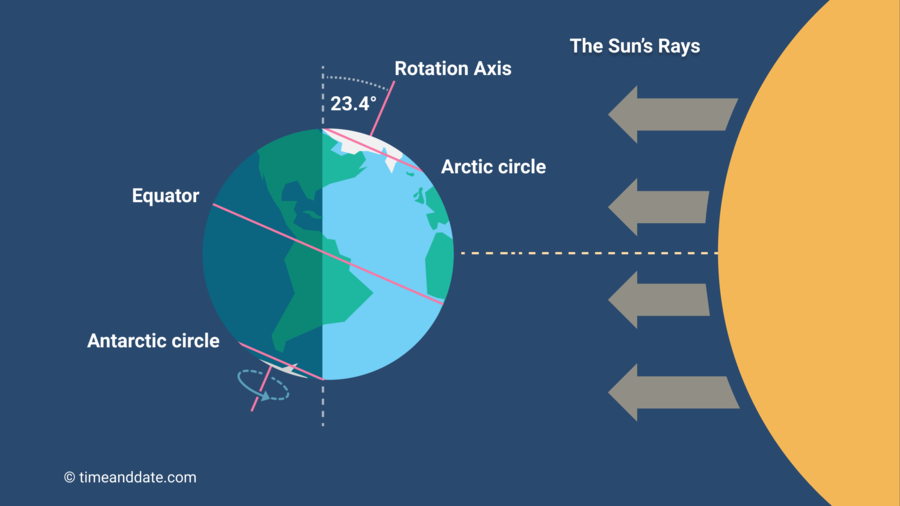
Each year, there is one solstice in June and one in December. The June solstice marks the longest day north of the equator and the shortest day in the south.

Earth's position in relation to the Sun's rays at the June solstice.
Position of Earth in relation to the Sun during the June solstice.
© timeanddate.com
June 2026: Do the Moon & planets affect solstices?

Sun Reaches Most Northerly Point

The June solstice is the moment the Sun is directly above the Tropic of Cancer in the Northern Hemisphere. This is the northernmost latitude it reaches during the year. After the solstice, it begins moving south again.

Find out how the Moon and planets affect the timing of solstices and equinoxes.
Equal day and night? It happens in June!99% of people see sunlight simultaneously around the June solstice   

Solstice Local Time & Date

Longest Day in the North

Since the Northern Hemisphere is tilted toward the Sun in June, it receives more sunlight during the course of a day. The North Pole’s tilt toward the Sun is greatest at the solstice, so this event marks the longest day of the year north of the equator.

This effect is greatest in locations that are farther away from the equator. In tropical areas, the longest day is just a little longer than 12 hours; in the temperate zone, it is significantly longer; and places within the Arctic Circle experience Midnight Sun or polar day, when the Sun does not set at night.

Shortest Day in the South

Conversely, the day of the June solstice is the shortest day of the year in the Southern Hemisphere. Here, too, the effect is greater the farther a location is away from the equator.

Places within the Antarctic Circle experience polar night, when the Sun does not rise at all.

Sun times at the South Pole in June
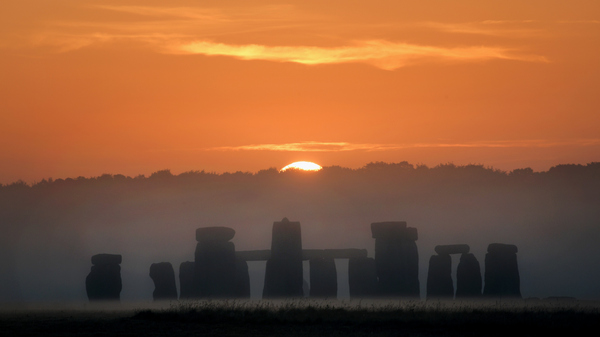
The uppermost sliver of the Sun is visible above a distant horizon, with Stonehenge, a formation of stone slabs, in the foreground.
Sunrise at Stonehenge on the day of the June solstice. After this, the Sun rises a bit farther south each day.
©iStockphoto.com/oversnap
11 facts about the June solstice

Why Is It Called a “Solstice?”

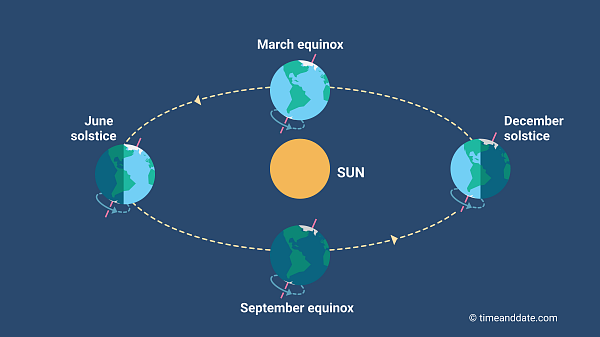
During a year, the subsolar point—the spot on the Earth’s surface directly beneath the Sun—slowly moves along a north-south axis. Having reached its southernmost point at the December solstice, it stops and starts moving northward until it crosses the equator on the day of the March equinox. At the June solstice, which marks the northernmost point of its journey, it stops again to start its journey back toward the south.

This is how the solstices got their name: the term comes from the Latin words sol and sistere, meaning “Sun” and “to stand still”.

Initially, the naming arose from observations of how the Sun’s apparent path across the sky changes slightly from one day to the next, which is caused by the same process as the subsolar point’s movement described above.

In the months leading up to the June solstice, the position of sunrise and sunset creeps northward. On the day of the solstice, it reaches its northernmost point. After that, the daily path of the Sun across the sky begins to creep southward again.

Earth: The living planetThe Sun: Our home star

Why Does the Sun Move North and South?

The subsolar point moves north and south during the year because the Earth’s axis is tilted at an angle of about 23.4° in relation to the ecliptic, an imaginary plane created by Earth’s path around the Sun. In June, the Northern Hemisphere is tilted toward the Sun, and the subsolar point is north of the equator. As the Earth travels toward the opposite side of its orbit, which it reaches in December, the Southern Hemisphere gradually receives more sunlight, and the subsolar point travels south.

How do seasons work?Equinox and solstice illustration.

The Solstices and the Seasons

The June solstice marks the start of summer in the Northern Hemisphere and the start of winter in the Southern Hemisphere, according to one definition.

Equinox and solstice dates—years 1-2149

Sunrise and Sunset Times Lag Behind

The longest day of the year is commonly associated with the earliest sunrise and latest sunset of the year. However, in most locations, the earliest sunrise happens a few days before the solstice, while the latest sunset occurs some days after itFind out why

The June Solstice in the Calendar

Even though most people consider June 21 as the date of the June solstice, it can happen anytime between June 20 and June 22, depending on the time zone. June 22 solstices are rare—the last June 22 solstice took place in 1975, and there won’t be another one until 2203.

Note: All dates refer to Coordinated Universal Time (UTC). Local dates may vary depending on the time zone.

Why Does the Date Vary?

The date of the equinoxes and solstices varies because a year in our calendar does not exactly match the length of the tropical year—the time it takes the Earth to complete an orbit around the Sun.

Today’s Gregorian calendar has 365 days in a common year and 366 days in a leap year. However, our planet takes about 365.242199 days to orbit the Sun. This means that the timing of the equinoxes and solstices slowly drifts apart from the Gregorian calendar, and the solstice happens about 6 hours later each year. Eventually, the accumulated lag becomes so large that it falls on the following date.

To realign the calendar with the tropical year, a leap day is introduced (nearly) every four years. When this happens, the equinox and solstice dates shift back to the earlier date again.

Other factors influencing the timing of the equinoxes and solstices include variations in the length of a tropical year and in the orbital and daily rotational motion of the Earth, such as the “wobble” in the Earth’s axis (precession).

The hidden trap of worry


Learning to stop worrying involves training your brain to recognize that worry is merely a misguided habit. By actively managing your mindset with techniques like scheduled worry periods, radical acceptance, and mindfulness, you can break the anxiety cycle and take back control of your life.

Worrying is generally unhelpful because it traps your brain in a loop of “what-ifs” without producing actionable solutions. While moderate worry can briefly motivate you to prepare for a specific event, excessive worrying impairs decision-making, reduces creative problem-solving, and harms your physical health.

Some feelings of worry can be healthy, pushing us to find solutions to real and present problems. However, chronic worry, even about things out of our control, can severely impact our mental health.

The German poet Rainer Maria Rilke put it well: “Life is not even close to being as logically consistent as our worries; it has many more unexpected ideas and many more facts than we do.” Worrying is pointless not only because it rarely makes things better, but also because you’re rarely ever worried about the right thing!

We hardly count our blessings. We enjoy counting our crosses. Instead of gains, we count our losses. We don’t have to do all that counting — computers do it for us. Information is easily had.

Facebook to and fro, back and forth, there and back — how many posts and comments have already been posted with sadness, loneliness, boredom strikes, problems and worries …

Just remember this: Opportunity doesn’t just knock — it jiggles the doorknob, and “your social media online friend” — the warrior is with you day and night, at every corner, following your every step. Complaining and grumbling are good excuses, right?

Seniors may experience more anxiety-inducing situations than younger adults, and they may not have as many resources for support. Some people may notice that their anxious thoughts get stronger or more frequent with age, but anxiety is a treatable mental health disorder.

Is social media bad for us? Four billion people, around 50% of the world’s population, use online social media — and we’re spending an average of two hours every day sharing, liking, tweeting and updating on these platforms, according to some reports. That breaks down to around half a million tweets and Snapchat photos shared every minute. Stress, mood, anxiety, depression, sleep — or, better, non-sleep — self-esteem: Overall, social media’s effects on well-being are ambiguous, according to a paper written last year by researchers from the Netherlands. However, they suggested there is clearer evidence for the impact on one group of people: Social media has a more negative effect on the well-being of those who are more socially isolated.

The whole world is an awful place filled with dreadful and horrible negativism. Yes, I confess, I’m also surrounded by many worriers who put their fears into me. Politicians, for example, often love to search for some grave alarm that will cause individuals to abandon their separate concerns and act in concert so that politicians can wield the baton. Calls to fatal struggles and fights are forever being sounded.

The overbearing person who tyrannizes the weak, who wants to domineer and bluster, is simply nothing else than a worrier who claims to be a friend. But he isn’t. Really not! The bullying of fellow citizens by means of dread and fright has been going on since Paleolithic times. The night wolf is eating the moon. Give me silver and I’ll make him spit out.

Well, when will we start counting our courage and not our fears, or enjoy instead of our woe? Worrying itself is pointless. Of course, no society has achieved perfect rules of law, never-ending education or uniquely responsible governments. Let’s seek out the worries but avoid the warriors, because they try to avoid liberty.

Worry, that sense of insecurity, unease and fear over what negative events may happen — as unrealistic as these concerns may be — is one of the most unpleasant emotions that you can experience as a human being. It is also one of the most common. While everyone has worried at some point, many people suffer from chronic worrying in the form of anxiety. In Australia alone, 2 million people will suffer from anxiety in any one year.

If you worry often, you’re far from alone. In fact, it may comfort you to know that many of us tend to worry about the same issues. All of those anxieties and stressors that may plague your life also affect a huge chunk of the rest of the world as well.

Melanie Greenberg, Ph.D., is a practicing psychologist, author, speaker, and life/business coach with more than 20 years of experience as a clinician, professor, and researcher. She says: “One of the most helpful things you can do instead of worrying is problem-solving. Problem-solving means defining the problem in a way that you can do something about it (e.g., “How do I prepare for a possible loss of income?” or “How can I learn to accept that my ex has moved on?”). Once you have a defined problem, you can generate some possible solutions and think through the likely consequences of each (e.g., “What is most likely to happen if I do X?”). Finally, you can implement your favorite solution, whether it involves taking action, discussing the situation, finding out more information, or working to accept something you cannot change.”

If you are still worrying right now about something, try to read Jeremiah 29:10-14 or Revelation 21:1-8, just to mention these two. It works.

+++

Comments, suggestions or questions? Email: doringklaus@gmail.com, follow me on Facebook, X-Twitter or LinkedIn, or log on to www.germanexpatinthephilippines.blogspot.com or www.klausdoringsclassicalmusic.blogspot.com.