You plan to move to the Philippines? Wollen Sie auf den Philippinen leben?

There are REALLY TONS of websites telling us how, why, maybe why not and when you'll be able to move to the Philippines. I only love to tell and explain some things "between the lines". Enjoy reading, be informed, have fun and be entertained too!

Ja, es gibt tonnenweise Webseiten, die Ihnen sagen wie, warum, vielleicht warum nicht und wann Sie am besten auf die Philippinen auswandern könnten. Ich möchte Ihnen in Zukunft "zwischen den Zeilen" einige zusätzlichen Dinge berichten und erzählen. Viel Spass beim Lesen und Gute Unterhaltung!


Visitors of germanexpatinthephilippines/Besucher dieser Webseite.Ich liebe meine Flaggensammlung!

free counters

Total Pageviews

Monday, July 6, 2026

Preparing your child to lead in AI


Barely a week goes by without someone asking me how to prepare their children for an artificial intelligence (AI)-driven world.

Just recently, a friend with a seven-year-old told me he was genuinely anxious, not the vague background kind of anxiety, but the sharp keeps-you-up-at-night kind.

What school should his child attend? If Philippine schools don’t teach AI competently, should the family consider migrating? Is it already too late to start?

I understand the fear. But I think the fear is aimed at the wrong target.

Schools teach information. But information is now ubiquitous, freely available, instantly searchable, endlessly generated.

What made education valuable in the past was access to knowledge that was scarce. That scarcity no longer exists.

What remains scarce, dangerously and increasingly scarce, is the human capacity to think, feel and lead.

Look at history. Humans have proven to be remarkably adaptive creatures.

We navigated the Renaissance, which upended how we understood art, science and the self.

We survived the Industrial Revolution, which replaced muscle with machine and reorganized entire civilizations around factories.

We are still navigating the Digital Age, which rewired how we communicate, consume and connect. Every era brought disruption. Every era produced humans who adapted and led.

But here is where I diverge from the optimists.

The threat of the AI Age is not that machines will replace us. It is that we will allow ourselves to become dependent on them before we have fully developed ourselves.

I am not afraid of AI. I am afraid of a generation that outsources its thinking to AI, its creativity to AI, its judgment to AI, and arrives at adulthood having never built the inner architecture that leadership requires.

Imagine a world where the most powerful tool ever built is operated by people who have forgotten how to be human.

That is the real risk.

So when my friend asked me what he could do, I gave him five concrete answers. Not app subscriptions. Not coding camps. Five fundamentals, executable at home, starting tonight.

  • First: Read with your child every night, with a book. Not a tablet. A physical book.

The ritual of a parent reading aloud builds vocabulary, comprehension, attention span and the experience of sustained, linear narrative. Children who are read to learn to follow an argument, absorb a story arc and sit with ideas long enough to understand them. That is the foundation of critical thinking.

  • Second: Have your child read aloud. Loud. With confidence.

Reading aloud builds fluency, diction and the courage to occupy space with one’s voice. Communication is not a soft skill. It is the primary skill of leadership.

Every great leader, in every field, has been able to articulate a vision, move a room, and persuade another human being.

That begins with a child learning to project their voice across the living room.

  • Third: Learn a musical instrument, any instrument. Even cymbals. Or a guitar.

Music is not about performance. It is about activating the creative hemisphere of the brain that logical training tends to neglect.

Playing an instrument builds pattern recognition, discipline, and the ability to translate abstract feeling into structured expression.

These are exactly the capacities that AI cannot replicate.

  • Fourth: Learn a second language, any language. A regional dialect. Spanish. Even Latin, though it has been dead for centuries.

Acquiring a second language opens neural pathways that a single-language existence leaves dormant.

It builds cognitive flexibility, the ability to hold two conceptual frameworks in the mind simultaneously and move between them.

That is precisely what you need in an AI world, where the ability to reframe a problem and think in multiple registers will separate leaders from followers.

  • Fifth: Play a sport, any sport. Chess counts. Swimming counts. Even a backyard game counts.

Sport builds the inner competitive spirit, the will to improve, to persist through failure, to measure oneself honestly.

It teaches a child that outcomes are not guaranteed, that effort matters, that losing is survivable and instructive.

In a world increasingly optimized for frictionless experience, children need the friction of competition to develop resilience.

These five things develop what matters most in an AI world: critical thinking, emotional intelligence and adaptability.

SEE ALSO

These are not supplementary virtues. They are the core operating system for human leadership in any era, and they are built at home, not in a classroom.

Many parents today are waiting. Waiting for schools to teach AI. Waiting for the right curriculum, the right program, the right government policy. That wait may never end.

Schools are still figuring it out, and the curricula being written today will be obsolete before your 7-year-old finishes high school.

But here is what I know for certain.

AI learning, real AI readiness, begins long before your child ever sits in a tech classroom.

It begins at home, in the early years, through the fundamentals. And it does not begin with a screen. It begins with a parent.

We are also seeing the consequences of neglecting these fundamentals in real time.

Student suicides are rising. Young people are struggling to manage pressure, failure and uncertainty in ways that previous generations, for all their disadvantages, seemed better equipped to handle.

This is not a school problem. It is a foundation problem.

Children who read develop inner worlds rich enough to process difficulty. Children who play sports learn that losing does not end you. Children who make music find an outlet for what they cannot yet put into words. These are not academic exercises. They are mental health interventions, preparing them for life’s battle ahead.

Your presence in these activities is not optional. It is the variable that makes the difference. A teacher can introduce a concept. Only a parent can build a foundation.

The most advanced school in the world will always be secondary to a parent who shows up, consistently and intentionally, in the small daily moments that shape a child’s character.

So read the book. Not the tablet. The book.

That is where AI readiness begins.

The author is president of the Management Association of the Philippines (MAP). He is also president and COO of DITO CME Holdings Corporation. Feedback at map@map.org.ph and donaldpatricklim@gmail.com.

Because I can


Mia Estelle Gonzales


I write, though I am not good. I sing, though I do not sing well. I dance, though I am stiff. I try, when I can.

When I can do everything yet nothing at the same time, what does that make me? When I can do just enough but never enough to be good, what would you call me? When do I stop being someone who can do just about anything and become someone actually good at something?

“Kaya mo ‘yan (You can do it),” my mom would say. She always did, with a smile on her face, and full faith that I would be able to.

In her smile, I saw dozens more who echoed the same, “Kaya niya ‘yan (She can do it).”

Because yes, I can. And most of the time, I do.

But just because I can doesn’t mean that it comes easily. I just happen to know how to finish that essay, but I rarely know how to use the proper punctuation; I know how to write enough words to fill the pages, but not enough to feel like they deserve to be read. I know how to stay on beat, but not how to move my body along with my steps. I know how to hold a tune, but not how to sing without second-guessing every note. I have learned how to raise my hand even when I am unsure, how to smile before singing into a microphone, how to count beats loudly enough for my groupmates to follow, even when I am counting mostly for myself. I know how to perform the part of someone capable. I know how to make it look like I know what I am doing, even when I am figuring it out as I go. But there is a very big gap between being able to do something and being able to do something well.

And that thought always lingers. It rings in my head every time someone praises something I know I barely managed to do. It is not because I was not able to do it, but because I can do many things just enough for people to believe in me, but not a single thing well enough for me to believe in myself.

They see me write essays spanning 10 pages and think I’m good with words. They hear me sing and assume I’m confident. They see me try in class and assume I am smart. They see me become a class officer and assume I can lead. They see everything I am capable of, yet nothing about why I am afraid.

Afraid that I am good, only because I try hard enough. That if I stop, I’ll have nothing left. That everyone will see what I’ve always believed is true, that effort is all I have. And effort is not the same as talent.

But my mom always said, “Talo ng masipag ang matalino (The industrious one defeats the smart one).”

So, I try.

Because still, behind my mother’s smile, everyone recites “Kaya mo’ yan.”

I know they mean no harm. I know these words are meant to comfort me. But most of the time, they feel more like a responsibility than reassurance. Like I am not allowed to fail because people have already decided that I can do it. Like every time someone believes in me, I have to prove that their belief was not misplaced.

And maybe that is why I keep trying so hard. Because if enough people believe in me, maybe one day I will believe them too. Maybe if enough people say that I am good, then it must mean there is some truth to it. Maybe their certainty can make up for the lack of my own.

I used to always say, “fake it till you make it,” which is funny, because I realize that I may have lived out my own twisted version of it. Except I am not pretending to be confident. I am borrowing confidence from everyone else. I let their belief carry me when I cannot carry myself. I let their words become proof, even when I do not fully trust them. Because maybe if I keep trying like someone who is capable, someone who is good, someone who deserves to be believed in, then one day I will stop feeling like I am only trying.

Maybe one day, I will believe it, too.

But maybe being capable of doing anything means that I am good at something.

Maybe it means I am good at starting, even when I am scared. Maybe it means I am good at showing up, even when I feel small. Maybe it means I am good at trying again and again, until effort stops feeling like a weakness and starts becoming proof that I have always been here, trying.

So I write, not because I’m good, but because I can.

I sing, not because I sing well, but because I can.

I dance, not because I’m graceful, but because I can.

So I keep trying, because still, I can.

And maybe, for now, that is something. Maybe it is not the kind of something people put on a stage, or publish, or praise loudly. But it is mine. It is the quiet proof that even if I am not yet good in the way I want to be, I am still trying. And maybe trying counts, too, even when it is slow and uncertain, even when I feel like it doesn’t.


The ganjingworld investigation began with statistics: Yuja Wang has played so far, Rachmaninoff Piano Concerto No. 2, thirty-five times, Rachmaninoff Piano Concerto No. 1, fourteen times, Rachmaninoff Piano Concerto No. 4, twenty-one times, Rachmaninoff Rhapsody on a Theme of Paganini thirty-one times, and Rachmaninoff Piano Concerto No. 3, a total of 72 times.

No one had ever attempted playing all of Rachmaninoff’s five works for piano solo with the orchestra before. Who else would have the stamina to do it? It’s akin to winning a gold medal in the Olympics or climbing Mount Everest.

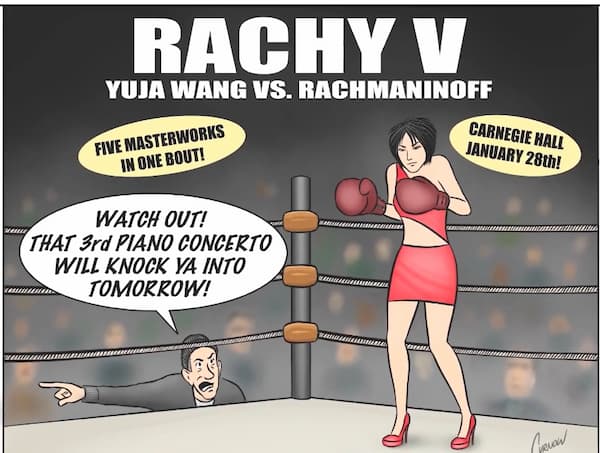
Cartoon of Yuja Wang vs Rachmaninoff

In planning the program, Yuja decided the 3rd Piano Concerto had to conclude the program as it is the epitome of emotion, drama, and physicality. Who can play anything after that?  

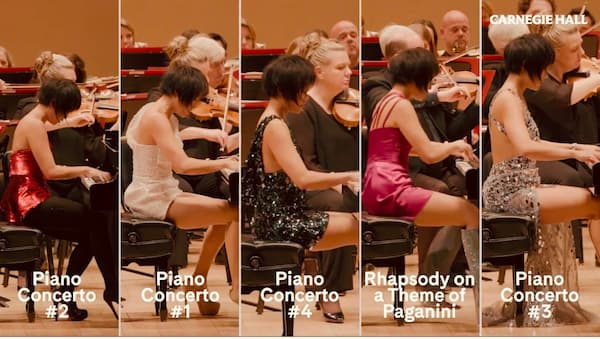
Unsurprisingly, Wang’s virtuosity and musicality were riveting from beginning to end. Wang also amazed the audience with a different outfit for each concerto while keeping track of the tracking device.

Yuja Wang in different outfits

© Carnegie Hall

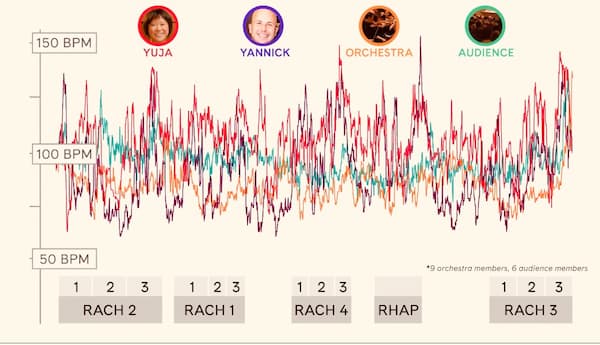
When the results were revealed to Wang, it was uncanny that she could look at the graph and identify exactly where she was in the music just by looking at the peaks and the valleys of her heartbeats.

Yuja Wang and others' heartbeat graph

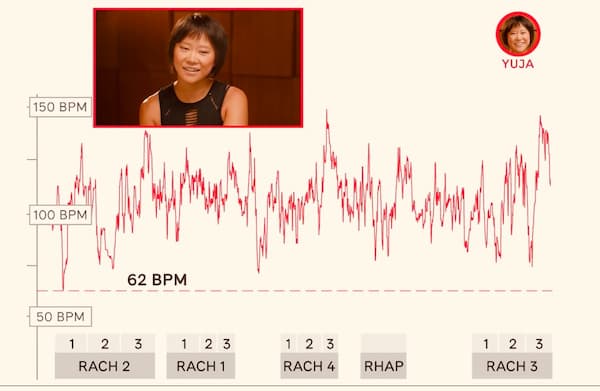
The highest peaks, of course, occur where the music is physically or psychologically difficult. As a benchmark note, resting beats per minute is approximately 62 BPM. During the finale of the 2nd Concerto, her heart rate reached 139 BPM, predictably where there are more notes, and it’s faster and louder. During the finale of the 3rd Concerto, she surpassed that number at 146 BPM. But the highest level reached 149 BPM— 233% more than resting—was during the finale of the 4th Concerto.  

The interesting thing is that Wang’s heart rate didn’t always consistently go up when it was loud and fast or just in the finales. In fact, the 3rd Concerto, despite being the longest and most difficult concerto, on average, indicated the lowest BPM rates. Wang thinks there are two reasons for this slower heart rate. Spiritually, the piece has a calming effect on her. Technically, as an elite and superbly skilled pianist, she’s able to save her energy when needed during the performance. Her heart rate is affected by how economical her movements are.

Yuja Wang's BPM during her different Rachmaninoff performances

There is a third possibility to consider. Perhaps the reason her heartbeats were higher in the first and fourth concertos is that Wang has had the least experience performing these works. If she was more keyed up, it certainly would affect one’s heart rate.

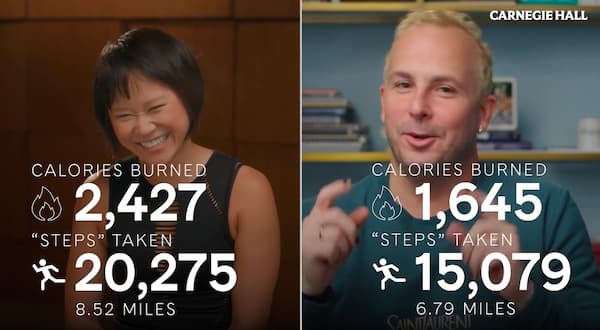
Another statistic amused Yuja Wang. The numbers indicated how much harder she worked than the conductor. She: 2,427 calories burned and 20,275 steps taken; He: 1,645 calories burned and 15,079 steps taken.

Yuja Wang and Yannick calories information during the Rachmaninoff performance

Vindicated! We musicians know this! But Yannick actually recorded the highest peak, higher than any of Wang’s uppermost BPMs, when he reached 153 BPM in the final variations #19-24 of the Rhapsody on a Theme of Paganini. It is, of course, a very exciting ending, and it’s strenuous to marshal all the musicians for this mighty climax, as it is for us to play it.  

Throughout his career, Nézet-Seguin has sought to bring people in sync with his music-making. He was astonished when he saw this reflected on the graph. There is an amazing synchronicity when comparing the heartbeats of the soloist and the conductor. Yuja and Yannick were musically and physically on the same wavelength throughout. But even more impressive, even during Wang’s cadenzas, when the orchestra and the conductor were “at rest,” their heartbeats rose in sync with the soloist’s playing and emotion. Whenever the music became more emotionally intense, the constant interdependence between all the musicians on stage, even when they weren’t playing, was notable. The phenomenon could be seen in the tracking devices of audience members as well. Their heartbeats went up, too, during the emotionally moving sections.

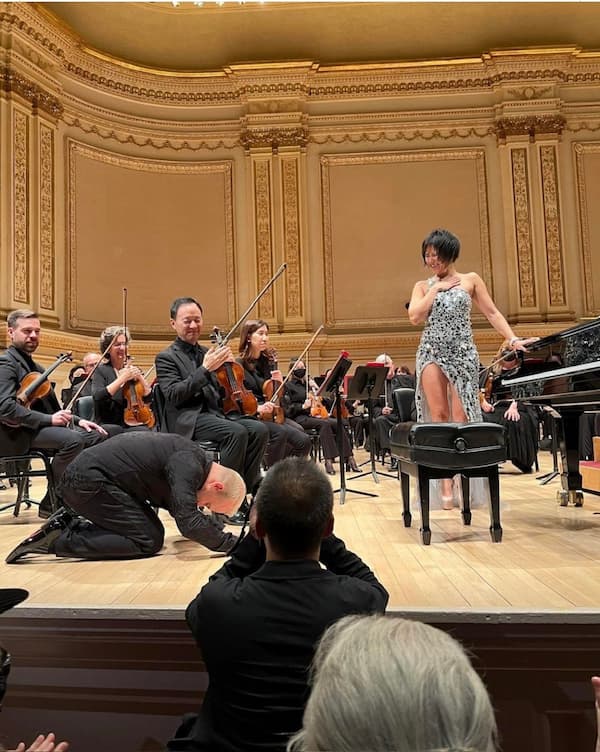
Yuja and Yannick taking a bow after the Rachmaninoff performance

Does this occur in other settings? Choir music and song have permeated civilisations throughout different cultures and religions. In a 2013 study, it was documented that when choirs sing, their heartbeats become synchronized, beating as one. An article in NPR and the BBC World Service in July of 2013 reported that researchers of the Sahlgrenska Academy at the University of Gothenburg in Sweden studied the heart rates of a high school choir in a variety of choral works. They published their results in Frontiers in Neuroscience. Singers must exhale and inhale in a coordinated fashion. The findings showed that singing in a choir calmed the singer’s heart rate, especially when they were singing in unison, and within a few moments, each person’s heartbeat became synchronised. Somehow, the singers’ collective consciousness is connected to each other. Their controlled breathing, as we’ve seen in yoga and in other meditational practices, had a quietening effect.

Listen to The VocalEssence Ensemble Singers conducted by Philip Brunelle perform “The Day is Done” by Minnesota composer Stephen Paulus to a poem by Henry Wadsworth Longfellow. “And the night shall be filled with music, And the cares, that infest the day, Shall be banished like restless feelings, That silently steal away.”

I can’t help respiring, sighing with them.  

Choirs breathe together, but so do wind and brass musicians in a band, ensemble, or orchestra—to make a phrase, to play seamlessly, and to express the musical lines homogeneously. Many audience members may not know that string players must also breathe together, especially during chamber music performances when we don’t have a conductor. The sniff at the beginning of a piece, in addition to body language, will lead colleagues, much like a conductor’s upbeat, and the rate of the sniff indicates many things—when to play, the type of entrance, the rhythm, the meter, the style. Breathing helps us stay together and to feel the music as one.

The Yuja Wang Rachmaninoff Heartbeat Study was more than an amusing experiment. Dr. Bjorn Vickhoff concludes, “We speculate that it is possible singing could also be beneficial.” Performing and listening to music is good for us and is a positive experience which can synchronise our heartbeats. Unlike many other activities, music can bring people of all ages, cultures, and backgrounds together, in sync, in harmony, despite wide-ranging experiences with music.

Here is the video of the entire study courtesy of Yuja Wang, and Carnegie Hall, director Joe Sabia, producer Greg T. Gordon, Images Carnegie Hall Rose Archives, Cartoon Jeffrey Curnow.

Family as Sacrament


July 5, 20263 min read

LIVING in the Philippines since 1999 for good, I found out about this. I learned so many things being a part of a Philippine family.  I was born in a parish house in Germany  but experienced years later how to survive in a broken family.

My Philippine mentor, Hermogenes E. Bacareza, former Chaplain of the Philippine community in Berlin and author of German-Philippine Relations,  taught me in 1988: The Christian family is also called to be a sacrament. They are called, like the Church, to be Christ to one another, as well as to the broader community. By becoming what they are called to be, the family lives the sacramental life, and the sacred can bubble up through the ordinary things of everyday life.

What on earth can be more of a sign of God’s grace than the authentic self-giving love of a fully committed married couple whose love for each other brings life and spills out upon their children and with them onto those beyond the family? This, I believe, is the new vision of the Christian family for the 21st century.

Authority, stability, and a life of relationships within the family constitute the foundations for freedom, security, and fraternity within society. The family is the community in which, from childhood, one can learn moral values, begin to honor God, and make good use of freedom.

Families are central to God’s plan for His children. They are the fundamental building block of strong societies. Families are where we can feel love and learn how to love others. Life is tough, and we need people we can lean on.

What’s the purpose of family? These bonds are important because family helps us get through the most disastrous times and the best times. Family is important because they can offer support and security coupled with unconditional love; they will always look to see and bring out the best in you even if you cannot see it for yourself.

Since residing in the Philippines, I experienced that family is important to Christians because family is about witnessing to the Lord’s faithful love for the Church and for the whole of humanity; family is about making present, in a concrete and daily manner, the reciprocity and beauty of the love that characterizes God’s life. Family is a rich school where we learn to be humane and generous, to be patient and steadfast, to be just and merciful, to be faithful and committed, to be together and to connect.

Single parented or mother-father; childless or fertile; in big cities or in the countryside; in harmony or in conflict/domestic violence; in home country or refugees; at peace or at war, married or cohabitating, separated or remarried; healthy or in illness/addiction, free or in prison, in a house or homeless, able or disabled, working locally or away from home, with or without pets; whatever the family… all families are precious in the eyes of God.

Sunday, July 5, 2026

A JUDAS AND A LITTLE BIT HOPE


Exploring the story of Judas reminds us that human weakness is common. While he is known for his ultimate betrayal, his story teaches us about forgiveness. Both Judas and Peter made huge mistakes, but the difference was that Peter accepted grace, while Judas let shame and doubt take over.


It’s easy to dismiss Judas as a villain or a victim, but I’m struck by the fact that, in many ways, he was just like me.


Judas was a follower of Jesus and a preacher of the gospel, but there was a double mindedness about him. In the end, he abandoned the faith he once professed.


The apostle Judas, probably also called Thaddeus or Jude, being a brother of James and Jesus, started as a fervent follower of Christ. Then, suddenly he changed. He felt that Christ didn't  satisfy his worldly expectations. The church, like Christ, is always loved by its true followers and is always hated by its apostates.  Till today - no matter what belief you are in... .


Judas didn't leave the apostolic community to become a Pharisee or a critic  of Christ. He  leaves to become a traitor! Such a traitor will always find fault or a misinterpretation of human teaching. Judas gathered reasons that he, himself, had heard  and witnessed  to justify  his betrayal. Yes, we all also know such people who betray us and sometimes a whole country.


A Jewish mob tried to throw Christ down a cliff, but nothing happened. Soldiers tried to arrest Him, but nothing happened. The Pharisees tried to entrap Him to no effect. It needed a friend to betray Him. He escaped from all, but not from the treason of a friend. "It would have been better for that man if he had not been born!" No such sentence was hurled, for example, to Pilate or Herod.


The lesson for all of us is very clear. A bad politician or one of our neighbors can be the foulest thing on earth. A bad pagan cannot be 1/10 corrupt.


"Do not betray another man's confidence!" the bible teaches us. But Judases can be found everywhere. Just as fire is not born from snow, so is the seeker after worldly honors not seeking heavenly ones. or have you ever seen the snow catch fire?


The maladroit politician named Judas betrays his voter and elector through beautiful soft promises while corrupting a whole nation. The peace conference member or peacemaker named Judas just gives double standards while allowing at the same time his jackals and accomplices to kill and injure his own countrymen. The neighbor, who declares how much he loves his family while going on unhindered destroying the environment is also named Judas... .


Judas' sins are really not rare. We commit it every day. Someone who has changed his ideals away from the ideals of the church and declares it to the world, anyone who leaves the church or the religious order and proclaims it to the world, "night had fallen on his soul"!


When Julius Caesar was being assassinated what hurt him was not the stabs of Caius but the presence of his friend Brutus. We might never know it, but we could be carrying on our lips the kiss of Judas!


Many times I do voice out people's longing for advice and actions through the institution's church. There are many. Please allow me to quote former Rev. Mariano C. Apilado, United Church of Christ in the Philippines, who had done a first important step already many years ago by saying:


"Christian hope does never shield people, much less  Christians  from disappointments, hardships and betrayals, nor does it provide neat and ready answers to the world's problems. Christian hope empowers Christians to take responsibility in the establishment of a government that respects the law and protection of the people and their rights in the struggle for justice and development. ... Christian hope is not peanuts for it assures us: there is always a future looking forward to it. Without hope, Christian faithfulness is suspect and without foundation. with this hope, we sing, celebrate and work faithfully and courageously, believing, 'that we shall overcome'!"

Warum leiden so viele Menschen an Depressionen?

 Die Depression ist kein Defekt. Sie ist ein Bote.

Das klingt zunächst hart, fast unfair gegenüber jedem, der dieses schwere Last kennt.

Wir sind es gewohnt, die Depression als Krankheit zu behandeln, als etwas, das von außen über uns kommt wie eine Erkältung, das man wegmachen muss, damit das Leben wieder funktioniert. Aber was, wenn sie etwas anderes ist? Was, wenn sie kein Feind ist, sondern ein Signal? Eine Stimme, die etwas mitteilen will, und zwar so lange lauter wird, bis man hinhört.

Schau dir an, wann die Schwere kommt. Sie kommt selten, wenn ein Mensch tut, wofür er gemacht ist. Sie kommt, wenn etwas im Leben übergangen wird. Wenn eine Wahrheit jahrelang zurückgehalten wird. Wenn ein Mensch ein Leben führt, das nicht seines ist. Wenn eine Aufgabe ruft und überhört wird. Viktor Frankl, der das Konzentrationslager überlebte, nannte es das existenzielle Vakuum: das Gefühl der Leere, das entsteht, wenn das Leben seinen Sinn verloren hat. Und er beobachtete, dass dieses Vakuum krank macht. Der Mensch ist ein sinnsuchendes Wesen. Nimm ihm den Sinn, und etwas in ihm beginnt zu verkümmern.

Genau das beschreibt auch die hermetische Tradition. Das Fehlen eines Sinnes im Leben führt zu dem Gefühl, das eigene Dasein zu verschwenden, und aus diesem Gefühl entstehen Lebenskrisen, die sich bis in psychische und körperliche Erkrankung vertiefen können. Die Depression wäre dann das, was geschieht, wenn die Seele zu lange gegen ihre eigene Richtung gelebt hat.

Hier kommt ein Gesetz ins Spiel, das einfach klingt und tief wirkt. Wohin du deine Aufmerksamkeit richtest, dorthin fließt deine Energie. Und was Energie bekommt, das wächst. Das ist der Grund, warum die Depression sich selbst verstärkt. Sie zieht die Aufmerksamkeit auf das Dunkle, auf den Mangel, auf die Sinnlosigkeit. Und je mehr die Aufmerksamkeit dort verweilt, desto mächtiger wird genau das, was den Menschen leiden lässt. Es entsteht ein Sog nach unten, eine Spirale, in der der Schmerz sich selbst nährt.

Doch in genau diesem Gesetz liegt auch der Ausweg.

Wenn die Aufmerksamkeit das ist, was die Wirklichkeit vermehrt, dann ist die Aufmerksamkeit auch der Hebel der Befreiung. Die Frage ist nicht mehr, wie werde ich das Leiden los, sondern wohin will dieses Leiden meine Aufmerksamkeit lenken. Was ruft hier nach mir? Welcher Teil meines Lebens wurde zu lange übergangen? Welche Aufgabe wartet, die ich aus Angst, aus Bequemlichkeit, aus alter Prägung immer wieder verschoben habe?

Denn meistens steht hinter der Schwere kein Nichts, sondern ein Zuviel an Ungelebtem. Ein Mensch fragt sich, warum er sich leer fühlt, und unter der Frage liegt eine andere, die er sich lange nicht gestellt hat. Wofür bin ich eigentlich hier? Was würde ich tun, wenn die Angst mich nicht aufhielte? Und ganz unten, bei fast jedem, sitzt dieselbe alte Wurzel: die Existenzangst. Die Angst, nicht genug zu sein, nicht genug zu haben, nicht zu bestehen. Sie treibt den Menschen in ein Leben, das auf Sicherheit ausgerichtet ist statt auf Sinn, und genau dort, im sicheren, aber sinnleeren Leben, wird die Depression geboren.

Die Botschaft der Schwere lautet dann nicht du bist kaputt, sondern du lebst noch nicht das, wofür du gekommen bist.

Das macht das Leiden nicht klein. Es macht es bedeutsam. Ein Schmerz, der eine Richtung hat, ist etwas vollkommen anderes als ein Schmerz, der sinnlos erscheint. Der erste lässt sich gehen. Der zweite frisst. Und der Wechsel zwischen beiden geschieht in dem Moment, in dem ein Mensch aufhört zu fragen warum geschieht mir das, und anfängt zu fragen wozu, wohin, was will sich durch mich melden.

Vielleicht ist die Depression deshalb für manche der Anfang gewesen, nicht das Ende. Der Punkt, an dem das alte Leben zu eng wurde und die Seele die Notbremse zog. Nicht um den Menschen zu zerstören, sondern um ihn zu zwingen, endlich hinzuschauen.

Die Schwere sagt: hier stimmt etwas nicht mit der Richtung deines Lebens.

Und das ist, wenn man es ganz zu Ende denkt, eine zutiefst hoffnungsvolle Nachricht. Denn eine Richtung kann man ändern.

Resting with the Lord


By Manila Bulletin Newsroom

Published Jul 5, 2026 12:05 am | Updated Jul 4, 2026 04:51 pm
REFLECTIONS TODAY
Gospel • Matthew 11:25-30
In this reflection, we focus on the theme of rest (Greek, anapausis) or being refreshed (Greek, anapauein).
This is what Jesus promises in the Gospel to those who are laboring or toiling. But Jesus is not only inviting people to take a rest; he invites them to himself because he has a special kind of rest for them.
What could this rest be, this special rest that he has in store for his followers? Every day, people work day in and day out.
Others even work more than they rest or sleep. No wonder they get so tired and even get sick. Indeed, daily life presents us with much to take care of, not just in the workplace but also in our homes.
Even in our supposed resting hours we can still be working, our minds continue to think of how to accomplish our tasks, meet deadlines, etc. Ideally, there is a rest day or even days given to us each week.
Presumably, to allow us to recover our energies or be refreshed for the next week’s schedules and tasks. Unfortunately, even our rest days, our days of the Lord, are taken up by unfinished tasks.
After a while, this becomes the pattern; rest is no longer part of our routine, and we simply are consumed with our work. But what kind of life is this? What sort of life are we living when we cannot even give time for ourselves and for God?
In the Gospel, Jesus invites his listeners to come to him, offering them rest. But actually, the next line/s seem to contradict what he just said. Because, instead of simply saying that if they come to him they will find rest, period, he adds an invitation or command, “Take my yoke upon you and learn from me…” (v 29). So, we are to still work after all? The yoke which Jesus offers still symbolizes labor, burden; why not take away this yoke altogether?
The following lines, however, give us a hint about the meaning of Jesus’ invitation: first of all, he as the giver of the yoke, and their teacher is meek and humble of heart.
He is not an imposing, strict “employer,” but a “meek and humble of heart” (Greek, praus… kai tapeinos te kardia).
Secondly, his yoke (Greek, zygos) is easy (Greek, chrestos) and his burden (Greek, phortion) is light (Greek, elaphron). In other words, when Jesus invites his followers to come to him, he does not promise them a life without burdens or responsibilities, a life as a mere “walk in the park,” we would say.
The key is in the person of Jesus, the “master” or the “employer”: he is not like others who are demanding, arrogant, unreasonable, cruel, but meek and humble of heart, giving tasks and mission that are not impossible, nor destructive and too heavy, but easy and light. But is it really the case that our mission and tasks as followers of Jesus easy and light? Why did he himself warn of persecutions and difficulties in following him?
Indeed, on the outside, being a disciple of Jesus seems very challenging and not an easy one. But probably, what he means is that being “yoked” with him offers us an “easier” and more “comfortable” way.
And this seems confirmed by those who had walked closely behind Jesus: the saints and martyrs who gave their lives for the faith.
Despite the heavy burdens that they carried, as they were really “yoked” with Jesus, they could bear all those and even glory and rejoice in them. They found Jesus’ yoke indeed easy and light.
Source: “365 Days with the Lord 2026,” St. Paul’s, 7708 St. Paul Rd., SAV, Makati City (Phils.); Tel.: 632-895-9701; E-mail: publishing@stpauls.ph; Website: http://www.stpauls.ph.

5 artificial dams formed by 7.8-quake in Davao Occidental


By Keith Bacongco

Published Jul 5, 202

DAVAO CITY – The Davao Occidental Provincial Disaster Risk Reduction and Management Office (PDRRMO) has reported that five artificial dams have been formed by landslides from the magnitude-7.8 earthquake last month that blocked rivers and streams in the remote areas of Jose Abad Santos town.

However, these have not been drained due to risk of landslides and rains from the easterlies, Jayson Hontimara, chief of the planning and research division of PDRRMO Davao Occidental, said.

The PDRRMO reported seven artificial dams but only five have been documented. Two have yet to be reached for further evaluation. Hontimara said that it is still too risky to clear the artificial dams due to the threat of landslides.

“We do not have yet a timeline as to when we can drain these artificial dams because it will depend on the weather conditions,” he explained during the Regional Resilience Caravan here on Friday, July 3, organized by the Office of Civil Defense-11 and the National Disaster Risk Reduction and Management Council-11.

Two are located in Barangay Butuan while the rest are in Barangays Bukid, Camalian and Sugal. They are located in the southern part of JAS, the most affected town in the Davao region.

Last week, the PDRRMO and several volunteers from different agencies drained the biggest dam that formed an artificial lake in the mountainous village of Barangay San Isidro.

Due to its size, the local government has imposed a preemptive evacuation in the downstream Barangay Nuing as it may breach anytime amid heavy rains.

According to the PDRRMO, the artificial lake had a depth of about 20 feet and an area of about 12 hectares.

Hontimara said that they cannot yet determine the size of these artificial dams as well as the number of residents affected pending ongoing validations.

Eight persons were killed, 40 injured, and 13 are still missing from the earthquake in JAS. Fatalities were due to landslides, according to the local government.

A total of 6,700 houses were damaged, 2,648 of which were totally destroyed, it added. The tremor has affected 22, 576 families and at least 4,000 of them are still in evacuation centers.

NEW CAREER-HIGH FOR ALEX


👏🏻
After barging into the Wimbledon Round of 16, Alex Eala resets her career-best ranking to No. 28 in the world as per the WTA live rankings on Sunday. Her previous high was No. 29.
Eala sports a chance to crack the Top 25 with a win against Italy’s Jasmine Paolini on Monday. | via John Bryan Ulanday
May be an image of tennis and text
All reactions:
875

BINI tapped as PH tourism ambassadors


By Carissa Alcantara

Published Jul 5, 2026 01:36 pm


BINI with The Department of Tourism Secretary Maria Bernardita “Dita” Angara-Mathay (Facebook)


The Department of Tourism (DOT) has picked popular girl group BINI as their newest ambassadors.

The group, composed of Jhoanna, Maloi, Stacey, Sheena, Gwen, Aiah, Colet, and Mikha, together with Star Magic head Lauren Dyogi, paid a courtesy call to Tourism Secretary Maria Bernardita “Dita” Angara-Mathay in Makati, recently.

In a report by ABS-CBN News, Mathay praised the girl group.

She said, “I am so happy. They have so many ideas. Sometimes the young people can direct a whole generation, a whole bureaucracy to go a certain direction, which will connect with the larger population. They are delightful and talented people."

Meanwhile, BINI leader Jhoanna Robles related how excited they are to share ideas with DOT.

"Sobrang dami namin gusto i-suggest. Mag-meeting muna kami. 'Yan ang special sa BINI. We are from eight different provinces. Nasimulan na namin before, and now we are grateful we have the support of the government. Mas malaki na,” Jhoanna said.

The DOT noted that BINI has long been championing Philippine tourism through their work.

"They are ambassadors already with what they are doing, what they are wearing, with the traditional outfits. It would be amiss for the government if we do not recognize the pride,” Assistant Secretary Ren Sapitan said.  

Aside from BINI, the DOT also hopes to work with SB19, Alex Eala, and other Filipinos who have proudly represented the country globally.