
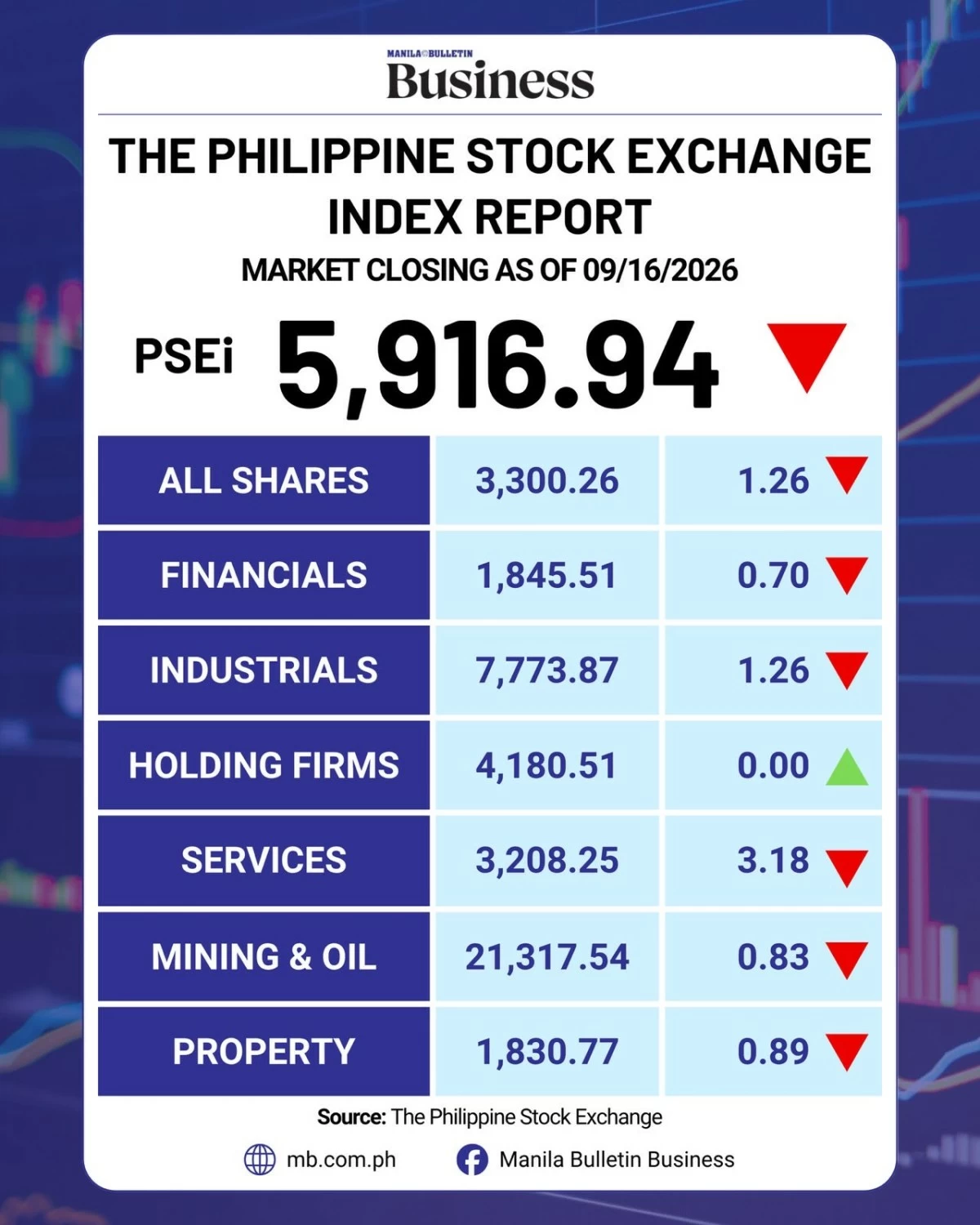
Local equities breached the key psychological floor on Wednesday, Sept. 16, falling below the 6,000 threshold as rising Treasury yields pulled capital toward fixed-income markets, while elevated global crude prices and currency weakness compounded domestic economic concerns.
The Philippine Stock Exchange index (PSEi) dropped 90.84 points, or 1.51 percent, to close at 5,916.94.
The services sector dragged the broader benchmark lower, offsetting relative stability among conglomerate heavyweights.
Trading volume held steady, with 612 million shares worth ₱5.89 billion changing hands. Market breadth was sharply negative, as declining issues outstripped gainers 139 to 54, with 58 stocks ending unchanged.
Philstocks Financial Research Manager Japhet Tantiangco noted that the local benchmark pierced its critical 6,000 support line as domestic and international treasury yields surged, shifting institutional demand toward fixed-income instruments.
He added that persistent weakness in the peso and sustained pressure from global crude prices continue to strain investor sentiment.
Macroeconomic anxiety extended beyond financial markets to broader corporate performance expectations. Regina Capital Development Corp. Managing Director Luis Limlingan noted rising caution among traders evaluating potential decelerations in third-quarter economic growth alongside escalating geopolitical tensions between the United States (US) and Iran.
External pressures further amplified domestic risk aversion. Rizal Commercial Banking Corp. Chief Economist Michael Ricafort noted that the benchmark logged its fourth loss in five trading sessions, driven by building market consensus around a potential 25-basis-point interest rate increase by the US Federal Reserve—which would mark its first rate hike in three years.
US Treasury yields hovered near 19-year highs not seen since 2007, reflecting persistent anxiety over global oil supply chains and sustained inflationary pressure across regional economies.
