You plan to move to the Philippines? Wollen Sie auf den Philippinen leben?

There are REALLY TONS of websites telling us how, why, maybe why not and when you'll be able to move to the Philippines. I only love to tell and explain some things "between the lines". Enjoy reading, be informed, have fun and be entertained too!

Ja, es gibt tonnenweise Webseiten, die Ihnen sagen wie, warum, vielleicht warum nicht und wann Sie am besten auf die Philippinen auswandern könnten. Ich möchte Ihnen in Zukunft "zwischen den Zeilen" einige zusätzlichen Dinge berichten und erzählen. Viel Spass beim Lesen und Gute Unterhaltung!


Visitors of germanexpatinthephilippines/Besucher dieser Webseite.Ich liebe meine Flaggensammlung!

free counters

Total Pageviews

Tuesday, October 13, 2026

Cotabato farmers plant rice amid El Niño threat


AN aerial shot of a rain-fed rice farm in Barangay Tigbawan, Pigcayawan, Cotabato. (Keith Bacongco) 


By Keith Bacongco

Published Oct 12, 2026 06:07 pm


PIGCAWAYAN, Cotabato Province – Amid the threat of the El Niño, many farmers in Cotabato took a risk and opted to plant rice for the next cropping season as many areas still have enough water supply for irrigation.  

But some farmers are still contemplating if they will plant or not, depending on the availability of the water for irrigation.  

One of them is Joseph Ragonton of Barangay Tigbawan here who is still waiting for more rains to come before preparing his farm for the next planting cycle.

While he is aware of the possible impact of El Niño in the coming weeks, Ragonton emphasized that, as a farmer, he has to take a gamble to survive. 

“We are worried about the possible impact of El Niño. Because as you can see now, water levels in our rivers have drastically dropped. But you are not a real farmer if you will not take a gamble,” Ragonton said.

Tigbawan is one of the villages in this rice-producing town that rely on rain for irrigation. Some areas depend on irrigation systems under the National Irrigation Administration. 

Ragonton said that if they cannot plant this season, they might wait until the dry spell is over by the end of the first quarter next year.   For now, they might plant heat-resistant crops to survive, according to him.  

Board Member Rosalie Hallado-Cabaya, chairwoman of the provincial council’s committee on agriculture, said that based on monitoring of the provincial government, many of the farmers in the irrigated areas have taken a gamble to plant amid the very strong El Niño forecast. 

Cabaya relayed that the NIA in the province has assured the farmers that there is still enough water supply to irrigate the rice farms. 

“But they were also told to plant heat-resistant varieties as well as varieties that can be harvested in 90 days so that they will not be affected by the dry spell,” she added. 

The Department of Science and Technology-Philippine Atmospheric, Geophysical, and Astronomical Services Administration (DOST-PAGASA) has issued an advisory that El Nino is expected to intensify into very strong between September and December and could persist through the first half of 2027.

Aside from this town, Cabaya noted that many farmers in most irrigated areas of  Carmen, M’lang, Matalam, Midsayap, Libungan, Pikit, and Tulunan have already planted rice right after the harvest period last September. 

“In upland areas, we advised the farmers to plant heat-resistant crops instead of upland rice varieties and proper management of water source,” she added.  

Amid the possible impact of El Niño, Cabaya said that many farmers still availed of the Cotabato Rice Revolution Program (CRRP), which provides fertilizer under a "2-2-2 scheme" involving the provincial government and 15 participating local government units (LGUs).

Under the provincial government program, farmers received six sacks of fertilizer for every hectare of rice farm – two each from the provincial government, the municipal government, and the Department of Agriculture.

However, Cabaya clarified that only those areas with enough water supply were prioritized in the program. 

The provincial legislator disclosed that ongoing dredging operations in marshy areas and waterways could also help in sustaining the water supply for the farmers.  

With the dredging operations, Cabaya said, water is impounded into these deep waterways and can be a source of water to irrigate  nearby rice farms. 

Carmen Agricultural Resources and Development Multi-Purpose Cooperative chairman Nasser Ali said that many of his members here and neighboring areas in the Special Geographic Area of the Bangsamoro Autonomous Region in Muslim Mindanao (SGA-BARMM) have also planted rice since September. 

Ali, who is based in Carmen, said that his fellow cooperative members have a total of 150 hectares of ricefields and rely on the irrigation system from the Malitubog-Maridagao River Irrigation. 

“We are hoping that by the time our rice will reach flowering and productive stages, there’s still enough water. Otherwise, it will be a disaster. But we are farmers, we are used to taking this kind of risk,” he said.

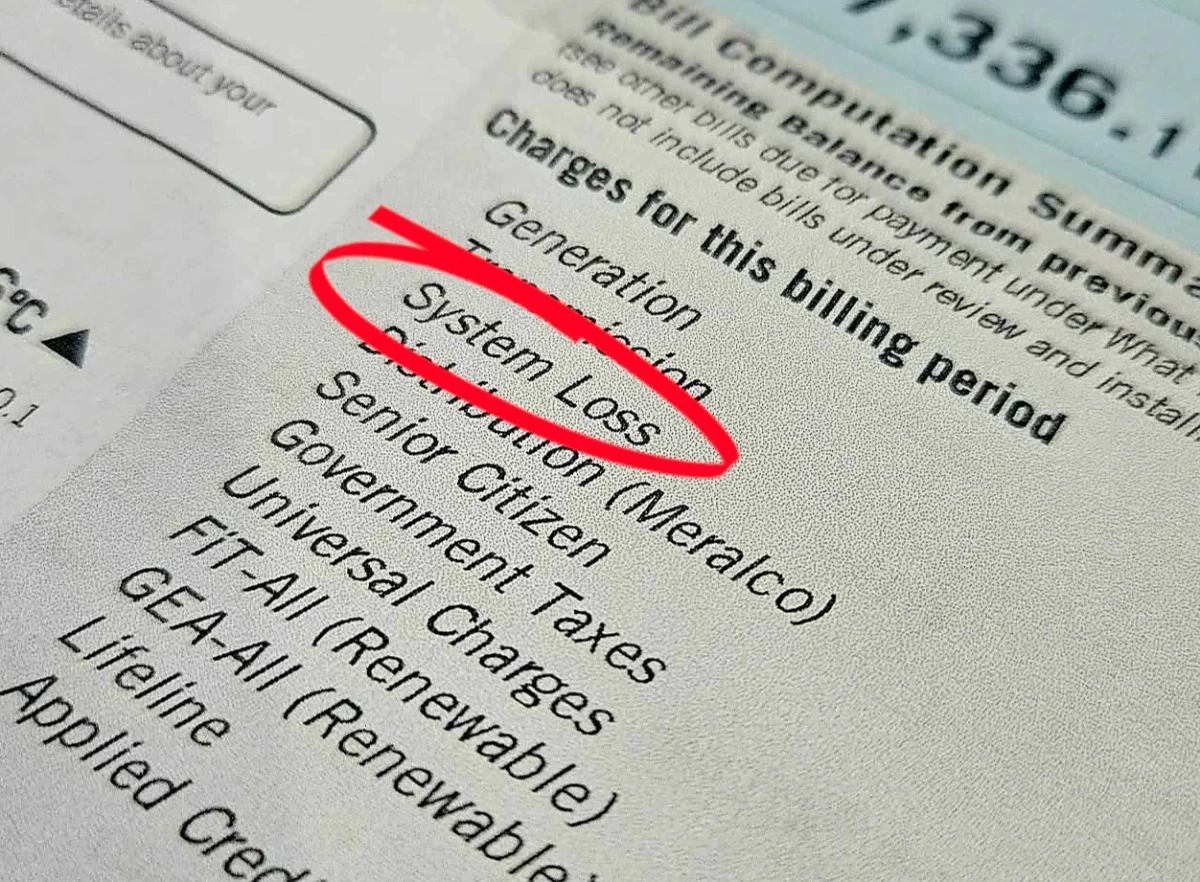
Energy panel OKs system loss, household power generation bills


Published Oct 12, 2026 11:19 pm
System loss charge on an electricity bill (Ellson Quismorio/ MANILA BULLETIN)


The House Committee on Energy has approved on Monday, Oct. 12 the substitute bills and the corresponding committee reports of measures seeking to free consumers from paying for system loss, and to liberalize power generation down to the consumer level.
A total of 43 House bills (HBs) and two House resolutions were filed seeking to end the practice of passing on to Filipino consumers the costs of inefficiencies arising from non-technical energy losses.
President Marcos identified the issue as a matter for legislative priority in his last State of the Nation Address (SONA) in July 2026. This caused the House of Representatives to spring into action.
Speaker Isabela 6th district Rep. Faustino “Bojie” Dy III and Majority Leader Ilocos Norte 1st district Rep. Sandro Marcos authored HB No. 10430, one of the measures filed as a response to the matter. The committee began to tackle tje measure in early August.
The bill, if and when enacted into law, would “provide meaningful relief to Filipino consumers by eliminating a charge that should properly be borne by the entities responsible for managing and operating the (electricity) distribution network".
Cagayan de Oro 1st district Rep. Lordan Suan, who filed a similar bill in HB No.10299, described the practice of passing on the system loss burden to a captive market as "unfair".
“It is unjust to pay for electricity you do not consume,” he said, echoing Marcos' words on the issue. He adding that this ran contrary to the principles of business efficiency and accountability.
The energy panel chaired by Palawan 2nd district Rep. Jose Alvarez also approved a substitute bill promoting the use of power generation and storage systems in households. It is seen to take advantage of advances in solar and energy storage technologies.
The proposed “Sariling Kuryente Act” seeks to reduce household electricity expenses, lessen dependence on the electric grid, and improve the country’s overall power supply.
Under the measure, regulatory requirements for the safe installation and operation of power generation and storage systems for non-commercial purposes would be simplified to promote wider public access to and use of existing and emerging energy technologies.
Proponents of the measure said “unnecessary procedures and restrictions” hinder nationwide adoption, discouraging “investments that could otherwise benefit households, enterprises and the country as a whole".
Both bills seek to amend Republic Act (RA) No. 9136, otherwise known as the Electric Power Industry Reform Act (EPIRA) of 2001.


House approves P7.2-T national budget for 2027


House approves P7.2-T national budget for 2027

Top: Philippine P1,000 bills Bottom: House of Representatives (MANILA BULLETIN, Facebook)

The House of Representatives approved on third and final reading the P7.2-trillion 2027 national budget, the largest in Philippine history, with 282 votes in favor, 13 against, and one abstention. The budget bill now goes to the Senate after 56 days of committee hearings and plenary debates in the House. Read more

Is this music or can it be deleted?


 The Daily Guardian is a renascent Iloilo-based publishing firm and media outfit with bureaus across Western Visayas and beyond. Led by Iloilo's most respected journalists, we pledge to tell the Ilonggo story as seen through the various lenses of society so that every side may be told.

BUREAUS: Kalibo Boracay Roxas Bacolod Antique Guimaras Manila


By Klaus Döring


The relationship between music and memory is powerful. Music evokes powerful emotions that then bring back memories. When we listen to a piece of music from years ago, we seem to travel back to that moment. We can feel everything as if we were there.

Our long-term memory can be divided into two distinct types, namely implicit memory and explicit memory. Explicit memory is a deliberate, conscious remembering of the past. Explicit memory involves things like textbook learning or experiential memories, things that must be consciously brought into awareness.

Implicit memories are our unconscious and automatic memories. For example, playing a musical instrument or recalling the words to a song when someone sings the first few words. A large part of memory takes place in the unconscious mind.

Explicit memory fades in the absence of recall, while implicit memory is more enduring and may last a lifetime even in the absence of further practice. The explicit memory systems become damaged by conditions such as Alzheimer’s disease.

I remember my parents’ irritation on their faces, like a broken mirror! Once upon a time, we went crazy while listening to our idols’ sounds. In my case, sometime during the 1960s and 1970s.

I felt “satisfaction” while listening to the Rolling Stones or dancing to the Beatles. I had hectic dreams with Pink Floyd or couldn’t hold myself back with “Da-da-da” and its then “German New Wave,” which later swept across the world — yes, even reaching the Philippines.

Today, we are the parents of the younger generation again. Is there diplomatic space for any discussions? What’s the music like nowadays?

Rap or house? Or something like this? Noise, din, row, racket, fuss, or damage to my (?) musical paintwork?

I remember harmonic chords with flutes and my accordion. Later, I found myself at the piano….

Two generations, even three, by now. Let’s strike the right chord — no matter which generation we belong to.

Shahram Heshmat, Ph.D., an associate professor emeritus at the University of Illinois at Springfield with a Ph.D. in managerial economics from Rensselaer Polytechnic Institute, describes it as follows: “In sum, music can help to unlock non-musical memories and promote communication in older adults with Alzheimer’s disease. Recalling a memory is not always easy. It doesn’t simply come when you want to retrieve it. However, music helps to recall all the memories that you’ve connected with a song. Listening to a piece of music that was played a lot during a significant life event, such as a wedding or funeral, can trigger a deeply nostalgic emotional experience.


***

Email: doringklaus@gmail.com or follow me on Facebook or LinkedIn or visit www.germanexpatinthephilippines.blogspot.com .

PSEi rises to 5,743 on bargain hunting


PSEi rises to 5,743 on bargain hunting

Emmanuel John Abris

Local stocks extended their gains on Monday as bargain hunting lifted the market despite foreign selling and concerns over the economic outlook.

The benchmark Philippine Stock Exchange Index (PSEi) climbed 0.74 percent, or 42.19 points, to close at 5,743.18.

Airfare relief ahead as fuel surcharge dips


Airfare relief ahead as fuel surcharge dips

Logan Kal-El M. Zapanta

Travelers flying within and out of the Philippines may see a slight reduction in ticket costs in the second half of October after the Civil Aeronautics Board (CAB) approved lower, although still elevated, fuel surcharges for the period.

In an advisory on Monday, the regulator said airlines would be allowed to impose a Level 16 fuel surcharge from Oct. 16 to Oct. 31, down one notch from Level 17 in the first half of the month, which marked a five-month high.

Ein Herbstgedanke


Der Herbst erinnert uns an etwas, was die Leistungsgesellschaft uns zuweilen vergessen machen möchte: Ohne Niedergang kann es kein Wachstum geben. Wenn es kalt wird, dann beißt der Baum nicht die Zähne zusammen und kämpft verbissen weiter. Er zieht die Nährstoffe zurück in den Stamm. Nur durch dieses Kräfteschonen kann er im kommenden Frühling wieder neues Leben sprießen lassen. Das Gleiche gilt für jeden von uns. Vielleicht können Sie daran denken, wenn Sie sich das nächste Mal ein schlechtes Gewissen haben, weil Sie eine Pause benötigen. (Foto: imago/Wolfilser)

Rules of Life

 Rules of Life

1. Ignore them: Don't listen to other people. Live a life that's empowered to you.

2. Let it go: Never ruin a good day by thinking about a bad yesterday.

3. Give it time: Time heals everything.

4. Don't compare: The only person you should try to beat is the person you were yesterday.

5. Stay calm: It's okay not to have everything figured out. Know that in time, you'll get there.

6. Change the plan: If the plan doesn't work, change the plan, but never the goal.

7. It's on you: Only you are in charge of your happiness.

8. Smile: Life is short. Enjoy it while you can.