
We offer a glimpse of where the country's food scene is headed

Valery Anthony of Lusso is beginning to attract positive attention through her leadership and her graceful ability to express her unique style while honoring the restaurant’s identity. I truly believe she has a special quality about her.

Two people immediately come to mind. Technically, Don is no longer ‘up and coming,’ but he’s still so young, and I’m such a big fan of how his mind works. If he’s already this brilliant now, I can’t wait to see what else he comes up with in the years ahead.
Don Baldosano seeks out historical, soulful, and long-forgotten ways of cooking, deeply rooted in his culinary heritage for global preservation and elevation of regional cuisine. Don Colmenares is another young rising kusinero who hails from Hinigaran, Negros Occidental, where he operates his farm-to-table dining concept, Sauma Farm.

I believe that my good buddy Don Baldosano is a young chef who, despite all the recognition and acclaim he has achieved to date, still has a lot to show. In fact, he’s just starting. Things are escalating for the boy wonder, and now that the country has witnessed his genius and talent, I can’t wait for the rest of the world to experience the same.

It is inspiring to see someone (Don Baldosano) think out of the box. And his ideas are so different from what I would do. And I think all of us more established, older chefs, watching him were so amazed by. Dapat ganun (That’s how it should be). Even us, we should still be open to creating new things.

Chef Francis Lacson possesses the qualities of a chef who is bound for greatness. He is talented, passionate, and, above all, grounded as a person. He understands the value of promoting regional Filipino cuisine while remaining innovative in his approach.
The dining industry in the Philippines is on a roll. With the introduction of the Michelin Guide to the Philippines last year, and now the second list of Michelin awards set to be announced just a few weeks from now on Oct. 29, I am confident to say that the dining industry, and the chefs and people behind it, are the modern rock stars now.
I still remember the Michelin awards last year. As the awardees were announced at the Marriott Grand Ballroom, the room erupted. There were chefs hugging, shaking hands, congratulating one another, and bantering with friends and colleagues. Everyone was excited, everyone was watching, and everyone seemed to have something to say.
I remember thinking: This is how alive the dining scene is in the Philippines.
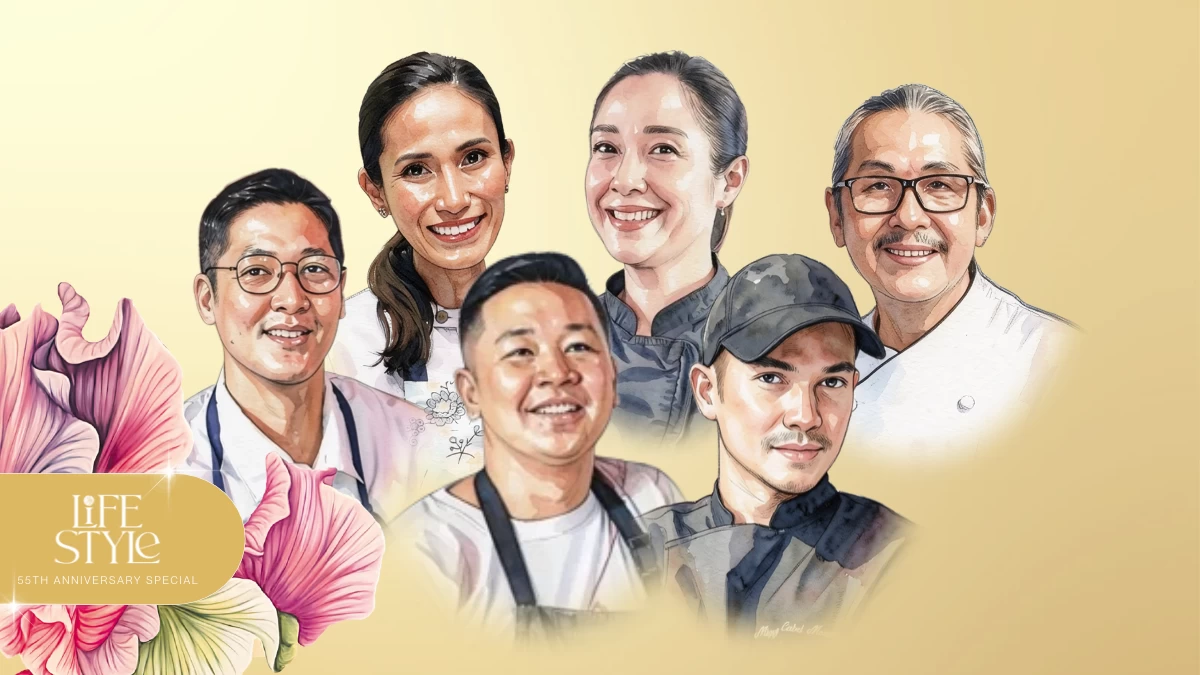
So, for our 55th anniversary issue, I asked some friends in the dining world their thoughts on our theme, the next generation. Who are the chefs we should be watching? Who are the people who will help shape what Philippine dining becomes in the coming years? This is by no means a definitive list. It is a glimpse, a sampling of the names that came up when I asked around.
Overwhelmingly, Don Baldosano was mentioned. And who can blame them? Don has already made a considerable mark with Linamnam, his intimate 10-seat restaurant in Parañaque. His cooking is rooted in Filipino ingredients, culinary history, foraging, and the traditions that can easily disappear if nobody makes the effort to preserve them.
His Michelin star in 2025, along with the Young Chef Award, simply gave international recognition to what he had already been doing. Long before the star, Don was writing and thinking about the need to reconnect with forgotten Filipino culinary knowledge. His restaurant became the place where those ideas could land on a plate.
I find Don particularly interesting because there is no sense that he is trying to make Filipino food fashionable. He is simply deeply interested in it. The ingredients, the stories behind them, the way people used to cook, and the possibilities that emerge when those things are examined with a contemporary eye.
In fact, Don and another name on this list, Kevin Uy, have known each other for some time. In 2024, the two young chefs collaborated on “Crossing Waters,” an 11-course dinner exploring connections between Filipino and Latin American cuisine. Even then, Kevin described Don’s cooking as embodying the best of the Philippine food scene.
Valery Anthony of Lusso is another name worth watching. Valery represents a different facet of the next generation. She is working within one of the brands created by the late Margarita Forés, an icon whose influence on Philippine dining is difficult to overstate.
Lusso has now become part of AF Hospitality, the group founded by Margarita’s son, Amado Fores, alongside other brands that Margarita built. The move was part of a larger effort by the Araneta-Fores family to preserve what Margarita created while giving the businesses room to move forward.
Valery’s role at Lusso places her at that interesting intersection between heritage and innovation. Her background in culinary training, her time studying and working in Italy, and her involvement in research, development, and culinary innovation point to a young chef who understands that maintaining a legacy does not mean standing still.
And then there is Kevin Uy of Flow. Kevin spent five years in Peru, including four and a half years at Central in Lima under Virgilio Martínez and Pía León, as well as time at Mil, Central’s high-altitude research center in Cusco. He returned to Manila with those experiences and built Flow around the meeting point of Peruvian and Filipino sensibilities.
What I find compelling about Flow is that Kevin is not simply recreating what he learned abroad. The restaurant’s tasting menu moves through what he calls “culinary biomes,” with landscapes, ingredients, and ideas connecting Peru and the Philippines.
“The whole experience was an eye-opener. Peruvian and Filipino cultures aren’t too far apart,” Kevin told Manila Bulletin. “It’s interesting to see where and how different worlds intersect.”
He works with his childhood friend and co-executive chef Gabriel Ong, who provides the classical grounding and operational structure alongside Kevin’s more experimental approach. Even the restaurant’s dinnerware was developed with local potters, reflecting Kevin’s belief that food can become a meeting point for different creative disciplines.
And, if the humble opinion of this author is to be entertained, chef Lee Jan Anicas is someone to watch out for as well. I say this partly because I have already experienced what Lee is trying to do at Bakuran Tasting Club in Project 8, Quezon City.
When I first received his invitation, I was intrigued by two things: the idea of building an entire tasting menu around “asim,” my favorite flavor, and the fact that the restaurant was in Project 8, an area where my family once had a home.
What I found was a dining room that felt deeply personal. Lee drew inspiration from his homes in Mindoro and Vigan, incorporating Capiz shell windows, wooden shelves, ferments, and other details that made the space feel more like a Filipino home than a conventional tasting room.
More importantly, Lee tells his team to be hosts first and chefs after. That philosophy is immediately apparent.
His first menu, “Asim: A Study on Balance,” looks at sourness not simply as a flavor but as part of the Filipino way of eating. Calamansi, biasong, tamarind, vinegar, and fermentation appear throughout the meal, each used to bring balance rather than simply acidity.
“I want to cut through the noise of the dining world,” Lee told me. And perhaps that is why his cooking stayed with me. There was no need to shout. The food was thoughtful, Filipino, and personal, while the setting made you feel welcome rather than intimidated by the tasting-menu format.
Another young rising kusinero is Don Colmenares, who hails from Hinigaran, Negros Occidental, where he operates his farm-to-table dining concept, Sauma Farm. His approach is deeply rooted in hyper-local sustainability, using roughly 95% local ingredients and allowing micro-seasons and what is available in provincial markets to shape his menus.
Chef Francis Lacson is another name to watch. Chef Miggy Moreno describes him as talented, passionate, and grounded, with a strong understanding of the importance of promoting regional Filipino cuisine while remaining innovative in his approach. Lacson’s recent restaurant concept, Digâmo, already reflects that direction, giving regional Filipino food a contemporary platform while staying rooted in its identity.
So, six names. Six very different approaches. Don looks to our culinary past to imagine its future. Don Colmenares embraces hyper-local cooking and lets the seasons and provincial markets shape his menus. Valery stands within a major legacy and represents the young talent helping carry it forward. Kevin brings international experience home and creates something new from the intersection of cultures. Lee takes the intimacy of Filipino homes and hospitality and places it inside a contemporary tasting-menu format. Francis brings regional Filipino cuisine to the table with a contemporary approach, as seen in his restaurant concept, Digâmo.
They are not the only ones, of course. The Philippine dining scene is now too broad, too energetic, and too interesting for any list to claim that.
But that, really, is the point. For Manila Bulletin Lifestyle’s 55th anniversary, the theme of the next generation is not about identifying a single successor or predicting who will become the next big name. It is about looking around and recognizing that the next chapter is already being written.
The chefs are experimenting. The restaurants are moving into new neighborhoods. Filipino ingredients are being reconsidered. International techniques are being brought home, adapted, challenged, and made our own.
The rock stars are already onstage. And judging by the energy in our dining rooms, the next generation has plenty more music to play.

No comments:
Post a Comment