You plan to move to the Philippines? Wollen Sie auf den Philippinen leben?

There are REALLY TONS of websites telling us how, why, maybe why not and when you'll be able to move to the Philippines. I only love to tell and explain some things "between the lines". Enjoy reading, be informed, have fun and be entertained too!

Ja, es gibt tonnenweise Webseiten, die Ihnen sagen wie, warum, vielleicht warum nicht und wann Sie am besten auf die Philippinen auswandern könnten. Ich möchte Ihnen in Zukunft "zwischen den Zeilen" einige zusätzlichen Dinge berichten und erzählen. Viel Spass beim Lesen und Gute Unterhaltung!


Visitors of germanexpatinthephilippines/Besucher dieser Webseite.Ich liebe meine Flaggensammlung!

free counters

Total Pageviews

Monday, June 22, 2026

Was ist der schwierige Teil beim Erlernen der deutschen Sprache?


 · 

Meine Muttersprachen - Englisch und Filipino - haben kein Genus-System, also als ich zum ersten Mal Deutsch lernen war, fand ich es wirklich schwierig.

Meine Lehrerin hat mir nicht erklärt, wie wichtig das Genus-System ist, deshalb habe ich mich nicht darum gekümmert, es auswendig zu lernen. "Der Kühlschrank" war einfach "Kühlschrank", "das Dach" war einfach "Dach" und so weiter.

Ich habe mich dran gewöhnt, Nomen ohne Genus zu lernen. Natürlich führte dies zu um so mehr Problemen, je weiter ich mit dem Deutschlernen fortgeschritten war. Ich kämpfte mit den Artikeln und auch mit den Synonymen, die das gleiche Wort bezeichneten, aber verschiedene Genus hatten. Adjektivendungen, Nominativ, Akkusativ, Dativ, und Genitiv waren auch große Probleme.

Immer wenn ich das falsche Genus benutze, fühle ich mich sehr verunsichert. Vor allem, wenn ich mit Deutschen spreche. Es ist schwer, sich nicht entmutigen zu lassen, Deutsch zu lernen, wenn man dumme Fehler macht, wie das falsche Genus zu verwenden.

Ich wünschte, dass ich früher mehr auf das Genus-System geachtet hätte. Vielleicht würde ich jetzt fließender Deutsch oder besser Deutsch sprechen.

Mein Deutsch ist noch schlecht (A2/B1 CEFR) so es tut mir wirklich leid für die viele Fehler! Thank you Bernhard Elsner for the corrections :)

Are there other German words in English that have kept their original meaning, like "kindergarten"? What are some examples?


English never invented a word for a ghost that throws furniture, or the guilty joy of watching someone fail. It just stole them intact from German.

Because both are Germanic languages, they share deep linguistic roots, but English has continually borrowed modern German words when it encounters a concept that requires a highly specific label. A few stand out because they perfectly capture complex experiences in a single, elegantly fused compound word.

One of the most famous is Schadenfreude. Translated literally, Schaden means damage or harm, and Freude means joy. Together, the word describes the specific, often guilty pleasure a person feels when witnessing the misfortune of someone else. English speakers adopted it in the mid-19th century because there was simply no direct English equivalent for that exact emotional cocktail.

Another prominent example is Zeitgeist. Formed from Zeit (time) and Geist (spirit or ghost), it literally translates to "spirit of the times." It refers to the defining mood, ideas, and beliefs of a particular period in history. The concept became closely associated with 19th-century German philosophy, and English eventually adopted it to describe the dominant cultural climate of an era, such as the rebellious Zeitgeist of the 1960s.

German is also responsible for naming several psychological and cultural concepts that remain completely untouched in English:

  • Poltergeist: Combining poltern (to rumble, crash, or make noise) with Geist (ghost), this word describes an invisible entity responsible for loud physical disturbances and thrown objects.
  • Doppelgänger: Literally a "double-walker," this originally referred to a ghostly twin or apparition of a living person, which folklore often interpreted as a dark omen. Today, people use it to describe any uncanny look-alike.
  • Wanderlust: Made from wandern (to hike or roam) and Lust (desire or pleasure), this captures a deep, restless urge to travel and explore the world.
  • Angst: While English already had words for fear and anxiety, it imported Angst in the 19th century—largely through the translation of existential philosophers and psychologists—to describe a profound, lingering dread or apprehension about the human condition.

These words survive perfectly intact because German possesses a unique grammatical ability to snap nouns together like building blocks. Rather than inventing a new word from scratch, German combines existing words to describe highly specific phenomena, creating a ready-made vocabulary that English speakers are frequently eager to borrow.

Happiness in Today’s World


Happiness in Today’s World

FEELING that the conditions of your life are good. Enjoying positive, healthy relationships with other people. Feeling that you have accomplished (or will accomplish) what you want in life. Feeling satisfied with your life. Feeling positive more than negative.

Global happiness and life satisfaction are characterized by shifting regional trends, with Northern European nations dominating the top rankings. While positive emotions generally remain frequent, industrialized nations—particularly among youth and English-speaking countries—have seen notable declines in well-being linked to social media use and dropping social trust.

Happiness is a complex and multifaceted mental state that encompasses a range of positive feelings, from contentment to intense joy. It is often associated with positive life experiences, such as achieving goals, spending time with loved ones, or engaging in enjoyable activities.

Happiness is a state of mind. Specifically, it is a state of “well-being and contentment.”

But the definition can be tricky and assumptions about the word can cause confusion. Many don’t even realize learning how to be happy is something that can be intentionally practiced. Some people, when they hear the word ‘happiness,’ assume it is speaking of an emotion such as pleasure or joy. For them, it is what people feel in the immediate here and now.

This is the reason some people say, “Don’t pursue happiness, seek joy. Happiness is fickle and fading, joy remains forever.”

But this short-term definition of happiness is not how everyone understands the word. Some define it to mean long-term satisfaction.

In fact, when I speak of experiencing happiness in life, I am not thinking of short-term emotions at all. I think of a quality of living—a much longer-term view of the word.

Both definitions are understood to be correct and speak of different realities.

But are they really that different? I don’t think so.

After all, a long-term experience of life satisfaction is almost certainly made up of many short-term feelings of joy and pleasure. Does that mean every day is a great day with no trials, temptations, or downturns? Certainly not. But it does mean when we look back at the many seasons of life, we can look back satisfied at how we navigated them.

The long-term feeling of life satisfaction is most experienced when we embrace the emotion of joy in the here and now.

And we accomplish that by taking steps each day to be happy.

What makes you feel happy now? Doing something you’re good at, such as cooking or dancing, is a good way to enjoy yourself and have a sense of achievement. Try to avoid things that seem enjoyable at the time but make you feel worse afterwards, such as drinking too much alcohol or eating junk food.

Why is being happy important? Experiencing happiness is important for our emotional and physical health. A stronger sense of happiness and wellbeing has been shown to lead to better relationships, increase social connection and contribution to the lives of others, as well as contributing to healthier physical wellbeing.

Is being happy the most important thing in life? Happy people are healthier all around and more likely to be healthy in the future. Happy people live longer than those who are not as happy. Happy people are more productive and more creative, and this effect extends to all those experiencing positive emotions.

Am I happy? Yes. Living in the Philippines for almost 28 years for good, I learned to be happy. Even during hard times. Filipinos are generally a happy people. They can smile whatever the situation. Their happy-go-lucky nature and positive mindset allow them to bounce back from the direst of circumstances, from disasters, from wars, and surely from today’s global situation.

Saturday, June 20, 2026

PAGASA warns of widespread 'habagat' rains as potential typhoon nears PAR


By Ellalyn De Vera-Ruiz

Published Jun 19, 2026 06:16 pm


PAGASA weather specialist Loriedin dela Cruz-Galicia said the tropical depression was not directly affecting any part of the country as of Friday.

However, she said there is a high chance the cyclone will enhance the habagat once it enters the Philippine Area of Responsibility (PAR) this weekend.

Satellite image of a tropical depression outside the Philippine area of responsibility (PAGASA)

Satellite image of a tropical depression outside the Philippine area of responsibility (PAGASA)

A tropical depression east of the Philippines could enhance the southwest monsoon or “habagat” and bring rains over large parts of the country starting Sunday, June 21, the Philippine Atmospheric, Geophysical and Astronomical Services Administration (PAGASA) (PAGASA) said on Friday, June 19.

PAGASA weather specialist Loriedin dela Cruz-Galicia said the weather disturbance was not directly affecting any part of the country as of Friday.

However, she said there is a high chance the cyclone will enhance the habagat once it enters the Philippine Area of Responsibility (PAR) this weekend.

“Maigting po natin itong mino-monitor dahil once na pumasok po ‘yan sa ating area of responsibility, mataas ang tsansa na magti-trigger o mag-e-enhance po ito ng southwest monsoon o habagat na siya pong magpapaulan sa malaking bahagi ng ating bansa by Sunday until early next week (We are closely monitoring it because once it enters our area of responsibility, there is a high chance it will trigger or enhance the southwest monsoon, which may bring rain over a large part of the country from Sunday until early next week),” she said.

As of 3 p.m. Friday, the tropical depression was located 1,735 kilometers east of Eastern Visayas, with maximum sustained winds of 55 kilometers per hour (kph) near the center and gustiness of up to 70 kph.

It was moving west-northwestward at 35 kph.

PAGASA said the cyclone could enter PAR by Saturday evening or Sunday morning, June 20 or 21, as a severe tropical storm or a typhoon.

Once inside the PAR, it will be given the local name “Francisco.”

Dela Cruz-Galicia said the cyclone is forecast to remain over the sea throughout its stay within PAR and may reach typhoon strength before approaching the country's landmass.

“Makikita nga po natin na sa entire stay po niya sa ating area of responsibility ay nasa typhoon category po ‘yan (It is expected to remain in the typhoon category throughout its stay within the Philippine Area of Responsibility),” she added.

She also said that while the current forecast shows the cyclone eventually recurving away from the country, PAGASA is not ruling out the possibility of landfall.  

The art of suffering quietly in the PH


 Jeniville Villamor

I used to think the most dangerous thing in the Philippines was violence. I thought it was the gunshots echoing through dark streets at midnight. The motorcycles slowing down beside you just long enough to make your chest tighten. The headlines about another body found on the roadside by morning.

But I was wrong.

Every morning before sunrise, I force myself into overcrowded jeepneys beside construction workers, students, vendors, and exhausted employees who all looked half-awake and half-defeated. We sit shoulder to shoulder in silence, sweating under the heat, carrying the same invisible burden: survive today, then survive tomorrow, then somehow do it all over again.

The roads leading to the business district always fascinated me. One side of the city looked abandoned by progress: floodwater trapped in potholes, tangled electrical wires hanging dangerously above homes made from patched metal sheets, children running barefoot through narrow streets that smelled of smoke and sewage.

Then only minutes away stood another world entirely. Towering condominiums. Air-conditioned malls. Luxury cars. Expensive restaurants.

Same city. Same country. Different realities.

Sometimes I wondered if poverty in the Philippines was no longer considered a tragedy. As if it had become scenery. Even politicians treated suffering like performance art and election season always hurts the most. The streets suddenly become filled with smiling faces on tarpaulins promising change, hope, a better future. Different colors. Different slogans. But after every election, the poor are still poor.

I noticed how quickly ordinary people were blamed for their own hardship. When someone stole food, society called them criminals. When workers collapsed from exhaustion, people called them weak. When families drowned in debt, they were told they simply did not work hard enough.

But the powerful? The rules always seemed softer for them.

Corruption scandals disappeared beneath press conferences and handshakes. Public funds vanished while hospitals lacked medicine and classrooms lacked chairs. Wealthy officials spoke about sacrifice while escorted by security guards and luxury vehicles paid for by taxpayers who could barely afford rice.

And still, ordinary Filipinos continued enduring everything in silence.

I see it in breadwinners forcing themselves to work through anxiety attacks because resting is a luxury they cannot afford. In employees crying silently inside workplace bathrooms, returning to work as if nothing happened. In fathers pretending they already ate so their children can have the last portion of rice. In mothers forcing smiles while drowning in unpaid bills.

One night, while walking home, I saw a crowd gathered near the roadside. Someone had been caught in the middle of violence nearby. People stood around staring for a moment before slowly continuing on with their night. By morning, the blood was gone. The street was busy again. Vendors were selling breakfast. Jeepneys were full. Children were laughing on the sidewalks.

I finally understood the deepest wound of this country: Filipinos had become too familiar with pain. Too accustomed to corruption. Too used to watching injustice happen in broad daylight without believing anything could change. Life moved on so quickly it was almost terrifying.

The longer I looked around, the clearer the pattern became. A small group remained comfortably above everyone else while millions carried the weight of keeping the country alive beneath them. Workers built cities they could never afford to live in. Farmers produced food they themselves struggled to eat. Citizens paid taxes into systems that rarely protected them.

And the cruelest part? Most Filipinos are too exhausted trying to survive to even question why life has to be this painful in the first place.

Sometimes I look around and wonder how many people are silently drowning beside me.

How many workers are one breakdown away from collapsing. How many students are carrying dreams they can no longer afford. How many families are pretending to be okay because they have no choice but to keep going. Because here in the Philippines, survival often comes before humanity.

You keep working even when your body is begging you to stop. You stay silent because speaking up changes nothing. You learn how to carry pain so well that eventually people stop noticing you’re hurting at all. And maybe that’s what hurts the most.

Because this country slowly teaches people to accept suffering as part of everyday life. As if we were born only to endure.

But deep inside me, there is still hope. Because I refuse to believe Filipinos were meant to live like this forever. And maybe real change begins the moment we stop calling this resilience and finally call it what it truly is: A nation silently bleeding while pretending to be okay.


IT’S NEVER TOO LATE!

0
167

It absolutely isn’t. Whether you are changing careers, pursuing a passion, or completely restarting your life, every positive choice is a step forward and a chance to rewrite your story.

The comforting truth about “starting late” is that you bring something invaluable to the table that you didn’t have when you were younger: experience.The Wisdom Advantage: You know yourself better, understand your limits, and are better equipped to avoid past mistakes.Redefining the Timeline: Many incredibly successful people didn’t hit their stride until later in life. For example, Colonel Sanders founded KFC at 65, and Vera Wang didn’t enter the fashion industry until she was 40.Taking the First StepThe hardest part is often simply beginning, but progress comes from small, consistent choices rather than giant, overwhelming leaps.

It’s never too late – never too late to start over, never too late to be happy. The time for action is now. It’s never too late to do something. It is never too late to correct our mistakes.

I know a lot of pensioner expatriates living in the Philippines for good. Many of them have a big problem – after staying here for only a couple of months, they get bored.

Having a vacation all day, all week, all month and all year long is really not an egg’s yellow. I must confess, I experienced the same in 1999 after moving to Davao City. At that time I just turned 46…

As you move through life, it is easy to look back and regret all the dreams and goals you haven’t achieved. But it is never too late to finally go after whatever is on your heart! Every day is a fresh start to create your own second chances! 

I remember my last days in an international publishing house in Berlin. I packed up my things after signing my resignation letter. Of course, I hadn’t reached my final pension age yet, but I got a lot of ideas on how to shape and organize my “new” life in the Philippines. I never forgot some office mates smiling at me:”We can’t cross such bridges before we come to them!” Of course guys, you have been right! Anyway, age doesn’t matter – you can enjoy the second half of your life residing in the Philippines. As many of you know already: I stayed in many countries worldwide. I could have migrated to the U.S. I didn’t. I chose the Philippines. Most important thing is: Keep yourself busy.

Getting bored, means also for some to start grumbling and complaining about everything and everybody in the Philippines. I always keep my distance from such negative people. We are not here to change this country and its people. Why? What for? Filipinos are also not planning to change our home countries.

I really don’t have more stress than I had in my home country before. Critics reproach and accuse me of living a life as an expatriate while wearing pink tinted glasses. Sorry, but my conscience is very clear.

I keep myself busy, too busy sometimes: Teaching, translating, writing, on the radio, and many more things; but I always find time for short vacations. It’s never too late. It’s your life! Take your chance and enjoy life in the Philippines. And, stay away from grumblers and grouses.

“It is never too late, no matter how old you get because anytime or at any point in your life you can always have a chance to make a difference. You can always make a change for the better no matter what background you derived from. You can always do your best and be all that you can be because you will always be uniquely you. It is why it is always wise to listen to your eternal heart, your eternal instincts, and what it has always strove for and/or to do because really anybody can make a difference not only in their own lives but in the lives of others. It is never too late to shine; never.” – George Eliot wrote this.

Friday, June 19, 2026

Atasha Muhlach takes on dream role as Annie Batungbakal


Nathalie Tomada - The Philippine Star 

June 18, 2026 | 12:00am


Viva artist Atasha Muhlach is set to play the titular role in ‘Bongga Ka, ’Day!: The Annie Batungbakal Musical,’ a dream assignment that brings her back to musical theater and allows her to essay one of the most iconic characters from the Manila Sound era. The newest Viva-Newport World Resorts-The Philippine STAR collab production is happening in September, with Sam Concepcion, Jeff Moses, Anthony Rosaldo and KD Estrada joining the cast as Atasha’s leading men.


Atasha Muhlach’s first reaction to landing her first-ever lead role on the theater stage was tears of joy.


The Viva artist is set to play the titular role in “Bongga Ka, ’Day!: The Annie Batungbakal Musical,” a dream assignment that brings her back to musical theater and allows her to essay one of the most iconic characters from the Manila Sound era.


The role was originated by the late National Artist Nora Aunor in the 1979 film of the same title.


“First reaction, tears of joy,” Atasha recalled to The Philippine STAR in an exclusive interview.

“I was super, super happy and more importantly, so grateful because it’s so exciting to be part of something like this, to be playing the role of Annie Batungbakal because it’s such an iconic role.”

According to Atasha, the role is special not only because it spells a major career milestone, but also because it comes with the chance to dance and sing to some of Hotdog’s most beloved songs, which she described as “part of Philippine music history.”

She said, “Hotdog and Annie Batungbakal made such a big, big contribution to pop culture and society. Given the chance to be part of this is really just such a big honor.”

Interestingly, when Atasha was previously asked by this paper about the possibility of doing theater again, this project was not yet on her radar.

Once she found out about the auditions, the first thing she did was listen to Hotdog tracks. While she already knew Manila, discovering more about the band’s music opened her eyes to just how deeply embedded the group’s music is in Filipino culture.

“I know the song Manila from before, from when I was in high school. I would always hear my friends play it, so it was kind of a surreal moment na, ‘Oh my God, ito pala, this is them,’” Atasha said.

Learning about the other songs, including Ikaw Ang Miss Universe ng Buhay Ko, made her appreciate the Manila Sound even more.

“Hearing all these songs, wow, they’re really so ingrained in Philippine culture. For the Manila Sound, iba talaga,” she added.

Asked more about the audition process, Atasha shared that she went through it with a “hopeful heart.” She knew there were no guarantees, but she made sure she arrived prepared. She tapped a dance coach, acting coach and vocal coach for help.

“I think I could speak in general for everyone in that way, wherein in auditions, you always go in with a hopeful heart and give it your all, not really knowing what will happen or what the outcome may be,” she said.

“But within myself, I just know that I prepared talaga to the best of my ability. As in binigay ko talaga yung 100 percent ko.”

She prepared two audition pieces: one Hotdog song and another one by a different artist from the ’70s to ’80s. She also performed a dance number to the music of Annie Batungbakal.

At one point, she was asked by “Bongga Ka, ‘Day” director Chris Millado to do choreography on the spot to test how quickly she could pick up movement.

“Syempre naman, kinakabahan ako, pero it went well,” she said. “I’m happy that I did it and I’m just happy with the preparations that I put in for this audition.”

The most challenging part of it, she admitted, however, was the singing. She had to go on vocal rest two days before the audition.

“So sabi ko, grabe, iba talaga ang respeto ko para sa mga theater artists and even for all artists,” she said.

Atasha also understands that the role will demand discipline and stamina, especially since she has no alternate for the part. But rather than feel overwhelmed, she chooses to accept it as a challenge.

“I super, super love challenges and I think that’s what keeps me going every day, always just to challenge myself,” she said.

Part of her preparations right now for the actual production in September is understanding the world that Annie Batungbakal comes from. Since she was not born in the ’70s, Atasha has been doing her homework on the period, the music and the cultural context that shaped the character.

“There’s a lot of research and studying required in order to understand the context of that time and to understand the character,” she said.

Based on a primer furnished to this paper, Annie is in her early 20s, a “creative, spirited, generous and lovable woman” but who’s a bit naive. She’s an employee, a dispatsadora, at the House of Pasion. Her dream as fashion designer fuels her desire to join the Coco Banana circle, but there’s something in her that initially blocks acceptance.

When asked if she could personally connect to Annie’s journey, without giving away too much about the story, Atasha shared, “For me, I think she’s a dreamer. She’s unapologetically herself. She’s deeply authentic.

“Just like all of us, we’re all unique in our own way. We’re all very different.”

She went on to say that Annie’s story is all about self-discovery and self-acceptance.

“It’s discovering who you are and realizing that you don’t have to change yourself to be worthy of success, love or acceptance.

“I think, personally, audiences of all ages will see a little bit of themselves in Annie, whether you’re chasing a dream, finding your place in the world or just simply trying to stay true to yourself. Her journey is incredibly relatable.”

The musical follows the success of “Bagets The Musical,” another Viva-Newport World Resorts-The Philippine STAR collaboration that introduced a new generation of young stars to the Philippine theater scene. The show, staged with PETA Plus, is slated to open, as mentioned, in September at the Newport Performing Arts Theater.

With “Bongga Ka, ’Day!” now being positioned as the next big stage offering, Atasha is aware of the anticipation surrounding the project, which earlier announced her leading men — Sam Concepcion, Jeff Moses, Anthony Rosaldo and KD Estrada.

“But I wouldn’t really call it pressure,” she said.

“I think it’s more of excitement.”

This is because the project feels like a full-circle moment for Atasha.

The last time she performed onstage, also at Newport, she was 10. It was during “The Sound of Music,” the musical that made her realize she wanted to become a performer.

“That’s why I’m just so, so, so excited to come back now. It’s like I’m really living my dreams now because this all started when I was 10, when I knew after ‘The Sound of Music’ that I really wanted to be part of the industry, I wanted to do this, I wanted to be a performer.”

“Fast forward years later, here we are on the same stage,” Atasha further reflected.

“I’m so excited to grow. I’m just so excited to work with everyone. I’m so excited to learn from them and just enjoy this journey.”

(Get first dibs on tickets by signing up for the waitlist now via newportworldresorts.com/bkd-waitlist. Ticket selling for “Bongga Ka, ’Day!: The Annie Batungbakal Musical” begins in July.)

PSEi snaps sell-off on US-Iran deal, but BSP rate hike caps gains


Published Jun 18, 2026 06:57 pm
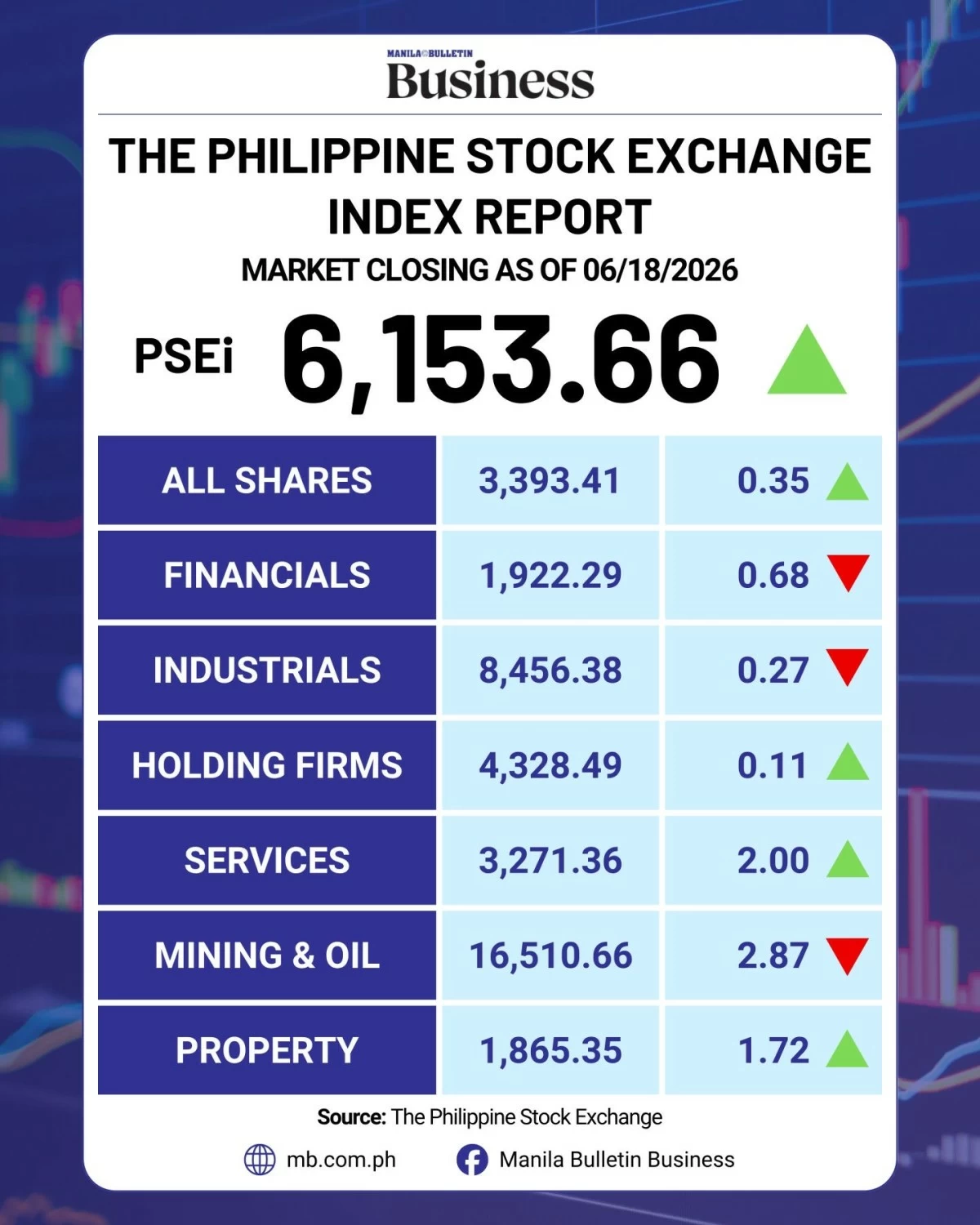
Local equities market halted its downward trajectory, staging a recovery after the United States (US) and Iran signed the preliminary accord aimed at a permanent peace agreement, but gains were severely capped after the central bank went ahead with an expected interest rate increase, prompting investors to scale back positions in rate-sensitive industries.
The Philippine Stock Exchange index added 38.85 points, or 0.64 percent, to settle at 6,153.66 on Thursday, June 18. The broader equity market showed deep division among sector amid tug-of-war between macroeconomic relief and local monetary tightening.
The Services index spearheaded the advances, while the Mining and Oil counter endured the steepest decline of the session.
Market liquidity thinned significantly during the session as trading volume dropped to 447 million shares, with transactions valued at ₱7.15 billion. Decliners also outnumbered advancers 100 to 82, while 56 issues closed unchanged.
“The Philippine market ended in positive territory, recovering from yesterday’s broad-based sell-off, supported by improved investor sentiment following reports of a peace deal between the US and Iran,” said Luis Limlingan, head of sales at Regina Capital Development Corp.
While buyers dominated the morning tape, the upward momentum began eroding as the afternoon session progressed. Selective profit-taking intensified across the board after the Bangko Sentral ng Pilipinas indicated it would maintain its restrictive monetary posture.
The central bank’s decision to continue its rate-hiking cycle forced money managers to reassess corporate valuations under higher borrowing costs.
The diplomatic breakthrough between Washington and Tehran carries heavy weight for the import-dependent Philippine economy. The memorandum of understanding includes an agreement to reopen the strategic Strait of Hormuz for a minimum of 60 days. This key maritime corridor is vital for global energy logistics, and its reopening is expected to cool volatile global oil prices.
“The local market bounced back as the US and Iran signed a memorandum of understanding with a goal of moving toward a permanent peace deal,” said Japhet Tantiangco, research manager at Philstocks Financial Inc.
He noted that the temporary resolution at the Strait of Hormuz is projected to alleviate global oil supply constraints, which will subsequently soften the domestic inflation outlook.

What social media doesn't tell you about vegetable dumping


By Yvette Tan
Published Jun 19, 2026 12:05 am | Updated Jun 18, 2026 04:45 pm
AVANT GARDENER
It seems that one can’t open social media without encountering a post about vegetable dumping, its comment section filled with netizens angrily wondering why nothing is being done.
Department of Agriculture (DA) Regional Executive Directors (RED) Rose Mary G. Aquino, PhD (Region II); Atty. Jennilyn M. Dawayan, CESO III (CAR); and Engr. Redeliza Gruezo (Region IV-A) explained in Tagalog why vegetable dumping keeps happening, what is being done to prevent it, and who should be held responsible.
First, they addressed the lack of a planting calendar. “We’ve been advocating for crop programming, but farmers are still hesitant,” Dawayan said, reporting on what farmers and provincial agriculturists said during the Farmers’ Congress in Benguet and Mountain Province. “Farmers in rain-fed areas will only plant when there’s water.”
Other reasons include,” harvests being sold exclusively to trading posts, which will receive the goods whether the market is up or down,” as well as a prevailing attitude of “If s/he can plant it, why can’t I? What if s/he hits it big and I don’t?”
Aquino added that the more farmers plant the same crop, the less likely their whole crop will be ravaged by pests, which means that they will still have something to sell. “There’s a relevance when it comes to pest outbreaks,” she said. “It’s a big effect on income because an attack can be tantamount to a 40-50 percent yield reduction. That’s huge.”
Gruezo agreed. “Aside from the technical aspects, it’s also about values. We keep promoting venturing into other commodities, but they keep planting tomatoes. They say, ‘Dito kami jajackpot, dito kami lulugi, dito pa rin. (This is where we’ll hit the jackpot, this is where we’ll lose, this is where we’ll stay.)’ It’s their expertise.”
Farmers are known for their ‘to see is to believe’ attitude, and when they see their neighbor making it big with a crop, they’re apt to follow, which could lead to an oversupply. When this happens, netizens tend to place the blame solely on the national government without also holding more directly involved players accountable.
While vegetable dumping gets massive attention on social media, Aquino explained that it’s not the whole picture. “They don’t lose money 12 months of the year… There’s a time when they earn big. People ask why they don’t plant other crops. They plant [the same crops] because they know that there’s a time of the year when they’ll earn a lot. We can even declare them millionaires because that’s how much they sell,” she said. “They know that they’ll lose money during a certain time of the year, but they’ll break even or make more when prices are high.”
Dawayan explained that, for tomatoes in particular, one plant can yield 18 primings, or harvests, with each harvest yielding fewer of their desired size or color. If well cared for, the farmer would have made a profit by the 3rd or 4th priming. Some dumped tomatoes come from the later harvests.
She also addressed the common netizen refrain of “Why can’t they just turn it into sauce?” “It doesn’t work that way,” Dawayan said, adding that they have already explored processing. “Even processing has its own quality requirements.”
Aquino brought up something important. Even if processing were possible, would there be a guaranteed market for the resulting product? “Processing is preservation so that [something] doesn’t go to waste. But a majority of consumers still prefer fresh [tomatoes].”
Sometimes, an oversupply is actually a logistics issue. “Can it still be called an oversupply if there’s an excess in one area and none in another?” Dawayan asked. If this is the case, solving it will require cooperation between agencies and organizations, not just the DA.
This doesn’t mean that vegetable dumping should be condoned. What the REDs are saying is that the DA has been looking for ways to end the practice, but they can’t do it themselves. “The DA has two faces: national and local government units. We should be helping each other, but when there’s a problem on social media, [it’s National] that gets attacked,” Aquino said, adding that it’s important that each player’s role is understood so that the proper parties are held responsible.
“All I ask on the part of media is it would be nice if they also covered the times when the farmers hit it big… when they’re instantly buying pickup trucks,” she added. “Not just when they’re throwing harvests away.”
It’s very easy to blame a nebulous entity when something goes wrong. However, part of repairing a broken system involves relevant parties taking responsibility for their actions. As the REDs point out, the DA can only do so much on a national scale. Other players closer to the ground, like local governments, farmers, and consumers, need to do their part as well.

Third BTS concert date added in Bulacan amid high demand


Concert promoter Live Nation Philippines announced on June 17 that a third show will take place on March 16, 2027, at the Philippine Sports Stadium in Bulacan, joining the previously scheduled March 13 and 14 performances.

“ARMY. One more night, one more chance to experience BTS WORLD TOUR ‘ARIRANG’ IN BULACAN,” the promoter said in its announcement, confirming the additional show for the group’s highly anticipated return to the country.   

The expansion of the concert schedule comes after widespread calls from fans, with many Filipino ARMY members urging organizers to add another date after thousands were unable to secure tickets for the initial two shows, both of which sold out quickly.

Ticket access for the newly added concert will follow a staggered sale schedule, with an ARMY Membership presale set on June 19 from 9 a.m. to 10 p.m., followed by the general onsale on June 20 starting 9 a.m. 

BTS'
BTS' "Arirang" world tour in Bulacan (Live Nation Philippines)
BTS'
BTS' "Arirang" world tour in Bulacan (Live Nation Philippines)
BTS'
BTS' "Arirang" world tour in Bulacan (Live Nation Philippines)
BTS'
BTS' "Arirang" world tour in Bulacan (Live Nation Philippines)
BTS'