You plan to move to the Philippines? Wollen Sie auf den Philippinen leben?

There are REALLY TONS of websites telling us how, why, maybe why not and when you'll be able to move to the Philippines. I only love to tell and explain some things "between the lines". Enjoy reading, be informed, have fun and be entertained too!

Ja, es gibt tonnenweise Webseiten, die Ihnen sagen wie, warum, vielleicht warum nicht und wann Sie am besten auf die Philippinen auswandern könnten. Ich möchte Ihnen in Zukunft "zwischen den Zeilen" einige zusätzlichen Dinge berichten und erzählen. Viel Spass beim Lesen und Gute Unterhaltung!


Visitors of germanexpatinthephilippines/Besucher dieser Webseite.Ich liebe meine Flaggensammlung!

free counters

Total Pageviews

Monday, October 19, 2026

Classes in Metro Cebu suspended due to poor air quality By Calvin Cordova


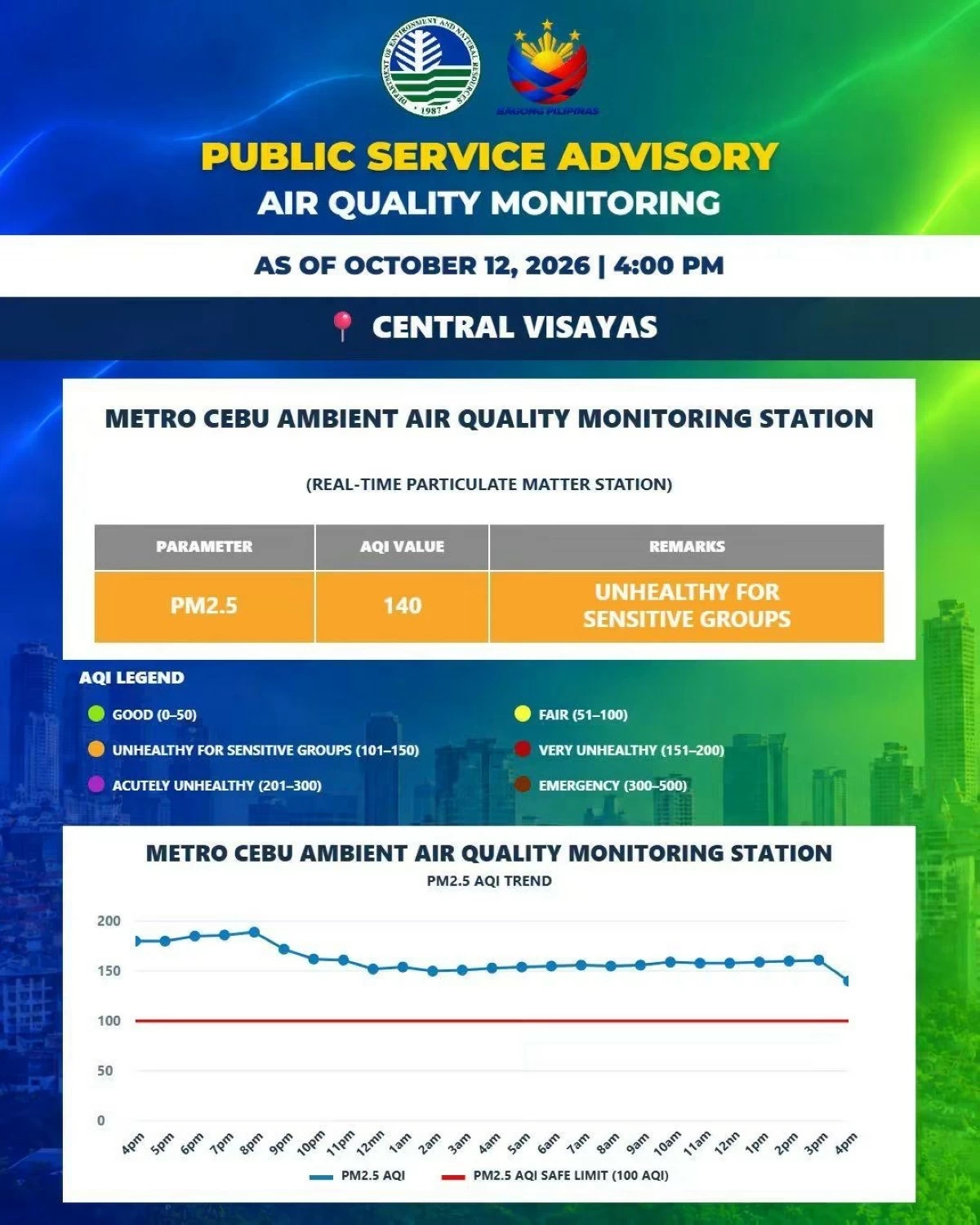
The air quality in Metro Cebu as of 4 p.m. on Monday, Oct. 12, was ‘unhealthy for sensitive groups.’ (EMB-7)
CEBU CITY – Due to poor air quality, several areas in Metro Cebu suspended face-to-face classes on Monday, Oct. 12.
Among those that cancelled in-person classes for all levels were the local government units of Cebu, Mandaue, Lapu-Lapu, and Talisay cities and the towns of Consolacion, Minglanilla, Compostela, and Liloan.
These LGUs instructed schools to shift to online classes.
“This precautionary measure aims to protect the health and safety of our students, teachers, and school personnel amid unhealthy air quality,” Cebu City Mayor Nestor Archival said.
The suspension of physical classes came on the eve of the announcement of the Environmental Management Bureau in Central Visayas (EMB-7) that air quality in Metro Cebu deteriorated once again.
On Sunday, the air quality index (AQI) in Metro Cebu rached 180 which fell under the “very unhealthy” category. 
On Monday morning, Oct. 12, the AQI hit 156 which still fell within “very unhealthy levels.”
In its 4 p.m. advisory on Monday, the AQI improved to 140 but was still “unhealthy for sensitive groups.”
With the poor air quality, children, elderly, and individuals with existing respiratory conditions are discouraged from going outdoors.
Wearing masks was also recommended for those venturing outdoors.
The EMB-7 attributed the poor air quality to local pollutants such as emissions from vehicles and industrial outputs.
The prevailing amihan (northeast monsoon) also contributed to the poor air quality, the agency said.

Useful Psychology Tricks

1. Lower your voice during arguments because calm energy changes the entire mood.

2. Stay quiet after excuses because silence often makes people say more than they planned.

3. Repeat their last few words softly because it encourages them to keep explaining.

4. Ask calm questions instead of fighting because questions break resistance faster than anger.

5. Keep your expression neutral because people respect what they cannot easily read.

6. Step away when emotions get high because self-control wins more battles than reactions.

7. Use simple and short sentences because powerful people rarely over-explain.

8. Change your environment when mentally stuck because new places create new thoughts.

9. Trust consistent actions more than sweet promises because patterns always reveal the truth.

If you are still reading this…I know you felt these lines somewhere deep inside you❤️.you saw your own story, didn’t you?

You gave too much… loved too deeply… and in return you got silence.

 Sharing valuable information and public service from the No. 1 regional newspaper in Western Visayas. https://lnk.bio/panaynews

Happiness in today’s world

FEELING that the conditions of your life are good. Enjoying positive, healthy relationships with other people. Feeling that you have accomplished (or will accomplish) what you want in life. Feeling satisfied with your life. Feeling positive more than negative.

Happiness is a state of mind. Specifically, it is a state of “well-being and contentment.”

But the definition can be tricky and assumptions about the word can cause confusion. Many don’t even realize learning how to be happy is something that can be intentionally practiced. Some people, when they hear the word “happiness”, assume it is an emotion such as pleasure or joy. For them, it is what people feel in the immediate here and now.

This is the reason some people say, “Don’t pursue happiness, seek joy. Happiness is fickle and fading, joy remains forever.”

But this short-term definition of happiness is not how everyone understands the word. Some define it to mean long-term satisfaction.
In fact, when I speak of experiencing happiness in life, I am not thinking of short-term emotions at all. I think of a quality of living — a much longer-term view of the word.

Both definitions are understood to be correct and speak of different realities.

But are they really that different? I don’t think so.

After all, a long-term experience of life satisfaction is almost certainly made up of many short-term feelings of joy and pleasure. Does that mean every day is a great day with no trials, temptations, or downturns?

ComScore Observer

Certainly not. But it does mean when we look back at the many seasons of life, we can look back satisfied at how we navigated them.
The long-term feeling of life satisfaction is most experienced when we embrace the emotion of joy in the here and now. And we accomplish that by taking steps each day to be happy.

What makes you feel happy now? Doing something you’re good at, such as cooking or dancing, is a good way to enjoy yourself and have a sense of achievement. Try to avoid things that seem enjoyable at the time but make you feel worse afterwards, such as drinking too much alcohol or eating junk food.

Why is being happy important? 

Experiencing happiness is important for our emotional and physical health. A stronger sense of happiness and wellbeing has been shown to lead to better relationships, increased social connection and contribution to the lives of others, as well as contributing to healthier physical wellbeing.

Is being happy the most important thing in life? 

Happy people are healthier all around and more likely to be healthy in the future. Happy people live longer than those who are not as happy. Happy people are more productive and more creative, and this effect extends to all those experiencing positive emotions.

Am I happy?

Yes. Living in the Philippines for almost 28 years for good, I learned to be happy. Even during hard times.

Filipinos are generally a happy people. They can smile whatever the situation. Their happy-go-lucky nature and positive mindset allow them to bounce back from the direst of circumstances, from disasters, from wars, and surely from today’s global situation.

***

Questions, comments or suggestions? Email me: doringklaus@gmail.com or follow me on Facebook or LinkedIn  or visit one of my websites www.germanexpatinthephilippines.blogspot.com or www.klausdoringsclassicalmusic.blogspot.com./PN

Digitally vigilant but spiritually lax


By Fr. Roy Cimagala

Chaplain

Center for Industrial Technology and Enterprise (CITE)

Talamban, Cebu City

Email: roycimagala@gmail.com


ONE of the biggest illusions of modern life is that everything important comes with a notification. Meetings appear on calendars. Flights send reminders. Bills trigger alerts. Even birthdays pop up automatically. We have become so dependent on warnings that we assume life itself will always give us advance notice. Jesus says otherwise.


In Luke 12:35-38, he paints a vivid picture: servants dressed for work, lamps burning, eyes fixed on the door, waiting for their master to return from a wedding feast. They do not know the hour. They simply remain ready. And then comes the astonishing promise. When the master finds them awake and faithful, he himself will seat them at table and serve them.


That reversal changes everything. The Lord whom we serve delights in serving those who have remained loyal to him. Divine authority is expressed not in domination but in self-giving love. The reward for fidelity is not merely admission into heaven but intimate communion with the One who came "not to be served but to serve."


Readiness, therefore, is not anxiety. It is love that refuses to fall asleep. Too many people imagine holiness as preparing for death at the last minute, as though eternity could be handled like cramming for an examination. The Gospel rejects that mentality. Readiness is not a final sprint but a daily way of living. Every ordinary task becomes part of our preparation to meet Christ.


That is why the Lord speaks of lamps. A lamp that is never refilled eventually burns out. So does the Christian who neglects prayer, the sacraments, acts of charity, and the constant struggle against selfishness. Faith cannot survive on yesterday's oil.


This warning lands squarely in today's culture. We stay awake until two in the morning binge-watching an entire television series, yet struggle to give God ten quiet minutes in prayer. 


We instantly respond to every notification on our phones but repeatedly ignore the gentle promptings of conscience. We anxiously refresh stock prices, sports scores, and social media feeds while forgetting to examine whether our own soul is growing closer to God.


Our gadgets are fully charged. Our spirits often run on one percent battery. Even in the Philippines, where religious devotion remains strong, the temptation is real. Churches fill during major feasts and Holy Week, yet honesty in business, integrity in public office, and charity in everyday relationships often lag behind. Public expressions of faith mean little if the lamp of daily conversion has quietly gone out.


The Gospel calls for consistency. The Christian does not wear discipleship like formal clothes reserved for Sundays or fiestas. Readiness is woven into every decision, every conversation, every responsibility. We remain alert because every moment offers another opportunity to love God and our neighbor.


There is another surprise in Christ's words. The servants are waiting, but the master is actually looking for them. Heaven is not indifferent to our struggle. God eagerly seeks hearts that remain faithful amid distractions, temptations, disappointments, and delays. He never overlooks hidden acts of goodness that the world ignores.


The happiest people, then, are not those who have everything under control but those who are always available to God. Their schedules may be interrupted, their plans may change, and their future may be uncertain, but their hearts remain prepared.


Life gives no final reminder before eternity arrives. Christ does not ask us to predict when he will come. Let’s just keep the lamp burning. Keep the heart awake. One day the door will open, and the Master we have long awaited will surprise us with the greatest joy of all—he will invite us to his table and serve us with the everlasting love that never sleeps.


Sunday, October 18, 2026

How dumpsites threaten ancestral lands and ecosystems


Image of dumpsite by Tom Fisk via Pexels

By Sean Fernando

Published Oct 18, 2026 11:12 am


The forests of Sitio Tibag in Barangay Naugsol, Subic, Zambales have long been an important part of the lives of the Aeta Ambala community. As part of their ancestral domain, the area provides clean water, food, medicinal plants, and other natural resources that support daily life. Beyond its environmental value, the forest also holds cultural and historical significance, reflecting the community's long-standing relationship with the land and its traditions of caring for natural resources.


In recent years, the area became the subject of national attention because of allegations that an open dumpsite had been operating within the ancestral domain. The issue was widely publicized through Ibinasurang Paraiso, an I-Witness documentary by journalist Kara David.

The documentary reported that municipal waste had allegedly been transported to the site beginning in 2019. It also presented accounts from residents who said garbage trucks regularly entered the area after a road was constructed, eventually leading to the accumulation of large amounts of waste in parts of the forest.

Community members interviewed in the documentary described foul odors, concerns about the quality of nearby streams, and changes to the surrounding environment that they said affected their health, livelihoods, and access to natural resources.

The controversy highlighted the importance of environmental management and Indigenous rights under Philippine law. The Ecological Solid Waste Management Act of 2000 (Republic Act No. 9003) establishes the country's framework for proper waste management. Among its provisions, the law prohibits open dumpsites and requires local government units to adopt environmentally sound methods of waste collection, treatment, and disposal. The law aims to reduce pollution, protect public health, and encourage sustainable waste management practices.

The case also drew attention to the Indigenous Peoples' Rights Act of 1997 (Republic Act No. 8371), which recognizes the rights of Indigenous Peoples over their ancestral domains. The law affirms their rights to possess, manage, and protect these lands according to their customs and traditions while also promoting their participation in decisions involving the use and development of their territories. It also seeks to preserve Indigenous cultures, knowledge, and the natural environments that support their way of life.

Following the public attention generated by the documentary, the Department of Environment and Natural Resources (DENR) ordered the closure of the reported dumpsite. The National Commission on Indigenous Peoples (NCIP) and members of Congress also initiated investigations to examine the allegations, determine whether environmental and Indigenous rights laws had been violated and assess the reported effects on the Aeta Ambala community. These investigations formed part of the government's process for establishing the facts, identifying any legal responsibilities, and recommending appropriate actions.

The controversy also prompted broader discussions about the responsibilities of local governments, private entities, regulatory agencies and communities in managing solid waste. It underscored the challenges of balancing development, public services, environmental protection, and respect for Indigenous rights. Environmental experts have long noted that improper waste disposal can affect water quality, soil, wildlife, and public health, making effective waste management an important concern for both urban and rural communities.

As authorities continued to investigate the allegations, the events in Sitio Tibag became an example frequently discussed in conversations about environmental governance and the protection of ancestral domains in the Philippines.

Regardless of the outcome of legal and administrative proceedings, the case has contributed to greater public awareness of the importance of complying with environmental laws, safeguarding Indigenous rights, and ensuring that waste management practices protect both people and ecosystems for present and future generations.


Palawan tops luxury magazine's list of best islands in Asia


BEST IN ASIA. Palawan takes the top spot in the Best Islands in Asia list by Condé Nast Traveler’s Readers’ Choice Awards. (Photo by Leon Macapagal | Pexels)

Palawan tops luxury magazine's list of best islands in Asia

In the recent release of the UK edition of the Condé Nast Traveler's Readers’ Choice Awards, Palawan has taken the top spot for Best Islands in Asia with a score of 98.99. Placed in second and third are Phu Quoc, Vietnam (scoring 98.26), and Koh Lanta, Thailand (scoring 97.50). Boracay also landed in the top 10, placing seventh with a score of 94.29. Read more

IT'S THE SMALL THINGS


By Alex M. Eduque

Published Oct 18, 2026 12:05 am


We are well into the second weekend of October. It is already October, which means we ask ourselves, “Are we all ready for the holidays?”

Before we talk Christmas though, as a Catholic, there is a lot in October that I personally feel adds a lot of meaning into our lives if we choose to notice, and that substantiates our spiritual and holistic health. October is the month of our holy rosary – a reminder to us not only to pray. More importantly, that prayer is not only about asking and waiting for our wants to be granted, but just as much about giving thanks for what has been, and what is to come.

The month of October also celebrates a lot of feast days of saints I pray to. The month actually begins with the Feast Day of Saint Therese de Lisieux who is known as the “little flower of Jesus.”

Saint Therese is revered because of her “Little Way” philosophy. Her life and the manner in which she chose to live reminds us all that whether it is holiness, or success, can be achieved through small everyday acts for as long as they are done rooted in love, and with intention, rather than more grand deeds.

This resonates so much with what this column chooses to celebrate and highlight – that at the end of the day, it is the small things we should place emphasis and focus on because in the grander scheme of things, they are what constitute and build greatness, and thus, matters most.

October second is the feast day of Holy Angels which honors the significance of our Guardian Angels and divine protection – the notion that the Lord assigns a heavenly guardian to guide and watch over each one of us from birth until death. Again another reminder to all of us to give thanks for the divine protection bestowed upon us, and to carve out even a small amount of time everyday to pray.

October the seventh was the feast day of Saint Gerard, known as the patron saint of mother’s and children. I remember praying fervently to him during my pregnancy, and I truly felt that he helped me traverse such a stressful and tumultuous time. His feast day is a reminder to all of us to always honor our mothers because of what they went through to bring us into this world.

Toward the end of the month on the twenty-fourth is the feast day of Saint Raphael the Archangel who is a reminder to all of us that God heals, and that even in the face of evil, our protectors will slay and we will make it through. And then on the twenty-eighth is the feast day of Saint Jude Thaddeus, he who is known as the saint of the impossible. A representation that nothing is impossible with prayer, and if we truly believe.

Of course, the month ends with Halloween. For the kids, and kids at heart, here is another excuse to dress up, play around, and enjoy the treats. Moreover, it is a reminder to all of us to take the time to honor those who have gone ahead of us; to pray for their memory and to find even the smallest ways to continue their legacy.

If there is a realization I want to end with this week it is, of course, to always stop, and take a pause to be grateful as that is the key to contentment and ultimately, happiness. Let us always keep an open mind because there is something new to learn everyday. And with that, let us also make the conscious effort to rid ourselves of bad habits, and to choose kindness always. It is hard enough to learn things, yes. But what we tend to forget over time, and take for granted is the difficulty that comes with unlearning them – the bad habits, the clutter, and the unnecessary, most especially.

As with a lot of things in life, cleaning up our everyday starts with the small things. And there is no better time to start than now. Always keep a prayer in your pocket, consistency is key, and remember that sometimes, our prayers are not answered exactly in the way that we request and that we expect, but trust that God listens and will always work to grant it in the way that is best for us.

The right time in life


The right time in life
By Klaus Döring

"The Right Time" is a song by Celtic folk rock band the Corrs, the third single from their debut album, Forgiven, Not Forgotten (1995). It was released in 1996 and the track was remixed for airplay. The remix replaced a light and breezy rhythm with a hard, pounding beat coupled with reggae-style bass. The remix was produced by Per Adebratt, Tommy Ekman, and Douglas Carr, who had previously worked with Ace of Base. The song was featured in Corr's live sets for several years.

"The Right Time" was targeted at pop radio by Atlantic US, hence the video theme of 1960s pop tinged with psychedelic, and the band's new haircuts and publicity photos. The new style lasted around a week before the Corrs' classic look returned. The video for the track was originally filmed and released with the "Radio Edit – Dance Mix" version; promotion was done with this version too. The album edit video can be found on the Best of The Corrs DVD.

A "once-in-a-lifetime" event is something so rare or exclusive that it happens only a single time for a person—or within a specific historical or cosmic span—and can never be repeated.The idiom "to have the time of your life" means to enjoy yourself very much, experiencing an extremely fun, exciting, and memorable occasion or period.

 While some listeners connect the melancholic lyrics to personal experiences of grief, many fans speculate that the track references his ex-partner, Maggie Thurmon, or the emotional toll of sudden celebrity.

Do we really know the right tine about anything in your or my life?  Who knows


Viva Hot Babes on being sexy then and now


Charmie Joy Pagulong - The Philippine Star 

MANILA, Philippines — No matter what they do, the members of the pop girl group Viva Hot Babes will always be associated with their sensual appeal and sexy image.

Some of them tried to distance themselves from that image, especially those who entered public service, but as time passed, they simply learned to accept and embrace it.  

“Actually, I tried na malayo from the sexy image because getting into public service medyo kailangan mong mawala ng kunti dun sa image na yun para hindi ka rin ma-bash ng constituents mo,” began Jaycee Parker during a presscon for their upcoming concert, “Bulaklak Viva Hot Babes Reunion Concert.” She is currently serving as a councilor in Angeles City, Pampanga.

“But kahit anong gawin ko ganun pa rin. They know that I’m part of the Viva Hot Babes. Before, I tried to distance myself from that image. But now, I’ve learned to accept it and ginagamit ko siyang talaga na dati akong Viva Hot Babes, that’s why they remember me. So instead of staying away from that image, I’ve decided to accept it and embrace it.”  

Actress and former beauty queen Andrea del Rosario shared a similar experience when she was elected vice mayor of Calatagan, Batangas, in 2016.

“There was a time na especially nung nakaupo ako wherein I tried my very best to remove the stigma of being a sexy symbol,” she recalled. “So talagang I worked hard for it. I turned down a lot of shows and movies ‘cause I owed it to my constituents to somehow mabigyan ng respeto yung position at that time. So that was my path and I tried to stay on that path. As a matter of fact, the last movie I did, medyo nag-iinarte ako kasi medyo, ako yun. It was my fault.”

The group formed by Viva’s Vic del Rosario became known not just for their sexy image, gracing magazine covers and starring in movies, but they also rose to fame with novelty pop-dance music, including hits such as Bulaklak, Kikay and Basketbol.

But over time, she realized that sensuality was something innate to her. “That’s why I think that’s something that we should embrace and not feel that’s something bad. And yeah, it’s either you have it or you don’t. And I think the Hot Babes have that, innately, that sensuality. For this show, we’re embracing it and embracing it confidently.”

“Siguro po nakatatak na talaga yung Hot Babes sa aming kaluluwa. Haha!” actress Katya Santos remarked. “Even if we take on mother, tita roles, lagi pa ring nandun yung sexy tita, sexy mommy, ganun. There’s always this connection to being a Hot Babe. I think it will never be gone.”  

She doesn’t mind being labeled as such. Instead, she takes it in stride and embraces it. “I think it’s a compliment for us because it means that we still maintain our looks. And I’m still thankful for that.”

Sheree, on the other hand, admitted that she is hesitant to take on mother roles in acting projects. “Pag sinabi ng handler ko, ‘Girl, are you ready to be a mom?’ Iniisip ko parang hindi ko pa kayang maging mommy because I feel that I haven’t found my forever yet. So I feel that I want to stay being a Hot Babe for now.

“But lately, parang naisip ko na parang, ‘Why not?’ Pero namimili pa rin ako. Wag naman yung ka-edad ko na tapos magiging nanay ako. But yes, we’re accepting it right now,” she said, adding that she still hopes to find her prince charming.

“Actually, I don’t think that sensuality can ever really be separated from us dahil tumatak sa tao. That’s how people see us,” added Gwen Garci.

Gwen said she’s open to exploring mother roles, although some people feel that she does not quite fit those roles just yet. “They are finding roles for us that would fit us like being an ate or tita. But for me, I’m OK with mother roles. Pero para sa kanila, hindi daw talaga bagay sa akin. They tell me to wait a few more years before I’m given a mother role.”

Their fun and nostalgic interviews, which revisit their heydays, will soon be available on Philippine STAR’s Youtube channel: https://www.youtube.com/@PhilippineStar
Photos from Russell Palma

For Jennifer Lee, it “depends on whose perspective” when it comes to being part of a sexy group. “But the sexy image was just a part of it. There’s actually more. We are also known as a pop group who are loved by kids, mommies and grandmothers.”  

“I don’t think it ever left. Haha!” declared Maui Taylor, adding that she often plays sexy kontrabida roles in her acting projects.

“I was even begging to be given mom role but hindi talaga. Even Boss Vic (del Rosario) told me, ‘Hindi ka pwede.’ So the sexy genre is still there but it’s more on the kontrabida side. Hindi na yung katulad nung pa-sexy like before. Kumbaga sexy na lang sa damit, ganun lang.”

Maui also stated that there is no need to compare them with fellow girl group SexBomb Girls, who recently held their own reunion concert. She likewise shared that one of the reasons they decided to stage their own reunion show was that they were inspired by the SexBomb Girls.

“They are actually good friends of everyone. So when they found out that we were having this reunion concert, they already sent a congratulatory message to the group.”

Acknowledging that comparisons will always be inevitable, Maui stressed that their ‘Bulaklak’ concert will offer something different from the SexBomb show. “We want to showcase the celebration of the 23 years of friendship and this is not just an ordinary concert. It’s going to be an experience for everyone. Ipaparamdam namin sa lahat na ito yung Viva Hot Babes.

“This is what we’ve gone through after all these years. This is what we’ve achieved. These are the years of friendship. And everyone’s gonna feel that all throughout the concert.”

Directed by GB Sampedro, the ‘Bulaklak Viva Hot Babes Reunion Concert’ will take place on Oct. 23 at the New Frontier Theater.

Words carry weight


By Manila Bulletin Newsroom

Published Oct 18, 2026 12:05 am | Updated Oct 18, 2026 09:29 am
Words can heal, inspire, and bring people together. They can also wound, humiliate, and deepen divisions. Once spoken, especially before an audience, they cannot always be taken back. This is why freedom of expression, however fundamental, must be exercised with responsibility.
The responsibility becomes even greater for those who command a public following. In an age when a passing remark can travel across social media within minutes, what is dismissed as a joke by one person may be repeated, normalized, and accepted by thousands of others.
The controversy surrounding the podcast Machong Chismisan is a troubling reminder. Its hosts have come under scrutiny after offensive remarks were made about Josh Aquino, the eldest son of television personality Kris Aquino, who is on the autism spectrum. The National Bureau of Investigation has issued subpoenas to five hosts as it examines possible violations of laws protecting persons with disabilities, as well as possible cyberlibel.
The investigation must proceed fairly, with due process for everyone concerned. But whatever its legal outcome, the episode raises a moral question that cannot be brushed aside: Since when did a person's disability become acceptable material for public amusement?
Humor has a place in public discourse. Satire can expose hypocrisy, challenge authority, and help people confront uncomfortable truths. But ridiculing someone for a condition beyond that person's control accomplishes none of these things. It merely turns vulnerability into entertainment.
Nor can the words “just for fun” erase the hurt they cause. For persons with disabilities, such remarks can reinforce prejudices that have kept them excluded from schools, workplaces, and opportunities. For families who have spent years fighting for acceptance, they are reminders of how much further society must go.
Our laws recognize that dignity deserves protection. Republic Act No. 9442, which amended the Magna Carta for Persons with Disability, expressly prohibits public ridicule and vilification based on disability. Violations may carry fines or imprisonment, subject, of course, to the findings of the proper authorities and the courts.
Yet responsible speech should not depend solely on fear of punishment. Respect should be practiced even when no law is watching, no complaint is filed, and no outrage erupts online.
This is especially important for podcasters, entertainers, influencers, and other personalities whose words reach young audiences. They help shape what listeners consider funny, acceptable, or worth imitating. When ridicule becomes a source of laughter and applause, cruelty risks passing from one generation to the next.
The same responsibility belongs to ordinary citizens. We need not have millions of followers to hurt another person. A remark at home, a joke among friends, or a careless comment online can either challenge prejudice or perpetuate it.
As this Sunday invites reflection on the week that has passed, perhaps we should examine not only what we have said, but also whom our words may have hurt. We can defend free expression without surrendering compassion. We can disagree without demeaning. We can entertain without making someone else's dignity the price of admission.
Words carry weight. Let us use them to lift people up, not push them further to the margins. At a time when divisions already run deep, the least we can do is speak in ways that help build a more decent and inclusive society.