You plan to move to the Philippines? Wollen Sie auf den Philippinen leben?

There are REALLY TONS of websites telling us how, why, maybe why not and when you'll be able to move to the Philippines. I only love to tell and explain some things "between the lines". Enjoy reading, be informed, have fun and be entertained too!

Ja, es gibt tonnenweise Webseiten, die Ihnen sagen wie, warum, vielleicht warum nicht und wann Sie am besten auf die Philippinen auswandern könnten. Ich möchte Ihnen in Zukunft "zwischen den Zeilen" einige zusätzlichen Dinge berichten und erzählen. Viel Spass beim Lesen und Gute Unterhaltung!


Visitors of germanexpatinthephilippines/Besucher dieser Webseite.Ich liebe meine Flaggensammlung!

free counters

Total Pageviews

Friday, July 31, 2026

10 Things to Know About the August 2026 Total Solar Eclipse


It’s the first totality on Earth for 28 months. Overall, a billion people will fall under the Moon’s shadow on August 12, 2026.


A screen-grab from timeanddate’s live stream of the April 2024 total solar eclipse—from Burlington, Vermont.
The last time anyone on Earth saw totality was the great American Eclipse on April 8, 2024—seen here from the timeanddate.com mobile observatory in Burlington, Vermont.
©timeanddate.com
Don’t miss the Perseid meteor shower

1. First Totality on Earth for 28 Months

Before 2026, the last time the Moon completely covered the Sun was the total solar eclipse across Mexico, the United States, and Canada on April 8, 2024.

It’s been a longer-than-average wait! A total solar eclipse happens somewhere in the world once every 16 months on average.

Protect your eyes!

2. First Totality for Mainland Europe Since 1999

Three decades ago, at the total solar eclipse of August 11, 1999, the path of totality clipped the southwest tip of the United Kingdom, then crossed continental Europe from France to Bulgaria.

Since then, however, the only places in Europe to see totality have been parts of Georgia and Russia in 2006, and the Faroe Islands and Svalbard in 2015.

3. Totality Visible from 5 Countries

On August 12, 2026, the path of totality begins in the far north of Russia, crosses Greenland and the western edge of Iceland, then sweeps across northern and eastern Spain.

Did we say 5 countries? Yes—just! The path of totality also takes in a few square miles of the northeast corner of Portugal.

How to use eclipse glasses
Advertising

4. A Huge Partial Eclipse Across Europe

Nearly the whole of Europe will get a partial solar eclipse on August 12. This list shows how much of the Sun’s disk will be covered by the Moon in five European capital cities.

Check eclipse timings for your town or city

5. North America Gets a Slice of the Action

It’s not only Europe that gets to see an eclipse on August 12: a partial eclipse will be visible across northern parts of North America.

New Yorkers, for instance, might have a chance to see the Moon take a lunchtime bite out of the Sun. At maximum eclipse in the Big Apple—at 13:54 (1:54 pm) local time—9.4% of the Sun’s disk will be covered by the Moon.

The northwest corner of the African continent is involved, too. Morocco’s biggest city, Casablanca, has an 86.9% partial eclipse in the evening of August 12.
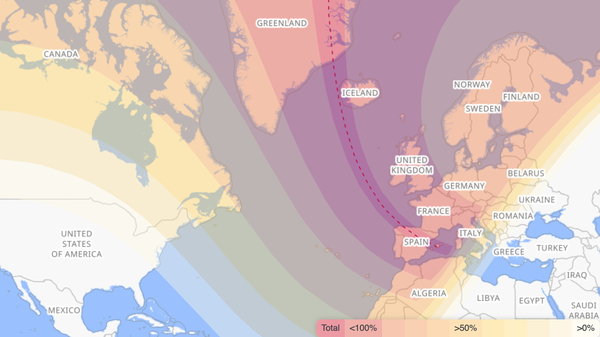
Screenshot of timeanddate.com’s interactive map for the total solar eclipse on August 12, 2026.

6. A Billion People Will Fall Under the Moon’s Shadow

For every solar and lunar eclipse, the timeanddate.com population tool calculates the number of people who live in areas where the eclipse is visible.

Our tool takes raw population data provided by the Center for International Earth Science Information Network (CIESIN) at Columbia University in New York City, and combines it with our own eclipse data. (CIESIN’s numbers are based on population estimates from the year 2000 to 2020.)

For the August 2026 solar eclipse, we calculate that:

  • Around 980 million people live in areas that will get a partial or total eclipse;
  • Of these, around 15.2 million people live along the path of totality.
Make a pinhole projector

7. A Polar Eclipse

The Moon’s shadow only just strikes the Earth this August—it skims across the top of the Northern Hemisphere.

One consequence of this is that nobody will get to see totality with the Sun and Moon high in the sky. At the point on the globe with the longest totality—2 minutes 19 seconds, just off the west coast of Iceland—the Sun will be 26.0° above the horizon when totality begins.

In the Spanish city of Valencia, near the end of the path of totality, the Sun will be just 4.6° above the horizon when totality begins, at 20:32 (8:32 pm) local time.

This means that across the European continent—and particularly in Spain—skywatchers will need to make sure they have a clear line of sight toward the western horizon. There is a risk that people’s view of the eclipse may be blocked by hills, buildings, trees, and other obstructions.
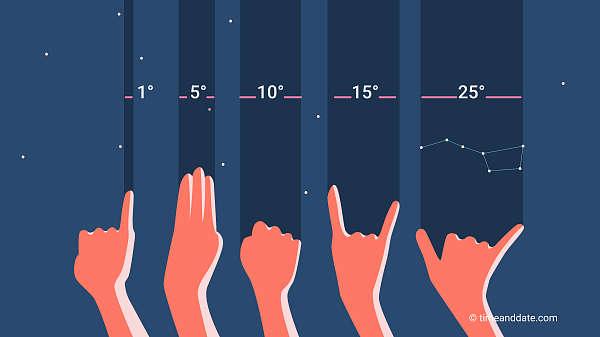
Illustration image

Another consequence of this polar eclipse: some places will be given a magical, fleeting glimpse of the stars and planets for the first time in months.

At Mount Clarence Wyckoff in northern Greenland, for instance, the Sun has been up—all day, every day—since the beginning of April. But during totality on August 12, the sky will darken and be filled with stars for an oh-so-brief 2 minutes… Have a look at the view during totality on our sky map (including Jupiter and Mercury just to the right of the hidden Sun).

8. The First of 3 Big Total Solar Eclipses in 23 Months

If you miss the total eclipse of August 2026, there are two more big Sun and Moon shows coming up.

On August 2, 2027, the path of totality will sweep across the southern tip of Spain, and parts of north Africa, the Arabian peninsula, and the Somali peninsula.

One year later, on July 22, 2028, totality will sweep across Australia and New Zealand—including 3 minutes 48 seconds of totality over Sydney Harbour.

9. It Coincides with the Perseid Meteor Shower

Solar eclipses happen at New Moon. This means the nights just before or after a solar eclipse are ideal for skywatching, since there’s no bright Moon to wash out the dark sky.

Happy coincidence: the moonless night of August 12–13, 2026, will be the peak of the Perseids—the Northern Hemisphere’s big summer meteor shower.

On August 12, don’t miss the chance to see a solar eclipse and the Perseid meteor shower on the same day.
©timeanddate.com

10. You Can Watch It on timeanddate.com

As always, you can follow the eclipse LIVE on timeanddate.com. We’ll have our telescopes on the ground in both León and Mallorca in Spain. We’ll also be teaming up with our friends and collaborators in Iceland, and across Europe and North America.

An photo of a telescope livestream test at the the timeanddate.com headquarters in Stavanger, Norway.
A sunny day at the timeanddate.com HQ in Stavanger, Norway: the perfect time for testing our telescopes and live stream equipment.
© timeanddate.com

God always provides for our needs


By Fr. Roy Cimagala

Chaplain

Center for Industrial Technology and Enterprise (CITE)

Talamban, Cebu City

Email: roycimagala@gmail.com


THE account of the multiplication of the loaves (Mt. 14:13-21) offers an important lesson about divine providence. Faced with a large crowd in a deserted place, the disciples focused on the scarcity of available resources. Jesus, however, revealed that God's providence is not constrained by human limitations. What appeared insufficient became more than enough when entrusted to him.


This episode naturally encourages confidence in God's care. At the same time, it raises an important question. How should believers understand those occasions when God's help seems absent despite sincere and persistent prayer? There are moments when illness continues, difficulties remain unresolved, and suffering appears to outlast our expectations. Such experiences are neither rare nor insignificant.


The Gospel itself provides the proper response. Rather than turning away from God during these periods of uncertainty, Christ invites his disciples to persevere in prayer. "Ask, and it will be given to you; seek, and you will find; knock, and it will be opened to you" (Mt. 7:7). 


These words are not a guarantee that every request will be granted exactly as desired. They are an assurance that God always responds according to a wisdom that surpasses our own understanding.


The multiplication of the loaves therefore teaches more than God's ability to provide material necessities. It points to a deeper reality. God's primary concern is not simply to solve immediate problems but to draw people into a more profound relationship with him. Material needs are important, yet they are not the ultimate goal of divine providence. God seeks above all the spiritual good of those he loves.


This perspective helps explain why certain trials remain. Difficulties can become occasions for growth in faith, hope, and trust. They reveal the limits of self-sufficiency and invite greater dependence on God. While human nature naturally seeks quick solutions, grace often works through a slower process of interior purification and maturity.


For this reason, the Church has always encouraged frequent recourse to the sacraments, particularly Reconciliation and the Eucharist. In these encounters with Christ, believers receive the grace needed to persevere, even when external circumstances remain unchanged. 


The sacraments remind us that God's greatest gifts are often invisible. His mercy, forgiveness, and transforming grace address needs that are ultimately more fundamental than material security.


The Gospel also reveals the generosity that characterizes God's love. Christ does not distribute the bread sparingly. Everyone eats until satisfied, and twelve baskets of fragments remain. 


The abundance is deliberate. It illustrates that God's generosity cannot be measured according to human calculations. His love is never merely transactional, granted only to those who have already earned it. Instead, he continually offers mercy, patience, and opportunities for conversion, even when people respond imperfectly.


This same generosity establishes the pattern for Christian living. Those who have freely received God's gifts are called to share them freely with others. Charity, therefore, is not simply occasional generosity but a habitual readiness to place one's abilities, time, and resources at the service of others. Such self-giving reflects the Father's own manner of loving.


The multiplication of the loaves ultimately directs attention beyond the miracle itself. It invites believers to trust that God's providence is always active, even when its workings remain hidden. His care embraces both our temporal needs and, more importantly, our eternal destiny. 


The challenge for every Christian is to remain receptive to grace, confident that God never abandons those who seek him sincerely. As faith matures, it becomes possible to recognize that God's greatest gifts are often those that transform the heart, enabling us to participate more fully in his own life and to love others with the generosity we have first received from him.