You plan to move to the Philippines? Wollen Sie auf den Philippinen leben?

There are REALLY TONS of websites telling us how, why, maybe why not and when you'll be able to move to the Philippines. I only love to tell and explain some things "between the lines". Enjoy reading, be informed, have fun and be entertained too!

Ja, es gibt tonnenweise Webseiten, die Ihnen sagen wie, warum, vielleicht warum nicht und wann Sie am besten auf die Philippinen auswandern könnten. Ich möchte Ihnen in Zukunft "zwischen den Zeilen" einige zusätzlichen Dinge berichten und erzählen. Viel Spass beim Lesen und Gute Unterhaltung!


Visitors of germanexpatinthephilippines/Besucher dieser Webseite.Ich liebe meine Flaggensammlung!

free counters

Total Pageviews

Saturday, September 26, 2026

Is the Philippines finally having its soft power moment?


Is the Philippines finally having its soft power moment?

In 2026, we’re reaching a point where Pinoy Pride no longer feels forced onto anyone with a drop of Filipino blood. Alex Eala’s been making tennis history, Olivia Rodrigo’s cemented her pop princess status, while Sophia Laforteza of Katseye and the members of Bini have been soaring to new career heights after their Coachella sets—and yes, ube’s the new matcha.

For a nation whose global news headlines usually revolve around natural disasters and political corruption, these wins are quite the comforting distraction. They also beg the question: Is the Philippines finally developing its own soft power?

Sophia Laforteza | Photo from sophia_laforteza/Instagram
Bini at Coachella | Photo from @bini_ph/Instagram

Soft power equals cool

Soft power is a term that refers to a country’s ability to influence and persuade people without the use of military or other coercive means. For countries like ours that don’t necessarily have or need strong militant forces, we can consider soft power as a culture of coolness.

Soft power brings in new tourists, TikTok vlogs that romanticize what you may consider mundane about your country, and the priceless recognition of your nation and culture as something “cool.”

All thanks to soft power, Japan exceptionally rebuilt its image after World War II, and South Korea became a global force to be reckoned with through the Hallyu wave after experiencing financial crises. Everyone being in a “very Chinese time of their lives” is another form of soft power—albeit a bit more unserious.

Soft power is more than capable of becoming a launchpad for countries that would otherwise be overlooked or overshadowed. For a country as multicultural as the Philippines, the development of tangible soft power could spell wonders for our already exceptional creative industries—as well as a solidified identity that no longer gets conflated with Latin American or Pacific Islander cultures.

Olivia Rodrigo (AP Photo_Chris Pizzello)

Everybody gets more Filipino now

There’s an apartment in Monaco that’s probably blasting Rodrigo’s newest album as we speak. That flat is probably owned by Anya Granados, the only Filipina journalist who’s accredited to cover Formula 1, Formula 2, and Formula E.

Like the newly crowned pop princess, Granados is also a mixed Filipina working to put the Philippines on the map in industries that have traditionally leaned Western. From mainstream pop music to motorsport, it’s initially been rare to see Asian voices at the forefront, but recent years are turning the tide there.

“Olivia has reached a point where her Filipino identity doesn’t have to be introduced to a Western audience as a novelty or an educational footnote,” Granados shares. “It simply exists within the global cultural picture she occupies. She is Filipina American, but she is also one of the biggest young artists in the world.”

“When she brings Filipino elements into that world, millions of people encounter them without being told, ‘here is a Filipino person you should know.’ They are simply encountering her,” she adds.

The world has been consuming Filipino culture for years

This distinction is of particular importance: for Granados, the world has been consuming Filipino culture for years. It just wasn’t paying attention to what was Filipino. In the early 2000s, we already had stars like Enrique Iglesias, Shay Mitchell, Nicole Scherzinger, and Vanessa Hudgens who had Filipino heritage, one way or another.

“There was a real pressure to assimilate, sometimes even to distance yourself from being Filipino,” as per Granados.

That pressure is a natural side effect of centuries’ worth of colonial mentality, despite an overwhelming Filipino presence scattered across the globe through our diaspora, and the “unusual amount of raw material” we have in music, fashion, beauty, food, film, literature, design, and sport. Raw materials like capiz shells and ylang-ylang, for example, are often associated with luxury and opulence first (see Ibiza-style dresses and Chanel No. 5), and their Filipino-ness second.

Anchored in their Filipina identity

What makes Rodrigo and Eala’s ascents to superstardom extra admirable is the visceral shift from that urge to distance oneself. Rodrigo and Eala are consistently anchoring their Filipina identity when they’re making their press rounds.

(Unless one lives under a rock, they’re bound to know about the aforementioned stars’ Filipino roots because they make where they hail from crystal clear.)

By doing so, they and their successes become instrumental in developing a more positive and nuanced view of Filipino people, which is important when the Western world still tends to associate Filipinos with the stereotypical roles of caregivers, nurses, and service workers.

Crab islands

What do Liza Soberano and Eala have in common, aside from being Filipinas making waves across the globe? They both prove how the Philippines is a country that loves to celebrate winners but cannot get itself to celebrate the process that makes them winners.

“Once there is a medal, a championship, a ranking, a record, suddenly everyone wants to claim them. But the years of development that came before the victory: the money, coaching, travel, sacrifices, and uncertainty, are much less glamorous and therefore much harder to get people excited about,” shares Granados.

Sports like tennis, gymnastics, and weightlifting only started to become palatable to a Filipino audience when Eala, Carlos Yulo, and Hidilyn Diaz started winning internationally. Prior to that (and honestly, even after that), we as a society only cared about basketball.

Similarly, before “Forgotten Island” became the highest-rated DreamWorks film at debut, people were too busy calling Liza Soberano an ungrateful woman for burning bridges in the Philippines.

These are just a few examples of the crab mentality that pervades the Filipino people. Generations raised on “hiya” and “utang na loob” make up a volatile Molotov cocktail that teaches us to look down on people trying to make a better life for themselves.

That’s why it’s easy to call people social climbers, ingrates, and other insulting terms: Filipino crab mentality tells us that if we can’t have something, other people can’t and shouldn’t either.

SEE ALSO

In a very Filipino time of our lives

Filipinos will only continue to make waves across different industries globally from here on out. For Granados, she fears that as we develop stronger cultural exports, the culture takes off before the people do.

“Something so specifically Filipino has traveled far enough to become commercially desirable in a place where Filipinos themselves are barely present,” she says as she recounts that irony.

While a development of soft power is mostly ideal and desirable, we have to exercise caution because we might end up exporting our problems alongside our culture.

A timeless example of this would be the distinctly Filipino value of resilience. Yes, there’s something beautiful about it, but there’s also something disconcerting about the concept of celebrating an ability to survive unsurvivable conditions.

Celebrating global success versus seeking validation from the West

Granados also thinks that we ought to strike a balance between celebrating global Filipino success and treating Western recognition as a final stamp of legitimacy on our culture.

“I hope we learn to support every kind of Filipino—not just the well-spoken, half-white person who wins a beauty pageant crown, the middle- and upper-class athlete who makes it into an elite sporting system, or the actor whose Filipino heritage we discover only after they’ve become famous abroad,” she says.

“Because if we only support something once it is aspirational, we never give ordinary people the opportunity to become extraordinary,” she adds.

That said, the true power lies in learning how to celebrate and build bridges for the wins of our people while simultaneously unlearning the urge to tear people down for exercising some form of upward mobility.

“I’d rather the Filipino value we export be: your success doesn’t diminish mine, and my success doesn’t have to come at your expense,” she ends.

******

Get real-time news updates: inqnews.net/inqviber

MAKING A DIFFERENCE


Sharing valuable information and public service from the No. 1 regional newspaper in Western Visayas. https://lnk.bio/panaynews


By Klaus Döring

Our globe and its population bear innumerable strange facts. Following many people's opinion, this world shows mostly worried characteristics and symptoms nowadays. No wonder. Just try to consume and digest today's headlines and news from all around the globe.

To "make a difference" means to have a significant or important effect on a person, a situation, or the world, usually by improving it or causing a positive change.

It is a world with quickly bridged distances -  our Mother earth is becoming smaller and smaller. Any tourist, even with little time and with only a small budget, can travel to other faraway cultures. But joining them as well as different races and religious communities requires first of all, great care, tact, instinctive feelings, empathy, and logical ideas.

The stranger whom we meet for the first time during a business meeting, for example, maybe an uncommon, odd and extraordinary guy. He may be someone from a foreign country, who speaks another language and whose skin is of another color. He may be a migrant, a restless hiker or the expatriate in our neighbourhood.

The foreigner beside you and me can become a provocation or a challenge. Strangeness can become exoticism. Maybe that's why my family and I decided to move to the Philippines. On the other hand - going abroad can open other and even better horizons. We must not feel as "a stranger in paradise". By the way, I never did since I have been touring around the globe many times.

However, a migrant bears a juxtaposition of optimism (even calculated optimism!), confused feelings, nostalgia, and homesickness. Yes guys, during the first two years of my expat's life in the Philippines, the round trip ticket was always in my mind, because no one among us can escape his native roots.

But, I am really a lucky guy. I experienced an amazing tolerance in the Philippines. A real practicing tolerance. Already, during my first business meetings, I met supportive, forbearing and  broad minded people. A wonderful mix of different cultures without giving up their own identity... .

Every new challenge in a strange country means a change. Changes in life are necessary and important. Let's alter or make a difference; let's put one thing for another; let's shift; let's quit one state for another; let's take fresh clothing. Let's burn the "lock fat" away. And remember: nothing comes from anything.

better calling in my life?


 The Daily Guardian is a renascent Iloilo-based publishing firm and media outfit with bureaus across Western Visayas and beyond. Led by Iloilo's most respected journalists, we pledge to tell the Ilonggo story as seen through the various lenses of society so that every side may be told.

BUREAUS:KaliboBoracayRoxasBacolodAntiqueGuimarasManila


By Klaus Döring


A better calling in your life starts by shifting your focus from finding a specific job title to living out a purpose rooted in everyday obedience, love, and alignment with God.

What is a calling? Your life’s calling is what makes you feel that life is meaningful. It helps you live a purposeful life. Callings look different for everybody. Some people, for example, want to help others as part of their calling.

Have you ever felt a sense of purpose or direction in your life that you couldn’t quite explain? Some people refer to this feeling as a “calling.” It’s a sense that there is something you were meant to do or become, a mission or a destiny that is unique to you.

A career is a rapid motion. A course of action. Sure! Professional conduct in life. Even progress through life. Here we are! That means a careerist is one who rushes wildly and makes his (or her) own personal advancement his (or her) aim in life!

What can we do if “career doubts” won’t go away? First, allow me to quote my Bible, especially Jude (Watch out! Sounding an alarm!), who writes in the style of a teacher who is watching a freight train bear down on his student driver. Yes, bells ring out: “Be merciful to those who doubt” (Jude 1:22).

What does my calling in life mean? Your calling can be thought of as the urge to share your gifts with the world. When you express your gifts for the sake of others, you often experience the joy of being fully alive.

A true calling is a career or walk of life that a person feels compelled or meant to pursue. Finding meaning in life is something people often spend a lot of time contemplating. Or some individuals may feel the passion so strongly that they know quickly in their hearts what they were born to do.

“The way that people pick up careers is incredibly primitive,” said Nicholas Lore, founder of the Rockport Institute, a career coaching firm, and author of “The Pathfinder.” Strong tobacco, indeed. That’s why so many people are indeed dissatisfied with their jobs.

Believe me, I always thought about a true calling for myself. Sure, people whose careers aren’t the right fit often feel like impostors, as Professor Robert I. Sutton, an organizational psychologist at Stanford University in Palo Alto, said. Very, very well said, Sir.

Notice dreams and signs. Prioritize creative expression. Think about what you used to love. Notice what feels good. Turn down the distractions. Pay attention to what keeps coming back. Try new things regularly.

How about you, my dear reader of this column? Are you also placing too high a value on the external rewards of a job, like money, prestige and power? Of course, for many of us (most?), these things are indeed important. Hold on, please! The work you do, the skills your opportunity requires and the value of your work are really more vital to fulfillment. Paperwork or not… You think you’ve found a better career fit? Go ahead — but don’t expect that this is your life’s career!

I waited for my “better calling” (what a terrible term!), experiencing many even better and wonderful moments in life. I also experienced that several professional things I did in the past were not very compatible with me. But I stored many valuable experiences.

Today, I am what I am. And I am proud of it. Almost 73. A retiree with so many opportunities still in the Philippines.


***


Questions, comments or suggestions? Email me: doringklaus@gmail.com or follow me on Facebook or LinkedIn or visit one of my websites: www.germanexpatinthephilippines.blogspot.com or www.klausdoringsclassicalmusic.blogspot.com.

Friday, September 25, 2026

There are no rules for behavior, dress and more


There are no rules for behavior, dress and more 

0
105

 It means “I am flexible” or “I don’t mind.” For example, if someone asks where to eat and you reply, “Anything goes for me,” you mean you will happily eat anywhere.Complete Openness: It shows you have no strict rules, judgments, or demands regarding a situation.Combined Idiom: It merges the general phrase “anything goes” (no rules/anything is allowed) with the expression “goes for me” (applies to me / I agree).

There are no rules for behavior, dress, etc. Today, in terms of clothing, almost anything goes, but they recall when the dress code was strictly formal.

If people say ‘anything goes’, they mean that anything people say or do is considered acceptable, and usually they mean that they do not approve of this. [disapproval] In the 90s, almost anything goes. See full dictionary entry for go.

Well, you see, in olden days, a glimpse of stocking was looked on as something shocking, but now, God knows, anything goes.

Good authors too who once knew better words now only use four-letter words writing prose, anything goes.

The world has gone mad today, and good’s bad today, and black’s white today, and day’s night today, when most guys today, that women prize today, are just silly gigolos.

And though I’m not a great romancer, I know that you’re bound to answer when I propose, because anything goes.

Originally used in the 19th Century as ‘Everything goes’, it simply means that one can do whatever one likes, without rules or consequences.

Anything goes? Yes, it seems so: illegal logging, natural disasters, improper disposal of garbage, climate change, melting icebergs, “my neighbor goes on burning rubber and plastic” (GRABE!), poisonous waste products … !

Guys, when will you stop doing this? Or, are you waiting for the next tsunami and taifun taking away your family and all your belongings and properties?

For years, I have on my desk a wonderful brochure entitled “Q&A Questions and Answers on YOUR ecosystem” – mentioning and explaining 365 (!) reasons to stand up for Mother Nature. And to be counted as “Barkada ng Kaliksan”! It’s really a primer on environment care, produced by the Kinaiyahan Foundation, Inc. and BARog KA likupan DAbaw, Inc. (BARKADA) with a foreword by Elisea G. Guzon, former secretary of the Department of Environment and Natural Resources.

Even having the fumes of burned poison garbage in my nostrils (I usually enjoy writing my columns somewhere outside in my tropical green garden!) I still study this valuable brochure.

Yes, anything goes! It really seems true! Why should one think about the ecosystem and its structures? Or, solar-energy and life on earth and why should it be protected? The effects of global warming can be seen more and more, but deforestation and profits kill the thoughts and deeds about the value of forests and how to protect them!
Fertilizer and its problems are known, but who really cares? Pesticides and their problems are very well known too, but who really cares? Anything goes? How do we handle major consumers of water managing water resources? Are we overusing groundwater?

Climate change, greenhouse-effect, gases that pollute the atmosphere, acid rains, and biodiversity are foreign words to these people, who continue to destroy our globe and provoke the next natural disaster. The above-mentioned brochure, mentioning the Top 30 Environmental Issues in the 21st Century, is not the only written examination or rebuke. I wish and pray for many followers. For our next generations!

El Niño is coming: Is gov't ready for rising food prices?


The government has to take action before food shelves become empty.
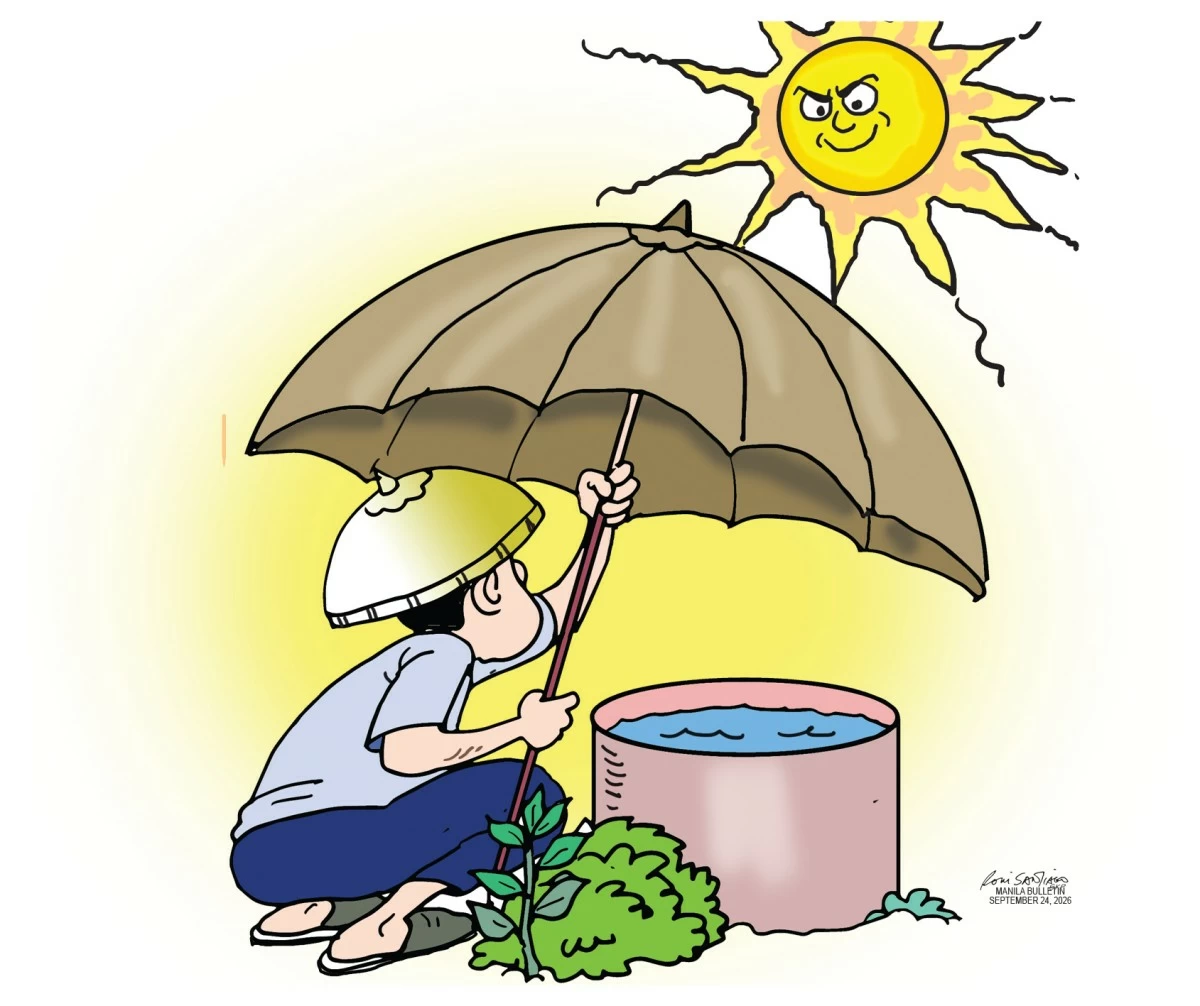
The warning is already here. The World Meteorological Organization (WMO) said early this month that El Niño is firmly established, is expected to intensify into a very strong event toward the end of 2026 and has a nearly 100 percent likelihood of persisting through February 2027. Its climate effects could extend well into 2027.
And experts say this may cause severe drought that is a threat to food security and therefore may trigger rising prices.
That should set off an urgent concerted national action—not only about heat, drought and water, but about food prices.
El Niño does not automatically dictate how severe its effects will be in every province. WMO itself cautions that local impacts vary by region, season, and other climate drivers. But the Philippine Atmospheric, Geophysical, and Astronomical Services Administration (PAGASA) said the phenomenon increases the likelihood of below-normal rainfall, dry spells, and drought in parts of the country, with potentially serious consequences for agriculture.
How would this impact the economic chain? Less water can mean lower harvests; lower harvests can mean tighter supplies; tighter supplies can mean higher prices. For poor families already stretching every peso, another increase in the cost of rice, vegetables, fish, or other staples is a threat to both nutrition and household survival.
The government therefore cannot afford a wait-and-see policy.
First, protect production now. Irrigation systems must be repaired and expanded where feasible. Farmers need timely access to drought-tolerant seeds, crop insurance, affordable credit, weather information and technical advice. Water harvesting and storage must move from isolated projects to a serious component of agricultural planning. Where traditional crops become impractical, farmers should receive support to shift intelligently rather than being left to absorb the losses alone.
Second, protect the food supply chain. The government should establish a real-time system connecting weather forecasts, farm conditions, inventories, transport costs, and retail prices. The purpose is not merely to monitor inflation after it happens, but to identify shortages before they become price shocks. Strategic imports, when necessary, should be timely and transparent—not rushed into action after prices have already surged.
But addressing this should not be left on the government alone.
Food companies, traders, supermarkets, logistics firms, and banks can help by investing in cold storage, efficient transport, water-saving technologies, climate-resilient production, and better supply forecasting. Businesses should also examine where waste and unnecessary costs can be removed before passing higher expenses to consumers. The private sector's role through resilient supply chains can help cushion the impact and are good business, as well.
There is also a role for every Filipino. Households can reduce food waste, conserve water, buy responsibly and support local producers. Communities can organize food-sharing, urban gardening, and assistance for vulnerable families. Small actions will not stop El Niño, but millions of responsible choices can reduce pressure on scarce resources and household budgets.
The World Food Programme estimates that the current El Niño could push at least 49 million additional people into acute food insecurity globally by the end of 2027, with South and Southeast Asia among regions expected to experience significant effects.
That number should change how we think about preparedness.
The Philippines has something priceless that a failed harvest cannot provide: advance warning.
With El Niño most likely to occur, it is now our choice whether we will act while there is still time—before drought reaches the farms, before supplies tighten, before food prices climb, and before Filipino families are forced to pay the highest price for government inaction.
We have to prepare now, or pay the hefty price later.

BOC officials inspect seized P3.2-B smuggled cigarettes in Agusan del Norte


Published Sep 24, 2026 06:25 pm
NASIPIT, Agusan del Norte – Top Bureau of Customs (BOC) officials on Thursday inspected a record P3.2-billion shipment of imported cigarettes seized in this town, described by authorities as the largest cigarette-smuggling haul in the country's history.
BOC Deputy Commissioner Emmanuel Luis Licup, Customs Intelligence and Investigation Service (CIIS) Director Thomas Narcise, and CIIS Northern Mindanao and Caraga Field Station chief Redford Surposa led the inspection at the Gothong Private Wharf here.
They were joined by Police Brig. Gen. Rolindo Suguilon, director of the Police Regional Office in Caraga (PRO-13).
Surposa said that authorities seized 54 container vans loaded with smuggled cigarettes during a joint operation by the BOC and the 1st Agusan del Norte Mobile Force Company on May 8, 2026 in Barangay Talisay, Nasipit.
"This is, so far, the biggest haul of smuggled imported cigarettes," Surposa said.
He said authorities spent several months conducting an inventory of the seized goods in preparation for filing appropriate charges.
"The case remains under investigation, and we are not yet disclosing certain details to the public. Even the names of the supposed recipients of the container vans appear to be fictitious," Surposa said.
In his remarks, Licup said the BOC, in coordination with PRO-13, will continue its investigation until the seized cigarettes are finally condemned and destroyed.
"Our presence here today underscores the bureau's continued focus on enforcement operations and ensuring that all procedures are strictly observed," Licup said.
He said a successful seizure becomes truly meaningful only when the goods remain secure, properly documented, and fully accounted for until their final disposition.
"Every stage, from inventory and safekeeping to condemnation and destruction, must be conducted with transparency," Licup said.
He added that the illegal cigarette trade causes significant harm by depriving the government of revenue, creating unfair competition for legitimate businesses, and exposing consumers to unregulated products.
"To our officers and personnel, remain vigilant and continue performing your duties with integrity. The leadership expects accountability from everyone while recognizing the challenges faced by those on the frontlines," Licup said.
He emphasized that the BOC leadership, headed by Commissioner Ariel Nepomuceno, along with the administration of President Ferdinand R. Marcos Jr., remains committed to supporting officers who carry out their duties lawfully and honestly. (PNA)

'Filipiñana' actress Jorrybell Agoto seeks financial help amid cancer treatment


Published Sep 24, 2026 11:18 am | Updated Sep 24, 2026 05:04 pm
Jorrybell Agoto (Facebook)

Actress Jorrybell Agoto, who stars in the Filipino film "Filipiñana," is seeking financial assistance as she undergoes treatment for cancer and remains confined in a critical care unit at St. Luke’s Hospital.

Agoto’s colleagues, Kamill Lipnica and Jane Dating, shared an appeal for assistance on social media, saying the actress is currently in critical condition.

In a Facebook post, Lipnica said Agoto is experiencing a buildup of fluid in the pleural area of her lungs, making it difficult for her to breathe. She said Agoto is currently using a Blake drain to manage the fluid.   

“Our beloved Jorrybell is currently admitted to the Critical Care Unit at St. Luke’s Hospital, bravely fighting through a difficult chapter in her battle against cancer,” Lipnica wrote.

The posts did not provide further details about Agoto’s current medical condition or treatment.


Agoto is part of the cast of "Filipiñana," which has been selected as the Philippines’ official entry for Best International Feature Film consideration at the 98th Academy Awards.

What should I know about German culture before going to Germany?


I can only write about my personal experience, but I have been living and working in Germany for four years now, so that makes me a four year expert - at least in Southern and Central Germany - although I have wandered into Schleswig-Holstein, Dresden, and Berlin in the North.

Germans are very practical in general - although they tend to be very genial in my experience, they can also be very direct. This has led to misunderstandings on both sides of the equation.

An example that drives me crazy is my American approach to customer service.

Americans tend to be concerned about how we are perceived, so we don’t like to say “no” to a request. We go with softer responses:

  • “We’ll look into it for you.”
  • “Let me check around to see if we can get it at another store…”

Germans, like their Northern European counterparts, prefer to be told “no.” I have been told my request is “impossible.” In my opinion, nothing is really impossible - unlikely maybe, but not impossible. So that response raised my hackles.

Our reluctance to “tell it like it is” comes across as insincere at best. It makes us look a bit superficial. It can lead to confusion if the vague response is taken at face value. So a typical American comment, “We need to get together sometime!”, may bring out day planners to ink in a specific date.

Also beware of casually asking “How are you?” You will be told exactly how the German is - colds, break-ups - a whole raft of TMI that an American may not be prepared to handle in the morning greeting to friends and co-workers.

Meantime, Germans are seriously concerned about their environment. Americans recycle - we do. Others (I won’t mention any European countries specifically, but you know who you are) are more casual about recycling.

Germans keep their streets mostly free of litter (you will find it in the larger cities, but it isn’t on the same scale as other countries), tend to be vigilant about hand pulling weeds, scrutinizing the exterior appearance of their homes, and diligently recycling.

Brown, clear, and green glass have their own separate containers. Plastics and packaging go in the yellow bag. Organic waste goes in the brown bin. Paper products go into the blue bin. Everything else into the black bin - a lot of work initially, but eventually you catch on. Don’t even think of putting the wrong thing in the wrong bin - it will not be collected. Of course, batteries go to their collection points, as do light bulbs. Everything in its place, and a place for everything …

One thing Americans don’t realize is that Germany was a confederation of little city-states until 1871. There is more than one Germany - as seen in dialects which, as often as not, are unintelligible outside the immediate geographical area where the dialect is spoken.

Clothing

Also, and this is really important - lederhosen and dirndls are not - I repeat not - worn all over Germany. They are Bavarian. Wearing them outside Bavaria draws peculiar looks (unless you are going to an Oktoberfest event).

Food

Beer, while undeniably popular in Germany, is not the only beverage consumed. In the wine growing regions (and I am a big fan of the Mosel and Rhine wines), more wine is consumed. Around Frankfurt you might find that people enjoy the apple wine (ebbelwoi) more than the very good white wines and beer. However, I am convinced that apple wine is an acquired taste…

While Germany has a reputation for consuming sausages - wurst - the ubiquitous dish to me is schnitzel - either plain (wiener schnitzel) or with sauces (lots to choose from.) However, the real joy of German cooking to me is the seasonal produce that is not only embraced but celebrated: white asparagus (spargel), fresh strawberries, chanterelles, the new wine (federweißer) of the fall. Don’t overlook the ubiquitous döner kebaps as a fast food meal on the go.

Another German specialty that I have learned about since being here is the green (grün) sauce found in Frankfurt - served on many things, it was a wonderful discovery, as was Handkäs mit Musik - a local cheese served with caraway seeds, and dripping oil and onions. The music comes later…

Of course, touring around there is the culture - some of the greatest scientists, philosophers, musicians, artists of every stripe have come from Germany. And, in spite of the damage from World War II, there is a huge amount to visit, explore, and enjoy