This might not be the typical expat blog, written by a German expat, living in the Philippines since 1999. It's different. In English and in German. Check it out! Enjoy reading!
Dies mag' nun wirklich nicht der typische Auswandererblog eines Deutschen auf den Philippinen sein. Er soll etwas anders sein. In Englisch und in Deutsch! Viel Spass beim Lesen!
You plan to move to the Philippines? Wollen Sie auf den Philippinen leben?
There are REALLY TONS of websites telling us how, why, maybe why not and when you'll be able to move to the Philippines. I only love to tell and explain some things "between the lines". Enjoy reading, be informed, have fun and be entertained too!
Ja, es gibt tonnenweise Webseiten, die Ihnen sagen wie, warum, vielleicht warum nicht und wann Sie am besten auf die Philippinen auswandern könnten. Ich möchte Ihnen in Zukunft "zwischen den Zeilen" einige zusätzlichen Dinge berichten und erzählen. Viel Spass beim Lesen und Gute Unterhaltung!
Visitors of germanexpatinthephilippines/Besucher dieser Webseite.Ich liebe meine Flaggensammlung!
Living in the moment (mindfulness) means being fully present with your mind, body, and surroundings in the here and now, rather than dwelling on past regrets or worrying about future events
When you live in the moment, you are fully present and aware of the emotions and thoughts that you have right now. If you're not present, your thoughts are either turned towards the past or fixated on the future.
Living in the present moment means no longer worrying about what happened in the past and not fearing what will happen in the future. It means enjoying what's happening now and living for today. Choosing to live in the past or the future not only robs you of enjoyment today, but it also robs you of truly living.
But living in the moment, although difficult, can benefit your relationships, productivity, and, most importantly, overall wellness. Living in the moment is about paying attention to the here and now. Instead of letting your mind wander, you're focused on your current actions, sensations, and surroundings.
Living in the moment means being fully aware and engaged in the present time—mind, body, and soul—instead of dwelling on the past or excessively worrying about the future.
Imagine this: you’re sitting on your couch, watching a movie while eating popcorn, scrolling through Instagram, and half-heartedly listening to your partner talk about their work day. All the while, you’re thinking about a task that you need to do next week.
Later, when you’re lying in bed, you realize you didn’t quite understand the movie, enjoy your popcorn, or hear what your partner said. What’s worse is that you don’t feel relaxed or rejuvenated.
We’re constantly surrounded by distractions, making it difficult to focus on just one thing at a time. Stress, anxiety, and regret can also make it difficult to focus on the present moment. But living in the moment, although difficult, can benefit your relationships, productivity, and, most importantly, overall wellness.
Living in the moment is about paying attention to the here and now. Instead of letting your mind wander, you’re focused on your current actions, sensations, and surroundings.
Learn to grow beyond a moment in your life. Don’t let life pass by you while you’re still stuck at a certain moment in your life. Don’t you give something that power over you or over your life. Learn to look at things exactly as they are without giving them a higher value. Because your life has so much more in it than this. The worst thing you could ever do to yourself is to narrow down your whole story into some of these moments and think that this is it.
Almost facing the age of 73 next month, I learned most of all these things from my Philippine family.
MANILA, Philippines — There is something fascinating about the phenomenon of Regine Velasquez. In recent clips from her “Finale” concert, one can hear moments when the voice that once seemed capable of conquering every musical mountain struggles to deliver the notes that made her legendary. And yet, the audience continues to cheer. They applaud, sing along and embrace her with an affection that seems undiminished by the imperfections of the performance.
Why? Perhaps because Regine has become something far greater than the voice we have admired for four decades. She has become part of our collective memory.
My earliest recollection of meeting Regine goes back to 1985, at BB’s, the karaoke sing-along bar of the late Bernardo Bernardo. She was there to sing and serve as one of three judges in a singing contest I joined that evening. I could not have imagined then the extraordinary career that awaited this young singer or how profoundly her voice would eventually become woven into the soundtrack of Filipino life.
Over the years, Regine gave us songs that became more than recordings. They became declarations of love, expressions of heartbreak, companions through loneliness and anthems for moments when words alone were insufficient. Her music traveled across generations, finding new listeners while remaining cherished by those who had grown up with her. Few Filipino singers have occupied such a lasting place in the hearts of so many.
But time, inevitably, changes everything — even a remarkable voice.
Regine herself has spoken candidly about the changes she has experienced, including vocal difficulties associated with menopause. She has acknowledged that she can no longer sound exactly as she did 10 or 20 years ago. For a singer whose identity and career have been built around extraordinary vocal command, that admission must carry a particular kind of pain. Imagine spending most of your life mastering an instrument, only to discover that it no longer responds in quite the same way.
Yet perhaps the most revealing part of the story is not that Regine struggles. It is that she has allowed us to witness that struggle.
We live in a culture that celebrates perfection, particularly in entertainment. We expect our idols to remain untouched by age, to reproduce their greatest performances indefinitely, and to preserve the very qualities that made them famous. We can be unforgiving when reality fails to meet nostalgia.
Regine’s “Finale” challenges that expectation. The concert is not simply a celebration of her 40 years in the industry; it is also an encounter with change, vulnerability and the difficult process of letting go. Her decision to step away from major solo concerts acknowledges a truth that even the greatest artists must eventually confront: the instrument may change but the contribution remains.
And then there is the extraordinary gesture of offering free performances to the very audience that helped build her legacy. What a beautiful way to give back. After years of receiving applause, affection and unwavering support, she is giving her audience something in return — not merely a concert, but an opportunity to celebrate a shared history. It feels less like a commercial farewell and more like a deeply personal thank-you.
This may explain why audiences continue to cheer even when the singing is not flawless. They are not necessarily applauding every note. They are applauding the years behind those notes. They are remembering the songs that accompanied their own lives, the performances that moved them and the artist who gave so much of herself to her craft.
To acknowledge that Regine’s voice has changed is not to diminish her. Nor should our affection require us to pretend otherwise. We can recognize the limitations of a present-day performance while remaining profoundly grateful for the artistry that preceded it.
Perhaps this is the real measure of greatness: not the ability to remain untouched by time but the ability to leave something enduring enough that time cannot erase it.
In the end, Regine may no longer be able to deliver every song as she once did. But the songs remain. The memories remain, and the love of her audience remains.
The voice may have changed, but the magic was never hers alone. It lives, too, in the millions of Filipinos who have carried her music in their hearts for 40 years.
And that is a legacy no imperfect note can take away.
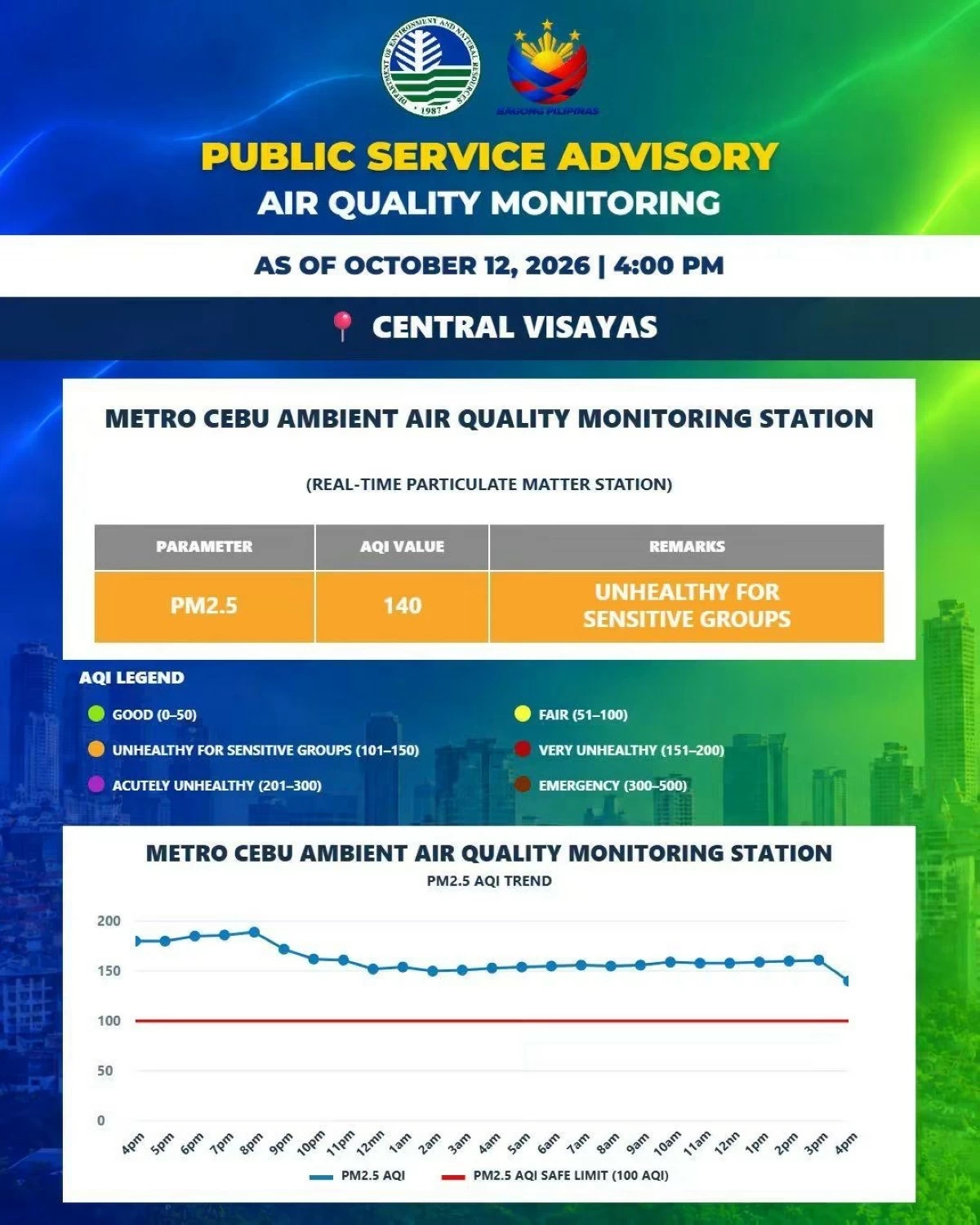
CEBU CITY – Due to poor air quality, several areas in Metro Cebu suspended face-to-face classes on Monday,.
Among those that cancelled in-person classes for all levels were the local government units of Cebu, Mandaue, Lapu-Lapu, and Talisay cities and the towns of Consolacion, Minglanilla, Compostela, and Liloan.
These LGUs instructed schools to shift to online classes.
“This precautionary measure aims to protect the health and safety of our students, teachers, and school personnel amid unhealthy air quality,” Cebu City Mayor Nestor Archival said.
The suspension of physical classes came on the eve of the announcement of the Environmental Management Bureau in Central Visayas (EMB-7) that air quality in Metro Cebu deteriorated once again.
On Sunday, the air quality index (AQI) in Metro Cebu rached 180 which fell under the “very unhealthy” category.
In its 4 p.m. advisory on Monday, the AQI improved to 140 but was still “unhealthy for sensitive groups.”
With the poor air quality, children, elderly, and individuals with existing respiratory conditions are discouraged from going outdoors.
Wearing masks was also recommended for those venturing outdoors.
The EMB-7 attributed the poor air quality to local pollutants such as emissions from vehicles and industrial outputs.
The prevailing amihan (northeast monsoon) also contributed to the poor air quality, the agency said.
Philippine Commission on Women (PCW) Commissioner and Airspeed Group of Companies Founder Rosemarie Rafael (left), PCW Co-Chair and Richprime Global Inc. CEO Myrna Yao (center), and Dr. Karen De Asis (right), founder of MKS Marketing Consulting and 2025 ASEAN Women Entrepreneur awardee.
11 ASEAN member states and partner countries in one immersive exhibition in Manila, Nov. 10–12, 2026
“Way of the Weave,” the central theme of the ASEAN Trade Expo 2026, will bring together the cultures, craftsmanship, and enterprises of ASEAN countries and Southeast Asian partners at Okada Manila from November 10 to 12, 2026, as one of the flagship events of the Philippines’ ASEAN Chairship.Read more
My competitors aren’t doing much about artificial intelligence (AI). We’re already ahead of them. Why should I hurry?”
A family business owner said this when I raised the urgency of transforming his company around AI. Think of a US logistics business, well positioned in its market, but operating on very tight margins.
My team and I help businesses make this transition to becoming fully “AI-native.” What does this mean? Becoming AI-native means building AI into the everyday running of your business—how work gets done, how information is shared and how decisions are made.
I explained where AI could improve his operations and offered to help. He shrugged off the urgency. He believed his competitors were moving slowly, if at all.
His conclusion was that he had time. This is wrong. I encounter this problem repeatedly in family businesses: There is no structured approach to AI because the owner has not made it a priority.
Your greatest strength = often your greatest weakness
An owner-led business has an enormous advantage. Decisions can be made quickly. But the reverse is equally powerful. If the owner overlooks a threat, the business remains exposed. If the owner sees no urgency, everyone else learns that there is no urgency.
The owner’s blind spots become the company’s blind spots. This is especially dangerous with AI. You can have talented people experimenting in individual departments while the company as a whole continues operating much as it did before. Employees write emails and produce presentations faster. Yet the underlying business has barely changed.
The owner does not need to become an AI engineer. But the owner must understand enough to recognize what is at stake, develop a vision for the business and bring in people who can deliver it. You can delegate the technical work. You cannot delegate the responsibility for giving the business direction.
‘My competitors are slow’ is no reassurance
There are three problems with the logistics owner’s argument. First, if your competitors really are moving slowly, you have an opportunity to get ahead. Why treat their inaction as permission to waste your advantage? In a business with thin margins, even a modest improvement in operating costs can make a meaningful difference to profitability.
Second, how much do you really know about what your competitors are doing? You do not sit in their internal meetings. You cannot see every project they are testing. A competitor has little reason to announce an advantage before it is ready.
By the time its lower prices, faster responses or better service become visible, you may be seeing the outcome of months of work. Starting then means beginning from behind.
Third, your next serious competitor may be a company you do not currently regard as a competitor. A new entrant can build around AI from the start, without having to defend the systems and habits your business has accumulated over decades.
The pace will differ across industries. But assuming that tomorrow’s competition will look like yesterday’s is a poor basis for protecting a family enterprise.
ILLUSTRATION BY RUTH MACAPAGAL
What does ‘AI-native’ actually mean?
It means designing the business so that AI is part of how work gets done, information moves and decisions are supported. Buying subscriptions for employees is only a beginning.
Think about how information travels through a traditional company. A customer raises an issue. Someone writes a report. A manager summarizes it. Another manager presents it. Eventually, the person with authority hears a filtered version and makes a decision.
An AI-native approach asks how much of that delay can be removed. Can relevant information reach the right people sooner? Can routine work happen automatically? Can a team act within clear limits without waiting for every decision to climb the management ladder?
Leaders and human judgment remain essential. But layers that exist mainly to collect, summarize and pass on information deserve a hard look.
This also requires making company knowledge usable by AI. Knowledge trapped in filing cabinets, scattered inboxes or the founder’s head cannot support the whole enterprise. Records need to be accurate, organized and accessible to the appropriate people and systems.
Where appropriate, record and transcribe meetings with participants’ permission and suitable confidentiality controls. Capture decisions, responsibilities and deadlines so they can be found and acted on. Stop valuable knowledge disappearing when a meeting ends.
For a logistics company, opportunities might include checking invoices, flagging suspicious transactions, reducing repetitive back-office work and responding faster to customers. Better information can also support decisions about vehicles, warehouses and other capital spending.
These are opportunities to test, rather than savings to assume. AI requires investment, reliable information and people who understand the business. Its value must show up in performance.
Give urgency a structure
Announcing “we need more AI” will achieve little. Neither will appointing a younger family member simply because he or she uses the latest tools. Knowing the tools does not qualify someone to lead the transformation.
Start by asking where your business loses the most time, money or customers. Where do people repeatedly enter the same information? Which decisions are delayed because nobody has a clear picture?
Choose an important, manageable process. Put a capable person in charge, give that person access to the relevant expertise and agree what success looks like. Measure the starting point: time taken, cost, errors or customer response. Then compare results after the change, including the cost of implementation.
Train the people doing the work. Explain how their roles will change and involve them in improving the process. Their practical knowledge can help prevent an impressive demonstration from becoming an expensive disappointment.
Set clear boundaries as well. Decide which information can be shared, who can access it and which actions require human approval. AI can produce confident mistakes. Faster work is valuable only when the business can trust the result.
Keep the wider vision in view. Use the first project to learn how to improve the next and connect it to the wider business. A collection of isolated experiments is no substitute for a company moving in a clear direction.
Family businesses can move remarkably fast once the owner commits. Use that strength while you still have room to choose the pace.
The three to thrive
1. Lead the urgency. Make AI transformation an owner-level priority. Learn enough to set the direction, then secure the expertise to execute it.
2. Set your own pace. Assess your opportunities and vulnerabilities. A competitor’s apparent inaction is no reason to postpone your own progress.
3. Give ambition a structure. Start with a measurable business problem, appoint an accountable leader, train your people and build toward a connected, AI-native enterprise.