
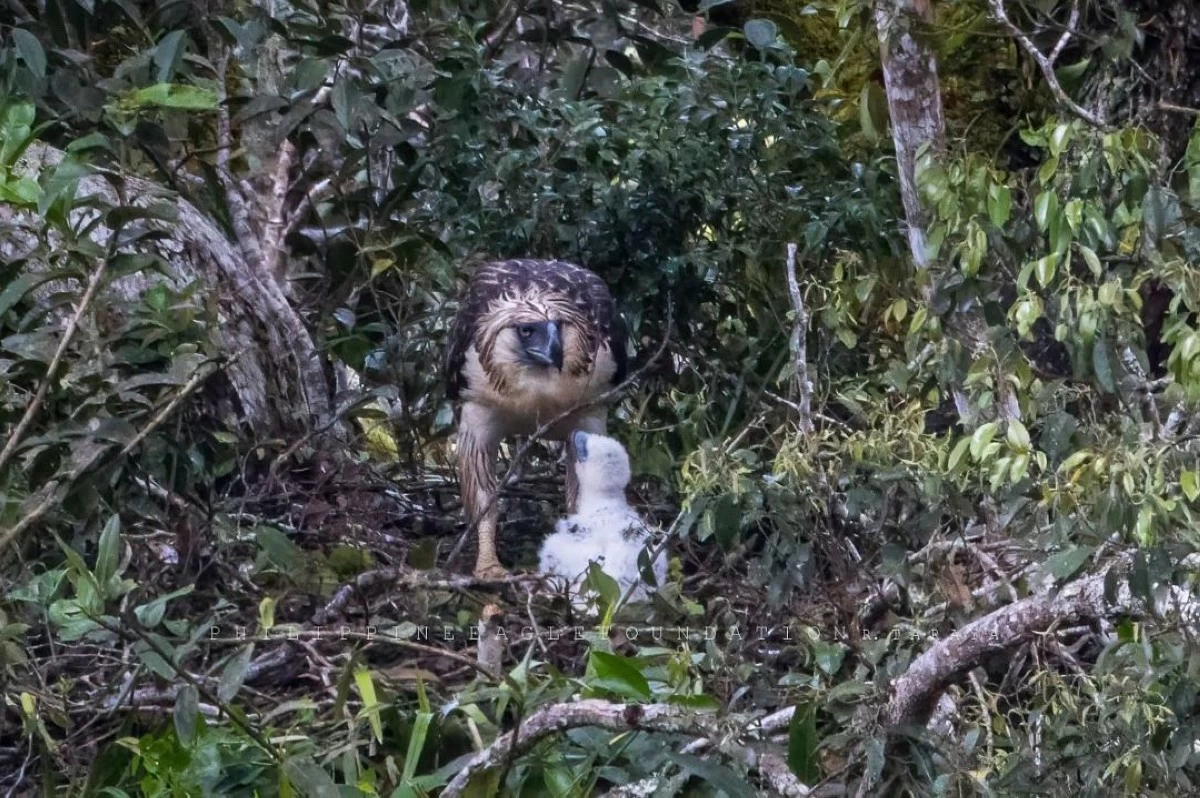
PHILIPPINE Eagles in the wild. (Ron Taraya/PEF)
DAVAO CITY – Conservationists are calling for a comprehensive measure to protect nesting territories of the critically endangered Philippine Eagle following recent electrocution and shooting incidents.
They commended the efforts of the provincial government of Cotabato to strengthen measures to protect the eagles and other forms of wildlife but also acknowledged the need to balance development initiatives and environmental conservation.
Dr. Jayson Ibañez, Director of Operations of the Philippine Eagle Foundation, specifically underscored the need to protect nesting territories around Mount Apo Natural Park.
Ibañez said nesting areas that sit within the Mount Apo Key Biodiversity Area covers about 99,006 hectares that can support around 10 Philippine Eagle nesting territories.
He added that five of these are in the Cotabato side, particularly in Barangay New Israel, Makilala; Ilomavis, Kidapawan City; Manobo-Don Panaca and Imamaling in Magpet, and Ganatan-Libertad in Arakan.
A pair of Philippine Eagle requires a massive territory of 4,000 to 11,000 hectares or roughly about 40- to 110-square kilometers of forest to survive, according to PEF.
“But within that larger landscape is a much smaller core area that the eagle uses most intensively, especially around its nesting territory,” Ibañez emphasized, adding that the best current estimate for this core area is about 1,300 hectares.
“For conservation planning, this gives us a practical scale for identifying areas that need the highest level of protection around known nests and nesting territories,” he added. “These core nesting areas should be protected from activities that could disturb breeding eagles or degrade their habitat.”
Aside from the threat of hunting activities, Ibañez underscored the need for stronger guarding and threat monitoring, including the retrofitting of power lines near the core areas.
He appealed that these powerlines should be retrofitted with insulated cables to reduce the risk of electrocution to adult eagles and dispersing young.
Oct. 1, the PEF reported a weak Philippine Eagle rescued by residents after it was found perching near a river in Barangay Manobo, Magpet on Sept. 27.
X-ray examination in an animal wellness clinic revealed that the eagle had three airgun pellets in the body. Veterinarians were only able to remove only two as the third was lodged deep inside the eagle's body.
Three days later, an eagle died from electrocution in powerlines in Barangay Libertad in Arakan, according to PEF.
Veterinarian Bayani Vandenbroeck, who performed the medical examination and X-ray procedure, said that the eagle had a fresh wound on its wing, indicating that it was shot days before it was electrocuted.
Ibañez disclosed that of the documented 104 rescue and recovery of Philippine Eagle from 1970 to 2026, of the 47 birds, or about 45 percent, have been found with documented evidence of firearm-related injury or embedded projectiles.
These cases involve airgun pellets, locally made ‘’Jolen’’ or marble guns, .22-caliber firearms, and other bullet wounds, he added.
He reiterated the need to regulate if not to totally ban airguns in identified eagle territories.
Conservationist Dr. John Aries Tabora of the University of Southern Mindanao in Kabacan expressed support for the initiative of Cotabato Gov. Emmylou Taliño-Mendoza in creating an inter-agency task force to ensure the implementation of wildlife laws in the province.
Tabora, however, acknowledged that there are challenges in conservation work, citing the harmonization of economic policies and conservation programs.
In the case of the Philippine Eagles around Mount Apo Natural Park, he cited that humans coexist with these critically-endangered eagles in the same area that is considered a hunting ground of other wild animals.
“Ang tao talaga mag-adjust kasi ang wildlife like the Philippine Eagles, talagang mag-hunt ‘yan kung gutom, instinct na ng animals ‘yan maghanap talaga ng pagkain. Ang tao, dahil siya naman ang makapag-isip at makapag strategize kung paano siya makakain, siya dapat ang mag adjust,” emphasized Tabora, who also works to conserve bats and crocodiles.
(Humans need to adjust to widlife like the Philippine Eagles, which need to hunt when hungry and their instinct)
But he admitted that there’s a need for an intensified education campaign for the protection of different forms of wildlife and their habitat.
He acknowledged the role of social media in awareness campaigns but underscored that face-to-face interaction with communities is still the most effective method.
Engr. Walter Mandolado, head of the Municipal Environment and Natural Resources Office (MENRO) in Magpet, acknowledged the gargantuan task of information dissemination and said that there’s still more work to be done.
Mandolado added that the creation of a multi-agency task force could help systematize the interventions needed for the protection of all forms of wildlife, not just around Mount Apo but as well as in other parts of the province.
He also hopes that the newly-formed body could also address the concerns of people living within the key biodiversity area.
Conservationists acknowledged the roles of local government units in strategizing economic interventions within the identified eagle territories as part of a comprehensive approach.
Through PEF’s culture-based conservation program, Ibañez said the foundation is not just mobilizing the indigenous peoples to become forest guardians but they are also provided with alternative livelihood programs.
He admitted that this is part of a long-term effort towards protecting the eagles and its habitat as the impact cannot be seen right away.
“For conservationists, this shows that protecting Philippine Eagles requires more than protecting their nests and forests. Reducing direct human threats – especially shooting – must also be part of conservation work across the wider landscapes where adult eagles hunt and where young eagles disperse,” Ibañez explained.

No comments:
Post a Comment