You plan to move to the Philippines? Wollen Sie auf den Philippinen leben?

There are REALLY TONS of websites telling us how, why, maybe why not and when you'll be able to move to the Philippines. I only love to tell and explain some things "between the lines". Enjoy reading, be informed, have fun and be entertained too!

Ja, es gibt tonnenweise Webseiten, die Ihnen sagen wie, warum, vielleicht warum nicht und wann Sie am besten auf die Philippinen auswandern könnten. Ich möchte Ihnen in Zukunft "zwischen den Zeilen" einige zusätzlichen Dinge berichten und erzählen. Viel Spass beim Lesen und Gute Unterhaltung!


Visitors of germanexpatinthephilippines/Besucher dieser Webseite.Ich liebe meine Flaggensammlung!

free counters

Total Pageviews

Wednesday, August 19, 2026

Let’s go unli


By Fr. Roy Cimagala

Chaplain

Center for Industrial Technology and Enterprise (CITE)

Talamban, Cebu City

Email: roycimagala@gmail.com


WE cannot deny that our earthly life is marked by many limitations. We grow gradually from childhood to maturity, learning little by little what real love means. Our capacity to love develops through time, experience, and God's grace.


Our sins also leave their mark on us. They can distort our understanding of love and make us think first of ourselves. Because of them, loving generously does not come easily.


Yet God never leaves us alone. His grace is always available to lift us beyond our natural weaknesses and sinful tendencies. If we cooperate with that grace, we can love far more than we imagine.


That is why we should never be afraid to give ourselves generously. As long as we refuse to say, "Enough," God supplies what we cannot provide ourselves. His strength fills the gaps left by our weakness.


This is the lesson behind the multiplication of the loaves and fishes. (Cf. Mt 15:29-37) When the disciples saw only scarcity, Christ saw an opportunity to bless. The little they offered became more than enough in his hands.


The same can happen in our own life. We may feel that we have reached the end of our strength, patience, or resources. But when we bring everything to Christ, he always knows how to provide.


This truth is especially important today. The challenges we face are not only numerous but also increasingly complex. Many problems seem beyond our ability to solve.


Instead of becoming discouraged, we should deepen our faith. Nothing is impossible for God, and he continues to work through those who trust him. His power can accomplish what our efforts alone never could.


True love, therefore, never settles for the minimum. It does not keep count of sacrifices or calculate the cost of giving. It continues to serve because it has first received God's love.


To many people, this may seem unreasonable. The world encourages us to protect ourselves and avoid giving too much. Christ teaches the opposite: love grows by giving itself away.


Real charity is not measured by convenience. It is measured by generosity, perseverance, and fidelity. It remains faithful even when there is no appreciation or reward.


In fact, authentic love continues even when it is rejected. It does not depend on being accepted, praised, or repaid. It reflects the unconditional love that God has shown us.


We see this most clearly in Christ himself. He loved those who welcomed him and those who rejected him. Even on the Cross, he continued to forgive and to love.


By ourselves, we cannot reach this level of self-giving. Our human strength is limited, and sooner or later it becomes exhausted. Only God's grace can sustain such generous love.


The more closely we are united with Christ, the more capable we become of loving.

His grace strengthens our mind, our heart, and our will. It enables us to go beyond what seems naturally possible.


We will still experience weakness and fatigue. Our bodies, emotions, and minds all have their limits. Yet our spirit can continue to give because Christ lives within us.


This is the great exchange of the Christian life. We offer God our limitations, and he shares with us his strength. We entrust him with our poverty, and he fills us with his grace.


That is how we can go "unli" in love. Not because we have unlimited strength, but because God's love has no limits. United with Christ, we can keep giving ourselves without ever saying, "Enough."


PAPER AND POWER


by Klaus Döring


Paper still matters, as I could learn from fellow Inquirer staff writer Phyllis Korkki. Yes, paper still matters. The frequent whirring of printers in offices - despite the Internet, Microsoft Word, social media (I love Facebook and Twitter), scanners, smart phones applications and many much more - attest to that.

Paper is a quiet yet profound invention that transformed human history. It allowed ideas to spread past elite circles, preserved scientific and cultural knowledge, and fueled global revolutions from the printing press to modern democracy. Even today, physical paper offers unique cognitive and practical benefits that screens cannot replace.

I am very old fashioned in many things. I was still typing on an old manual typewriter, when my colleagues in different publishing houses already used electric units. I loved my antique typewriter. I love it till today. Yes, it's still here in my office in Davao City. I can't use it anymore, because no more ribbons are available in the Philippines. It's okay. My electric typewriter is also here. Just beside the manual unit. Those were the days, my love... .

It has been sometimes at the end of the 1990s. I worked in an international publishing house in Berlin with branches in Amsterdam and New York. I still used one of those wonderful electric typewriters - and tried to avoid a personal computer. Already during that time I needed to hold paper in my hands. Paper, says the productivity expert David Allen, is "in your face". I strongly agree with David. He said, "Its physical presence can be a goal to completing tasks, whereas computer files can easily be hidden and thus forgotten. I am also returning to paper planners for this very reason. Please, don't laugh at me, my dear readers!

The power of paper lies in its unique ability to preserve human thought, foster deep cognitive focus, and act as a tangible, sustainable medium for communication and art that transcends the digital world.

David Allen, the author of "Getting Things Done", does much of his writing on a computer. So I do meanwhile. But, there are still times when writing with a fountain pen on a notepad. It allows "us" to get "our" heads in the right place. When I tried to learn more from David Allen, I really got surprised, that we have many things in common. Old fashioned or not? I don't care. Here are some facts:

Paper print outs serve an important function. For long texts, a print out can allow a reader to better understand relationships between sections and writings. Paper handouts are still a presence at meetings partly because they are useful for taking notes. Reading a long document on paper rather than on a computer screen helps people "better understand the geography of the argument contained within, "said Richard H.R. Harper, a principal researcher for Microsoft in Cambridge/England and co-author with Abigail J. Sellen of "The Myth of the Paperless Office," published already in 2001.

I also strongly agree with Sellen, saying that using more than one computer screen can be helpful for all this cognitive juggling. But when workers are going back and forth between points in a longer document, it can be more efficient to read on paper.

How about "e-reading a book"? A novel, a drama, whatever? What do you prefer, my dear reader? You wanna know my opinion? I am sure, you can imagine. Yes guys, I still need a book in my hands for my leisure reading. I need to feel the book as well as I need to smell a fresh-printed newspaper. Environment savers might start yelling at me now, though I am one of them. So, where is the edge and borderline?

Paper can be indeed a luscious and beautiful thing - the way we savor fine food and wine, as Steve Leveen, co-founder and CEO of Levenger, said. People complain that writing by hand is slow (yes I am really!), BUT that can be good for thinking and creating! Here we are again!

Yes, it matters still: in defence of the power of paper! What do you think, my dear readers, while holding this newspaper right now in your hands?

+++

Email: doringklaus@gmail.com or follow me in Facebook, Linkedin or X - Twitter or visit  www.germanexpatinthephilippines.blogspot.com or www.klausdoringsclassicalmusic.blogspot.com .

The Daily Guardian is a renascent Iloilo-based publishing firm and media outfit with bureaus across Western Visayas and beyond. Led by Iloilo's most respected journalists, we pledge to tell the Ilonggo story as seen through the various lenses of society so that every side may be told.

BUREAUS:KaliboBoracayRoxasBacolodAntiqueGuimarasManila

Politicizing entertainment


 By: Paulo Fajardo 


No matter how hard you prepare for it ahead of time, college finals season is like no other.


There are no rules. You can eat all you want, or you can also opt not to. As much as I want to protect my sleep schedule to be from 12 a.m. to 6 a.m., I found myself having to sleep from 4 a.m. to 7 a.m.—which is actually the longest hours of sleep I ever had in two weeks of the finals season.


In one subject, you have a group presentation tomorrow and you will only start preparing today. In another, you have a long test you need a miraculous grade in. As much as possible, you need to fit 30 hours’ worth of work in 24 hours.


The only real break I have is whenever I eat dinner while watching YouTube. As someone who grew up in a typical Filipino household watching “It’s Showtime,” even after moving into Metro Manila to pursue education, I brought this habit of watching Vice Ganda, Vhong Navarro, and Anne Curtis on our television back home to my phone now in my condo.


My favorite noontime show has ceased being a room for entertainment full of sunshine and rainbows. Through its hosts, it has actively participated in political discourse, one joke or side comment at a time.


Scrolling through comments online, some have aired their concerns about the show being too political. Some even asserted that the hosts simply wanted the revival of their network by driving their political discussions on air.


But that is not what I see.


I see Filipino citizens, regardless of whether they are the highest taxpayers or not, actively using their platform to raise awareness given their wide reach. I see celebrities who are privileged and financially stable, but actively step out of their bubble to experience life beyond themselves.


Even if the survival of a network—which was shut down during the pandemic, an era wherein the dissemination of information was highly needed—remains in their interests, it does not diminish the value of their political activeness. Calling out political discrepancies, after all, is a right of all Filipino people.


We also see this pattern of being politically vocal despite being in an industry shaped by societal expectations, even in other cases. Beauty queens like Catriona Gray, Joy Barcoma, and Bea Millan-Windorski have come down from their pedestal and pure glamor to go with the masses and rally for transparency and accountability.


Given the political nature of their humor, many have expressed their concern for the safety of the “Showtime” hosts. However, the very cost of them taking a stance makes it more meaningful and revolutionary, which they do for the people with significantly less security. In a society that molded them to be all fun and jokes, they refused to submit to the illusion of peace equating to silence and laughter; they use their platform for those who do not have the privilege of being heard.


What one hears in their jokes is frustration, not just theirs, but of ordinary Filipinos who share the same realities as them. They carry the voices not just of other vocal personalities, but also of those who are afraid of being one, for it might cost them their job, or social dynamics with their family members.


Growing up, “Showtime” has been in every phase of my life—from being a child who watched out of boredom, to being a young adult taking a break from studies.


If anything, “Showtime” does not just give me time to rest and laugh. During finals season, or in life in general, it is easy to fall into the temptation of focusing too much on what we are doing in the present—practicing every day for the next test or pulling an all-nighter for the next presentation. We can lose sight of what we are doing all of these for, or for whom we are fighting for.


However, little moments like this remind me, and hopefully, other Filipinos, to look at the bigger picture. Beyond academic struggles is a world that needs saving, and admittedly, as we are busy grinding, we may be in need of reminding. And the hosts and comedians we grew up with, given how visible they are on social media, are here to do that.


In a country facing intense political turmoil, comedians using politics in their skits are gifts. They do not ask us to escape. They encourage us to be vocal like them or represent us if we could not. They redefine Filipino resiliency not just as endurance, but facing problems with a smile, yet with conviction—or to fully encapsulate it, to face it with “paninindigan.”


Contrary to other comments that defend them as “Filipinos first, comedians next,” they actually embed their Filipino identity and values in everything they do, instead of treating them as different identities.


Tuesday, August 18, 2026

How Thinking About the Future Makes Life More Meaningful


By Klaus Döring


During these awful and negative minded times all over the world, thinking about the future keeps me not really positive.


Well, mindfulness is all the rage these days, and for good reason. Focusing on the moment can improve our well-being, foster compassion, and help our relationships. What about going beyond the present moment? Yes, thinking about the future can trigger anxiety—but a growing body of research suggests that it can also make our lives more meaningful.

Humans aren’t alone in having some ability to consider the future, a process that scientists call “prospection.” After all, your dog gets excited when they see you holding a leash because they anticipate a walk is imminent; your cat may show similar excitement at the sound of a can being opened. There’s even evidence that some animals—like bonobos and ravens—can choose and save tools that they plan to use in the future.

But prospector's unique benefits to humans extend beyond that of other animals. Not only do we fantasize about our next vacation or decide whether it would be better to take the stairs or the elevator, but our perspective can cast far into the future: We might save for our children’s education or plan for our retirement decades from now. We can make predictions about our own futures based on what we’ve learned about other people’s experiences and even from characters in books and movies. And we can consider multiple directions our futures might take.

It is this remarkable ability to simulate our possible futures that makes prospection special. Just like gold prospecting may literally make you rich, studies suggest that prospecting about your future can enrich your life in at least four ways.

Perhaps one of the most fundamental and important functions of prospection is that it helps us decide how to act: Thinking about what the future likely holds helps us decide what course to take in the here-and-now. Several studies have examined how thinking about the future shapes our decision-making.

Researchers have been particularly interested in the psychology that drives our process of deciding between receiving something now versus receiving something of greater value later. In general, people tend to choose smaller but more immediate rewards over larger rewards that they have to wait for, a phenomenon known as “delay discounting.”

But they don’t always choose short-term rewards over long-run gains. For instance, studies have shown that present-day connection to a possible future event can counteract delay discounting. 

Another study showed that participants who felt closer to their future selves were more willing to wait for a larger reward than those who anticipated changing; the same was true when they were asked to make decisions on behalf of a fictional character who they knew would go through a life-changing event (like a religious conversion or returning home from war).

While interesting in its own right, this research could have important personal ramifications. If people could be made to feel a more immediate connection to their eventual retirement (and consequent drop in income), they may be more motivated to make prudent decisions.

In fact, one experiment found that manipulating how people think about the time until their retirement—in days rather than years—caused them to plan to start saving for retirement sooner, because the shift in time perspective made the participants feel more connected to their future selves. A 2014 study found that viewing realistic computer-generated images of what they may look like in the future decreased their discounting of future rewards and led them to contribute more to a hypothetical retirement account.

Prospection has another important application: It motivates us to achieve our goals. But the relationship here is not a simple one. Work by psychologist Gabriele Oettingen and colleagues shows that whether thinking about the future helps us actually reach our goals depends on how we think about the future.

In fact, research has found that positive thinking about our future can backfire. The more people positively fantasize about successfully reaching their goals, the less effort they actually put into realizing them. For example, in one study, the people who fantasize more about successfully losing weight actually lost less weight. Another study found that students who fantasized about their transition into a professional career were less successful in their job search and students who dreamed more about their crush were less likely to start a relationship with their crush.

Importantly, both of these studies found the opposite effect for having positive expectations (“judging a desired future as likely”). People who expected to lose weight were more likely to actually lose weight; students who expected they would find a job were more likely to actually land one; and students who expected to enter a relationship with their crush were more likely to actually do so.

It makes sense that having positive expectations—optimism, essentially—could increase our ability to achieve our goals, but why might fantasizing about the future actually decrease the chance of achieving what we want? Because, write Oettingen and Klaus Michel Reininger, positive fantasies “lead people to mentally enjoy the desired future in the here and now, and thus curb investment and future success.”

But often our goals come from our fantasies. We want to excel at work, find Mr. or Mrs. Right, or run a marathon. How do we turn these fantasies into behaviors that can help us reach our goals? Research suggests that while optimism is important, it is also helpful to draw a contrast between our fantasies and our current reality, which allows us to see barriers that must be overcome.

For example, one study asked students to mentally contrast their positive fantasies about benefiting from a vocational training program with aspects of the program that could impede their progress. This reflection caused students who expected to do well in the program to commit themselves more, and those who expected to do poorly to commit themselves less—again pointing to the importance of optimistic expectations to success. But the mental contrast was also key: Positive expectations did not increase commitment in participants who were not assigned to compare their present situation with their future desires.

Results from a later study suggest that the effectiveness of mental contrasting is due to “energization”—meaning that, when people have high expectations for succeeding at something, considering what might impede their goals gives them energy to try to overcome those barriers. In other words, it helps to stress yourself out a little bit.

Mental contrasting, particularly when used in conjunction with “implementation intentions”—making plans to help move past potential barriers—has been shown to help people reach their goals. To describe this process, Oettingen and colleagues use the acronym WOOP : Wish, Outcome, Obstacle, Plan. In studies, WOOP-type interventions have helped people break a bad snacking habit, get more exercise, and improve academic performance.

Thus, research suggests that thinking about the future can motivate us to take the steps necessary to reach our goals—but only if we take obstacles into account.

Discover the four stages of change. Find out how to set up the right environment for changing your habits.

How to choose goals that make you come alive.

Besides helping us make decisions and reach our goals, there is evidence that prospection may improve psychological health more generally. It might even help people who are struggling with depression and those recovering from trauma.

Indeed, some researchers pose a link between poor prospection and certain psychological disorders such as depression.

“We see faulty prospection as a core underlying process that drives depression,” write psychologists Martin Seligman and Anne Marie Roepke in the book Homo Prospectus. In particular, they note that people with depression imagine possible futures that are more negative than people without depression. Moreover, people with depression tend to overestimate risk and to have more pessimistic beliefs about the future.

One way to engage in anticipatory savoring, suggested by Roepke and Seligman in a recent review article, is to modify the “three good things” gratitude exercise. Instead of writing three good things that happened today, you can write three good things you anticipate happening tomorrow and what you can do to make it more likely that those things actually happen. For people who are struggling, they suggest also writing down three methods that could be used to mitigate disappointment if the good things do not actually happen. These could include coping strategies (exercise, reaching out to a friend, etc.) or alternative strategies to making the good thing happen (e.g., if a friend canceled lunch, you could suggest lunch next week).

While there’s a lot left for researchers to discover about prospection, you don’t need to wait for their published studies. You can try your own experiments right now, to see if prospection helps you to live a more generous, happier, and more meaningful life.

Protecting the Filipino youth in the digital space


Published Aug 18, 2026 12:05 am | Updated Aug 17, 2026 04:53 pm
President Ferdinand Marcos Jr. has raised a concern that deserves far more than passing attention: the growing influence of social media and online personalities, including politicians, on children and young people.
Speaking before the Foreign Correspondents Association of the Philippines (FOCAP) in Malacañang, the President warned about children’s exposure to harmful online content and distorted realities.
His observation comes at a critical time. For Filipino children, the smartphone is no longer merely a communication device. It has multiple functions: classroom, playground, entertainment center and, increasingly, a source of news and political information. The line separating the conveyance of factual information from engaging in persuasion can be dangerously thin.
That young Filipinos have, in fact, become more politically aware is not being disputed. The concern is whether they are being equipped to distinguish fact from fiction and public service from self-promotion.
Unscrupulous politicians possess an unprecedented ability to communicate directly with young audiences, bypassing traditional media filters and reaching them through short videos, memes, influencers and algorithmically curated feeds. What attracts attention is not necessarily what is true or socially beneficial. Content that provokes anger, fear or amusement can travel faster than careful explanations of complex public issues.
Are our safeguards adequate? Clearly, they need strengthening.
The Philippines already has laws and institutions addressing cybercrime, child exploitation, data privacy and online harms. Congress is also considering stronger measures. A House proposal would prohibit children below the age of 13 from creating or maintaining social media accounts and require platforms to implement reliable age-verification systems and safeguards against evasion. A Senate measure has proposed raising the threshold to age 16.
These initiatives merit serious consideration, but legislation alone will not solve the problem. A prohibition that cannot be effectively enforced risks becoming another rule honored more in the breach than in practice.
There are useful lessons to be learned from other countries.
Australia now requires age-restricted social media platforms to take reasonable steps to prevent those below age 16 from holding accounts. Its approach is backed by an independent online safety regulator and consultation involving industry, educators, researchers, parents and young people themselves.
Britain, meanwhile, is examining minimum-age requirements alongside restrictions on risky design features such as infinite scrolling and autoplay, while considering how age-assurance technology can support implementation.
The lesson is not necessarily to copy Australia’s under-16 model wholesale. It is to build a comprehensive ecosystem of protection: enforceable platform responsibility, privacy-conscious age assurance, parental guidance, school-based digital and media literacy, accessible reporting mechanisms, and meaningful penalties for platforms that repeatedly fail to protect children.
Equally important is teaching young Filipinos how algorithms work and why their feeds are not neutral windows to reality. Critical thinking must become as essential a digital skill as reading and writing.
Government, platforms, schools, parents and the news media all have responsibilities. So do political leaders. Those who seek the attention and trust of young people must recognize that influence carries a corresponding obligation to uphold truth, civility and democratic values.
The President’s warning should, therefore, become a call to action for responsible digital citizenship.
The objective should be neither to keep young Filipinos away from the digital world nor to dictate what they should think. It is to ensure that when they enter that world, they are sufficiently informed, critical and discerning to decide for themselves.
In a democracy, protecting young minds is ultimately about protecting the quality of tomorrow’s electorate.

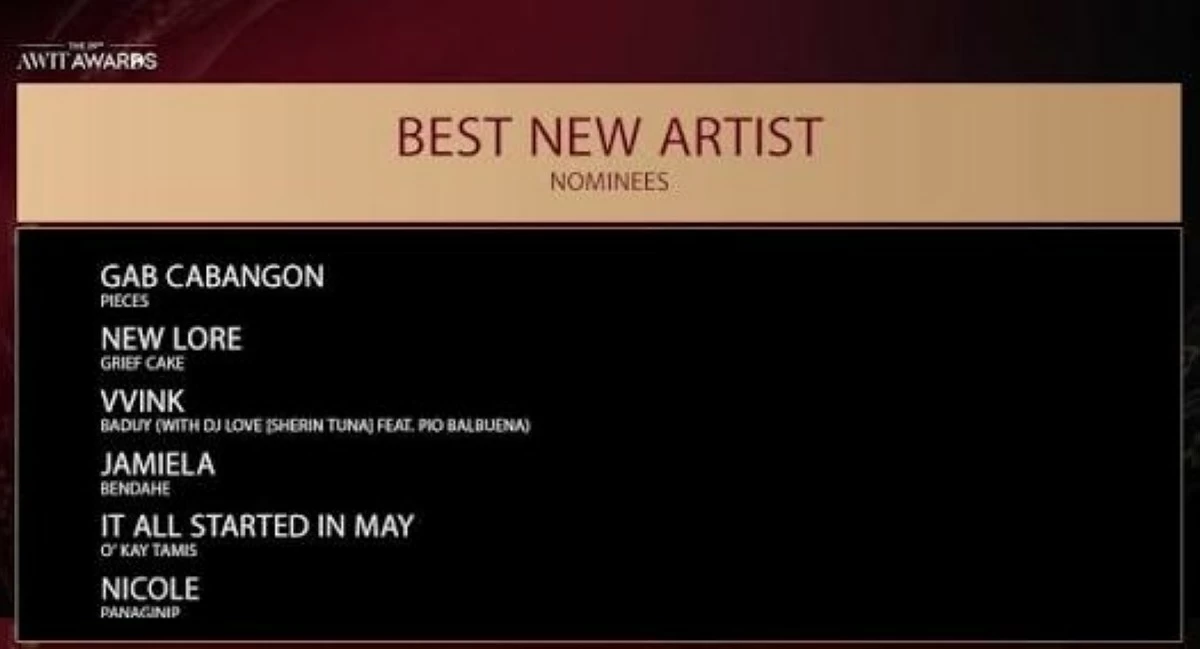
Gab Cabangon, NEW LORE, VVINK earn Best New Artist nods at 2026 Awit Awards


Published Aug 17, 2026 10:55 am | Updated Aug 17, 2026 01:42 pm

At A Glance

  • Gab Cabangon, NEW LORE, and VVINK shared with Manila Bulletin Entertainment what the their first major Awit Awards nomination means to them and how they hope to introduce their music to a wider audience.

The Philippine music scene’s rising acts are getting their moment in the spotlight as the 39th Awit Awards recognizes a new generation of artists making their mark on OPM.

Among the nominees for Best New Artist are singer-songwriter Gab Cabangon, art-pop trio NEW LORE and P-Pop group VVINK, who are competing alongside Jamiela, Nicole and It All Started in May for one of the ceremony’s most anticipated honors.

The Awit Awards, organized by the Philippine Association of the Record Industry (PARI), celebrates outstanding achievements in Filipino recorded music, recognizing artists, songwriters, producers, and other music industry professionals across various categories.  

With their first major Awit Awards nomination, Cabangon, NEW LORE, and VVINK shared with this writer what the recognition means to them and how they hope to introduce their music to a wider audience.

Gab Cabangon: ‘It hasn’t really sunk in for me’

For Cabangon, the nomination came as an unexpected milestone, particularly because it arrived with his debut single.

“Honestly, it hasn’t really sunk in for me,” Cabangon said. “I never aspired to win an Awit Award, let alone be nominated.”

Despite the surprise, he said he is grateful to receive his first nomination and to be recognized alongside artists he respects and admires.  

“It feels extra special that my first ever nomination was with my debut single,” he said. “Regardless of whoever wins, just the fact that I was one of the artists recognized for the 39th Awit Awards is already a really cool moment.”

Cabangon jokingly describes his sound as “nonchalant sadboi,” but his music is rooted in the singer-songwriter tradition, drawing inspiration from artists such as John Mayer and Ebe Dancel. He combines chill guitar-driven arrangements with soulful and emotional vocals, using his songs to reflect on different stages of life.

“I like to think my songs are my personal reflections about going through different phases of life,” he said. “I do hope that my listeners are able to appreciate the story and message of my songs.”

NEW LORE: Turning grief into music

For NEW LORE, the Best New Artist nomination feels like an affirmation of the world the group has been building through music and visual art.

“It feels surreal and deeply affirming,” the group said. “NEW LORE began as three friends trying to turn grief, paintings, journal entries, and very honest conversations into music.”

The recognition is particularly meaningful because of how early it has come in the group’s journey.

“To be recognized by the Awit Awards this early in our story means so much to us,” NEW LORE said. “We are grateful to everyone who listened, shared our songs, came to our shows, and made space for the strange little world we are building.”

The group describes its music as art pop that moves between dream pop, indie rock, folk, and electronic music. Their songs can shift from intimate and delicate to expansive and cinematic.  

“For us, the songs, paintings, clothes, stories, and performances all belong to the same world,” they said.

VVINK: ‘We get to represent our genre’

P-Pop group VVINK was equally surprised by its nomination, particularly as the only P-Pop group in the Best New Artist category.

“We were honestly very surprised when we found out,” the group said. “It’s such an honor to be included in this category, especially alongside so many talented artists.”

The group also expressed pride in “Baduy” and what it has accomplished since their debut. Being recognized as Best New Artist carries an added significance for VVINK because of the opportunity to represent P-Pop on the Awit Awards stage.

“Being nominated as Best New Artist, and being the only P-Pop group in the category, makes us even prouder because we get to represent our genre and what we do,” they said. The group sees the nomination as recognition of the work that went into their training, debut, and album.

VVINK describes its sound as playful, energetic, and distinctly FlipMusic, with each member bringing different personalities and strengths to the group.

“We love experimenting with different styles while keeping our identity as a P-Pop group,” they said. “We want our music to feel fresh, fun, and very VVINK.”

For Cabangon, NEW LORE, and VVINK, the nomination is already a milestone regardless of who ultimately takes home the trophy; an indication that their respective sounds and stories are finding a place in the ever-evolving OPM landscape.

What are Filipinos a mix of?


 · 

Filipinos are surprisingly not that mixed… the vast majority of Filipinos are Austronesians, who are related to the southern Chinese and Taiwanese aboriginals. Others may have very small and insignificant European ancestry.

  • Those who have major European genetic influence are a very small minority, which only accounts for 3% of the population.

“Average Austronesian Filipinos”

Average Filipinos

When Inclusion Meets Reality: A Mainstream Teacher’s Perspective on Learners with Special Needs

By Ma. Kimberly I. Ylanan, Teacher VII, Special Needs Education
Inclusive education is an important step toward building a school environment where every child, regardless of ability or learning needs, is given the opportunity to learn, participate, and belong.
Today, mainstream classrooms are increasingly welcoming learners with special educational needs, including children with autism, developmental delays, learning disabilities, communication difficulties, behavioral needs, and other conditions that may require additional support.
As teachers, we recognize the value of inclusion. Every child deserves to be accepted and given the opportunity to reach his or her potential. However, while inclusion is a meaningful goal, its implementation can also present significant challenges for regular teachers handling mainstream classes.
One of the biggest concerns is class size.
When a teacher is responsible for a large number of learners, providing individualized attention becomes difficult. Learners with special needs may require additional time, differentiated instruction, closer supervision, or specific approaches to communication and classroom activities.
For a teacher handling an entire class, meeting these individual needs while also ensuring that the rest of the learners are properly taught and guided can be challenging.
The situation becomes even more difficult when there is no assistant teacher, classroom aide, or learning support personnel available.
The teacher is expected to manage the whole class, deliver lessons, monitor learner behavior, provide academic assistance, address individual needs, and maintain a safe and productive learning environment—all at the same time.
This does not mean that teachers are against inclusion.
Quite the opposite. Teachers want their classrooms to be places where every learner feels accepted, respected, and supported. But good intentions need to be accompanied by adequate resources and support.
Inclusion should not simply mean placing learners with special needs in a mainstream classroom. It should mean providing the necessary support for them to genuinely participate and learn.
Smaller class sizes can give teachers more opportunities to attend to individual learners. The presence of trained assistant teachers or learning support personnel can also make a significant difference. These additional hands can help address specific needs while allowing the classroom teacher to continue giving attention to the entire class.
Teachers also need continuous training and practical guidance on differentiated instruction, classroom management, communication strategies, and other approaches that can help them respond effectively to diverse learners.
At the same time, inclusion benefits everyone. Mainstream learners can develop empathy, patience, respect, and a deeper understanding that people learn and communicate in different ways. Learners with special needs, meanwhile, are given opportunities to develop social skills, confidence, independence, and a sense of belonging.
The challenge, therefore, is not whether we should include learners with special needs. The question is how we can make inclusion work better for everyone.
Schools, teachers, parents, education leaders, and the community must work together to create a supportive system. Inclusion becomes more meaningful when teachers are equipped, classrooms are manageable, and learners receive the assistance they need.
Every child deserves a place in the classroom.
But every teacher also deserves the support, resources, and assistance necessary to make that inclusion successful.
— Ma. Kimberly I. Ylanan, Teacher VII, Special Needs
May be an image of one or more people and people smiling