
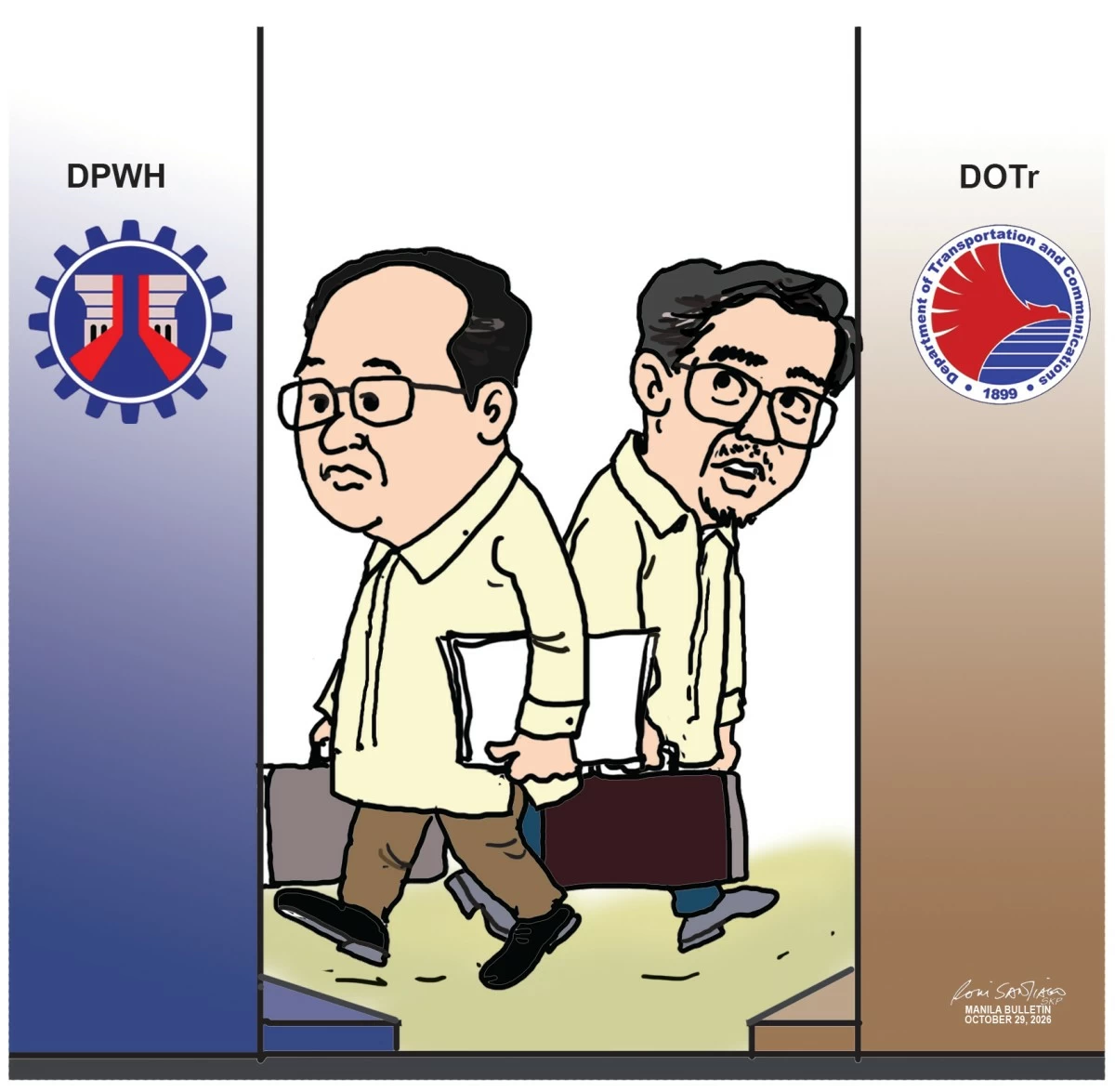
The decision of the President to switch the heads of two critical government departments is a welcome move, but it also raises an important question: Can changing the people at the top bring meaningful change to institutions whose problems have persisted for decades?
On Oct. 26, Malacañang announced that Vince Dizon would return to the Department of Transportation (DOTr), while Giovanni Lopez would take over the Department of Public Works and Highways (DPWH).
The Palace explained that the reshuffle was intended to accelerate reforms. Dizon was being sent back to ease the daily struggles of commuters, while Lopez, described as a systems builder, was tasked with institutionalizing reforms at the DPWH.
Both departments face enormous challenges. The DOTr must address worsening traffic congestion, unreliable public transportation, delayed infrastructure projects, and bureaucratic inefficiencies. The DPWH, meanwhile, must confront corruption, questionable infrastructure spending, unfinished projects, and the continuing controversy surrounding flood control programs.
Dizon knows these challenges firsthand. In fact, social media memes have even portrayed him as having visibly aged during his stint at the DPWH, perhaps reflecting the enormous pressures associated with leading an agency battered by allegations of corruption.
The symbolism became more pronounced during the two secretaries' joint press conference on Oct. 27. Instead of the traditional turnover of a flag, Dizon handed Lopez envelopes containing documents on alleged corrupt officials, whom he described as “rotten apples.” He urged his successor to remove those responsible while protecting honest employees.
The gesture was revealing. It suggested that the problems confronting the department extend well beyond its leadership. And herein lies the greater challenge—changing secretaries may provide fresh leadership, renewed energy, and different management approaches. But will changing faces be enough when the problems themselves are systemic?
The DPWH and DOTr are sprawling bureaucratic institutions, with central offices, regional units, attached agencies, and thousands of personnel. Their operations depend on established systems, administrative procedures, procurement practices, and organizational cultures developed over many years.
A secretary may issue directives, dismiss erring officials, or introduce reforms. Yet unless these changes reach the foundations of the organization, old practices can easily return once that secretary leaves.
We could appoint 10 different secretaries, but if the underlying systems remain unchanged, the same problems will continue under 10 different names.
What the administration must pursue, therefore, is not simply a reshuffling of personalities but a fundamental transformation of these agencies. Stronger accountability mechanisms, transparent procurement, merit-based appointments, independent monitoring, and enforceable safeguards against corruption must become permanent features of government operations.
Such reforms should not depend on the personal determination of whoever occupies the secretary's office.
We wish Dizon and Lopez success in their new assignments. Their success, if any, will ultimately benefit millions of Filipinos who deserve safer roads, reliable transportation, and infrastructure built with integrity.
But the Marcos administration must demonstrate greater firmness and resolve in pursuing changes that will outlast its remaining years. Cabinet secretaries come and go. They serve at the pleasure of the President, and their faces change with every administration.
Institutions, however, must endure.
The true measure of this reshuffle will not be the personalities involved, but whether it produces reforms that remain effective long after these officials have left office. The next generation of Filipino taxpayers deserves to inherit institutions that function properly, not the same problems under different names.

No comments:
Post a Comment